


Category A felonies are the most serious class of crimes in Nevada. These crimes are generally punishable by
- life in state prison and
- possibly even the death penalty in the case of a first-degree murder.
Section 193.130(a) of the Nevada Revised Statutes reads as follows:
A category A felony is a felony for which a sentence of death or imprisonment in the state prison for life with or without the possibility of parole may be imposed, as provided by specific statute.
Sometimes, the prosecutor will be willing to plea bargain a category A charge down to a lesser felony charge. You are entitled to a jury trial if you do not accept the D.A.’s offer to settle.
Category A felonies can be sealed only once ten (10) years have passed since the case ended. Aliens charged with these crimes face certain deportation unless the case gets thrown out or changed to a non-deportable crime.
The following table spells out the penalty ranges for Nevada’s five categories of felonies:
| Felony Category in Nevada law | Penalties (under Nevada Revised Statutes 193.130) |
| A |
|
| B |
|
| C |
|
| D |
|
| E | Probation and a suspended sentence with a possible jail sentence of up to 1 year. Though if you have two or more prior felony convictions, the court may order:
|
In this article, our Las Vegas criminal defense attorneys will address the following key issues regarding category A felonies in Nevada.
- 1. Examples
- 2. Penalties
- 3. Jury Trials
- 4. Record Seals
- 5. Immigration Consequences
- Frequently Asked Questions
- Additional Reading
1. Examples
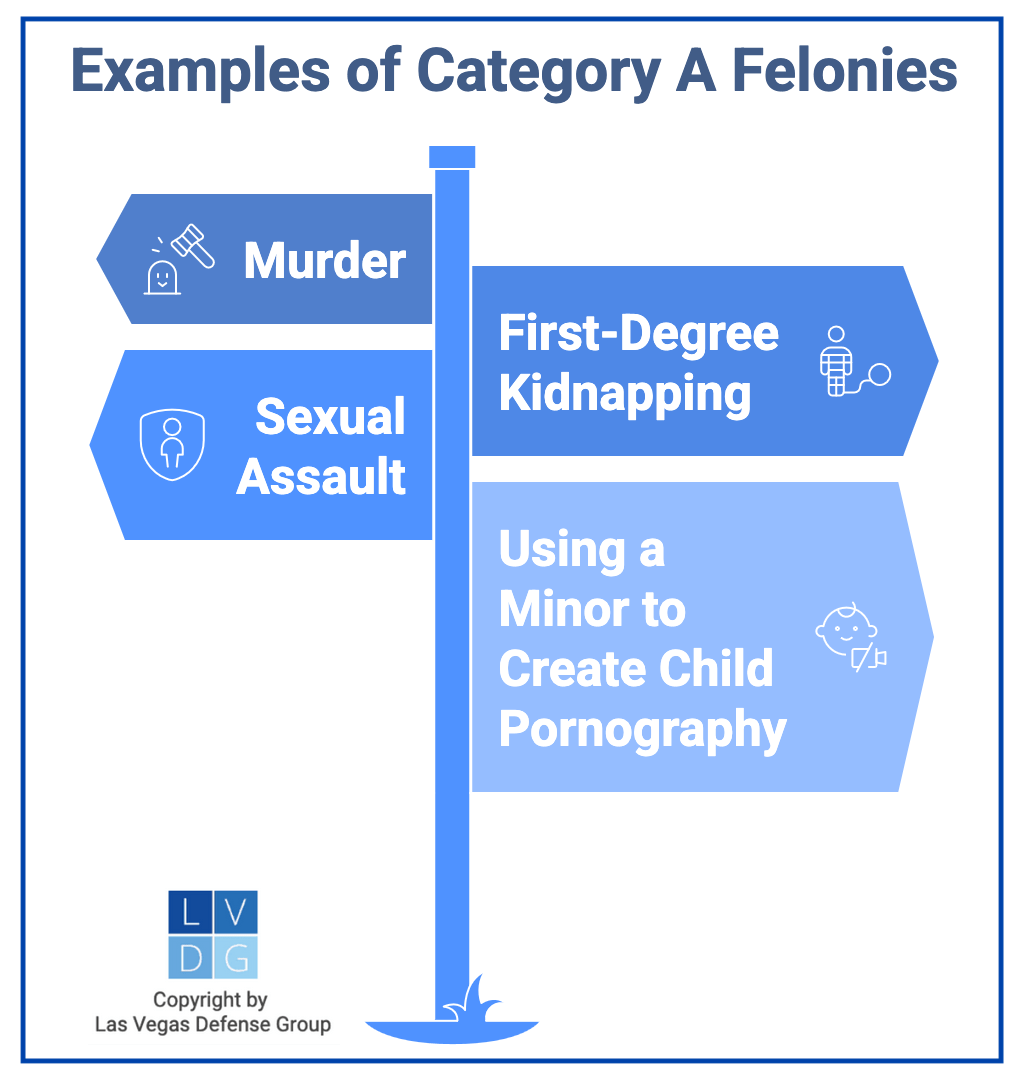
Category A felonies in Nevada comprise the most egregious offenses.1 Some of these include:
- First- or second-degree murder,2
- First-degree kidnapping,3
- Sexual assault,4
- Using a Minor to create child pornography,5 and
- Battery (with intent to commit sexual assault and that results in substantial bodily injury or is done by strangulation).6
2. Penalties
Category A felonies generally carry life in prison with or without the possibility of parole. Note that the most serious category A felony – first-degree murder – potentially carries:
- Death penalty if the aggravating circumstances outweigh the mitigating circumstances, or
- Life in prison with or without the possibility of parole after 20 years, or
- 50 years in prison with the possibility of parole after 20 years.
Furthermore, the court cannot grant probation in lieu of prison for category A felony convictions; prison is mandatory. In addition to incarceration, the court can levy hefty fines and victim restitution payments.
Note that an attempt to commit a category A felony crime is prosecuted as a category B felony. This carries two to 20 years in Nevada State Prison.7
Remember that a criminal defense attorney may be able to negotiate a resolution in which a category A felony charge is significantly reduced to a lesser charge.
3. Jury Trials
If you are charged with a category A felony in Nevada, you can have a trial by jury. Otherwise, you can choose a bench trial.8

Jury trials are available to felony defendants in Nevada.
4. Record Seals
Nevada law mandates a ten (10) year waiting period to seal category A felony convictions. However, if the charge was for a
- sex crime,
- crime against a child or
- felony DUI,
then the case is unsealable.9
That said, category A felony charges that get dismissed can be sealed immediately because there is no finding of guilt.10
The following table spells out the record seal wait times for Nevada’s five felony categories:
| Type of Nevada Felony Conviction | Waiting Period to Get a Record Seal |
| Category A felony
Crime of violence Burglary of a residence |
10 years after the case closes |
| Category B felony | 5 years after the case closes |
| Category E felony | 2 years after the case closes |
| Sex crimes
Crimes against children |
never |
5. Immigration Consequences
Any immigrant facing category A felony charges in Nevada will certainly face removal if a court ultimately convicts them. This is because all category A felonies in Nevada qualify as aggravated felonies, which are deportable.11
Therefore, aliens facing these charges should hire counsel to try to get the D.A. to change it to a non-removable offense.

All category A felonies in Nevada carry a life sentence. Some have the possibility of parole. Only first-degree murder may carry the death penalty.
Frequently Asked Questions
Is probation an option for a category A felony?
No. In Nevada, category A felonies are “non-probationary.” This means that if you are convicted, the judge is required to sentence you to a term in state prison. Unlike lower-level felonies (categories D or E), the court does not have the discretion to grant a suspended sentence or supervised release in lieu of incarceration.
Can a category A felony be reduced to a lower category?
Yes, through a plea bargain. A skilled attorney can often negotiate with prosecutors to reduce a category A charge to a category B or C felony. This is a critical distinction because lower categories carry fixed-term sentences (such as one to 10 or one to 20 years) rather than the “life” sentences mandatory for Category A convictions.
What is the minimum time served before parole eligibility?
For most category A felonies where “life with the possibility of parole” is granted, Nevada law typically requires a minimum of 20 years to be served before you are eligible for a parole hearing. However, depending on the specific crime (such as certain high-level sexual assaults), the non-parolable period may be as long as 25 or 50 years.
Are there financial penalties in addition to prison time?
Yes. While the primary focus of a category A felony is Nevada State Prison, the court can also impose significant fines and mandatory restitution. Restitution requires you to financially compensate victims for medical bills, property damage, or loss of income resulting from the crime. These financial obligations remain even after a prison sentence is completed.
Additional Resources
For more information, refer to the following:
- Nevada Department of Corrections (NDOC): This is the state agency responsible for the incarceration and supervision of offenders in Nevada’s state prisons and for parole.
- Reentry Services: Part of NDOC that aims to help offenders reintegrate into society.
- Innocence Center of Nevada (ICON): A non-profit dedicated to exonerating the wrongfully convicted and reforming the criminal justice system in Nevada.
- Rocky Mountain Innocence Center (RMIC): A non-profit that covers Utah, Nevada, and Wyoming, providing pro bono post-conviction innocence investigation and litigation services.
- Hope for Prisoners: A non-profit that helps individuals transitioning from correctional facilities reintegrate into the workforce and society.
See our related article, What are the Nevada felony sentencing guidelines?
Legal References
- NRS 193.130. See, for example, Dion Walter Mason v. The State of Nevada (Nev. App. 2025) 568 P.3d 134; Michael Ralston v. The State of Nevada (Nev. 2025) 141 Nev. Adv. Op. No. 88712.
- NRS 200.030.
- NRS 200.310.
- NRS 200.366.
- NRS 200.710 and NRS 200.720.
- NRS 200.481.
- NRS 193.130. NRS 193.153.
- U.S. Constitution, Sixth Amendment.
- NRS 179.245.
- NRS 179.255.
- 8 USC § 1227.