

Most arrests in Las Vegas eventually lead to criminal charges being filed. Though in a minority of cases, when you check the court status online or show up for what you expect will be your arraignment, you will see a phrase that sounds like good news: “D.A. denial.”
You might think, “Great! The District Attorney dropped my case! I won!”
Not exactly. While a D.A. denial is certainly better than being charged, it is different from a case dismissal or a “not guilty” verdict.
When prosecutors decline to bring criminal charges against you, they can still change their mind anytime before the relevant statute of limitations runs. Therefore, D.A. denials put you in a state of limbo for one or more years depending on the allegations.
The good news is, in my experience, most denied charges stay denied. In fact, I have a long track record of contacting prosecutors prior to the arraignment and persuading them to deny the charges due to lack of evidence.
Below I discuss what you need to know about D.A. denials in Las Vegas.
Meaning of “D.A. Denial”
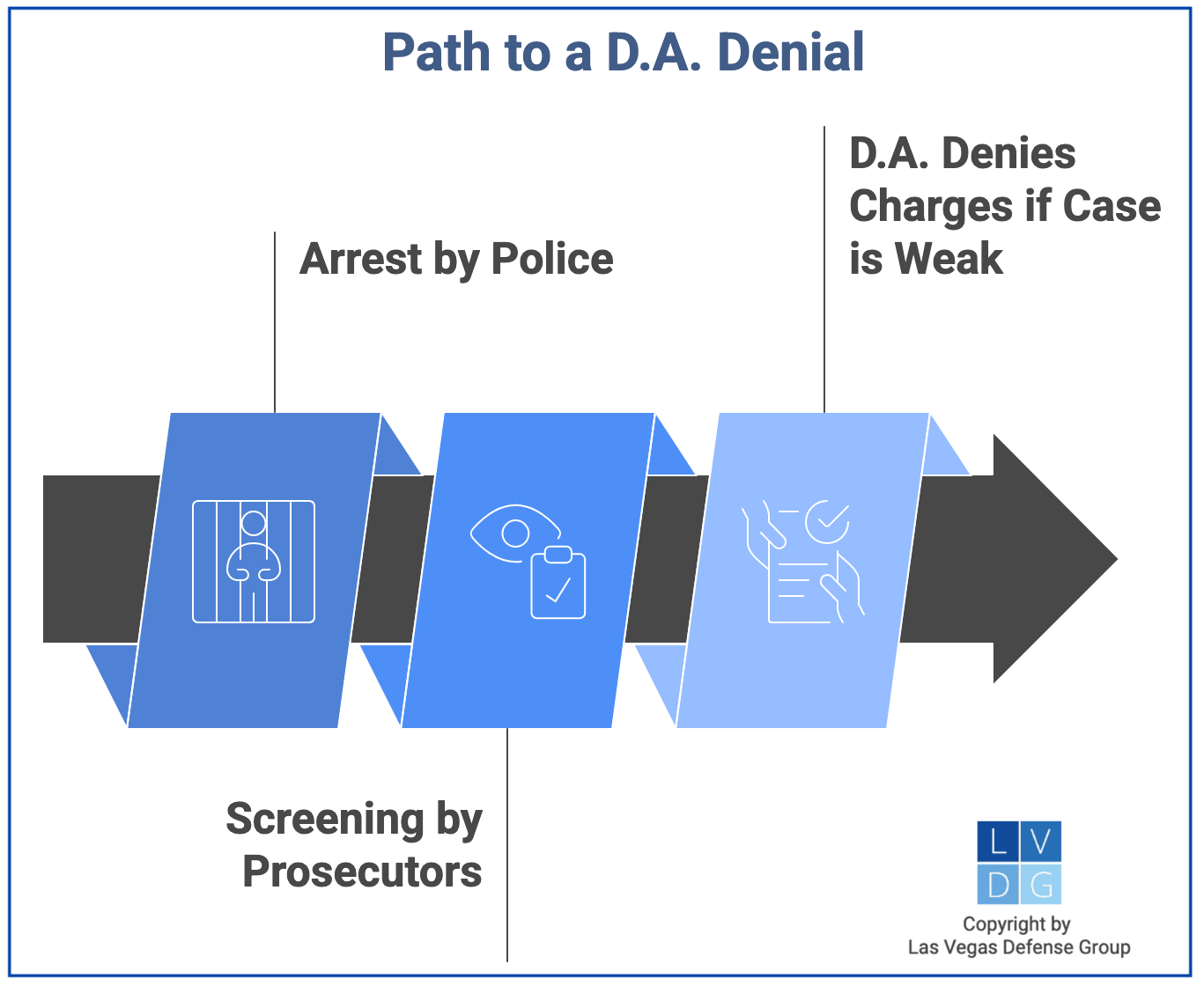
In Las Vegas, a D.A. denial means that prosecutors have reviewed the police report and evidence regarding your arrest or citation and decided not to file formal criminal charges against you at this time. Here is how the process works behind the scenes:
- Arrest & Report: Police arrest or cite you based on “probable cause” (a reasonable belief that a crime was committed). They write a report and send it to the D.A.
- Screening: The D.A.’s screening division reads the report. Their job is to decide if there is enough evidence to prove a crime beyond a reasonable doubt in court, which is a much higher standard than what the police need to arrest you.
- The Decision: If the evidence is weak, contradictory, or missing, the D.A. may issue a “denial.” This tells the court, “We are not filing a criminal complaint right now.”
Consequently, your upcoming court date is usually vacated (cancelled), and you do not have to enter a plea.
How We Get Ahead of Cases
This “screening” phase is exactly where experienced Las Vegas defense attorneys can make a massive difference. I believe in being proactive, not reactive.
When clients call us after an arrest – before charges are filed – we can often intervene early. We may contact the D.A.’s screening prosecutors directly to present our side of the story. We might show them that:
- the “victim” has a motive to lie, or
- there is video evidence the police ignored, or
- the police lacked probable cause for the arrest in the first place.
Prosecutors have a lot of discretion when deciding whether or not to bring charges.1 Therefore, our goal is to persuade the D.A. that their case is too weak and that they would likely lose if they moved forward.
If we succeed, prosecutors issue a D.A. denial, sparing you the stress, expense, and public record of a formal criminal charge.

A prefile intervention is where I reach out to the D.A. shortly after an arrest in attempt to convince them to deny the charges for lack of proof.
The Catch: The Statute of Limitations
Here is the part most defendants do not realize: A D.A. denial does not prevent the prosecutor from changing their mind later.
Under Nevada law, the state has a specific time window – known as the statute of limitations – after the alleged crime to file charges. As long as that window is open, the D.A. can pull your file off the shelf and charge you if new evidence comes up (like a witness coming forward or a new DNA test).
The time limits vary by crime:
- Most misdemeanors: 1 year (such as simple battery or petty theft).
- Gross misdemeanors: 2 years (such as most indecent exposure cases).
- Most felonies: Generally 3 years (such as drug possession or felony DUI).
- Felony theft: 4 years (such as grand larceny or robbery).
- Sexual assault: Generally 20 years or no statute of limitations at all.
Until this time runs out, you are technically still “at risk” of being charged for that arrest.2 Click here for a comprehensive list of crimes and their statute of limitations in Nevada.
Why You Cannot Seal Your Record…Yet
This brings us to the most frustrating part for my clients. You want to wipe this arrest off your record immediately so you can apply for a job with a clean background check.
However, because the D.A. could theoretically file charges tomorrow, you typically cannot petition the court to seal your record until after the applicable statute of limitations has expired.
Example: If you were arrested for felony drug possession but the D.A. denied it, the D.A. technically has three years after you allegedly committed the felony to file charges. Therefore, you generally must wait these three years before we can move to seal that arrest record.
There is a small exception: The law allows sealing earlier if the D.A. stipulates (agrees) to it. However, in practice, prosecutors rarely agree to seal a record while the statute of limitations is still active, just in case they decide to prosecute you later.3
The Clark County District Attorney has discretion over whether to bring criminal cases in Las Vegas and throughout the county.
Frequently Asked Questions
How do I know if the D.A. denied my charges?
You can typically check the status of your case on the Clark County Courts or Justice Court website. If the status reads “Denied,” “Declined,” or shows no complaint filed by your court date, the D.A. has likely denied charges. However, you should always have an attorney verify this to ensure there isn’t a warrant for your arrest.
Can the D.A. file charges after a denial?
Yes. A denial is not a dismissal with prejudice. If the police find new evidence or the D.A. re-evaluates the case within the statute of limitations period (for example, one year for most misdemeanors, three years for most felonies), they can file charges and issue a summons or warrant for you to come to court.
Do I need a lawyer if the D.A. denied charges?
It is highly recommended. Even though you aren’t fighting a court case right now, an attorney can monitor the filing status to ensure you aren’t surprised later. More importantly, we track the statute of limitations clock so we can file a petition to seal your arrest record the moment you are eligible.
Does a “D.A. Denial” show up on a background check?
Yes. The arrest itself is a public record. Even though there is no conviction and no active court case, a background check will show that you were arrested and detained. This is why waiting out the statute of limitations to seal the record is so important.
Additional Reading
For more in-depth information, refer to these scholarly articles:
- Prosecutorial Discretion: An Overview – American Criminal Law Review.
- The Need for Prosecutorial Discretion – Temple Political and Civil Rights Law Review.
- Recasting Prosecutorial Discretion – Journal of Criminal Law & Criminology.
Legal References
- State v. Second Judicial Dist. Court (2018) 134 Nev. 783 (the decision to file – or not file – charges is an executive function belonging solely to the prosecutor, highlighting their discretion in the “denial” process).
- NRS 171.085. NRS 171.090. Cairns v. Sheriff (1973) 89 Nev. 113 (the state can proceed with an indictment even if a prior justice court action was dismissed, reinforcing the D.A.’s broad power to bring charges as long as the legal time limits allow).
- NRS 179.255.
