


Nevada Revised Statute § 202.360 prohibits people with felony convictions from owning or possessing guns for life. Being a “felon with a firearm” is a category B felony, punishable by:
- 1 to 6 years in Nevada State Prison and
- up to $5,000 in fines.
The only way to restore your Nevada gun rights after a felony conviction is through a Governor’s Pardon. Getting a record seal has no effect other than clearing your background check.
In this article, our Las Vegas criminal defense attorneys will address the following key issues regarding being a felon in possession of a firearm in Nevada:
- 1. Elements of NRS 202.360
- 2. The Wobbler Exception
- 3. Defenses
- 4. Misdemeanors with Gun Bans
- 5. Immigration Consequences
- 6. Record Seals
- 7. Pardons
- 8. Federal Law
- Frequently Asked Questions
- Additional Reading
1. Elements of NRS 202.360
For you to be convicted of being a felon in possession of a firearm in Nevada, prosecutors have to prove beyond a reasonable doubt the following two elements:
- You are a convicted felon; and
- You possessed a firearm.
It does not matter whether the felony occurred outside of Nevada or occurred long ago. The only time NRS 202.360 does not apply is if your felony conviction was “pardoned” by the applicable state governor.
Note that “firearms” comprise all types of handguns and long guns, including pistols, revolvers, rifles, semi-automatic weapons, and antique firearms. You are considered in “possession” of a firearm in one of three ways:
- actual possession, such as physically carrying the gun; or
- constructive possession, such as owning the gun or keeping the gun in your home, car, or other location you have control over; or
- joint possession, such as sharing a gun with someone else.
Note that if you unlawfully possess multiple firearms at one time and place, you would face only one NRS 202.360 charge, not a separate charge for each firearm.1
2. The Wobbler Exception
In Nevada, certain attempt crimes known as “wobblers” can be punished as either felonies or gross misdemeanors. If your defense attorney negotiates a plea deal where your wobbler charge is recorded as a gross misdemeanor—either at sentencing or retroactively after you finish probation—you are not considered a “convicted felon.”
Getting a gross misdemeanor conviction rather than a felony conviction does not carry the lifetime firearm ban unless the crime was for domestic violence or stalking.2
However, be careful: A standard “honorable discharge” from a felony probation without a specific reduction of the charge to a gross misdemeanor does not restore your gun rights. The conviction must officially be entered as a gross misdemeanor to avoid the ban.

It is a felony for a prohibited person to possess firearms in Nevada.
3. Defenses
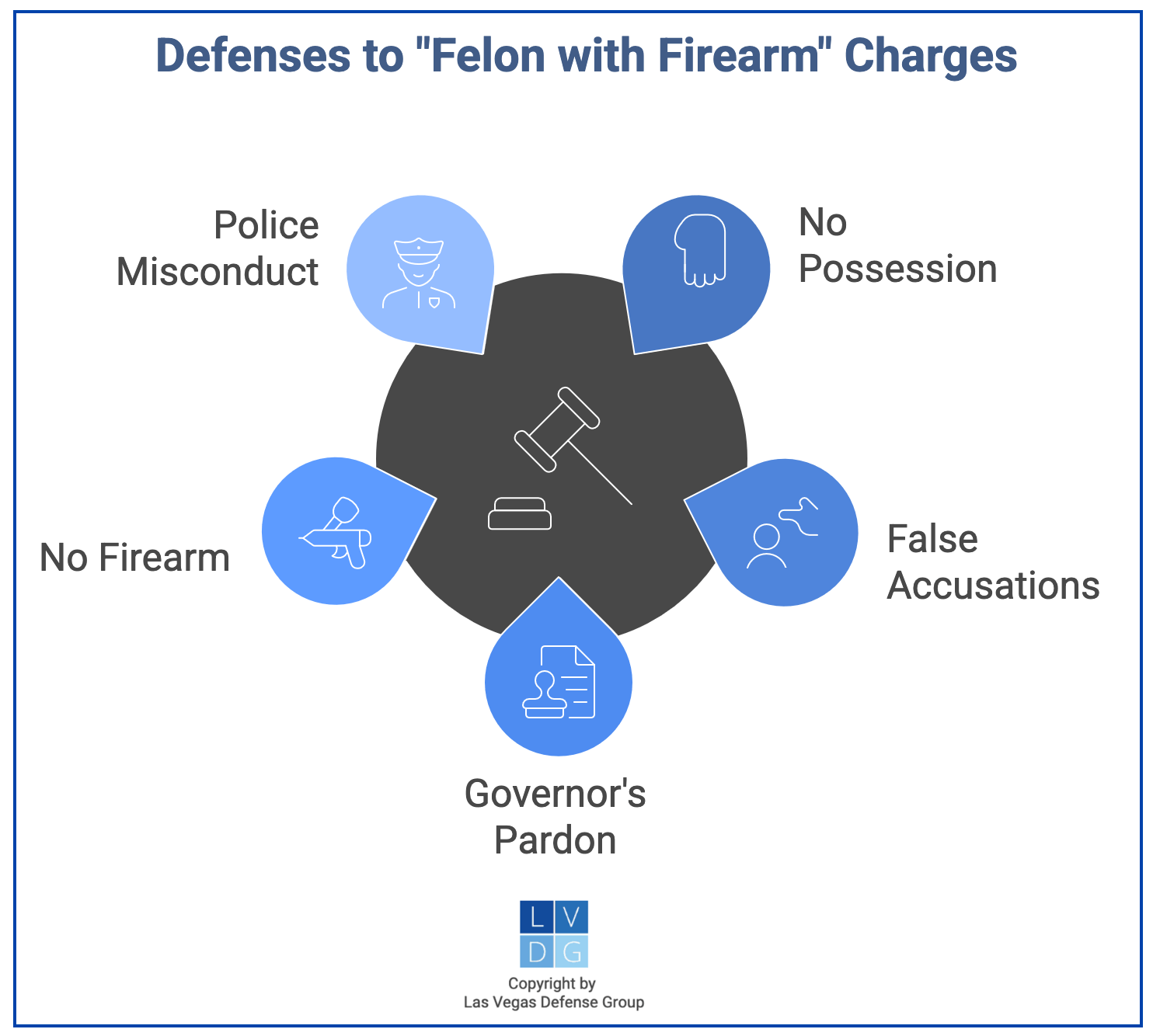
Here at Las Vegas Defense Group, we have represented countless people charged with possessing a gun following a felony conviction, In our experience, the following five defenses have proven very effective with prosecutors, judges, and juries at getting NRS 202.360 charges reduced or dismissed:
- You were never in possession of the firearm and did not own it, and law enforcement was mistaken.
- Someone falsely accused you.
- Your past felony was pardoned, and therefore, you are allowed to possess guns.
- The object you had might resemble a gun but does not qualify as a firearm.
- The police department committed misconduct, such as entrapment or an unlawful search or seizure.
Note that it is not a solid defense to “felon with a firearm” charges to argue that you possessed the gun for self-defense. Nevada’s “stand your ground” law only protects you if you are not engaged in criminal activity at the time you use force: Since being a “felon in possession” is itself a crime, you are technically committing a crime the moment you pick up a gun to defend yourself.
Therefore, prosecutors would argue that you lose the statutory immunity of “standing your ground” and have a duty to retreat, especially before using deadly force. The court may then find that any self-defense claim is invalid because your possession of the weapon was unlawful from the start.3
4. Misdemeanors with Gun Bans
Most misdemeanor convictions do not trigger lifetime gun bans in Nevada, but there are two exceptions:
- battery domestic violence (BDV) and
- stalking a family member or current or former intimate partner.
Possessing a gun in Nevada following a misdemeanor BDV or stalking conviction carries the same penalties as if you were a convicted felon:
- 1 to 6 years in prison and
- up to $5,000.4
5. Immigration Consequences
All firearm offenses are usually deportable.5 Consequently, non-citizens facing charges of violating NRS 202.360 should retain an attorney right away to try to get the charge reduced or dismissed: That may be the only way to remain in the U.S.

Misdemeanor convictions of domestic violence or stalking trigger lifetime gun bans in Nevada.
6. Record Seals
If you are convicted of being a felon in possession of a firearm in Nevada, you can petition the court for a record seal five years after the case closes. Though if the charge gets dismissed, you can pursue a record seal immediately.6
Remember that Nevada record seals do not restore gun rights. Only Nevada pardons can reverse a lifetime ban.
Non-Nevada Felonies
While Nevada does not allow record sealing to restore gun rights, federal law looks to the law of the state where the conviction occurred. If you have a felony conviction from another state that does allow for “expungement” or “set asides” that fully restore civil rights (including gun rights), the federal government typically honors that restoration.7
This means if you had an out-of-state conviction expunged effectively in that jurisdiction, you might not be prohibited under federal law, even if you live in Nevada now. Always consult an attorney to verify if your specific expungement qualifies.
7. Pardons
The only avenue for regaining gun rights following a Nevada felony conviction is applying for a governor’s pardon. Getting a pardon is rare and requires a showing of exceptional rehabilitation.
When determining whether to issue a pardon, the Nevada Board of Pardon Commissioners considers such factors as:
- The seriousness of the felony,
- Whether enough time passed since the felony occurred (usually 10-plus years of clean behavior),
- Whether you were honorably discharged,
- Any other criminal history,
- Whether you have remorse for past crimes,
- Your employment history (stability matters),
- Whether your character has been rehabilitated since your conviction.
The Board is not just the Governor acting alone; it consists of the Governor, the Attorney General, and the Justices of the Nevada Supreme Court. To get your gun rights restored, a majority of this Board—including the Governor—must vote to grant your application.8
8. Federal Law
Federal law prohibits convicted felons from possessing firearms or ammunition that was transported across state lines. The prison sentence is up to 10 years, though defendants with at least three prior felony convictions face a minimum of 15 years in prison.9

Unlawful possession of a firearm by a felon in violation of NRS 202.360 carries up to 6 years in prison.
Frequently Asked Questions
Are felons the only people prohibited from owning guns in Nevada?
No. NRS 202.360 also bans firearm possession for several other groups, including:
- People convicted of misdemeanor domestic violence or stalking;
- Fugitives from justice;
- Unlawful users of or addicts to controlled substances (including marijuana);
- People adjudicated as mentally ill or committed to a mental health facility; and
- Undocumented immigrants.
Can I go to a shooting range if I do not own the gun?
If you are banned from having firearms in Nevada, that applies at shooting ranges. Renting a gun at a range or holding a friend’s gun for “target practice” constitutes actual possession and can lead to a felony charge.
Can I live in a house with a gun if my spouse owns it?
If you are banned from having firearms in Nevada, you are advised not to live anywhere that has guns on the premises. If that is unavoidable, make sure you have no access to the gun.
To avoid “constructive possession” charges, the gun must be kept in a safe that you do not have the combination or key to. If the gun is left on a nightstand or in a shared closet, you could be charged with a felony even if you never touch it.
Does a medical marijuana card allow me to own a gun?
No. Marijuana is still unlawful under federal law. NRS 202.360 incorporates federal law, so it remains a Nevada crime for an “unlawful user” of a controlled substance (including medical marijuana) to possess a firearm.
Does the gun ban expire after 10 years?
No. In Nevada, the ban on firearm possession for felons is a lifetime ban. It does not expire after a certain number of years, and “staying out of trouble” does not automatically restore your rights. The only way to lift the ban is to obtain a Governor’s Pardon.
Additional Reading
For more in-depth information, refer to these scholarly articles:
- Time To Reload: The Harms Of The Federal Felon-in-possession Ban In A Post-Heller World – Duke Law Journal.
- Problematic Presumptions: Why The Current State of Felon-in-Possession Law Risks Punishing the Innocent – University of Pennsylvania Law Review.
- Notice(ing) Ex-Offenders: A Case Study of the Manifest Injustice of Passively Violating a Felon-in-Possession Statute – Wisconsin Law Review.
- Going off Half-Cocked: Opposing as-Applied Challenges to the “Felon-in-Possession” Prohibition of 18 U.S.C. Sec. 922(g)(1) – Penn State Law Review.
- In Defense of Felon-in-Possession Laws – Cardozo Law Review.
Legal References
- Nevada Revised Statute 202.360 – Ownership or possession of firearm by certain persons prohibited; penalties.
1. A person shall not own or have in his or her possession or under his or her custody or control any firearm if the person:
(a) Has been convicted of the crime of battery which constitutes domestic violence pursuant to NRS 200.485, or a law of any other jurisdiction that prohibits the same or substantially similar conduct, committed against or upon:
(1) The spouse or former spouse of the person;
(2) Any other person with whom the person has had or is having a dating relationship, as defined in NRS 33.018;
(3) Any other person with whom the person has a child in common;
(4) The parent of the person; or
(5) The child of the person or a child for whom the person is the legal guardian.
(b) Has been convicted of a felony in this State or any other state, or in any political subdivision thereof, or of a felony in violation of the laws of the United States of America, unless the person has received a pardon and the pardon does not restrict his or her right to bear arms;
(c) Has been convicted of a violation of NRS 200.575 or a law of any other state that prohibits the same or substantially similar conduct and the court entered a finding in the judgment of conviction or admonishment of rights pursuant to subsection 7 of NRS 200.575;
(d) Except as otherwise provided in NRS 33.031, is currently subject to:
(1) An extended order for protection against domestic violence pursuant to NRS 33.017 to 33.100, inclusive, which includes a statement that the adverse party is prohibited from possessing or having under his or her custody or control any firearm while the order is in effect; or
(2) An equivalent order in any other state;
(e) Is a fugitive from justice;
(f) Is an unlawful user of, or addicted to, any controlled substance; or
(g) Is otherwise prohibited by federal law from having a firearm in his or her possession or under his or her custody or control.
–> A person who violates the provisions of this subsection is guilty of a category B felony and shall be punished by imprisonment in the state prison for a minimum term of not less than 1 year and a maximum term of not more than 6 years, and may be further punished by a fine of not more than $5,000.
2. A person shall not own or have in his or her possession or under his or her custody or control any firearm if the person:
(a) Has been adjudicated as mentally ill or has been committed to any mental health facility by a court of this State, any other state or the United States;
(b) Has entered a plea of guilty but mentally ill in a court of this State, any other state or the United States;
(c) Has been found guilty but mentally ill in a court of this State, any other state or the United States;
(d) Has been acquitted by reason of insanity in a court of this State, any other state or the United States; or
(e) Is illegally or unlawfully in the United States.
–> A person who violates the provisions of this subsection is guilty of a category D felony and shall be punished as provided in NRS 193.130.
3. A person shall not use or carry a firearm during and in relation to, or possess a firearm in furtherance of, the commission of any act in violation of NRS 453.321, 453.322, 453.337, 453.3385 or 453.401. A person who violates the provisions of this subsection is guilty of a category B felony and shall be punished by imprisonment in the state prison for a minimum term of not less than 1 year and a maximum term of not more than 6 years, and may be further punished by a fine of not more than $5,000.
4. As used in this section:
(a) “Controlled substance” has the meaning ascribed to it in 21 U.S.C. § 802(6).
(b) “Firearm” includes any firearm that is loaded or unloaded and operable or inoperable.
NRS 202.360. State v. Fourth Judicial Dist. Court of Nev. (Nev. 2021) 481 P.3d 848. Pohlabel v. State (2012) 128 Nev. 1. SB 367 (2023). SB 412 (2023). State v. Fourth Judicial Dist. Court (2021) 137 Nev. 37 (“the State properly charges a defendant with only a single violation of NRS 202.360(1)(b) when it alleges… that the defendant is a felon who possessed ‘any firearm’—that is, one or more firearms—at one time and place”). - NRS 202.360.
- Wood v. State (Nev. App. July 26, 2024) No. 87278-COA (district court failed to properly apply the “automobile exception” to the warrant requirement during the search of the defendant’s vehicle). NRS 200.120.
- NRS 202.360.
- 8 U.S.C. 1227
- NRS 179.245; NRS 179.255. Note that sealing is not the same as expungement, which Nevada does not allow.
- 18 U.S.C. 921.
- NRS 213.005 – NRS 213.100.
- 18 U.S.C. 922.