

A first-time Nevada DUI arrest triggers two entirely separate cases with separate penalties:
- The Administrative Case, where the DMV can revoke your license for 185 days (though you can usually keep driving with an ignition interlock device in your car); and
- The Criminal Case, where the court usually suspends any jail sentence as long as you pay up to $1,000 in fines (plus court costs), complete DUI School, and attend a Victim Impact Panel.
It is entirely possible to win your criminal case but still lose your driver’s license through the DMV process, and vice versa. Even if you win the DMV case, losing the criminal case will still cause your license to be revoked.
This dual-track system is where an experienced Las Vegas drunk driving attorney makes a crucial difference, attacking both tracks to minimize or eliminate the DUI-1st penalties.
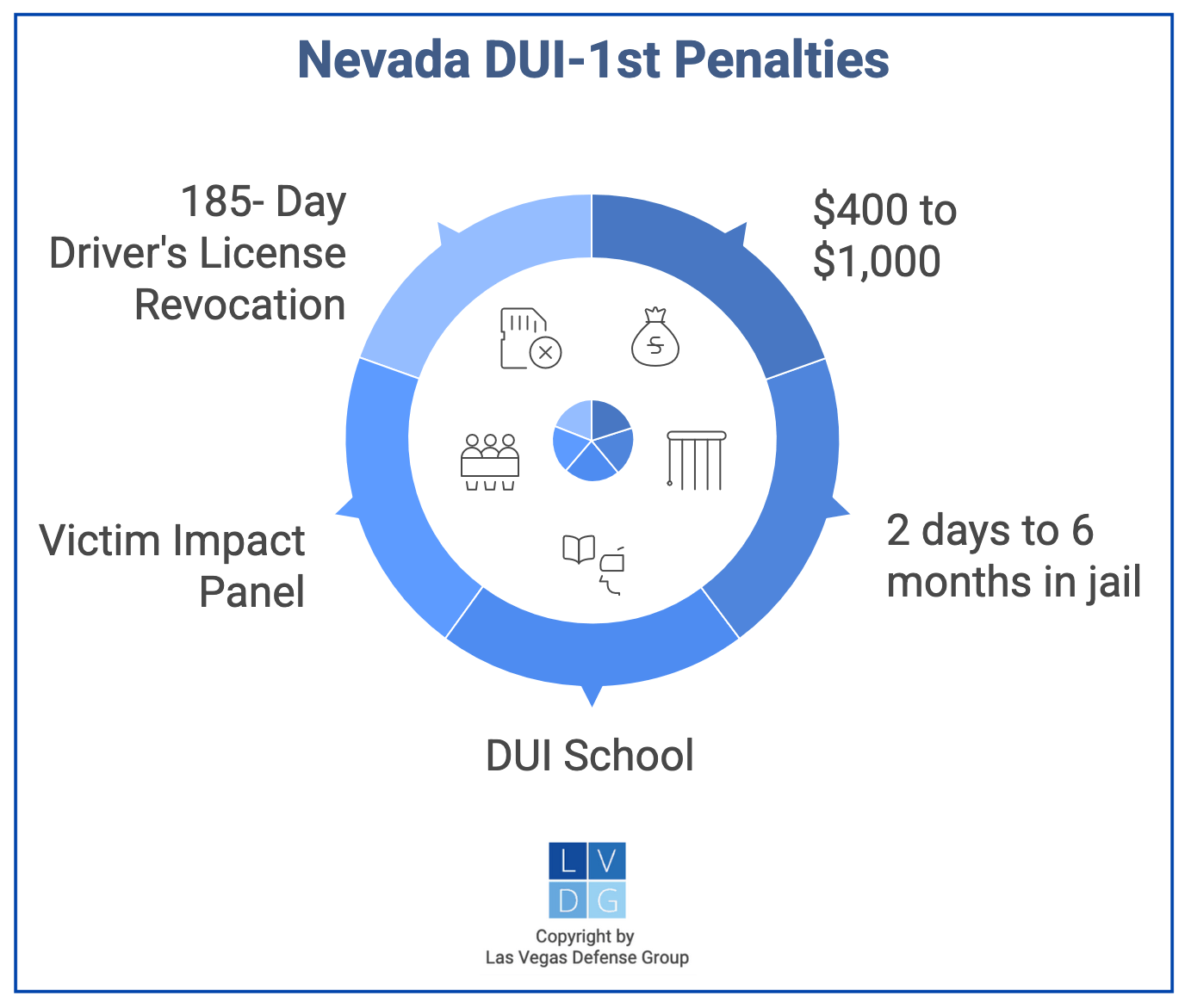
Track 1: Criminal Penalties (What Happens in Court)
A first DUI within the last seven years (measured from arrest date to arrest date) is a misdemeanor in Nevada as long as it did not cause substantial bodily harm or death. If you are convicted, you face the following punishments:
1. Jail or Community Service
The DUI statute mandates judges to impose two days to six months in county or city jail.
The good news is that many judges suspend this jail sentence as long as you complete all the other sentencing terms (discussed below). Even if the judge imposes the minimum two-day jail sentence, you may be able to perform community service instead (usually 48 to 96 hours).
Note that it is more likely the judge will impose some jail if you had a child under 15 in the car while committing DUI.
2. Fines
The mandatory fine range for a 1st DUI is no less than $400 and no more than $1,000. However, this fine does not include mandatory court costs, administrative assessments, and other “penalty assessments” that can effectively double the total amount you owe the court.
3. DUI School & Victim Impact Panel
Upon a DUI-first conviction, you will be required to:
- Complete and pay for an approved Nevada school for traffic safety/DUI education (a minimum 8-hour course you can usually do online); and
- Attend a “victim impact panel” (often hosted by Mothers Against Drunk Driving, or MADD), designed to show the real-world consequences of drunk driving.
You must provide a certificate of completion for both to the court.
4. 185-Day Driver’s License Revocation
Getting a DUI-1st conviction in Nevada triggers a 185-day driver’s license revocation (unless your license was already revoked due to losing the DMV administrative case).
Fortunately, you usually can continue driving during this revocation period as long as you have an ignition interlock device (IID) installed in your car. However, you are responsible for all the installation, maintenance, and removal costs.
5. Additional Penalties
If you had a blood alcohol level (BAC) of 0.16% or higher, you will also be required to:
- Take the Coroner’s DUI program, where you are shown photos of deceased drunk driving victims as a DUI deterrent; and
- Submit to an alcohol/drug evaluation and possibly rehab; and
- Drive with an IID for one to three years.1

You can usually complete DUI School online.
Track 2: Administrative Penalties (The DMV Case)
Every first-time Nevada DUI arrest ends with you taking an evidentiary breath test or blood test. If your BAC is at least .08% (or your blood contains certain drugs), you receive an “Order of Revocation” from the Nevada DMV along with a temporary seven-day driving permit.
If you request a DMV hearing before the seventh day, you can continue driving pending the result of the hearing. Otherwise, your driver’s license will be revoked for 185 days.
The DMV hearing is like a mini-trial, but it is harder to win than DUI criminal trials because the state’s burden of proof is much lower. Though even if you lose, you can usually continue driving during all 185 days as long as you get an ignition interlock device (IID) installed in your car(s).
Note that if you lose your DMV trial and also get criminally convicted of DUI, your license will not get revoked for a second time: 185 days is the maximum license revocation in DUI cases.
However, if you refused to take the breath or blood test after your DUI arrest, the DMV will revoke your license for an extra year. This is true even if you end up winning both your DMV trial and the criminal case.
Reinstatement Requirements
Once the 185-day revocation period ends, your driving privilege does not automatically return. To get your Nevada driver’s license back, you must:
- Pass appropriate eye and knowledge tests; and
- Pay necessary reinstatement fees (currently $120); and
- Secure SR-22 insurance verification and maintain it for three consecutive years (meaning you are flagged by your insurer as a high risk).2

Victim impact panels can become emotional for both the victims and the defendants watching.
Frequently Asked Questions
Is my 1st DUI felony or misdemeanor?
In nearly all cases where there are no other aggravating factors (such as causing substantial bodily harm or death), a first DUI within a seven-year period is a misdemeanor in Nevada. A second DUI in seven years is a misdemeanor as well but with harsher penalties.
Can I refuse to take a DUI test (breath or blood)?
Nevada is an “implied consent” state. This means that by accepting a Nevada driver’s license and using Nevada roads, you have already consented to chemical testing if an officer has reasonable grounds to believe you are DUI. Refusing the test results in an automatic, mandatory one-year administrative license revocation by the DMV.
Will I go to jail for my first DUI?
In most cases, judges will suspend a DUI-1st jail sentence as long as you complete all the other terms: Paying fines and completing DUI School and the victim impact panel. If you do not complete all the other terms, then the judge can revoke your probation, un-suspend the jail sentence, and remand you into custody for the remainder of the sentence.
What happens if my DUI involved drugs (like marijuana)?
The penalties are the same as an alcohol-related 1st-offense DUI. Nevada law treats driving under the influence of drugs (DUID) just as seriously as drunk driving.
How much does a 1st DUI conviction cost?
The total costs are staggering. A criminal fine is only $400 to $1,000, but when you add mandatory court assessments, DUI school, victim impact panel fees, IID installation and monthly fees (potentially $1,000+ per year), and the dramatic spike in SR-22 insurance premiums for three years, a conservative estimate for a single first-offense DUI conviction often totals between $6,000 and $10,000.
Can DUI be reduced to reckless driving?
Possibly, if your attorney can persuade prosecutors that they lack sufficient evidence to prove beyond a reasonable doubt that you committed DUI. The biggest benefit of reckless driving is that the conviction can be sealed from your criminal record after only one year; in contrast, a DUI-1st conviction must remain on your record for seven years.
What if I am an alcoholic?
If you are addicted to alcohol, you may be eligible for DUI Treatment Court, an intensive one-year rehabilitation program offered by many Nevada courts. Upon successful completion, your DUI charge may be reduced to reckless driving.
Additional Resources
If you are suffering from alcoholism, look to the following for help:
- Alcoholics Anonymous (AA): A widespread, spiritually-inclined fellowship where members share their experiences and work through a 12-step program to achieve and maintain sobriety.
- SMART Recovery: An evidence-based, secular alternative to 12-step programs that teaches practical, cognitive behavioral therapy (CBT) tools to help you manage urges and change unhelpful behaviors.
- LifeRing Secular Recovery: A secular, abstinence-based peer support network that empowers you to design your own personalized recovery plan without relying on a higher power.
- Women for Sobriety: An organization specifically for women that focuses on discarding guilt and shame while building self-value and emotional growth through their “New Life” program.
- SAMHSA National Helpline: A free, confidential, 24/7 federal treatment referral and information service to help you find local treatment facilities, support groups, and community-based organizations.
