


Nevada Revised Statute § 484B.550 prohibits evading the police, which is when a motorist “willfully fails or refuses to bring the vehicle to a stop…when [police give a] signal to bring the vehicle to a stop by a flashing red lamp and siren.”
The offense is also called “eluding the police.”
Depending on the circumstances, prosecutors can charge evading as a misdemeanor or a felony, as the following table shows:
|
Evading a Traffic Stop in Nevada |
Penalties under NRS 484B.550 |
| The incident involved no DUI, dangerous driving, property damage, injury, or death | Misdemeanor: Up to 6 months in jail and/or up to $1,000 |
| You were committing driving under the influence (DUI) | Category D felony: 1 to 4 years in Nevada State Prison and up to $5,000 |
| You were driving dangerously or caused damage to another’s property | Category B felony: 1 to 6 years in prison and up to $5,000 |
| You caused a fatality or substantial bodily harm to someone else | Category B felony: 2 to 20 years in prison and up to $50,000 |
It may be possible to get an evading charge reduced or dismissed through a plea bargain.
In this article, our Las Vegas criminal defense attorneys will address the following key issues regarding evading police in Nevada.
- 1. Elements of NRS 484B.550
- 2. Defenses
- 3. Punishment
- 4. Deportation
- 5. Sealing Records
- 6. Related Offenses
- Frequently Asked Questions
- Additional Reading
1. Elements of NRS 484B.550
For you to be convicted of evading a traffic stop in Nevada, prosecutors must prove beyond a reasonable doubt that you continued driving once the police have signaled for you to pull over by both flashing red light and sounding a siren.1
Once you become aware that a police car is signaling you to stop, you should pull over to the side of the road as soon as it is safe to do so.
Example: John is driving with a broken tail light. An officer with the Las Vegas Metropolitan Police Department sees him and signals for John to pull over by sounding its siren and flashing its red lamp. John wants to hear the end of the song he is listening to on the radio, so he waits until it is over before pulling over.
Even though John was planning to stop for the police eventually, he could still be charged with evasion for unnecessarily delaying pulling over.
Another common evasion scenario occurs when a driver speeds up or changes course to elude police completely. This could lead to a police chase with the Nevada Highway Patrol and serious damages.

Police must illuminate their red lamp to signal you to pull over.
2. Defenses
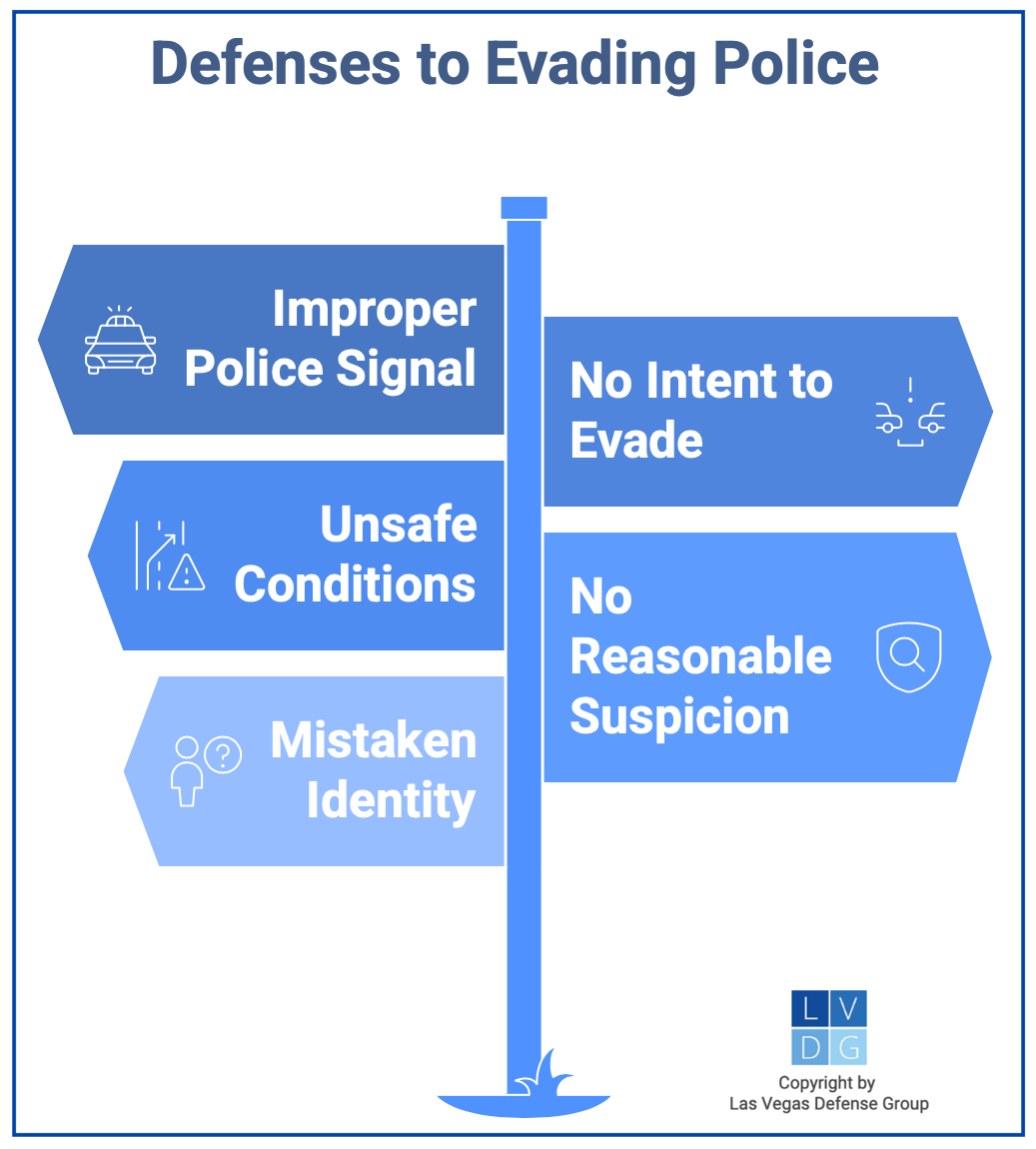
Here at Las Vegas Defense Group, we have represented literally thousands of people charged with Nevada traffic offenses, including evading the police. In our experience, the following five defenses have proven very effective with prosecutors and judges at getting NRS 484B.550 charges reduced or dismissed.
- Police Used the Wrong Signal. The official signal that Nevada police must use to initiate a traffic stop is a flashing red light and a siren. Therefore, if the police used the wrong signal or if their signal was broken, then you should not be found guilty of failing to pull over.
- You Lacked Intent to Evade. Evading is an intent crime in Nevada: You should not be convicted of it unless you willfully ignored the police’s signal to stop their car. Perhaps you genuinely did not notice the police were there. Or perhaps you were suffering a disabling medical episode. If the prosecution cannot prove beyond a reasonable doubt that you acted with intent, the evading charges should be dropped.
- It Was Unsafe to Pull Over. Prosecutors may be willing to drop evasion charges if the only reason you failed to pull over is that it was unsafe to do so. Evidence such as video recordings and eyewitnesses could be brought in to show that it would have been dangerous to stop, and that you behaved justifiably under the circumstances.
- Police Lacked Reasonable Suspicion. Police may not initiate a traffic stop unless they have reasonable suspicion that you violated the law. In some cases, we can use the police dashcam footage to show prosecutors that you were in fact not evading, and the police did not have enough reasonable suspicion to pull you over or enough probable cause to cite you.
- You Were a Victim of Mistaken Identity. Perhaps another motorist was evading the police, but in the hubbub of a busy street the police mistook you as the offending driver. This is another situation where police dashcam footage can help us show that you were wrongfully charged.

Violating NRS 484B.550 can be a misdemeanor or a felony.
3. Punishment
Violating NRS 484B.550 can be a misdemeanor or a felony in Nevada, depending on the case. The punishment depends on the following factors:
- whether you acted in a dangerous manner,
- whether any property was damaged,
- whether anyone sustained serious bodily harm or was killed, and
- whether you were driving under the influence
Note that a misdemeanor charge of reckless driving is a “lesser included offense” of felony evasion: You cannot be convicted of both misdemeanor reckless driving and felony evasion for the same matter.
Standard Sentence
Evading is only a Nevada misdemeanor as long as:
- no one got seriously hurt, and
- you were not drunk or high, and
- you were not driving dangerously
Misdemeanor penalties include:
- up to 6 months in jail and/or
- up to $1,000 in fines
Evading while DUI
If you were also intoxicated by drugs or alcohol at the time you were evading, then ignoring a traffic stop is a category D felony in Nevada. The punishment carries:
- 1 to 4 years in prison and
- a fine of up to $5,000 (at the court’s discretion)
Note that you would probably also be charged with the separate crime of DUI. DUI penalties depend on
- your criminal history and
- whether anyone was harmed.
Evading while Driving Dangerously or Causing Damage
If while evading you cause damage to another person’s property — or were driving in a way likely to endanger people or property — you face category B felony charges in Nevada. The sentence includes:
- 1 to 6 years in prison and/or
- up to $5,000 in fines (at the court’s discretion)
Evading Causing Death or Serious Injury
It is also a category B felony when you cause a fatality or serious injury to someone while evading. The penalty in Nevada is:
- 2 to 20 years in prison and/or
- up to $50,000 in fines (at the court’s discretion)
Learn more in our article on evading police and causing death or injury.3

Evasion with DUI is a felony in Nevada.
4. Deportation
Immigration judges may consider evasion to be a crime involving moral turpitude, which is deportable.4 Consequently, aliens facing criminal charges are strongly advised to seek legal representation in an attempt to get their charges dismissed or reduced to a non-deportable offense.
Learn more in our article on immigration consequences for DUI defendants who evade police.
5. Sealing Records
The waiting period to get an evading case sealed depends on what crime category you were convicted of:
|
Nevada Evading Conviction |
Record Seal Waiting Time |
| Misdemeanor | 1 year after the case ends |
| Category D felony | 5 years after the case ends |
| Category B felony | 5 years after the case ends |
Note that if you have a felony DUI conviction on your record, you cannot get any other crimes on your record sealed. Therefore, if you are convicted of both felony DUI and evading, you would be unable to get either sealed.5
Also note that if the evasion charge gets dismissed (meaning there is no conviction), then you can apply for a record seal right away.6 However, the record seal process itself takes several weeks.
Even if you have only misdemeanor convictions on your record, you are urged to get your record sealed as soon as possible. An evasion conviction looks bad on background checks and could cause prospective employers to pass over an otherwise qualified candidate.
6. Related Offenses
Resisting Arrest
Resisting arrest occurs when you are trying to keep a police officer from carrying out an arrest or other duties.
Resisting without a weapon is a misdemeanor, carrying up to six months in jail and/or up to $1,000 in fines.
Using a weapon in an attempt to take an officer’s weapons while resisting an arrest is a felony, carrying at least one year in prison.7
Obstructing Public Officers
Obstructing a public officer happens when you lie to or withhold information from a public officer. Police are an example of public officers.
Obstruction is punished as a misdemeanor, carrying up to six months in jail and/or up to $1,000 in fines.8
Battery on a Peace Officer
Battery of a peace officer is when you apply unlawful physical force on a police officer. Common examples of battery include
- throwing objects at,
- hitting, or
- spitting on.
A battery of police without strangulation or without causing substantial physical injuries is a gross misdemeanor. This carries up to 364 days in jail and/or up to $2,000 in fines.
Otherwise, battery of a peace officer is a category B felony, carrying two to 10 years in prison and/or up to $10,000 in fines.
If the incident involves a deadly weapon, the maximum prison sentence increases to 15 years.9
Escaping from Prison
Escaping custody happens when you break out of or flee from prison, jail, or police custody. The penalties depend on the original crime you were incarcerated for.10
Failure to Obey a Traffic Signal
Defying a traffic signal such as running a red light is typically a civil infraction carrying a fine. The amount of the fine depends on where it occurred.11

Resisting arrest can be a misdemeanor or a felony in Nevada.
Frequently Asked Questions
Is evading police a felony in Nevada?
It depends on how you drove. Evading is a standard misdemeanor if you were sober and drove safely while failing to stop. However, it becomes a felony if you were driving under the influence (DUI), caused an accident, or drove in a dangerous manner (reckless driving).
What if I didn’t stop because it was unsafe?
If you delayed pulling over solely to reach a safe, well-lit location, you may have a valid defense. Nevada prosecutors must prove you had the “criminal intent” to flee. Showing that you acknowledged the officer (such as put on hazards) and stopped at the first safe opportunity can help get charges dismissed.
Can I be convicted if I didn’t see or hear the police car?
No. NRS 484B.550 requires a willful failure to stop. If you can show that loud music, distractions, or visibility issues prevented you from realizing the officer was signaling you, you did not have the required intent to commit a crime.
How soon can I seal an evading conviction from my record?
If you are convicted of misdemeanor evading, you can petition to seal your Nevada criminal records one year after the case closes. If you are convicted of felony evading, the waiting period increases to five years after the case closes.
Additional Reading
For more in-depth information, refer to these scholarly articles:
- Swimming against the Tide: The Eighth Circuit Holds That Fleeing a Police Officer in a Motor Vehicle is Not a Crime of Violence – Missouri Law Review.
- The Policeman’s Privilege to Shoot a Fleeing Suspect: Constitutional Limits on the Use of Deadly Force – American Criminal Law Review.
- Per Se Reasonable Suspicion: Police Authority to Stop Those Who Flee from Road Checkpoints – Duke Law Journal.
Legal References
- NRS 484B.550 Stop required upon signal of peace officer; manner in which signal must be given; penalties.
1. Except as otherwise provided in this section, the driver of a motor vehicle who willfully fails or refuses to bring the vehicle to a stop, or who otherwise flees or attempts to elude a peace officer in a readily identifiable vehicle of any police department or regulatory agency, when given a signal to bring the vehicle to a stop is guilty of a misdemeanor.
2. The signal by the peace officer described in subsection 1 must be by flashing red lamp and siren.
3. Unless the provisions of NRS 484B.653 apply if, while violating the provisions of subsection 1, the driver of the motor vehicle: (a) Is the proximate cause of damage to the property of any other person; or (b) Operates the motor vehicle in a manner which endangers or is likely to endanger any other person or the property of any other person, –> the driver is guilty of a category B felony and shall be punished by imprisonment in the state prison for a minimum term of not less than 1 year and a maximum term of not more than 6 years, or by a fine of not more than $5,000, or by both fine and imprisonment.
4. If, while violating the provisions of subsection 1, the driver of the motor vehicle is the proximate cause of the death of or bodily harm to any other person, the driver is guilty of a category B felony and shall be punished by imprisonment in the state prison for a minimum term of not less than 2 years and a maximum term of not more than 20 years, or by a fine of not more than $50,000, or by both fine and imprisonment.
5. If the driver of the motor vehicle is convicted of a violation of NRS 484C.110 or 484C.120 arising out of the same act or transaction as a violation of subsection 1, the driver is guilty of a category D felony and shall be punished as provided in NRS 193.130 for the violation of subsection 1.Also see Baldridge v. State (Nev. Ct. App. May 18, 2016) No. 68605 (There was enough evidence to sustain an evasion conviction when the defendant failed to stop upon the police signal, pulled over a curb, drove around a business, and then reversed into the police car). - Kelley v. State (Nev. 2016) 371 P.3d 1052: (“The elements of the felony eluding offense, as charged in this case, include: (1) driving a vehicle (2) in a manner that endangers or is likely to endanger any other person or the property of any other person. NRS 484B.550(1), (3). All of the elements of misdemeanor reckless driving—(1) driving a vehicle (2) in willful or wanton disregard of the safety of persons or property, NRS 484B.653(1)(a)—are included in the elements of the charged offense of felony eluding under NRS 484B.550(3)(b), making misdemeanor reckless driving a lesser included offense in this case. Because the offense of reckless driving is a lesser included offense of felony eluding as charged in this case, Kelley could not be punished for both crimes.”) Also see Nelson v. State (2007) 123 Nev. 534.
- NRS 484B.550. See also Shelton v. State (Nev. 2025) No. 87412.
- See, for example, discussion in Ramirez-Contreras v. Sessions (9th Cir., 2017) 858 F.3d 1298.
- NRS 179.245.
- NRS 179.255.
- NRS 199.280.
- NRS 197.190.
- NRS 200.481.
- NRS 212.090.
- NRS 484B.300.