


Nevada Revised Statute § 207.280 makes it a misdemeanor to knowingly make a false police report that causes law enforcement to conduct an investigation. The penalties for false reporting of a crime include up to six months in jail and/or up to $1,000 in fines, though the judge can impose probation instead of jail.
NRS 207.280 states that:
Every person who deliberately reports to any police officer, sheriff, district attorney, deputy sheriff, deputy district attorney or member of the Department of Public Safety that a felony or misdemeanor has been committed, which causes a law enforcement agency to conduct a criminal or internal investigation, knowing such report to be false, is guilty of a misdemeanor.
In this article, our Las Vegas criminal defense attorneys will address the following key issues regarding making false police reports in Nevada:
- 1. Elements of NRS 207.280?
- 2. Defenses
- 3. Immigration Consequences
- 4. Record Seals
- 5. Related Crimes
- Frequently Asked Questions
- Reporting Crimes
1. Elements of NRS 207.280
For you to be convicted of making a false police report in Nevada, prosecutors have the burden to prove beyond a reasonable doubt the following three elements of the crime:
- You deliberately made a false police report to law enforcement that a crime has occurred, and
- You knew it was false, and
- This false report then caused law enforcement to conduct a criminal investigation or internal investigation.
It does not matter whether the false reporting of a crime is made orally in person, over a phone call, or through writing or electronic communication. The false report must be made to either:
- police officers,
- sheriffs or deputy sheriffs,
- district attorneys or deputy district attorneys, or
- any member of the Nevada Department of Public Safety.1
A common scenario is when an angry spouse lies to the police about the other spouse committing battery domestic violence. If the police investigate and determine that the reporting spouse was not being truthful, prosecutors may press charges against the accuser for the false reporting of a crime.
2. Defenses
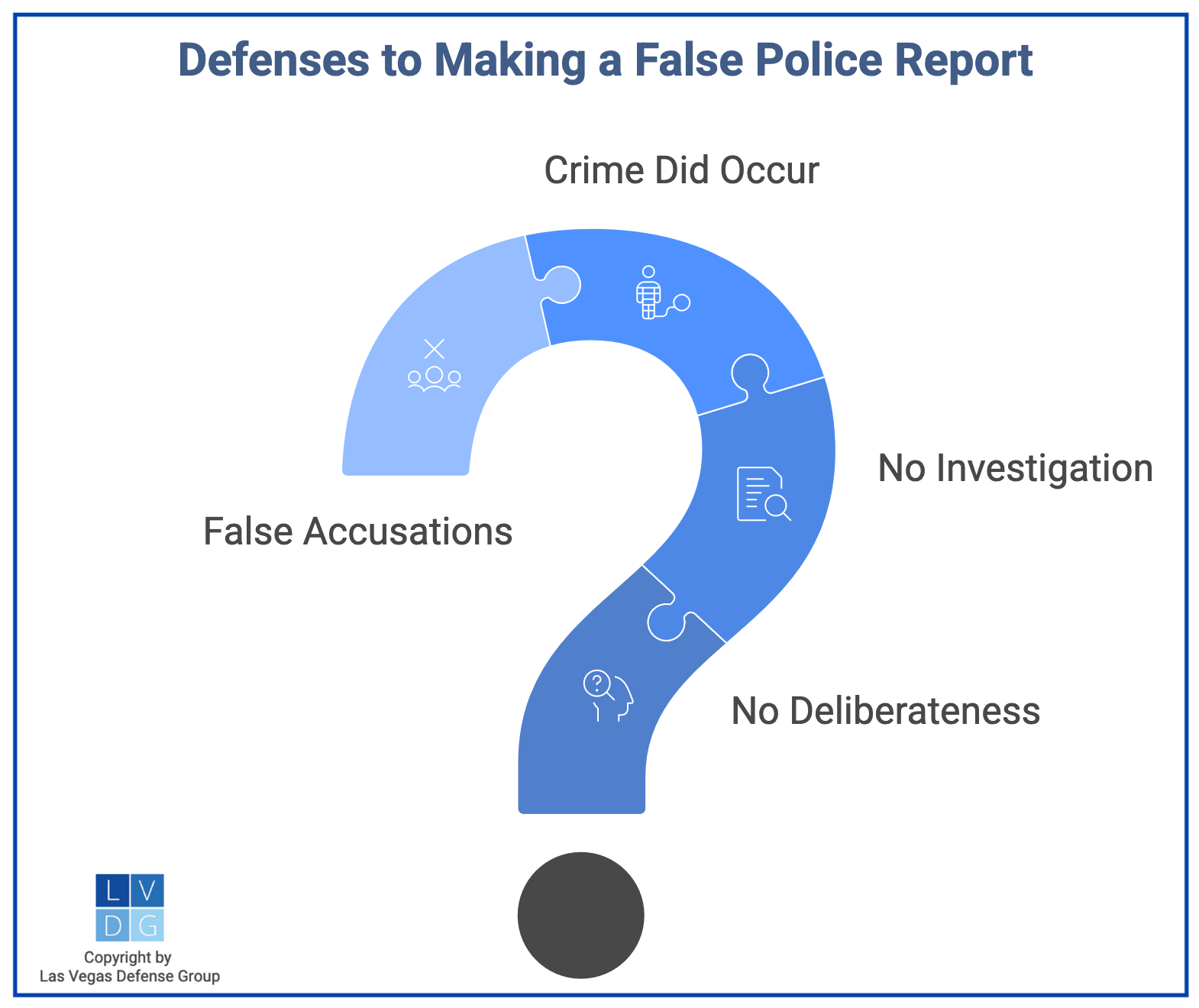
Here at Las Vegas Defense Group, we have represented literally thousands of people charged with crimes such as making a false police report. In our experience, the following four defenses have proven very effective with prosecutors, judges, and juries at getting NRS 207.280 charges reduced or dismissed.
- No deliberateness. It is unlawful to report a crime to law enforcement personnel only if the person reporting it knew it was false. So if you honestly believed that a crime had been committed and were acting in good faith, no law has been broken.
- No investigation. You should not be convicted of false crime reporting unless the police department took the initiative to investigate the matter. So if a defense attorney can show that law enforcement commenced no investigation into the crime report, the case should be dismissed.
- A crime had been committed. Just because a police investigation did not turn up evidence of a crime does not mean that a crime did not occur. If the defense attorney can show that the misdemeanor, gross misdemeanor, or felony that you reported did in fact happen, the charges should be dropped.
- False accusations. Perhaps someone who has a personal vendetta against you levied false allegations against you out of retaliation. In these cases, we can often find evidence of the accuser’s motivation to lie by poring over their text messages, voicemails, and emails.
Typical evidence in these cases includes eyewitness accounts, surveillance video, and recorded communications.2

NRS 207.280 cases often include defendants misrepresenting the circumstances to police or misidentifying a criminal suspect.
3. Immigration Consequences
Filing a false police report is potentially a crime involving moral turpitude and therefore deportable.3 Therefore, non-citizens facing criminal charges should retain an experienced lawyer immediately to attempt to get the charge dismissed or changed to a non-deportable crime.
4. Record Seals
Nevada convictions for filing a false police report can be sealed from your criminal record one year after the case ends. Though if your case gets dismissed, the case can be sealed immediately.4
Note that the record seal process itself takes several months. Learn how to seal Nevada criminal records.
5. Related Crimes
- Perjury (NRS 199.120) – Lying under oath or inducing others to lie under oath (subornation of perjury). This is usually a felony crime.
- False Declarations (NRS 199.145) – Making a willful and false statement in a material matter in a declaration under penalty of perjury. This is always a felony crime.
- Obstructing a Public Officer (NRS 197.190) – Making false statements to, hindering, or withholding information from a public officer (such as police or judges). Like making a false police report, obstruction is a misdemeanor.

Violating NRS 207.280 is often referred to as false reporting or making a false report of a crime.
Frequently Asked Questions
Can I be charged if I report a real crime but lie about who did it?
Yes. Under NRS 207.280, “false reporting” is not limited to inventing crimes that never happened. It also applies if you provide misleading information about a real incident—such as intentionally naming the wrong person as a suspect or misrepresenting the facts—provided your report triggers a police investigation.
When does a false report become a felony?
While NRS 207.280 is a misdemeanor, the charge can escalate to a category D felony under NRS 199.145 if the false report is made in a written statement signed under penalty of perjury. Additionally, if you use an emergency line (like 911) to make a false report that results in serious injury or death (often called “swatting”), you can face category E felony charges under NRS 207.245.
Can the person I falsely accused sue me in civil court?
Yes. Beyond criminal penalties, you can be held civilly liable for damages. The person you accused may sue you for defamation, intentional infliction of emotional distress, or malicious prosecution. In these cases, you might be ordered to pay for their legal fees, lost wages, and damage to their reputation.
Will the court make me pay for the police investigation?
Frequently, yes. Nevada judges have the authority to order restitution as part of a sentence. This means you may be required to reimburse the law enforcement agency for the costs associated with the unnecessary investigation, including officer man-hours, forensic testing, and other diverted resources.
Reporting Crimes
You can always report crimes in Nevada by calling 911. For more information re. reporting abuse of children, the elderly, or vulnerable people, refer to the following:
- Nevada Child Abuse Prevention, Nevada Department of Health & Human Services Division of Child & Family Services
- Report Suspected Child Abuse or Neglect, Nevada Department of Health & Human Services Division of Child & Family Services
- Report Vulnerable Adult Abuse, Nevada Department of Health & Human Services Division of Child & Family Services
- Abuse Neglect, Las Vegas Metropolitan Police Department
- Prevent Child Abuse Nevada, UNLV Nevada Institute for Children’s Research & Policy
- Adult Protective Services (APS), reachable by calling 211
Legal References
- NRS 207.280.
- See, for example, Young v. State (Nev. 2025) 577 P.3d 691.
- Diaz v. Uribe (2012, U.S. District Court for Central District of California) Case No. EDCV 12-0861-VBF (RNB).
- NRS 179.245; NRS 179.255.