

NRS § 202.285 is the Nevada gun law that prohibits willfully and maliciously firing a gun into a building or vehicle.
Discharging a firearm at an occupied building or vehicle is a category B felony carrying one to 10 years in Nevada State Prison and/or up to $5,000. Though if the structure or vehicle was abandoned, then shooting a gun at it is a misdemeanor carrying up to six months in jail and/or up to $1,000.
The statute in its entirety reads:
NRS 202.285. 1. A person who willfully and maliciously discharges a firearm at or into any house, room, apartment, tenement, shop, warehouse, store, mill, barn, stable, outhouse or other building, tent, vessel, aircraft, vehicle, vehicle trailer, semitrailer or house trailer, railroad locomotive, car or tender:
(a) If it has been abandoned, is guilty of a misdemeanor unless a greater penalty is provided in NRS 202.287.
(b) If it is occupied, is guilty of a category B felony and shall be punished by imprisonment in the state prison for a minimum term of not less than 1 year and a maximum term of not more than 10 years, or by a fine of not more than $5,000, or by both fine and imprisonment.2. Whenever a firearm is so discharged at or into any vessel, aircraft, vehicle, vehicle trailer, semitrailer or house trailer, railroad locomotive, car or tender, in motion or at rest, and it cannot with reasonable certainty be ascertained in what county the crime was committed, the offender may be arrested and tried in any county through which the vessel, aircraft, vehicle, vehicle trailer, semitrailer or house trailer, locomotive or railroad car may have run on the trip during which the firearm was discharged at or into it.
In this article, our Las Vegas criminal defense attorneys explain:
- 1. Elements of NRS 202.285
- 2. Defenses
- 3. Record Seals
- 4. Immigration Consequences
- 5. Gun Rights
- 6. Related Offenses
- Frequently Asked Questions
- Additional Resources
1. Elements of NRS 202.285
For you to be convicted of violating NRS 202.285, Nevada prosecutors have the burden to prove beyond a reasonable doubt that you willfully and maliciously fired a gun at or into a
- structure,
- vehicle,
- aircraft or
- watercraft.
It makes no difference under state law if the bullet never reaches the structure or vehicle.
Example: One night John gets angry and shoots a handgun at his ex-girlfriend’s house. The bullet instead hits a lamp post and ricochets onto the street.
A law enforcement officer from the Las Vegas Metropolitan Police Department immediately arrests John for maliciously discharging a firearm at a structure. The fact he missed makes his action no less unlawful.
Note that you face a separate charge for each bullet fired, even if you discharge them in quick succession. So firing ten bullets would invite ten individual charges for discharging a firearm.2

Shooting a gun into an occupied structure is a felony in Nevada.
2. Defenses
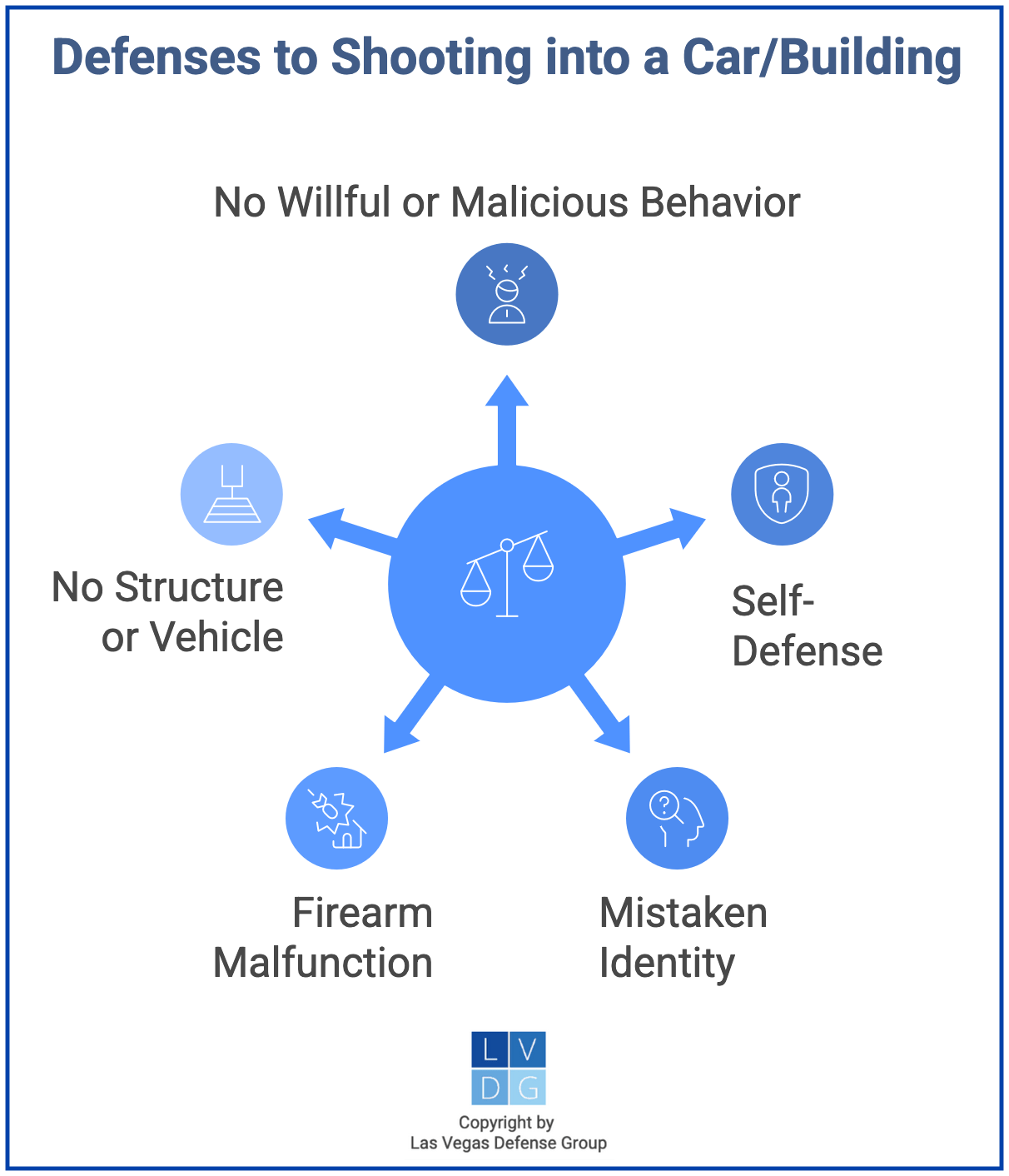
Here at Las Vegas Defense Group, we have represented literally thousands of people charged with gun crimes, including shooting firearms into structures or vehicles. In our experience, the following five defenses have proven very effective with prosecutors, judges, and juries at getting NRS 202.285 charges reduced or dismissed.
- Gun was not fired at a structure or vehicle. Perhaps you actually fired the gun at an open field, a lake, or the sky. If the police cannot find a bullet that matches your gun, the D.A. may have insufficient evidence to show you actually fired at a building or vehicle.
- There was no willful or malicious behavior. Accidentally or negligently firing a gun at a structure or vehicle does not violate NRS 202.285. If we can show that you never meant to discharge the weapon, the case should be dropped.
- You are a victim of mistaken identity. In many of these cases, shots are fired at night or from a distance, making eyewitness identification unreliable. Arguing that the police arrested the wrong person—or providing an alibi showing you were elsewhere—is a strong defense.
- The firearm malfunctioned. If a gun discharges due to a defective trigger mechanism rather than a willful trigger pull, the “malicious” intent element of the crime is absent. We can hire forensic experts to show that the gun was defective.
- You acted in lawful self-defense. You are allowed to fire a gun in self-defense if you are facing an immediate threat of death or physical injury.
Example: Alan is walking down the street in Henderson when a man suddenly jumps him. Alan pulls out his gun and shoots the man, though some of the bullets miss and go into one of the parked motor vehicles on the street.
Chances are good Alan will not be prosecuted. The state would probably agree that he acted in lawful self-defense.
3. Record Sealing
If you are convicted of violating NRS 202.285 as a category B felony, you can pursue a record seal five years after the case ends. If you are convicted of a misdemeanor, then the wait time is only one year after the case ends.
Note that if your case is dismissed, you can immediately petition for a record seal.3 Learn more about sealing Nevada criminal records.
4. Immigration Consequences
Most gun crimes are potentially deportable under federal law.4 So if you are a non-citizen charged with discharging a gun into a structure or vehicle, be sure to hire an attorney to try to get the charge dropped or changed to a non-deportable offense.
5. Gun Rights
Getting convicted of discharging a firearm as a category B felony strips you of your gun rights for life.5 The only avenue for restoring your gun rights following a felony conviction is through a Nevada pardon.
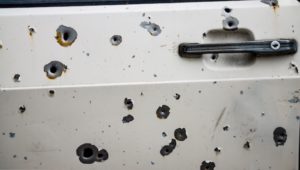
Each bullet fired in violation of NRS 202.285 counts as a separate offense.
6. Related Offenses
Shooting from a Car or Building
Shooting a gun from a car or building (NRS 202.287) can be a category B felony or a misdemeanor, depending on whether you are in a populated area as designated by local law. The penalties are identical to those for shooting a gun at a car or building.
Discharging a Firearm in Public
Under NRS 202.280, it is a misdemeanor to discharge a gun on a public street, public building, or other public place while you are:
- intoxicated by alcohol or controlled substances, or
- acting wantonly, maliciously, or negligently.
Brandishing a Weapon
NRS 202.320 makes it a misdemeanor to draw a deadly weapon in a threatening manner in front of two or more human beings. Though if you put someone in fear of immediate bodily harm, you instead would face charges for assault with a deadly weapon – a felony.
Assault with a Deadly Weapon
Like it sounds, assault with a deadly weapon (NRS 200.471(2)(b)) is using a firearm, knife, or other deadly weapon in an attempt to strike a victim or place them in fear of immediate bodily harm. This is always a felony.
Reckless Endangerment
If we successfully argue that a shooting was not “willful and malicious,” the prosecution might still try to pin you with a charge for reckless endangerment (NRS 202.595). This is the act of disregarding a substantial and unjustifiable risk to human life.
Frequently Asked Questions
Does it matter if I did not know anyone was inside the building or car?
Yes, it makes a massive difference in your penalties, but it does not excuse the crime.
Under Nevada law, shooting into an “abandoned” structure is a misdemeanor (up to six months in jail), but shooting into an “occupied” structure is a category B felony (up to 10 years in prison).
However, prosecutors will often argue that you should have reasonably known a house or business might be occupied. As your defense team, we can fight to get felony charges reduced by proving the structure was clearly abandoned or unoccupied at the time.
Can I be charged if I shoot into my own house or car?
Yes. NRS 202.285 does not require the property to belong to someone else.
If you maliciously discharge a firearm into your own occupied home or vehicle—for example, during a domestic dispute or a fit of rage—you can still be charged with a category B felony. The law is designed to protect human life and public safety, not just property rights.
What happens if someone is actually injured or killed by the bullet?
NRS 202.285 only covers the act of shooting at the structure itself, regardless of whether anyone is hit. However, if your bullet strikes and injures someone inside the vehicle or building, you will face additional, more severe charges, such as battery with a deadly weapon or attempted murder. If the person dies, you could be charged with murder, which carries a potential life sentence.
Additional Resources
For more information, refer to the following:
- Gun Safety Rules – National Rifle Association
- Firearms Q&As – Bureau of Alcohol, Tobacco, Firearms and Explosives
- Out-of-State Carry Concealed Weapon Permit Recognition – Nevada State Police Records, Communications and Compliance Division.
- Nevada Gun Laws: A Complete Guide – Giffords Law Center.
- National Instant Criminal Background Check System (NICS) – Federal Bureau of Investigation
See our related articles on altering a gun’s serial number, violating a restraining order, possession of a firearm by a felon, and concealed weapons/concealed firearms (CCW permits).