

Joyriding may seem like a harmless guilty pleasure. All you are doing is taking someone else’s vehicle out for a spin and giving it back, often without them ever knowing it was gone.
In Nevada, however, joyriding is a serious crime under NRS 205.2715. Formally called “unlawful taking of vehicle,” joyriding is a gross misdemeanor carrying:
- up to 364 days in jail and/or
- up to $2,000 in fines.1
It is irrelevant that you never intended to keep the vehicle permanently.
More Than Just Cars
In Nevada, you can be convicted of joyriding using any kind of vehicle, including:
- automobiles,
- motorcycles,
- e-scooters,
- motorboats, or
- airplanes.
Note that NRS 205.2715 does not apply to non-motorized devices such as bikes, skateboards, or rowboats. The statute also does not apply to devices that move only on rails or tracks, like train cars.2
Fighting the Charge
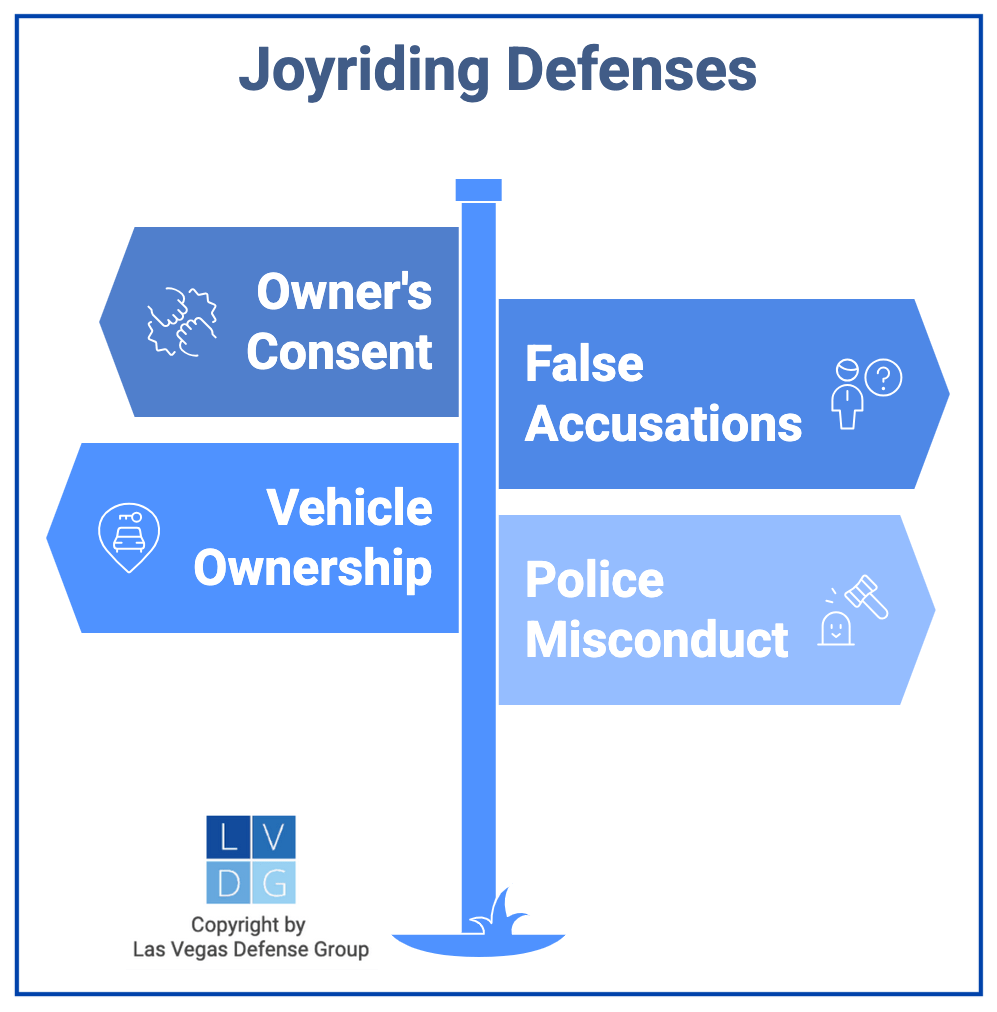
In my experience, there are four effective defenses to Nevada joyriding charges:
- You had the owner’s consent to drive the vehicle; or
- It was someone else who took the vehicle, and you were falsely accused; or
- You owned or shared title to the vehicle in question; and/or
- The police committed misconduct, such as entrapping you or coercing your confession.
Getting joyriding charges reduced or dismissed is always an uphill battle because courts automatically infer you violated NRS 205.2715 if you are found in possession of a vehicle without the owner’s consent.3 To overcome this inference, I typically rely on such evidence as:
- recorded communications between you and the vehicle’s owner,
- GPS data,
- vehicle title documents,
- odometer readings,
- video surveillance footage, and/or
- eyewitness accounts.
Joyriding vs. Car Theft
Joyriding with a car is a less serious Nevada crime than stealing a car, which is formally called:
- “grand larceny of a motor vehicle” or
- “grand theft auto.”
This is because with car theft, you intend to take someone else’s car permanently. Joyriding is meant to be a temporary taking.
The following table shows the penalty ranges for car theft in Nevada.
| Grand Theft Auto Crime |
Nevada Sentence |
| First offense | Category C felony: 1 to 5 years in prison and up to $10,000 |
| Second/successive offense | Category B felony: 1 to 6 years in prison and up to $5,000 |
In addition, the court will order you to pay restitution to the vehicle’s owner.4

Temporarily taking someone else’s car without their consent is a Nevada crime.
Frequently Asked Questions
Is joyriding a felony in Nevada?
No, joyriding is officially classified as a gross misdemeanor under NRS 205.2715. However, it is common for prosecutors to initially charge a person with grand larceny of a motor vehicle (a felony) until it can be proven that there was no intent to keep the car permanently.
Can I be charged if I was only a passenger?
Yes. Nevada law is broad enough that if a passenger knows (or should have known) that the vehicle was taken without the owner’s consent, they can be charged with the same gross misdemeanor. Simply being in the car can lead to an “inference” of involvement.
What is the difference between joyriding and “grand larceny”?
The difference in Nevada is your intent. Joyriding assumes you intended to return the car or leave it where it could be found (temporary use). Grand larceny assumes you intended to steal the car permanently, sell it, or strip it for parts.
Will a joyriding conviction stay on my record?
A gross misdemeanor conviction in Nevada can typically be sealed after a two-year waiting period following the close of the case. Sealing the record is not automatic; you must petition the court to ensure the charge no longer appears on standard background checks.
Additional Reading
For more in-depth information, refer to the following scholarly articles:
- Injuries related to car crime: the joy-riding epidemic – Injury.
- Perceptions of Physical, Psychological, Social and Legal Deterrents to Joyriding – Crime Prevention and Community Safety.
- Investigation into Joyriding as an Addictive Behaviour – Loughborough University.
- Speeding and Joy Riding – Shades of Deviance: A Primer on Crime, Deviance and Social Harm.
- Addicted to joyriding? An exploration of young offenders’ accounts of their car crime – Psychology, Crime & Law.
Legal References
- NRS 205.2715. Unlawful taking of vehicle: Inference; penalty.
1. Every person who takes and carries away or drives away the vehicle of another without the intent to permanently deprive the owner thereof but without the consent of the owner of such vehicle is guilty of a gross misdemeanor.
2. Every person who is in possession of a vehicle without the consent of the owner of such vehicle may reasonably be inferred to have taken and carried away or driven away the vehicle.
3. Vehicle” as used in this section means every device in, upon or by which any person or property is or may be transported or drawn upon a public highway, waterway or airway, excepting devices moved by human power or used exclusively upon stationary rails or tracks.
- Same.
- Same. See also Sullivan v. State (Nev. 2020) 476 P.3d 441. Montes v. State (1979) 95 Nev. 891. Walsh v. State (1994) 110 Nev. 1385.
- NRS 205.228. See also Young v. State (Nev. 2025) 577 P.3d 691 (re. prejudicial jury instructions regarding larceny).
