

If you get injured by a drunk driver in Nevada, you can sue the driver and their insurance company for negligence. The driver’s intoxication from alcohol and/or drugs could be an aggravating factor that leads to a bigger settlement.
Typical compensatory damages awarded in Nevada DUI accident cases include money for:
Even if you played some role in your injuries – such as by speeding – you would still be entitled to damages as long as the drunk driver (or drugged driver) was at least 50% to blame.
In this article, our Las Vegas personal injury attorneys discuss what you need to know about filing a lawsuit after DUI accidents in Nevada.
- 1. Claims
- 2. Defendants
- 3. Damages
- 4. Statute of Limitations
- 5. Proof
- 6. Defenses
- 7. Partial Fault
- Frequently Asked Questions
- Additional Reading
1. Claims
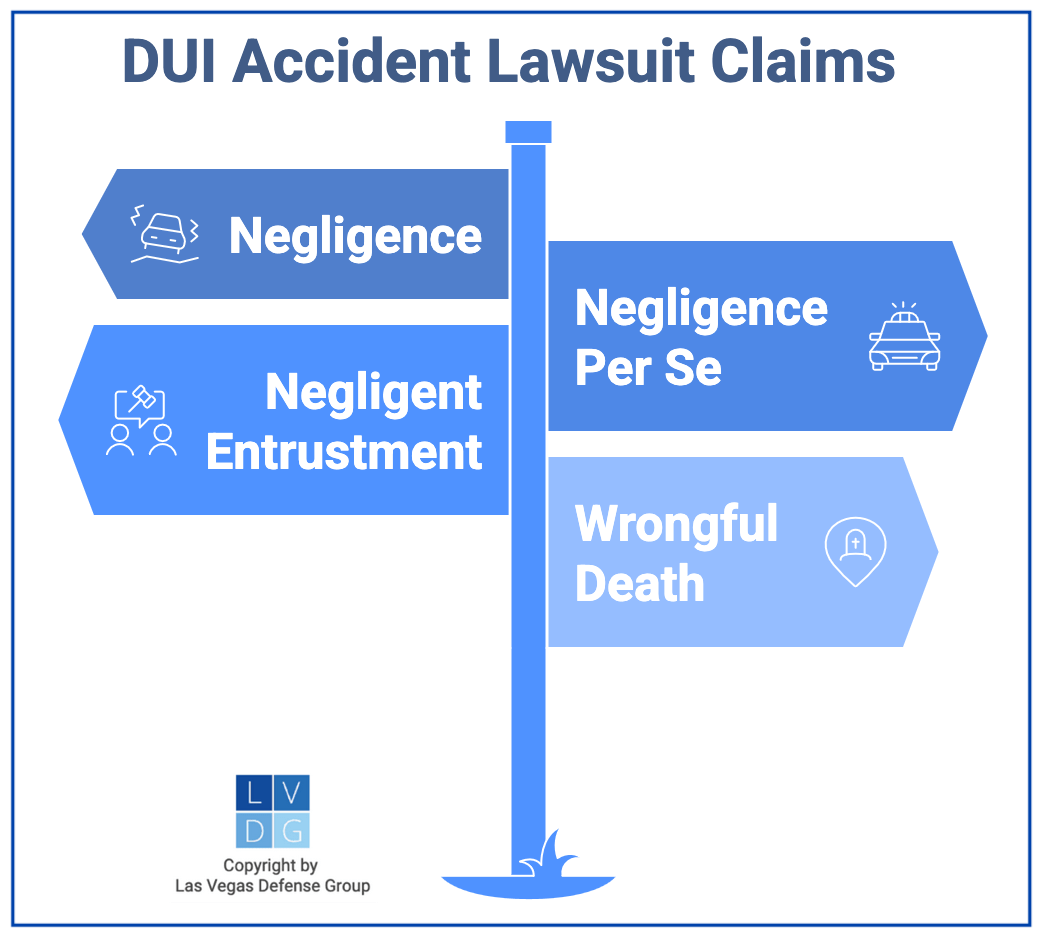
As the victim in a DUI-related car crash, you may file a lawsuit against the parties responsible for the crash. Common “causes of action” you may sue for include:
- negligence;
- negligence per se;
- wrongful death (if the victim died); and
- negligent entrustment.
You would be the “plaintiff” in the lawsuit. Meanwhile, the parties you are suing are the “defendants.” If the DUI driver died in the crash, you could sue their estate.
Negligence
Probably the most common claim in car accident cases is negligence in Nevada. To prove that the defendant was negligent, you would need to show the following:
- the defendant owed you a duty of care;
- the defendant breached that duty of care; and
- the defendant’s breach of duty proximately caused your injuries.1
Negligence Per Se
Any drunk or intoxicated driver who allegedly causes an accident is vulnerable to a lawsuit for negligence per se in Nevada. You would need to demonstrate the following in order to win on this claim:
- the defendant had the duty to follow a certain law (Nevada’s DUI laws);
- you are one of the people that law was designed to protect (anyone else sharing the road);
- the defendant violated that law (by driving drunk or high); and
- the defendant’s violation proximately caused your injuries.2
Wrongful Death
If an intoxicated driver caused a fatality, then the victim’s estate and family may bring a Nevada wrongful death lawsuit. You would need to prove the following:
- The victim passed away;
- This death was caused by the defendant’s wrongful act or negligence;
- You are an heir or personal representative of the victim; and
- You suffered damages for monetary injury as a result of the death.3
Negligent Entrustment
As discussed in the following section, any party knowingly allowing a driver to operate a vehicle while intoxicated could be liable for negligent entrustment in Nevada. You would have to prove the following elements in order to prevail on this claim:
- The defendant left the automobile with another person (a drunk driver);
- The defendant knew — or should have known — that this person is incompetent to use the vehicle and could use it to harm others; and
- The drunk driver used the car in a negligent fashion, harming you.4
2. Defendants
Indeed, the apparent party to sue following a drunken automobile accident is the driver. Other possible defendants may include anyone who allowed the driver to take the wheel despite knowing that they were impaired.
Example: Jack lends his son Henry the keys to his car even though Henry is visibly intoxicated. If Henry proceeds to get into an accident, the accident victim could sue Jack for “negligent entrustment” (discussed in the previous section).
If the car the drunk driver was operating may have been defective, you may also sue the car manufacturer for strict products liability in Nevada. Plus if poor roads or inadequate signage may have contributed to the accident, you could also sue the local city or county for negligence.

As a victim in a DUI car crash, you may be entitled to receive both compensatory and punitive damages.
3. Damages
If an inebriated driver injures you, you may be eligible for compensatory damages to cover the following expenses:
- Medical bills (such as for hospital stays, home health care, rehab hospital stays, and counseling),
- Lost wages, tips, and bonuses,
- Loss of future earnings,
- Pain and suffering,
- Vehicle-repair service bills, and/or
- If the victim died, funeral expenses and loss of support.
If you take the matter to trial and win, the court may also award punitive damages to “punish” the defendant and “deter” others from acting like the defendant. Punitive damages can be far bigger than compensatory damages.5
4. Statute of Limitations
In most cases, personal injury lawsuits must be filed no later than two years after the accident or when you became aware of your injuries. However, special circumstances may extend this time limit.
Learn more about statutes of limitations in Nevada personal injury cases.6
5. Proof
The easiest way to prove that a defendant in a car accident case was drunk or high is if the defendant was convicted of DUI for that same incident. There are various DUI offenses in Nevada, including:
- first-time DUI
- second-time DUI
- third-time (or successive) DUI
- DUI causing injury or death (NRS 484C.430)
- vehicular homicide (NRS 484C.130)
- commercial driver DUI (NRS 484C.120)
All you would need to produce is court records documenting the conviction. Even if the defendant managed to escape conviction – or if the criminal case is still pending – it may still be possible to show that the defendant was under the influence.
Burden of Proof
When bringing a personal injury lawsuit, you only need to prove that the defendant is liable “by a preponderance of the evidence.” In plain English, this means that it is more likely than not that the defendant was at fault.
This “preponderance of the evidence” standard in civil cases is much lower than the “beyond a reasonable doubt” standard in criminal cases. Therefore, a person could be found civilly liable for causing a drunken crash even if they were found not criminally liable for the same incident.
Evidence
Typical evidence to prove that someone was driving while under the influence includes:
- the police report;
- results from the defendant’s DUI breath test in Nevada or DUI blood test in Nevada that show the defendant was driving with a blood alcohol content of at least .08%.
- surveillance video of the defendant (including from cameras the police officers wear);
- eyewitnesses; and/or
- any confessions the defendant may have given at the scene to the police

A criminal guilty verdict for DUI often serves as proof in the related civil case that the defendant drove drunk or high.
6. Defenses
Defendants in DUI accident cases may try to show that there is insufficient evidence that they were indeed intoxicated or high. Some of the arguments they use include the following:
- the breath- or blood-testing equipment in their case was defective;
- the police waited too long to take a breath- or blood test (more than two hours after being stopped);
- the defendant suffered from a medical or physical condition that caused an inaccurate Nevada BAC (blood alcohol content) result;
- the defendant suffered from a medical or physical condition that resembled intoxication;
- the defendant was not driving the car at the time of the accident;
- the defendant did not begin drinking or ingesting drugs until after the accident;
- the people who administered the breath- or blood-tests made mistakes; and/or
- the defendant was not found guilty of DUI in criminal court.
Non-DUI Related Defenses
Other arguments that DUI accident defendants may try to use have nothing to do with intoxication: They are standard defenses in any car crash case:
- the crash was caused by a manufacturer’s defect in the car, not the defendant’s behavior;
- the crash was caused by poor weather or badly maintained roads or signage; and/or
- you were more to blame for the crash than the defendant (scroll down to the next section for more information on this)
Burden of Proof
As discussed in the previous section, you have a lower burden of proof than prosecutors do in a criminal case. Even if the defendant was acquitted of DUI in criminal court, it may still be possible for you to show “by a preponderance of the evidence” that the defendant was liable for the crash.
7. Partial Fault
It is not uncommon for car crashes to have several causes, including your own negligence. The defendant may have been drunk, but perhaps you were texting or speeding at the time of the accident. Even still, you often can recover damages anyway:
Under Nevada’s comparative negligence laws, you may recover damages in a personal injury case as long as the defendant was at least 50% at fault. So if you were more at fault than the defendant, then you would not be eligible for anything.
Example: Kay is high on marijuana while driving down the 215 in Las Vegas. Sarah is driving next to her while simultaneously applying her makeup in the visor mirror. Kay swerves into Sarah, damaging her car and injuring her shoulder.
At trial, the court determines that Sarah was 25% to blame because she may have been able to drive out of the way in time had she been paying attention. Though since Kay is more than 50% to blame, Sarah is eligible for a financial reward.
Note that if you were partly to blame for your accident, you will receive less money than if you were completely blameless.7
If you are injured by a drunk driver, you can sue them for negligence and other claims.
Frequently Asked Questions
Can I sue the bar or restaurant that over-served the drunk driver?
In most cases, no. Unlike many other states, Nevada does not have “Dram Shop” laws. This means that commercial establishments like bars, casinos, and restaurants generally cannot be held legally responsible for damages caused by a patron’s drunk driving, regardless of how intoxicated the patron was or how many drinks they were served. Your primary legal action will be against the driver directly.
What is the legal blood alcohol concentration (BAC) limit in Nevada?
For most drivers aged 21 and older, the legal BAC limit is .08%. However, Nevada enforces stricter limits for specific motorists. For drivers under the age of 21, the legal limit is just .02%. Commercial drivers (such as truck drivers) are held to a .04% BAC limit. If the driver who hit you was above their respective legal limit, it serves as powerful evidence of negligence in your civil case.
Do I have to wait for the drunk driver’s criminal case to end before filing my lawsuit?
No. Civil lawsuits and criminal proceedings are entirely separate. The State of Nevada pursues criminal charges to penalize the driver and protect the public, which can happen even if no one was injured. You do not need to wait for a criminal conviction to pursue your civil claim. In fact, you can file a civil lawsuit to recover financial compensation for your medical bills and property damage while the criminal case is still ongoing.
How common are drunk driving accidents in Nevada?
Unfortunately, they are very common. Nevada sees roughly 10,000 drunk driving arrests every single year. Statistically, a convicted drunk driver has driven under the influence an average of 80 times before finally being caught by law enforcement. Because of how prevalent this issue is, Nevada courts take civil claims against drunk drivers very seriously.
Additional Reading
For more information, see our related articles:
- How to get your “car repair bills” paid after a Nevada accident
- A guide to “bodily injury liability” insurance in Nevada
- How to file a car insurance claim after an accident in Nevada
- How uninsured motorist insurance and underinsured motorist insurance (UM / UIM) works in Nevada
- How “Med Pay” car insurance works in Nevada