

Special circumstances is another term for “aggravating factors” in Nevada capital murder cases. Aggravating factors make you seem more blameworthy; an example is torturing a victim before killing them.
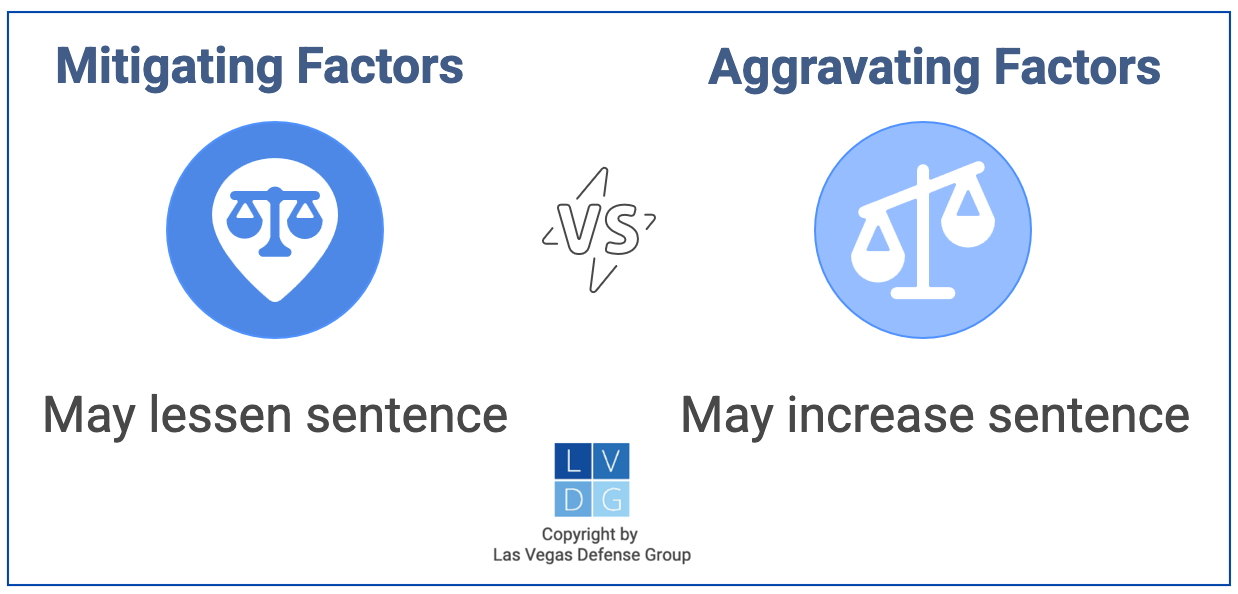
For you to be sentenced to the death penalty for first-degree murder in Nevada, the court must find that there was at least one aggravating factor. Furthermore, this aggravating factor(s) must not be outweighed by any mitigating factors.
The opposite of aggravating factors, mitigating factors make you seem less blameworthy. An example is if you were abused as a child: This childhood abuse does not excuse the murder, but it does show you in a more sympathetic light.
During the sentencing phase following a murder conviction, the district attorney presents evidence of aggravating factors, while I, as the criminal defense attorney, would present evidence of mitigating factors.
Aggravating Circumstances
Nevada Revised Statute 200.033 spells out the 15 special circumstances that can aggravate your first-degree murder conviction and therefore make you eligible for capital punishment:
- You were a prisoner at the time of the killing.
- You have a criminal history of either murder or a felony involving the use or threat of violence.
- You knowingly created a great risk of death to more than one person by means of a weapon, device or course of action which would normally be hazardous to the human life of more than one person.
- The murder was committed while you were in perpetration of a robbery, first-degree arson, burglary, invasion of the home, or first-degree kidnapping, and you either 1) killed or attempted to kill the person murdered, or 2) knew or had reason to know that life would be taken or lethal force used.
- The murder was committed to avoid or prevent a lawful arrest or to effect an escape from custody.
- You killed to receive financial gain or any other thing of value.
- You knowingly killed an on-duty peace officer (including law enforcement officers / police officers) or firefighter.
- The murder involved torture or the mutilation of the victim.
- The killing was committed at random and without an apparent motive.
- The victim was less than 14 years of age.
- The killing was a hate crime (due to perceived race, color, religion, national origin, physical or mental disability, sexual orientation or gender identity or expression).
- You have more than one prior murder conviction.
- You – alone or with others – sexually assaulted the victim.
- The killing took place on school property, at a school event, or on a school bus, and you intended to create a great risk of death or substantial bodily harm to more than one person by means of a weapon, device or course of action that would normally be hazardous to the lives of more than one human being.
- The murder was committed with the intent to commit, cause, aid, further or conceal an act of terrorism.
As I mentioned above, Nevada’s criminal justice system requires that the jury find at least one aggravating factor before it can sentence you to death. Though if the mitigating factors outweigh the aggravating ones, the jury may not impose death.1
Degrees of Murder
In Nevada, first-degree murder comprises either:
- premeditated murder or
- felony murder (killing done in the commission of a crime, such as a robbery or carjacking gone wrong).
Second-degree murder in Nevada has no premeditation. Instead, you must act with reckless indifference to human life, not the specific intent to kill anyone. A classic example is playing Russian Roulette: Everyone knows death is likely to result from firing a deadly weapon like a firearm.2
Note that voluntary manslaughter is a less serious crime than murder. It comprises “heat of passion” killings done without premeditation. In my experience, prosecutors may be willing to reduce murder charges down to manslaughter as part of a plea bargain.3

Torture is a special circumstance in a Nevada murder case.
Murder Penalties
First-Degree Murder
A category A felony, first-degree murder carries the death sentence in Nevada only if:
- there is at least one aggravating circumstance, and
- it is not outweighed by any mitigating circumstances.
People sentenced to death often remain on death row for years before their execution. Currently, executions are on hold while the state is having trouble obtaining the supplies necessary for lethal injection. (Note that death row is in Ely, not Las Vegas.)
Otherwise, Nevada’s punishment for first-degree killing includes:
- A sentence of life imprisonment without the possibility of parole; or
- Life with the possibility of parole, with eligibility for parole beginning when a minimum of 20 years has been served; or
- 50 years in prison, with eligibility for parole beginning when a minimum of 20 years has been served.
The court does not need to find aggravating circumstances before deciding whether to grant the possibility of parole.4
Second-Degree Murder
Also a category A felony in Nevada, second-degree killing carries:
- life with the possibility of parole, with eligibility for parole beginning when a minimum of 10 years have been served; or
- 25 years, with eligibility for parole beginning when a minimum of 10 years have been served.5

Killing for money is a special circumstance in a Nevada murder case.
Death Penalty States
In addition to Nevada, state executions are also lawful in the following jurisdictions:
- Alabama,
- Arizona,
- Arkansas,
- California,
- Florida,
- Georgia,
- Idaho,
- Indiana,
- Kansas,
- Kentucky,
- Louisiana,
- Mississippi,
- Missouri,
- Montana,
- Nebraska,
- North Carolina,
- Ohio,
- Oklahoma,
- Oregon,
- Pennsylvania,
- South Carolina,
- South Dakota,
- Tennessee,
- Texas,
- Utah, and
- Wyoming.
Despite popular belief, Colorado is not a death penalty state.
In 2020, the United States Supreme Court let stand an appeals court ruling permitting the Trump administration to resume implementing the death penalty in federal capital punishment cases following a 17-year lull.6

Mutilation is a special circumstance in a Nevada murder case.
Additional Reading
For more in-depth information, refer to these scholarly articles:
- Social Context of Capital Murder: Social Histories and the Logic of Mitigation – Santa Clara Law Review.
- Capital Punishment and Capital Murder: Market Share and the Deterrent Effects of the Death Penalty – Texas Law Review.
- Aggravation and Mitigation in Capital Cases: What Do Jurors Think? – Columbia Law Review.
- Can All Murders be Aggravated: A Look at Aggravating Factor Capital-Eligibility Schemes – St. Louis University Law Journal.
- No Path Forward: Nevada’s Death Penalty – Nevada Law Journal.
Legal References
- NRS 200.033. See, for example, Acosta v. State (2025) 141 Nev. Adv. Op. No. 40.
- NRS 200.030.
- NRS 200.050.
- See note 2.
- Same.
- Bourgeois, Alfred, et. al. v. Barr, Atty Gen., et. al. (2020) No. 19-1348.
