
Quick summary
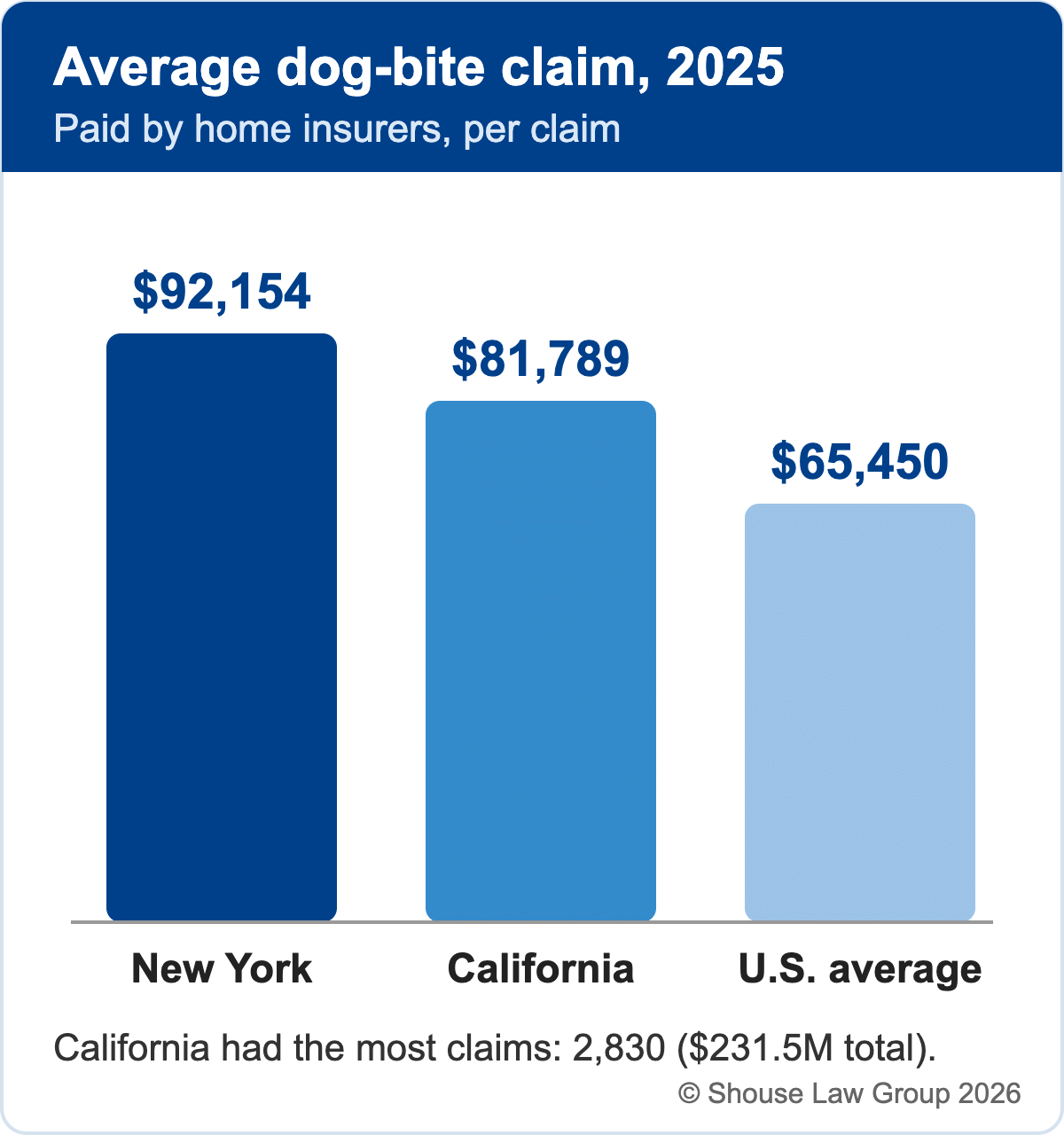
A dog bite settlement is money the dog’s owner, or more often their insurance company, pays you to end your injury claim. In California, home insurers paid an average of about $81,789 per dog-bite claim in 2025, but your amount depends on your injuries, your costs and the insurance available.1
4 key things to know:
- California makes a dog’s owner responsible for a bite in a public place or on private property where you were allowed to be, even if the dog never bit anyone before.
- A settlement covers medical bills, lost wages, pain and suffering and scarring, and is usually paid by a homeowners or renters policy with limits of about $100,000 to $300,000.
- You generally have 2 years to sue, but only 6 months to file a claim against a city, county or other public agency.
- A child’s settlement is final only after a court approves it. Our California dog bite lawyers offer a free consultation.
In this article, our California dog bite lawyers answer 11 common questions about dog bite settlements:
- 1. How much is a dog bite settlement in California?
- 2. What is a dog bite settlement?
- 3. What affects how much my case is worth?
- 4. How is a dog bite settlement calculated?
- 5. Who pays a dog bite settlement?
- 6. What if the person bitten is a child?
- 7. What is the deadline to sue?
- 8. How does the settlement process work?
- 9. How long does a dog bite settlement take?
- 10. How can I get the most from my settlement?
- 11. Questions and answers
1. How much is a dog bite settlement in California?
There is no set amount, but California dog bite claims are among the most expensive in the country. In 2025, California had more dog-bite insurance claims than any other state: 2,830 claims worth about $231.5 million, or about $81,789 per claim. The U.S. average was $65,450 per claim (as of April 2026).2
Averages mix very different cases. A puncture wound that heals in a few weeks may settle for a few thousand dollars. A mauling that needs surgery and leaves a scar on the face can settle for six figures or more. What moves your number is covered in section 3.
2. What is a dog bite settlement?
A dog bite settlement is an agreement that ends your claim. The dog’s owner, or more often their homeowner’s insurance, pays you compensation. In return, you sign a release and drop your case.
What a settlement is meant to cover
The money is meant to make you whole again. It reflects what you could likely win at trial, minus the risk and delay of going to trial. It covers your damages, which can include:
- Past medical bills and the care you will likely need in the future,
- Health insurance deductibles and co-pays,
- Lost wages,
- Lost earning potential,
- Pain and suffering, and
- Loss of consortium for your spouse (or registered domestic partner).
Why the owner usually pays
California’s dog bite statute, Civil Code 3342, makes the owner strictly liable. That means you do not have to prove the owner was careless. The owner is liable when you are bitten:
“while in a public place or lawfully in a private place, including the property of the owner of the dog, regardless of the former viciousness of the dog or the owner’s knowledge of such viciousness.”3
In plain terms: it does not matter that the dog never bit anyone before. A narrow exception applies to police and military dogs used in certain law enforcement work.
Example: Luis delivers a package in Sacramento. As he sets it on the porch, the homeowner’s dog bites his hand. Because Luis was lawfully on the property, the owner is liable under the statute even though the dog had always been friendly.
A settlement is final
Once you accept a settlement and sign the release, the case is over. If you later find the money was not enough, you cannot reopen it. That is why it pays to know the full cost of your injury first.
3. What affects how much my case is worth?
Every case is different, but these factors drive most dog bite settlements in California. When several are present, the value can rise sharply.
Your age
Children often recover more than adults. Children are less able to defend themselves, are more often bitten on the face, and may carry scars and a fear of dogs for life. Disfigurement often affects a child more deeply than an adult. (Special court rules for children’s settlements are in section 6.)
How severe the bite was
A bite that does not break the skin is worth far less than one that needs surgery. Key factors include:
- Whether the bite broke the skin,
- Nerve, tendon or muscle damage,
- Infection, including rabies treatment,
- Lost fingers or other amputations, and
- How long treatment lasts.
When a dog attack causes death, the family may bring a wrongful death claim.
Long-term injuries
Injuries that cause lasting weakness, limited movement or disability usually lead to larger settlements, because they bring years of future medical bills and can limit your work.
Scarring or disfigurement
Permanent scars raise settlement value, especially on the face, neck or hands. Even small scars can be a daily reminder of the attack and can affect how you feel in public.
In our experience, the first offer from a dog owner’s insurer often covers the bills already paid but leaves out future scar treatment such as revision surgery or laser therapy.
Emotional trauma and fear of dogs
Many people develop anxiety, nightmares or a lasting fear of dogs after an attack. Counseling costs and this emotional harm are part of your damages.
Whether the owner knew the dog was dangerous
The owner is liable under the statute either way. But if the owner knew the dog had attacked before and did nothing, a jury could award punitive damages. That requires “clear and convincing evidence” of “oppression, fraud, or malice.”4 The risk of punitive damages, which insurance often does not cover, can push owners to settle for more.
Whether you were trespassing
The dog bite statute protects only people who are in a public place or lawfully on private property. Trespassers cannot rely on it. A trespasser would have to prove the owner’s negligence instead. In one California case, a child who went through a closed gate into a backyard was “not lawfully upon the property of the dog owner at the point where the biting occurred,” so the statute did not apply.5
Example: Ava, 9, is told to stay in the front yard at a friend’s house. She climbs over a closed side gate to pet the dog and is bitten. Because she went where she was not allowed, the strict-liability statute may not help her, and her family would need to show the owner was careless.
Even when the statute applies, California’s comparative fault rules can reduce your award if your own actions helped cause the bite, such as teasing or provoking the dog.
4. How is a dog bite settlement calculated?
A dog bite settlement adds up two kinds of damages: economic losses you can total from bills and pay stubs, and non-economic losses like pain and scarring that have no receipt. Insurers start with the economic losses and then put a value on the rest.
Here is how the two types compare:
| Type | What it includes | How it is proven |
|---|---|---|
| Economic damages | ER and doctor bills, surgery, prescriptions, future scar treatment, counseling, lost wages, lost earning capacity | Bills, records, pay stubs, a doctor’s estimate of future care |
| Non-economic damages | Pain and suffering, scarring and disfigurement, emotional distress, fear of dogs, loss of enjoyment of life | Photos, your own account, family testimony, counseling records |
| Loss of consortium | Your spouse’s loss of companionship and support | Testimony from you and your spouse |
Who can claim loss of consortium
In California, your spouse can claim loss of consortium when you are seriously hurt. Your children cannot: the California Supreme Court has held that a child has no claim “for loss of parental consortium.”6
What comes out of the settlement
The total is not what you take home. Medical liens, such as a health insurer’s right to be paid back, and attorney fees are paid from the gross amount. Ask for a written breakdown before you agree to any settlement.
For more on amounts, see our article on how much you can sue for after a dog bite.
5. Who pays a dog bite settlement?
Most dog bite settlements are paid by the owner’s homeowners or renters insurance. These policies usually cover dog-bite liability up to their limits, typically $100,000 to $300,000; the owner is responsible for anything above that.7
Homeowners and renters insurance
Ask the owner for their insurance company and policy number right away. If the owner rents, their renters insurance may cover the bite. Some policies exclude certain breeds or all dog bites, so get the policy in writing. If there is no coverage, see what happens when the owner has no insurance.
Landlords
A landlord is not automatically liable for a tenant’s dog. The landlord must have known the dog was dangerous. In a 2024 case, a California appeals court explained that this can be shown “by circumstantial evidence the landlord must have known about the dog’s dangerousness as well as direct evidence he actually knew.”8 In that case, the landlords were not liable because there was no such evidence.
Example: Dana is attacked by two dogs that escape from a rented house in Long Beach. She can claim against the tenant who owns the dogs. She can also claim against the landlord only if she can show the landlord knew the dogs were dangerous, for example from neighbors’ complaints to the landlord.
Cities and counties
Suing a city or county for failing to control a dangerous dog is very hard. In a 2024 case, a California appeals court held that “public entities and their employees are immune from tort liability for legislative action or discretionary law enforcement activity,” so the county was not liable for failing to act against dangerous dogs.9 A public agency can still be liable in other situations, such as a police dog biting a bystander who had nothing to do with the incident.10 Any claim against a public agency must first be filed within 6 months (see section 7).
6. What if the person bitten is a child?
A parent cannot simply sign a settlement for a child. Under California law, a child’s settlement “is valid only after it has been approved, upon the filing of a petition, by the superior court” in the county where the child lives or where the case could be filed.11
This process is called a minor’s compromise. A judge reviews whether the amount is fair and how the money will be protected. In most cases, the money is placed in a blocked account or annuity until the child turns 18.

Example: Six-year-old Maya is bitten on the arm by a neighbor’s dog in Fresno. Her parents agree to the insurer’s offer, but the settlement is not final until a judge approves it at a short hearing, and the money is set aside for Maya.
7. What is the deadline to sue?
In most California dog bite cases, you have 2 years from the bite to file a lawsuit. The statute covers any action “for assault, battery, or injury to, or for the death of, an individual caused by the wrongful act or neglect of another.”12
If a city, county or other public agency may be responsible, the deadline is much shorter: you must file a written claim with the agency “not later than six months after” the bite.13 Missing either deadline can end your case, no matter how strong it is. Learn more about the dog bite statute of limitations.
8. How does the settlement process work?
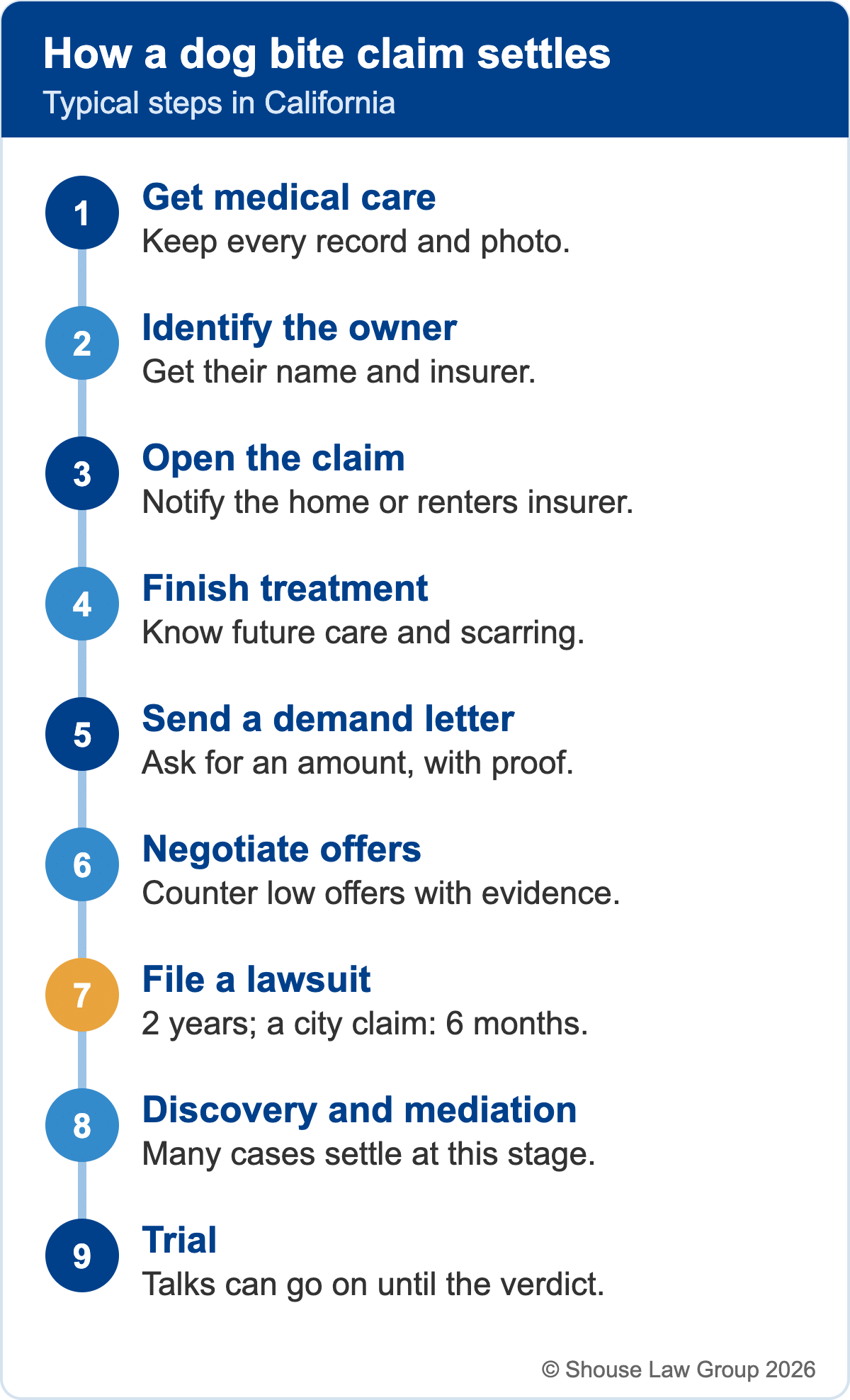
The settlement process is a series of negotiations between you, or your lawyer, and the owner’s insurance company. It can start days after the bite and continue right up until a jury returns a verdict.
The first offer
The process often begins with an early offer from the insurer. It may cover the medical bills you have already paid, but it usually leaves out future care, lost income and pain and suffering.
The demand letter
If you turn down the first offer, you or your attorney send a demand letter. It explains your injuries, lists your losses with proof, and asks for a specific amount.
Filing a lawsuit
If talks stall, the next step is filing a lawsuit within the deadline. The lawsuit starts discovery, when each side exchanges evidence. Settlement talks often pick up as the evidence comes in, and many cases settle at mediation.
Trial
Most dog bite cases settle out of court. If yours does not, it goes to trial. Even then, the insurer can make offers right up until the jury returns a verdict.
9. How long does a dog bite settlement take?
Many California dog bite cases settle within a few months, but cases with serious injuries or a lawsuit can take a year or more. The biggest factors are how long your treatment lasts, how cooperative the owner and insurer are, and whether the case goes to trial. For more detail, see how long it takes to get a dog bite settlement.
10. How can I get the most from my settlement?
You can protect the value of your claim by getting full medical care and by having your case prepared as if it were going to trial.
Get full medical care
Medical records create a paper trail of your injuries. They take the guesswork out of what your treatment costs, which makes it harder for the insurer to argue the bite was minor.
We often see settlement value rise once a plastic surgeon puts the cost of future scar care in writing.
Prepare the case for trial
Insurers weigh how well a claim would hold up in court. A claim backed by organized records, photos, witness statements and a clear demand is more likely to draw a fair offer than one that looks ready to settle for anything.
Before you accept the first offer:
- Finish your medical treatment, or get a doctor’s estimate of future care.
- Photograph your wounds and scars as they heal.
- Ask the insurer for the policy limits in writing.
- Check the deadline: 2 years to sue, 6 months for a claim against a public agency.
11. Questions and answers
What is the average dog bite settlement in California?
Insurers paid about $81,789 per dog-bite claim in California in 2025, compared with a U.S. average of $65,450. Individual settlements range from a few thousand dollars for minor bites to six figures or more for serious injuries.
How long does a dog bite settlement take?
Many claims settle within a few months once treatment is complete. Cases that go to a lawsuit can take a year or more.
Does homeowners insurance pay for dog bites?
Usually, yes. Homeowners and renters policies typically cover dog-bite liability up to their limits, often $100,000 to $300,000, unless the policy excludes the dog.
Can a parent settle a child’s dog bite claim without a court?
No. In California, a child’s settlement is valid only after a superior court approves it, and the money is usually held until the child turns 18.
What is the deadline to sue for a dog bite in California?
Generally 2 years from the bite. If a public agency may be responsible, you must file a claim with it within 6 months.
Talk to a California dog bite lawyer
If you or your child was bitten by a dog, our dog bite lawyers can help you value your claim and deal with the insurance company. We offer a free consultation. Our firm is based in Los Angeles, with offices throughout California; see our Los Angeles dog bite attorneys.
Legal references:
- Insurance Information Institute, “Dog-Related Injury Claims on the Rise in 2025” (April 13, 2026) (U.S. average $65,450 per claim; California and Florida had the most claims; homeowners and renters policies typically cover dog-bite liability “up to the liability limits of the policy (usually $100,000 to $300,000)”). California figures (2,830 claims, $231.5 million, $81,789 average) are from Triple-I and State Farm’s 2025 state table.
- Insurance Information Institute, “Dog-Related Injury Claims on the Rise in 2025” (April 13, 2026) (U.S. average $65,450 per claim; California and Florida had the most claims; homeowners and renters policies typically cover dog-bite liability “up to the liability limits of the policy (usually $100,000 to $300,000)”). California figures (2,830 claims, $231.5 million, $81,789 average) are from Triple-I and State Farm’s 2025 state table (see note 1 above).
- California Civil Code 3342(a): “The owner of any dog is liable for the damages suffered by any person who is bitten by the dog while in a public place or lawfully in a private place, including the property of the owner of the dog, regardless of the former viciousness of the dog or the owner’s knowledge of such viciousness.” See also 3342(b)–(d) (police and military dogs).
- California Civil Code 3294(a): punitive damages where “it is proven by clear and convincing evidence that the defendant has been guilty of oppression, fraud, or malice.”
- Fullerton v. Conan (1948) 87 Cal.App.2d 354, 358: the child “was not lawfully upon the property of the dog owner at the point where the biting occurred.”
- Borer v. American Airlines, Inc. (1977) 19 Cal.3d 441, 451: “we should not recognize a cause of action by a child for loss of parental consortium.”
- Insurance Information Institute, “Dog-Related Injury Claims on the Rise in 2025” (April 13, 2026) (U.S. average $65,450 per claim; California and Florida had the most claims; homeowners and renters policies typically cover dog-bite liability “up to the liability limits of the policy (usually $100,000 to $300,000)”). California figures (2,830 claims, $231.5 million, $81,789 average) are from Triple-I and State Farm’s 2025 state table (see note 1 above).
- Fraser v. Farvid (2024) 99 Cal.App.5th 760, 763: the “actual knowledge rule” can be satisfied “by circumstantial evidence the landlord must have known about the dog’s dangerousness as well as direct evidence he actually knew.”
- Danielson v. County of Humboldt (2024) 103 Cal.App.5th 1, 13: “public entities and their employees are immune from tort liability for legislative action or discretionary law enforcement activity.”
- California Civil Code 3342(a) (see note 3 above).
- California Probate Code 3500(b): “The compromise or covenant is valid only after it has been approved, upon the filing of a petition, by the superior court of either of the following counties: (1) The county where the minor resides when the petition is filed. (2) Any county where suit on the claim or matter properly could be brought.”
- California Code of Civil Procedure 335.1: “Within two years: An action for assault, battery, or injury to, or for the death of, an individual caused by the wrongful act or neglect of another.”
- California Government Code 911.2(a): a claim for injury to a person “shall be presented … not later than six months after the accrual of the cause of action.”