
Quick summary
DUI expungement in California means asking the court that convicted you to dismiss your DUI under Penal Code 1203.4 once you finish probation. For a DUI, the judge decides whether to grant it.
- When to file: Usually as soon as probation ends, or earlier if the judge ends probation early.
- Jobs: Most private employers can no longer ask about or use the dismissed DUI.
- What doesn’t change: The DUI still counts as a prior for 10 years and stays on your DMV record.
- How long it takes: Often a few months, from filing the petition to a signed order.

In this article, our California DUI defense lawyers answer 10 common questions about clearing a DUI from your record:
- 1. Can a DUI be expunged in California?
- 2. Is it automatic or up to the judge?
- 3. When can I expunge my DUI?
- 4. How do I expunge a DUI?
- 5. Can a felony DUI be expunged?
- 6. Will my DUI be cleared automatically?
- 7. What does expungement do and not do?
- 8. How long does a DUI stay on my record?
- 9. What if I owe fines or violated probation?
- 10. Questions and answers
1. Can a DUI be expunged in California?
Yes. Most California DUI convictions can be expunged under Penal Code 1203.4 once you finish probation. That includes misdemeanor DUIs and many felony DUIs.
“Expungement” is the everyday word. The law calls it a dismissal. You withdraw your guilty or no contest plea and enter a plea of not guilty. If you were found guilty at a jury trial or a bench trial, the judge sets aside the verdict instead. Then the court dismisses the case.1
What you need before you file
You can usually ask for a DUI expungement if all of these are true:
- Probation is over. You finished it, or the judge ended it early.
- No new case. You are not charged with another crime right now.
- No other sentence. You are not on probation or serving a sentence for another offense.
- Probation went well. If you violated probation, you can still ask, but it is harder (see section 9).
If you were not given probation, a different law applies (see section 3).
2. Is it automatic or up to the judge?
For a DUI, it is up to the judge. For most crimes, a judge must grant the dismissal once you finish probation. DUI is an exception. Penal Code 1203.4 says the automatic right does not apply to the driving offenses listed in Vehicle Code 12810.2 That list includes DUI under Vehicle Code 23152 and DUI causing injury under Vehicle Code 23153.3 For these cases, the judge may still grant the dismissal “in its discretion and the interest of justice.”
In People v. Murphy, a California appeals court confirmed this in 2025. It said that “automatically granting expungement is prohibited” for someone convicted of a DUI or DUI causing injury, but that the court can still grant relief in its discretion.4
What judges look at
Because the judge has a choice, your petition should show why a dismissal is fair. Judges often consider:
- How probation went: whether you finished DUI school, paid what you could, and stayed out of trouble.
- The facts of the DUI: a DUI with no accident usually looks different from one where someone was hurt.
- Your life since then: work, school, family and treatment.
- Why you need it: a job, a license or a housing application.
In our experience, judges grant most DUI expungement petitions when probation went smoothly. The petitions that draw questions usually involve an injury or a probation violation.

The same rule applies to a wet reckless or dry reckless plea, because reckless driving is also on the Vehicle Code 12810 list.5 You can ask the court to dismiss it after probation, and the judge decides.
3. When can I expunge my DUI?
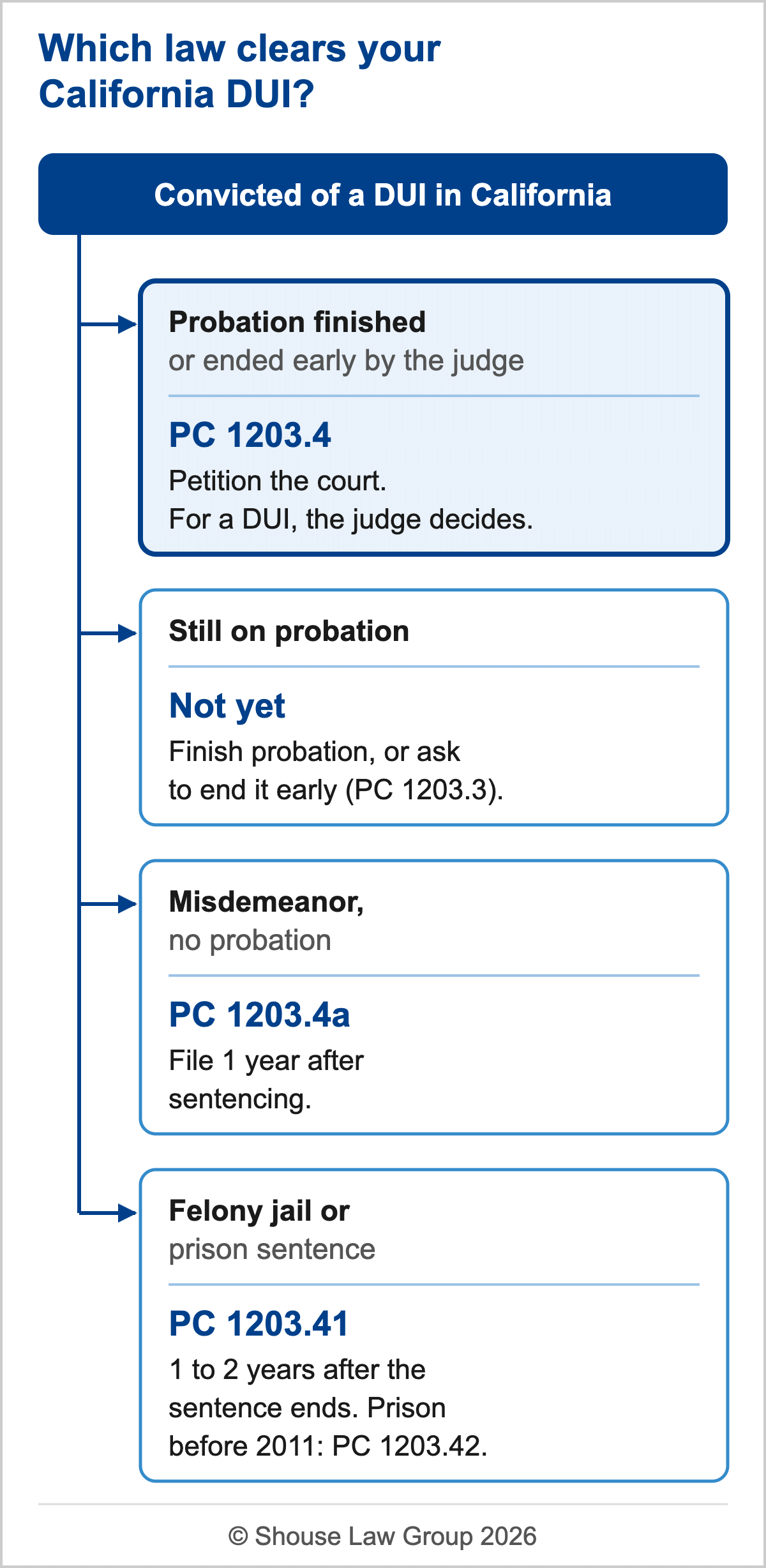
You can usually file as soon as your probation ends. There is no extra waiting period after probation for a DUI with probation. The flowchart below shows which law applies to your sentence.
If you are still on probation
DUI probation usually lasts 3 to 5 years.6 You can ask the court to end it early, and then file for expungement.7 Judges are careful with early termination in DUI cases, because one condition of DUI probation is not driving with any measurable alcohol in your system. In our experience, a request to end probation early goes better when you can show a specific need, such as a job offer that depends on a clean record. Read more about early termination of probation and DUI probation.
If you did not get probation
If you were convicted of a misdemeanor DUI and not given probation, you use Penal Code 1203.4a. You can file one year after the judge pronounced the sentence, if you completed it and have not been charged with a new crime.8
4. How do I expunge a DUI?
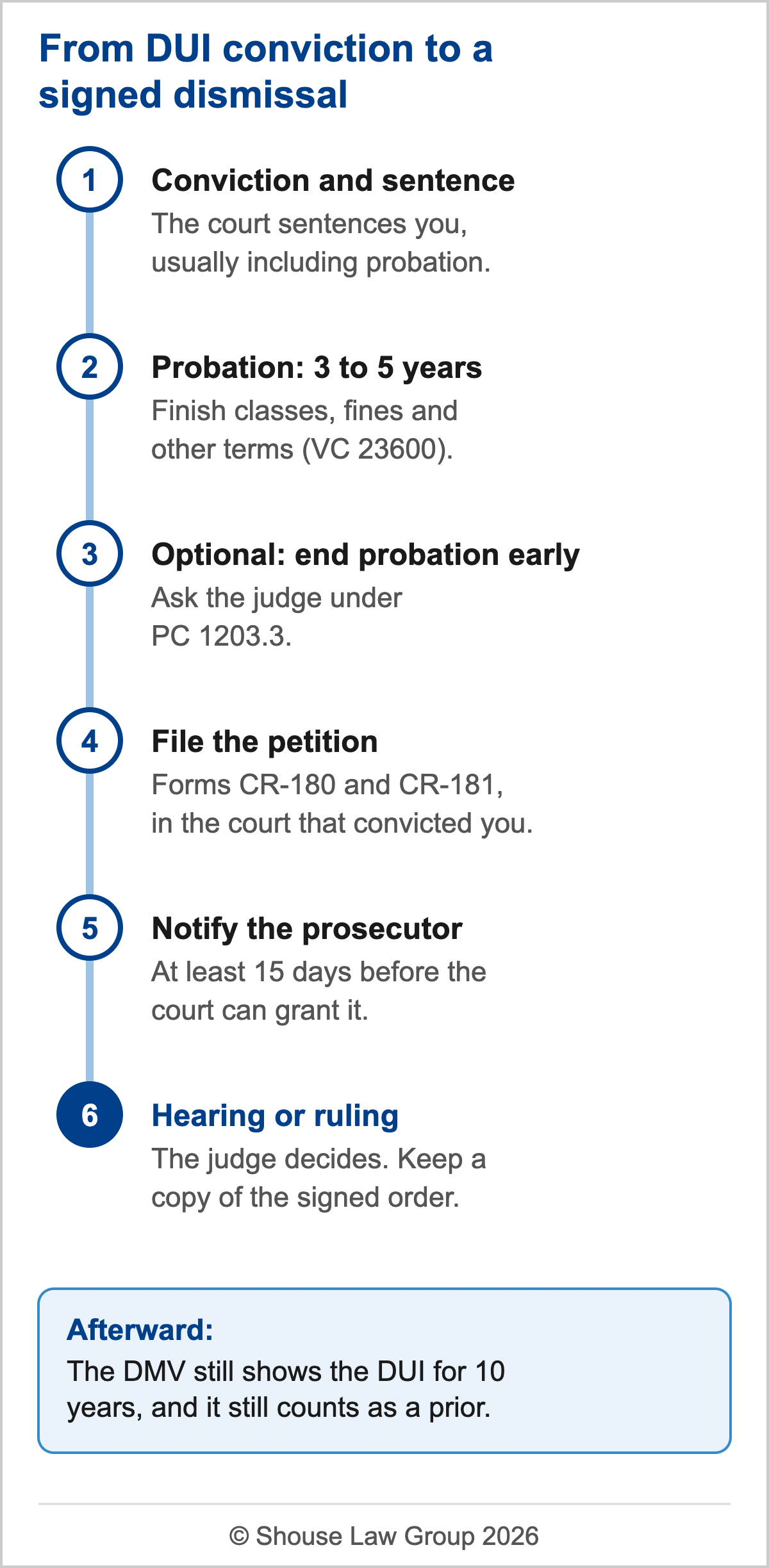
You file a petition with the court that convicted you. Many people handle the forms themselves. These are the steps:
- Get your case details. You need the case number, the court and the date of conviction. You can also request your criminal record from the California Department of Justice to check what it shows.
- Fill out the forms. Most courts use Judicial Council form CR-180 (Petition for Dismissal) and CR-181 (Order for Dismissal). Add a short statement explaining why the dismissal is fair, since the judge decides DUI petitions.
- File the petition. File in the court that handled your DUI. Ask the clerk whether the court charges a fee. If you can’t afford one, you can ask for a fee waiver.
- Notify the prosecutor. The district attorney must get at least 15 days’ notice of the petition before the court can grant it.9
- Go to the hearing, if there is one. Some courts decide on the papers. Others set a hearing, especially if the prosecutor objects.
- Get the signed order. Keep a copy. If your record doesn’t show the dismissal later, the order is your proof.
The process often takes a few months from filing to a signed order, depending on the court’s calendar. The timeline below shows the steps from conviction to a cleared case.
Example: Maria finishes three years of DUI probation in San Diego. She fills out forms CR-180 and CR-181, files them with the court that convicted her, and serves the district attorney. The judge grants the petition, and Maria can now answer “no” when a private employer asks about convictions.
A lawyer can draft the statement to the judge, handle the notice to the prosecutor and appear at the hearing for you. That matters more for DUIs than other crimes, because the judge has a choice.
5. Can a felony DUI be expunged?
Often, yes. Which law applies depends on your sentence:
- Felony probation: once probation ends, you petition under Penal Code 1203.4, the same as a misdemeanor. The judge decides.
- County jail or prison sentence: Penal Code 1203.41 lets the court dismiss a felony one year after you finish a split sentence (jail plus supervision), or two years after you finish a straight jail or state prison sentence. You can’t be on parole or supervision, and the relief is up to the judge.10 A fourth DUI within 10 years is now sentenced under the county-jail rules.11
- Prison sentence before October 2011: if your crime would have been a county-jail sentence after the 2011 Realignment Legislation, Penal Code 1203.42 may apply.12
Reducing a felony DUI to a misdemeanor first
DUI causing injury (Vehicle Code 23153) can be charged as a felony or a misdemeanor.13 If you were convicted of the felony, you can ask the judge to reduce it to a misdemeanor under Penal Code 17(b) at the same time you ask for the dismissal. See also our guide to expunging a felony in California.
Example: John is convicted of felony DUI causing injury and placed on probation. After probation ends, his lawyer asks the judge to reduce the conviction to a misdemeanor and then dismiss it. The judge decides each request, looking at the injury, John’s record on probation and his life since.
6. Will my DUI be cleared automatically?
Sometimes. Under Penal Code 1203.425, the California Department of Justice reviews its records every month and grants relief on its own to people who qualify.14 It applies when:
- Misdemeanor with probation: you completed probation without it being revoked.
- Misdemeanor without probation: you completed the sentence and at least one year has passed since judgment.
- Felony: you completed every part of the sentence, including supervision, and four years have passed with no new felony conviction. Serious and violent felonies, and felonies that require sex offender registration, don’t qualify.
You also can’t be on supervision, serving a sentence, facing a pending charge, or required to register as a sex offender. Find out more in our article on SB 731.
Why filing can still be worth it
Automatic relief depends on the state’s records being complete, and the law makes it subject to the state budget. If your probation was ever revoked, for example over a missed class, the case doesn’t qualify for automatic relief. One thing we’ve found: people often assume their DUI was cleared automatically when it wasn’t. Check your Department of Justice record. If it doesn’t say “relief granted,” filing a petition is the sure way.
7. What does expungement do and not do?
An expungement helps most with jobs, but it does not erase the DUI. The table below sums up what changes.
| Area | After an expungement |
|---|---|
| Private job applications | Most employers can’t ask about it or use it |
| Professional licenses (Business and Professions Code) | The board can’t deny a license because of it, but you must still answer a direct question about it |
| Public office, other state or local licenses, Lottery contracts | You must still disclose it if asked |
| A later DUI | It still counts as a prior within 10 years |
| Driver’s license and DMV record | No change |
| Gun rights after a felony DUI | Not restored by the dismissal |
| Court record | Still exists, marked as dismissed |
Jobs
California employers can’t ask job applicants about a conviction that was dismissed under Penal Code 1203.4, and can’t use it in decisions about hiring, promotion or firing.15 Under the ban-the-box law, most employers also can’t ask about convictions at all until after a conditional job offer.16 Some employers that are required by law to run background checks are treated differently. See the benefits of an expungement and jobs you can’t get with a DUI.
Professional licenses
Licensing boards under California’s Business and Professions Code can’t deny you a license because of a conviction that was dismissed under Penal Code 1203.4.17 But the dismissal order does not excuse you from answering a direct question on an application for public office, for a license from a state or local agency, or for a contract with the California State Lottery.18 Other agencies, such as the one that issues teaching credentials, have their own rules. See our page on professional licenses and criminal convictions.
Later DUIs
An expunged DUI still counts as a prior. If you are convicted of another DUI within 10 years, you face second-offense penalties.19
Example: Lena is convicted of driving with a BAC of 0.08% or higher. She completes probation and gets the conviction expunged. A few years later she is convicted of DUI of drugs. Even though her first DUI was expunged, she faces the penalties for a second DUI.
Driver’s license
An expungement doesn’t end a license suspension or revocation, and the DMV still counts the DUI for later license actions.20
Guns
If your DUI was a felony, the dismissal does not restore your right to own or possess a firearm.21 See restoring gun rights in California.
The record itself
Despite the name, an expungement doesn’t wipe the DUI away. A California appeals court said Penal Code 1203.4 “does not in fact produce such a dramatic result” as erasing the conviction.22 Your record shows the case as dismissed, and the arrest can still appear on some background checks.

Travel to Canada
A DUI can make you inadmissible to Canada, and whether Canadian officers accept a California dismissal is not settled. Before you travel, read our page on entering Canada with a DUI and talk to a Canadian immigration lawyer.
8. How long does a DUI stay on my record?
A DUI stays on two different records, and they follow different rules:
- Criminal record: the conviction stays until a court or the Department of Justice grants relief. Even then, the record shows the case as dismissed rather than deleting it.
- DMV record: the DMV keeps a DUI on the record it shares for 10 years from the date of the offense. An expungement doesn’t change that.23
Separately, a DUI counts as a prior for sentencing if you get another DUI within 10 years, whether or not it was expunged.
9. What if I owe fines or violated probation?
Owing restitution does not block an expungement. Penal Code 1203.4 says a petition “shall not be denied due to an unfulfilled order of restitution or restitution fine.”24 In the 2025 Murphy case, the court reversed a judge who had relied on unpaid restitution to deny a DUI petition.25 You still owe the money after the dismissal.
If you violated probation, you can still ask the judge to grant the dismissal “in the interest of justice.” Explain what happened, what you did to fix it and how you have done since.
10. Questions and answers
Can a DUI be expunged in California?
Yes. Most DUIs can be dismissed under Penal Code 1203.4 after probation ends. For a DUI the judge decides, but petitions with a clean probation record are usually granted.
How long does it take to expunge a DUI?
It often takes a few months from filing to a signed order. The prosecutor must get at least 15 days’ notice, and some courts set a hearing.
Does an expungement remove a DUI from my DMV record?
No. The DMV keeps a DUI on the record it shares for 10 years, and an expungement doesn’t change any license suspension.
Do I have to tell employers about an expunged DUI?
Not most private employers. You must still disclose it if directly asked on an application for public office, a state or local license, or a California State Lottery contract.
Does an expunged DUI still count as a prior?
Yes. If you get another DUI within 10 years, the expunged one still counts and raises the penalties.
Is DUI expungement automatic in California?
Sometimes. The Department of Justice grants relief on its own in some cases, but only when its records show you qualify. Filing a petition is the sure way.
Need help clearing a DUI? Our California DUI lawyers can check whether you qualify, prepare your petition and argue it in court. Contact Shouse Law Group for a free consultation.
Legal references:
- California Penal Code 1203.4(a)(1) PC: “…the defendant shall, at any time after the termination of the period of probation… be permitted by the court to withdraw their plea of guilty or plea of nolo contendere and enter a plea of not guilty… and… the court shall thereupon dismiss the accusations or information against the defendant…”
- California Penal Code 1203.4(c) PC: “(1) Except as provided in paragraph (2), subdivision (a) does not apply to a person who receives a notice to appear or is otherwise charged with a violation of an offense described in subdivisions (a) to (e), inclusive, of Section 12810 of the Vehicle Code. (2) If a defendant who was convicted of a violation listed in paragraph (1) petitions the court, the court in its discretion and in the interest of justice, may order the relief provided pursuant to subdivision (a) to that defendant.”
- California Vehicle Code 12810(b) VC: “A conviction of a violation of Section 23152 or 23153 shall be given a value of two points.”
- People v. Murphy (2025) 116 Cal.App.5th 249, 254: “But automatically granting expungement is prohibited if the defendant… has been convicted of violating Vehicle Code section 12810, e.g., a DUI or DUI causing injury.… Nonetheless, a court may, ‘in its discretion and the interest of justice,’ determine that such a defendant ‘should be granted’ expungement relief.”
- California Vehicle Code 12810(c) VC: “A conviction of reckless driving shall be given a value of two points.”
- California Vehicle Code 23600(b)(1) VC: “If any person is convicted of a violation of Section 23152 or 23153 and is granted probation, the terms and conditions of probation shall include… a period of probation not less than three nor more than five years…”
- California Penal Code 1203.3 PC (court’s authority to modify or terminate probation early).
- California Penal Code 1203.4a(a) PC: “Every defendant convicted of a misdemeanor and not granted probation… shall, at any time after the lapse of one year from the date of pronouncement of judgment, if they have fully complied with and performed the sentence of the court… be permitted by the court to withdraw their plea…”
- California Penal Code 1203.4(d)(1) PC: “Relief shall not be granted under this section unless the prosecuting attorney has been given 15 days’ notice of the petition for relief.”
- California Penal Code 1203.41(a)(2) PC: “The relief available under this section may be granted only after the lapse of one year following the defendant’s completion of the sentence, if the sentence was imposed pursuant to subparagraph (B) of paragraph (5) of subdivision (h) of Section 1170, or after the lapse of two years following the defendant’s completion of the sentence, if the sentence was imposed pursuant to subparagraph (A)… or if the defendant was sentenced to the state prison.”
- California Vehicle Code 23550(a) VC: “If a person is convicted of a violation of Section 23152 and the offense occurred within 10 years of three or more separate violations… that person shall be punished by imprisonment pursuant to subdivision (h) of Section 1170 of the Penal Code…”
- California Penal Code 1203.42(a) PC: “If a defendant was sentenced prior to the implementation of the 2011 Realignment Legislation for a crime for which the defendant would otherwise have been eligible for sentencing pursuant to subdivision (h) of Section 1170, the court, in its discretion and in the interest of justice, may order the following relief…”
- California Vehicle Code 23554 VC: “If any person is convicted of a first violation of Section 23153, that person shall be punished by imprisonment in the state prison, or in a county jail for not less than 90 days nor more than one year…”
- California Penal Code 1203.425(a)(1) PC (automatic conviction relief, version operative October 1, 2024): the Department of Justice “shall identify persons with convictions that meet the criteria… and are eligible for automatic conviction record relief.”
- California Labor Code 432.7(a)(1): “An employer… shall not ask an applicant for employment to disclose… information… concerning a conviction that has been judicially dismissed or ordered sealed pursuant to law, including, but not limited to, Sections 1203.4, 1203.4a, 1203.425… of the Penal Code.”
- California Government Code 12952 (AB 1008, effective January 1, 2018: employers may not ask about conviction history before a conditional offer of employment).
- California Business and Professions Code 480(c): “Notwithstanding any other provision of this code, a person shall not be denied a license on the basis of any conviction, or on the basis of the acts underlying the conviction, that has been dismissed pursuant to Section 1203.4, 1203.4a, 1203.41, 1203.42, or 1203.425 of the Penal Code…”
- California Penal Code 1203.4(a)(1) PC: “The order shall state, and the probationer shall be informed, that the order does not relieve them of the obligation to disclose the conviction in response to any direct question contained in any questionnaire or application for public office, for licensure by any state or local agency, or for contracting with the California State Lottery Commission.”
- California Penal Code 1203.4(a)(1) PC: “However, in any subsequent prosecution of the defendant for any other offense, the prior conviction may be pleaded and proved and shall have the same effect as if probation had not been granted or the accusation or information dismissed.”
- California Vehicle Code 13555 VC: “A termination of probation and dismissal of charges pursuant to Section 1203.4 of, or a dismissal of charges pursuant to Section 1203.4a of, or relief granted pursuant to Section 1203.425 of, the Penal Code does not affect any revocation or suspension of the privilege of the person convicted to drive a motor vehicle under this chapter.”
- California Penal Code 1203.4(a)(2) PC: “Dismissal of an accusation or information pursuant to this section does not permit a person to own, possess, or have custody or control of a firearm…”
- People v. Frawley (2000) 82 Cal.App.4th 784, 791: “…while a number of courts have used forms of the word ‘expunge’ to describe the relief made available by section 1203.4…, the statute does not in fact produce such a dramatic result.”
- California Vehicle Code 1808(b)(1) VC: “The department shall make available or disclose abstracts of convictions… if the date of the occurrence is not later than the following: (1) Ten years for a violation pursuant to Section 23140, 23152, or 23153.”
- California Penal Code 1203.4(c)(3)(A) PC: “A petition for relief under this section shall not be denied due to an unfulfilled order of restitution or restitution fine.”
- People v. Murphy (2025) 116 Cal.App.5th 249, 254 (see note 4 above).