
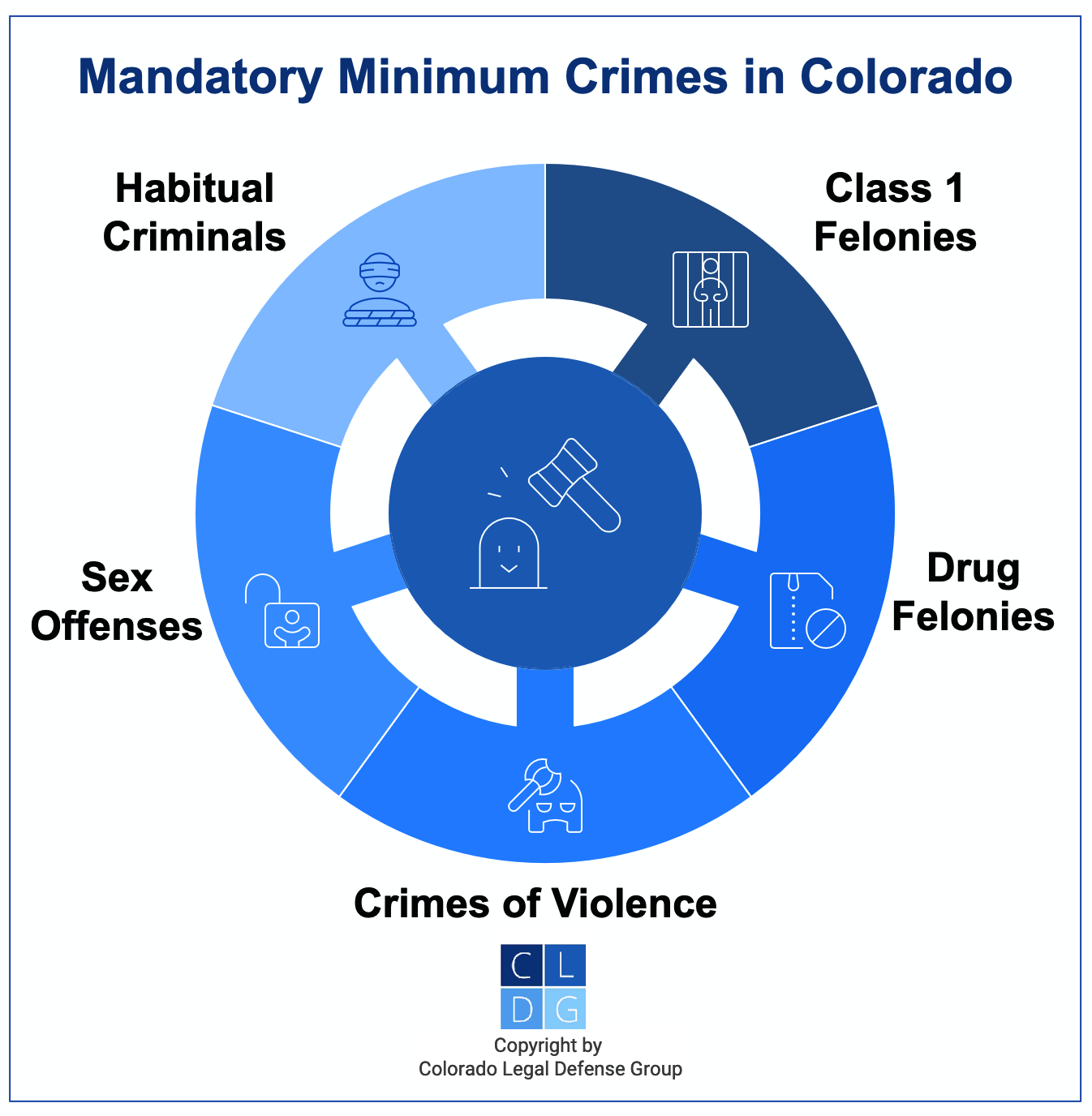
Colorado’s mandatory minimum sentencing law requires you to serve at least the minimum allowable prison sentence for the following five high-level crime categories:
- Class 1 felonies,
- Drug felonies,
- Crimes of violence,
- Sex offenses, and
- Habitual criminals.
The sentencing court judges in the above cases do not have the discretion to grant sentences lower than the mandatory minimum laid out in the statute.
In the below article, I discuss in detail the mandatory minimum sentences in these five Colorado crime categories:
- 1. Class 1 Felonies
- 2. Drug Felonies
- 3. Crimes of Violence
- 4. Sex Offenses
- 5. Habitual Criminals
- Other Crimes with Mandatory Minimums
- Downsides of Mandatory Minimums
- Frequently Asked Questions
- Additional Resources
1) Class 1 Felonies
The mandatory minimum penalty for class 1 felonies is a life sentence in the Colorado Department of Corrections (DOC) without the possibility of parole.1 If you were under 18 (a juvenile) at the time of the offense, the mandatory minimum is life imprisonment with the possibility of parole after 40 years.2
Colorado’s class 1 felonies are:
- First-degree murder (C.R.S. 18-3-102),
- First-degree kidnapping (C.R.S. 18-3-301),
- Child abuse (C.R.S. 18-6-401) causing death of a child under 12,
- Assault during escape with intent to commit bodily injury with a deadly weapon or force (C.R.S. 18-8-206(1)(a)), and
- Treason (C.R.S. 18-11-101).
2) Drug Felonies
Colorado convictions for level 1 drug felony offenses carry a minimum mandatory sentencing scheme of:
- 8 years in prison, if there are no aggravating circumstances; or
- 12 years in prison, if there are aggravating circumstances.
After prison you must also serve three years of parole. In addition, there is a fine of $5,000 to $1,000,000 plus a $4,500 surcharge.3
There is no mandatory minimum prison term for other controlled substance felonies unless you have two or more previous felony convictions. In that case, the criminal justice system requires you to serve no less than the minimum sentence of the presumptive range for that drug offense, as the following table shows.
|
Colorado Drug Felony |
Mandatory Minimum if You Have Two or More Prior Felony Convictions |
| Level 2 |
After prison you must also serve two years of parole. In addition, there is a fine of $3,000 to $750,000 plus a $3,000 surcharge. |
| Level 3 |
After prison you must also serve one year of parole. In addition, there is a fine of $2,000 to $500,000 plus a $2,000 surcharge. |
| Level 4 |
After prison you must also serve one year of parole. In addition, there is a fine of $1,000 to $100,000 plus a $1,500 surcharge. |
Note that certain level 4 drug felonies are wobblers. This means the court may reduce a wobbler down to a level 1 drug misdemeanor if you are otherwise eligible and complete probation or community corrections.4
Eligible defendants can also avoid long prison terms through intensive rehab programs such as Veterans Treatment Court and Mental Health Court.
3) Crimes of Violence
Colorado’s mandatory minimum sentences for crimes of violence (COVs) generally depend on the felony level:
- Class 2 felonies: 16 years in prison.
- Class 3 felonies: 10 years in prison.
- Class 4 felonies: 5 years in prison.
- Class 5 felonies: 2.5 years in prison.
- Class 6 felonies: 1.5 years in prison.5
Note that five years are added to the felony sentence for a violent crime if there was a dangerous or semiautomatic assault weapon involved.6
Colorado’s crimes of violence (COVs) include the following offenses if you either used – or threatened to use – a deadly weapon or caused serious bodily injury or death:
- Murder,
- Assault (first degree and some instances of second degree),
- Kidnapping,
- Sexual offense,
- Aggravated robbery (C.R.S. 18-4-302),
- First degree arson (C.R.S. 18-4-102),
- First degree burglary (C.R.S. 18-4-202),
- Escape (C.R.S. 18-8-208),
- Criminal extortion (C.R.S. 18-3-207),
- Unlawful termination of a pregnancy (first- or second-degree), and
- Any crime against an at-risk juvenile or at-risk adult.7
People convicted of crimes that carry mandatory minimums cannot do probation in lieu of that minimum sentence.
4) Sex Offenses
If you are convicted of a Colorado sex crime – such as sexual assault (C.R.S. 18-3-402) – you must serve at least the minimum in the presumptive sentencing range for the particular offense.8 Though if the sex offense also qualifies as a crime of violence, the mandatory minimum sentence is the midpoint in the presumptive range for the particular offense.9
Note that if the sex offense conviction makes you a habitual sex offender against children, the mandatory minimum is three times the upper limit of the presumptive range for the particular offense.10
Also note that if you tested positive for HIV before committing the sex offense, the mandatory minimum is the upper limit of the presumptive range for the particular offense.11
5) Habitual Criminals
In Colorado, the mandatory minimum for repeat offender sentencing turns on the type of habitual criminal you are adjudicated as:
|
Habitual Offender in Colorado |
Mandatory Minimum (in general) |
| Little habitual | For level 1 drug felonies, 48 years in prison.
For other felonies, three times the maximum presumptive sentence.12 |
| Big habitual | For level 1 drug felonies, 64 years in prison.
For other felonies, four times the presumptive maximum sentence.13 |
| Bigger habitual | Life in prison with the possibility of parole after 40 years.14 |
| If you are sentenced under the “three strikes” statute after a conviction for a third level 1 drug felony, a class 1 or 2 felony, or a class 3 felony crime of violence. | Life in prison with the possibility of parole after 40 years.15 |
| Habitual burglary offender | Greater than the presumptive maximum term.16 |
Other Crimes with Mandatory Minimum
Robbery
Robbery, if the victim is an at-risk adult or an at-risk juvenile, carries a mandatory minimum of four years in Colorado State Prison.17
Felony Theft
Felony theft from a store – when you have at least two “felony from a store” convictions in the prior four years – carries a mandatory minimum of Colorado’s presumptive range for the theft offense, which depends on the value of the items stolen.18
Escape from Custody
Escape from custody in Colorado carries a mandatory minimum of the presumptive range for the offense, which depends on what crime you were originally incarcerated for.19
Removal of Explosives
In Colorado, removal of explosives or incendiary devices from the premises without express consent from the lawful user, vendor, transporter, or manufacturer carries of mandatory minimum sentence of:
- For explosives or incendiary devices: 2 years in prison;20 or
- For chemical, biological, or radiological weapons: 4 years in prison.21
Downsides of Mandatory Minimums
The pros of having mandatory minimum sentences – namely the consistency and deterrence effect – are far outweighed by its cons. In my experience, these downsides include:
- Colorado prisons are overcrowded. Having mandatory minimum sentences ensures that prisons will remain at capacity.
- If you are innocent, you may feel pressured to accept a plea bargain out of fear that you will face definite prison time if convicted of the original charge.
- Judges have no power to keep you out of prison, even if they believe that you do not deserve prison based on the unique facts of the case.
- Requiring prison only exacerbates already existing racial disparities in the criminal justice system.22

Mandatory minimum crimes in Colorado include drug felonies, crimes of violence, sex offenses, class 1 felonies, and being an habitual criminal.
Frequently Asked Questions
What happens if I am facing a charge with mandatory minimum sentencing in Colorado?
If you are convicted of certain serious crimes in Colorado (like Class 1 felonies, drug felonies, crimes of violence, sex offenses, or as a habitual criminal), the judge must sentence you to at least the minimum prison time required by law. The judge cannot give you a lighter sentence, even if they think your case has special circumstances that would normally call for less time.
Can I get probation instead of prison time for a mandatory minimum offense?
No, you cannot receive probation instead of prison time if you are convicted of a crime that carries a mandatory minimum sentence. Colorado law requires you to serve at least the minimum prison sentence – judges have no discretion to offer probation as an alternative.
How long is the mandatory minimum sentence for drug felonies in Colorado?
For Level 1 drug felonies, the mandatory minimum is eight years in prison (or 12 years if there are aggravating circumstances), plus three years of parole. For other drug felony levels, there is only a mandatory minimum if you have two or more prior felony convictions – ranging from six months for Level 4 up to four years for Level 2 drug felonies.
What makes a crime qualify as a “crime of violence” with mandatory minimum sentencing?
A crime becomes a “crime of violence” in Colorado if you used or threatened to use a deadly weapon, or caused serious bodily injury or death while committing certain offenses like murder, assault, kidnapping, sexual offenses, aggravated robbery, first-degree arson, or burglary. Crimes of violence carry mandatory minimums ranging from 1.5 years (Class 6 felonies) to 16 years (Class 2 felonies) in prison.
Additional Resources
For more information, refer to the following:
- Colorado Department of Corrections (CDOC): The state prison and parole system.
- Colorado Innocence Project: Organization that works to exonerate wrongfully convicted individuals in Colorado.
- Reentry Services: Colorado program to help inmates reintegrate into society, run through the CDOC.
- Youth Violence Prevention: The Colorado Department of Public Health and Environment’s initiative focused on keeping youth out of custody.
- Colorado Criminal Justice Reform Coalition (CCJRC): Organization that focuses on criminal justice reform and policy.
- Overview of Colorado’s Mandatory Minimum Sentencing Scheme – 2017 Memorandum by the Colorado Legislative Council Staff.
Legal References
- Colorado Revised Statute (C.R.S.) 18–1.3-401 (4)(a).
- C.R.S. 18–1.3-401(4)(b).
- C.R.S. 18–1.3-401.5(7).
- C.R.S. 18–1.3–401.5(2)(b)(V).
- C.R.S. 18–1.3-406(1)(a). The mandatory minimum is the midpoint in the extraordinary risk crime presumptive range (with rare exceptions).
- C.R.S. 18–1.3-406(7)(a).
- C.R.S. 18-1.3-406(2)(a)(1). See also People v. Austin (Colo. 2018) 419 P.3d 587. See also People v. Wiseman (Colo.App. 2017) 413 P.3d 233.
- C.R.S. 18–1.3–1004(1)(a). See, for example, Godinez v. Williams (Colo. 2024) 544 P.3d 1233.
- C.R.S. 18-1.3-1004(1)(b).
- C.R.S. 18-1.3-1004(1)(c).
- C.R.S. 18–1.3–1004 (1)(d); C.R.S. 18-3-415.5 (5)(b).
- C.R.S. 18–1.3-801(1.5). Colorado’s General Assembly decided not to apply “little habitual” laws to class 6 felonies. And note that a fourth conviction involving domestic violence labels the defendant as a habitual domestic violence offender.
- C.R.S. 18–1.3-801(2).
- C.R.S. 18–1.3–801(2.5).
- C.R.S. 18–1.3-801(1).
- C.R.S. 18-1.3-804(1).
- C.R.S. 18–6.5-103(4).
- C.R.S. 18–4-413(2).
- C.R.S. 18–8-208.1(5); C.R.S. 18-8-208(9).
- C.R.S. 18–12-109(5)
- C.R.S. 18–12-109(5.5).
- State Sentencing Reforms Had Little Impact on Racial Disparities in Imprisonment (Council on Criminal Justice, April 2024)(Black Coloradans are still imprisoned at a rate 4.9 times higher than White Coloradans).