
Quick summary
The finger count test (also called the finger tap or finger dexterity test) is a field sobriety test in which the officer has you touch your thumb to each fingertip while counting out loud: 1, 2, 3, 4, then 4, 3, 2, 1. It is not one of the 3 standardized tests, and in the only government study of it, it was the weakest test on its own.
- The clues: Officers look for 6 clues, such as starting too soon, miscounting or doing the wrong number of sets.
- Accuracy: In a 1977 federally funded study, the test alone was right only 57% of the time for drivers at or above a .10% BAC.
- Refusing: No California law requires you to take it, but prosecutors can argue that refusing shows you knew you were impaired.
- Why it can be wrong: Injuries, arthritis, cold hands, nerves and unclear instructions can all make a sober person “fail.”
In this article, our California DUI defense lawyers answer 7 common questions about the finger count test:
- 1. What is the finger count test?
- 2. How is the test done?
- 3. What do officers look for?
- 4. How accurate is it?
- 5. Do I have to take it?
- 6. How do I fight the results?
- 7. Questions and answers
1. What is the finger count test?
The finger count test is a short coordination and counting exercise that police use when they suspect a driver of DUI. It checks whether you can follow instructions, count and move your fingers at the same time. This is called a “divided attention” task.
Other names for the test
Police reports and other websites may call it the finger tap test, the finger dexterity test or the finger counting test. They all describe the same exercise.
It is not one of the 3 standardized tests
The National Highway Traffic Safety Administration (NHTSA) has standardized only 3 field sobriety tests: the horizontal gaze nystagmus (eye) test, the walk and turn test and the one-leg stand test. The finger count test is not one of them.
The California Highway Patrol (CHP) calls the finger count an “alternate” test. Its DUI manual says the 3 validated tests “should be used whenever possible.” Other tests are for times when the standardized ones can’t be given.1 Other non-standardized tests include the hand pat test, the Romberg balance test, the finger-to-nose test and the alphabet test.
Where it fits in a DUI stop
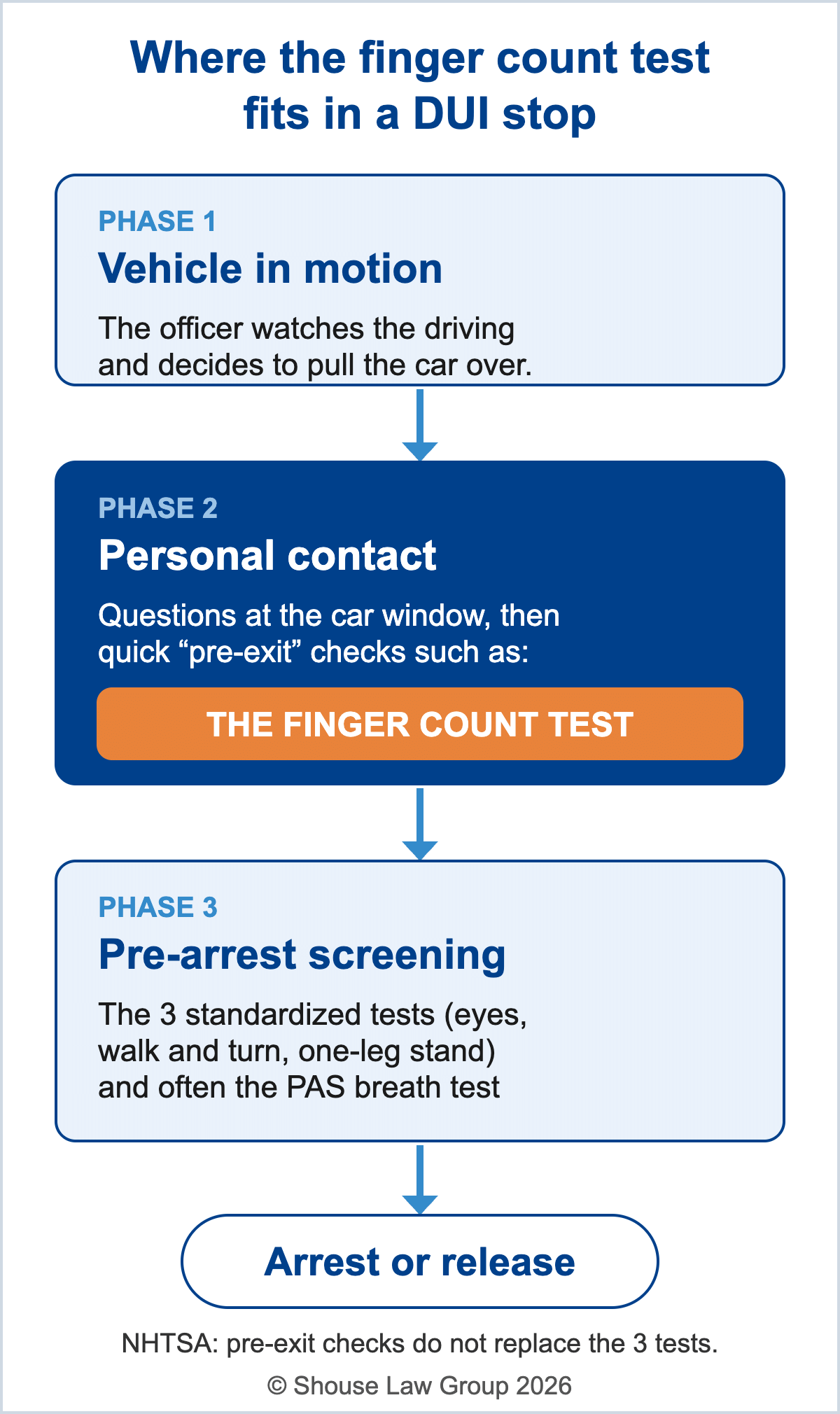
NHTSA’s officer training manual splits a DUI investigation into 3 phases. The finger count is one of the quick “pre-exit” checks an officer may use in phase 2, often while you are still in the car. The manual says these checks do not replace the standardized tests.2 The chart below shows the order.
2. How is the test done?
CHP officers are trained to give the test this way:3
- Stand ready. You stand with your feet together and your arms at your sides, and you are told not to start until the officer says so.
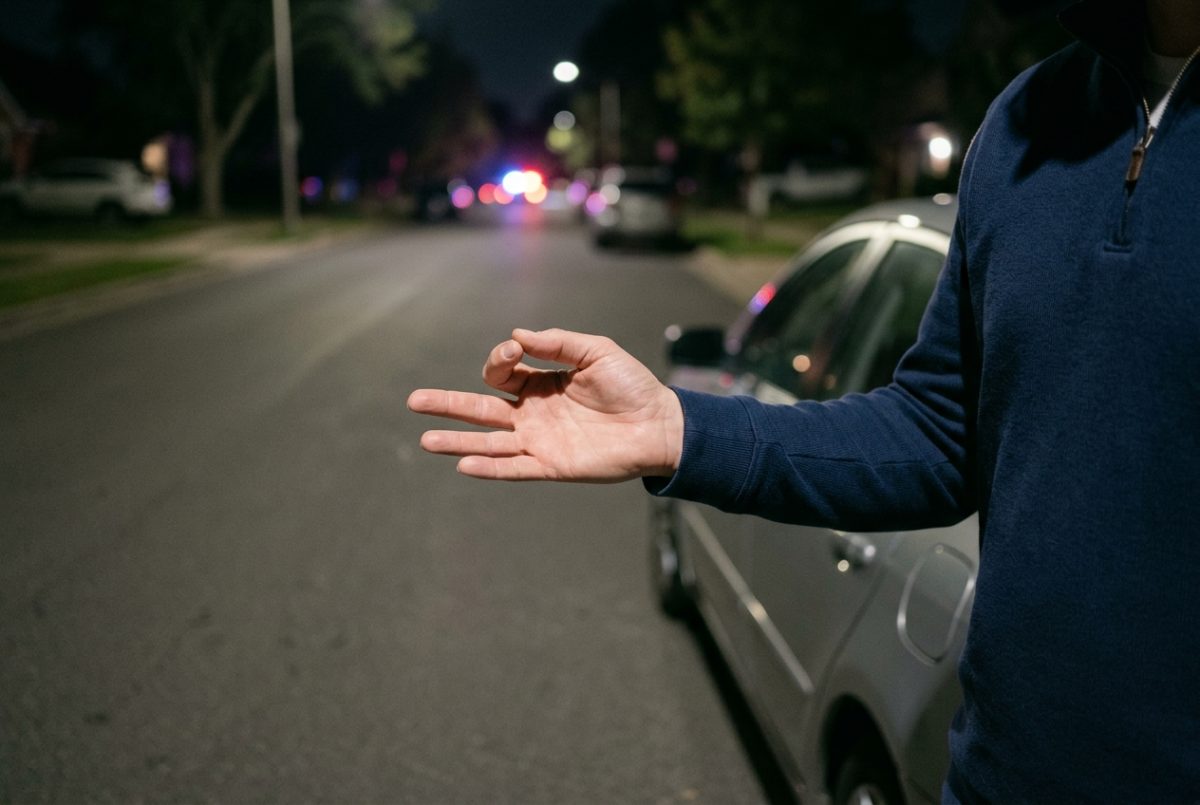
- Hold out one hand. When told, you hold one hand out in front of you with the palm facing up.
- Count up. You touch the tip of your thumb to your index finger and say “one,” then your middle finger (“two”), ring finger (“three”) and little finger (“four”).
- Count back down. Then you reverse it, counting 4, 3, 2, 1 as you go back to your index finger.
- Repeat. You do 3 complete sets in all, then stop.
Other police agencies may give the test differently, because there is no national standard for it.
3. What do officers look for?
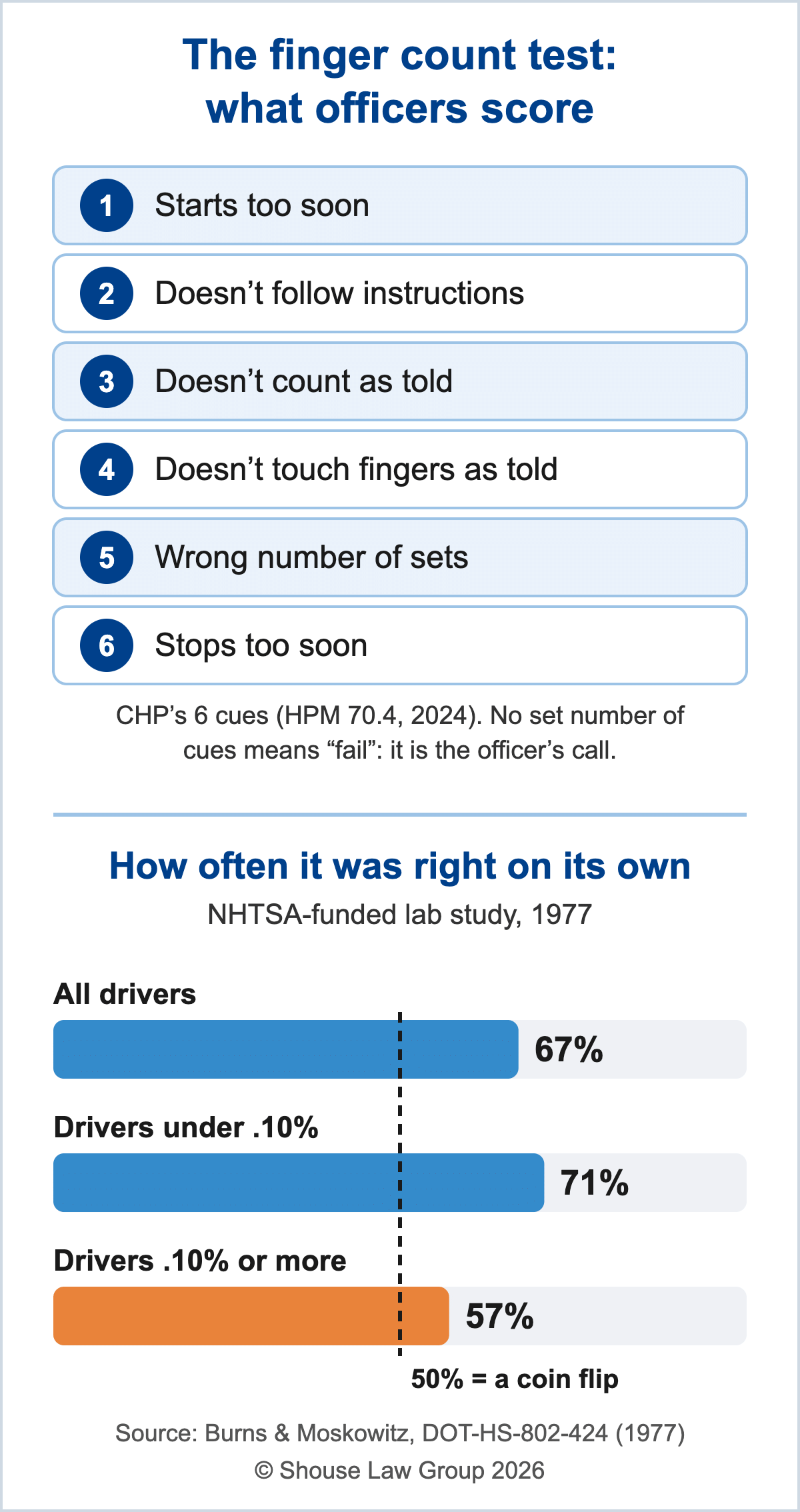
The CHP lists 6 “cues,” or clues, that officers watch for during the finger count:4
- Starting too soon, before the officer says to begin
- Not following instructions
- Not counting as instructed, such as skipping or repeating a number
- Not touching the fingers as instructed, such as missing a fingertip or touching 2 at once
- Doing the wrong number of sets, more or fewer than 3
- Stopping too soon, before the officer says to stop
Unlike the standardized tests, the finger count has no set number of clues that counts as a “fail.” Whether you passed is up to the officer’s judgment.
4. How accurate is it?
Not very. The finger count is one of the few non-standardized tests that was actually studied, and it did poorly.
The government studied it, and it came in last
In 1977, NHTSA paid the Southern California Research Institute to test 6 roadside sobriety tests on 238 volunteers with blood alcohol levels from zero to above .15%. The finger count was one of them.5 Used alone, it sorted people correctly:
- 67% of the time overall,
- 71% of the time for people below .10% blood alcohol, and
- only 57% of the time for people at or above .10%, barely better than a coin flip.6
The finger count also had the weakest link to blood alcohol of any test in the study. For women, the link was too weak to be statistically significant.7 The researchers left the finger count out of the 3-test set they recommended, which became today’s standardized tests.8
Example: Daniel is stopped in Riverside at 1 a.m. The officer asks for a finger count, and Daniel touches 2 fingers at once in his second set. The only government study of the test found that, on its own, it correctly flagged drivers over .10% just 57% of the time, so one missed touch says little about whether Daniel was impaired.
It measures blood alcohol, not driving
Even the 3 standardized tests were designed to estimate blood alcohol, not to measure how well someone drives. NHTSA’s own 1998 validation report says they “do not directly measure driving impairment.”9 The finger count was never validated as a measure of either one.
A 2011 review in the journal Behavioral Sciences & the Law looked at decades of research on judging intoxication. It found that only the 3 standardized tests have substantial research support, and that even that support is “seriously flawed.”10
The officer decides what “failing” means
Because there is no scoring standard, 2 officers watching the same person can reach different conclusions. California courts treat field tests as just one part of an officer’s “total observations,” not as proof of intoxication on their own.11
5. Do I have to take it?
No law requires it
No California law requires you to do the finger count or any other roadside coordination test. The CHP’s own manual says officers cannot force anyone to complete one.12 There is no license suspension for declining. That is different from the blood or breath test after a DUI arrest, which California’s implied consent law requires (Vehicle Code 23612).
But refusing can be used against you
California courts have held that refusing a field sobriety test can be treated as “consciousness of guilt,” meaning evidence that you thought you would fail.13 In Marvin v. Department of Motor Vehicles, a California appeals court said a driver’s refusal to get out and do a field test helped give the officer probable cause to arrest.14
The handheld PAS breath test at the roadside is treated differently. The officer must tell you it is optional, and a court has held that your refusal of it cannot be used as evidence of guilt.15 See our page on the PAS test.
What you say during the test can be used
Comments you make while doing the test, such as “I can’t do this,” can also come into evidence. A California appeals court has held that asking a DUI suspect to perform physical tests is not “interrogation” under Miranda.16
Passing does not guarantee you won’t be arrested
Officers base the arrest decision on everything they see: your driving, how you talk and move, any odor of alcohol and the other tests. Doing well on the finger count does not stop an officer from arresting you.17 For more, see our article on whether you have to do field sobriety tests.
6. How do I fight the results?
A poor finger count is weak evidence, and there are many ways to show it doesn’t mean you were impaired. In our experience defending DUI cases, the finger count often appears in the police report as a single line, with no detail about which clues the officer saw. Here are the most common defenses.
Medical conditions and injuries
Arthritis, carpal tunnel syndrome, nerve damage (neuropathy), a hand or finger injury and some neurological conditions can make it hard to touch each fingertip quickly and in order. None of them has anything to do with alcohol.
Example: Maria, 62, has arthritis in both hands. At a stop in Fresno, she can’t touch her ring finger to her thumb on the second set. Her doctor’s records can show that the “clue” came from her joints, not from drinking.
Cold, numb or wet hands
Many DUI stops happen late at night. Cold fingers are slower and clumsier, especially if you’ve been standing outside for several minutes.
Example: John is pulled over near Truckee on a 20-degree night and waits outside his car for 15 minutes before the test. His stiff, cold fingers miss 2 touches. His lawyer can point to the weather and the wait.
Nerves, fatigue and confusion
Being stopped by police is stressful. Being exhausted, anxious or hard of hearing can make it hard to follow a fast set of spoken instructions, and the test scores instruction-following as a clue.
Unclear or non-standard instructions
There is no national standard for this test, and versions differ. The 1977 study, for example, had people count to 5 and back.18 If the officer didn’t explain or demonstrate the test clearly, or used a different version than the CHP’s, the results are hard to trust.
Example: An officer tells Priya to “count your fingers up and down a few times,” without saying how many sets. When she stops after 2, he scores it as a clue. Since he never said “3 sets,” that clue is unfair.
Poor conditions at the roadside
Flashing lights, passing traffic, noise and poor lighting can distract anyone. Ask whether the officer moved you to a safe, quiet spot before the test.
No video, or video that doesn’t match
We often find that the body-camera or dash-camera video doesn’t match the police report’s account of how the test was explained or performed. Your lawyer can get the video and compare it with the report.
Why the officer used a weaker test
Because the CHP’s manual says the validated tests should be used “whenever possible,” your lawyer can ask why the officer relied on the finger count instead.19 These issues can be raised at your DMV hearing and in court. See our page on California DUI defenses.
A note on drugs: poor coordination caused by a drug, even a prescription drug, is not a defense. Driving under the influence of any drug is its own DUI charge in California (Vehicle Code 23152(f)).20
7. Questions and answers
Is the finger count test a standardized field sobriety test?
No. NHTSA has standardized only 3 tests: the eye (HGN) test, the walk and turn and the one-leg stand. The finger count is an “alternate” test with no national scoring standard.
How many times do you count on the finger count test?
Under CHP training, you count 1 to 4 and back down to 1, touching your thumb to each fingertip, and repeat for 3 complete sets.
Can I refuse the finger count test in California?
Yes. No law requires it and there is no license penalty. But prosecutors can argue that refusing a field sobriety test shows “consciousness of guilt.”
How accurate is the finger count test?
Not very. In a 1977 government-funded study, it was right only 57% of the time on its own for people at or above .10% blood alcohol, and it was left out of the standardized tests.
Can a sober person fail the finger count test?
Yes. Arthritis, hand injuries, cold fingers, nerves, fatigue and unclear instructions can all cause the same clues officers look for.
Call us for help
If you or a loved one is facing a DUI charge after a field sobriety test, our California DUI defense lawyers can review the police report and video and find the weak points in the case. Contact us for a free consultation.
Legal references:
- California Highway Patrol, HPM 70.4 Driving Under the Influence Enforcement Manual, Chapter 2 (revised June 2024), sections 6-8: the standardized tests “should be used whenever possible”; the Finger Count is an “alternate FST”; “It is impossible to demand or force anyone to complete an FST against their will.”
- NHTSA/IACP, DWI Detection and Standardized Field Sobriety Testing Participant Manual, Session 6 (Phase Two: Personal Contact): “THESE TECHNIQUES DO NOT REPLACE THE SFSTs.”
- California Highway Patrol, HPM 70.4 Driving Under the Influence Enforcement Manual, Chapter 2 (revised June 2024), sections 6-8 (see note 1 above).
- California Highway Patrol, HPM 70.4 Driving Under the Influence Enforcement Manual, Chapter 2 (revised June 2024), sections 6-8 (see note 1 above).
- Burns & Moskowitz, Psychophysical Tests for DWI Arrest, DOT-HS-802-424 (NHTSA, 1977), pp. 2, 8, 39 and Table A-4: Finger Count alone classified 67.1% correctly overall, 70.8% below .10% BAC and 57.1% at or above .10%; correlation with BAC r = .334 (men) and .190 (women, not significant).
- Burns & Moskowitz, Psychophysical Tests for DWI Arrest, DOT-HS-802-424 (NHTSA, 1977), pp. 2, 8, 39 and Table A-4: Finger Count alone classified 67.1% correctly overall, 70.8% below .10% BAC and 57.1% at or above .10%; correlation with BAC r = .334 (men) and .190 (women, not significant) (see note 5 above).
- Burns & Moskowitz, Psychophysical Tests for DWI Arrest, DOT-HS-802-424 (NHTSA, 1977), pp. 2, 8, 39 and Table A-4: Finger Count alone classified 67.1% correctly overall, 70.8% below .10% BAC and 57.1% at or above .10%; correlation with BAC r = .334 (men) and .190 (women, not significant) (see note 5 above).
- Burns & Moskowitz, Psychophysical Tests for DWI Arrest, DOT-HS-802-424 (NHTSA, 1977), pp. 2, 8, 39 and Table A-4: Finger Count alone classified 67.1% correctly overall, 70.8% below .10% BAC and 57.1% at or above .10%; correlation with BAC r = .334 (men) and .190 (women, not significant) (see note 5 above).
- Stuster & Burns, Validation of the Standardized Field Sobriety Test Battery at BACs Below 0.10 Percent, DOT HS 808 839 (NHTSA, 1998), pp. 11, 28: the tests provide “indications of a driver’s BAC, rather than indications of driving impairment.”
- Rubenzer, Judging Intoxication (2011) 29 Behavioral Sciences & the Law 116: “Among sobriety tests, only NHTSA’s Standardized Field Sobriety Tests (SFSTs) have substantial, but seriously flawed, research support.”
- People v. Randolph (2018) 28 Cal.App.5th 602, 612: such testing “is part of an officer’s total observations of a suspect. This is one basis for an officer’s opinion concerning intoxication.”
- California Highway Patrol, HPM 70.4 Driving Under the Influence Enforcement Manual, Chapter 2 (revised June 2024), sections 6-8 (see note 1 above).
- Espinoza v. Shiomoto (2017) 10 Cal.App.5th 85, 103: “the courts have held that refusal to submit to field sobriety tests is properly treated as evidence of consciousness of guilt.”
- Marvin v. Department of Motor Vehicles (1984) 161 Cal.App.3d 717, 720: her “refusal to submit to a field sobriety test, reasonably interpreted as a consciousness of guilt,” supported probable cause.
- California Vehicle Code 23612(h)-(i) VC (PAS test is a field sobriety test; officer must advise the person); People v. Jackson (2010) 189 Cal.App.4th 1461, 1466 (error to admit refusal of PAS test because the statute grants the right to refuse).
- People v. Cooper (2019) 37 Cal.App.5th 642, 651: “Asking a DUI suspect to perform physical tests is not an ‘interrogation.'”
- People v. Randolph (2018) 28 Cal.App.5th 602, 612 (see note 11 above).
- Burns & Moskowitz, Psychophysical Tests for DWI Arrest, DOT-HS-802-424 (NHTSA, 1977), pp. 2, 8, 39 and Table A-4: Finger Count alone classified 67.1% correctly overall, 70.8% below .10% BAC and 57.1% at or above .10%; correlation with BAC r = .334 (men) and .190 (women, not significant) (see note 5 above).
- California Highway Patrol, HPM 70.4 Driving Under the Influence Enforcement Manual, Chapter 2 (revised June 2024), sections 6-8 (see note 1 above).
- California Vehicle Code 23152(f) VC: “It is unlawful for a person who is under the influence of any drug to drive a vehicle.”