
Quick summary
Vehicle Code 23612 is California’s implied consent law: if you are lawfully arrested for DUI, you must take a breath or blood test (and in some cases a urine test). Refusing does not end the DUI case, and it brings penalties of its own.
4 key things to know:
- If you refuse, the DMV takes your license for 1 to 3 years, depending on your record.
- If you are convicted of DUI, refusing a breath or urine test adds mandatory jail time. Refusing a blood test does not.
- Police can still get a warrant for your blood, and the prosecutor can tell the jury that you refused.
- You have 10 days to ask for a DMV hearing if you want it held before the suspension starts.

In this article, our California DUI defense lawyers answer 9 common questions about Vehicle Code 23612:
- 1. What does VC 23612 say?
- 2. Which test do you have to take?
- 3. What must the officer tell you?
- 4. What counts as a refusal?
- 5. What are the penalties for refusing?
- 6. Can police force a blood test?
- 7. Is the roadside PAS test different?
- 8. How do you fight a refusal suspension?
- 9. Questions and answers
1. What does VC 23612 say?
Vehicle Code 23612 VC is California’s implied consent law. By driving in California, you are treated as having agreed to a chemical test (a breath or blood test that measures alcohol or drugs) if you are lawfully arrested for DUI under VC 23152, VC 23153 or VC 23140 (under-21 DUI).1
The key sentence of the law
The statute opens this way:
“A person who drives a motor vehicle is deemed to have given his or her consent to chemical testing of his or her blood or breath for the purpose of determining the alcoholic content of his or her blood, if lawfully arrested…”
Vehicle Code 23612(a)(1)(A).1 In plain English: the “consent” is built into your license to drive, but it only kicks in after a lawful DUI arrest. An arrest without probable cause is the start of a defense, not a valid test request.
What each part of VC 23612 requires
The statute is long. This table sums up each part:2
| Subsection | What it means for you |
|---|---|
| (a)(1)(A)-(C) | After a lawful DUI arrest, you must take a breath or blood test for alcohol, or a blood test for drugs. An officer with reasonable cause must order it. |
| (a)(1)(D) | The officer must warn you what happens if you refuse. |
| (a)(2) | You choose breath or blood. In a drug case, a blood test may be added. |
| (a)(3) | If you are taken to a hospital first, you choose from the tests available there (including urine). |
| (a)(4) | No right to a lawyer before or during the test; a refusal can be used against you in court. |
| (a)(5) | An unconscious person is treated as not having withdrawn consent. |
| (b)-(c) | People with hemophilia, or a heart condition treated with a prescribed blood thinner, take a urine test instead of blood. |
| (d) | You may ask for a test yourself. If one test is unavailable, you take the other; urine only if both are unavailable. |
| (e)-(g) | If you refuse, the officer serves a suspension notice, takes your license and gives you a 30-day temporary license. |
| (h)-(i) | The roadside PAS breath test is a separate, optional screening test. |
2. Which test do you have to take?
You get to choose between a breath test and a blood test, and the officer must tell you that you have that choice.3 What happens next depends on whether the arrest is for alcohol or drugs.
Alcohol DUI: breath or blood
If you are arrested for driving under the influence of alcohol, you pick breath or blood. If you can’t complete the test you chose, or say you can’t, you must take the other one.3 See our pages on breath tests and blood tests.
Drug DUI: a blood test may be added
In a drug DUI case you still choose breath or blood. If you choose breath, the officer can ask for a blood test too, but only with reasonable cause to believe you were driving under the influence of a drug and reasonable cause to believe a blood test will show it. The officer must write those facts in the report.3
Example: John is arrested for DUI in Sacramento and chooses a breath test. It shows a low alcohol level, but the officer saw signs of marijuana use and noted them in his report. John must also take a blood test. If he can’t complete it, he must take a urine test.
When the test you want isn’t available
If the breath or blood test is unavailable, you take the other one. You give a urine sample only if both are unavailable.4 If you are taken to a hospital for treatment first, you choose from the tests available there, which can include urine.4
Medical exceptions
Two groups are exempt from the blood test but must take a urine test instead: people with hemophilia, and people with a heart condition who take an anticoagulant (a blood thinner) under a doctor’s direction.5
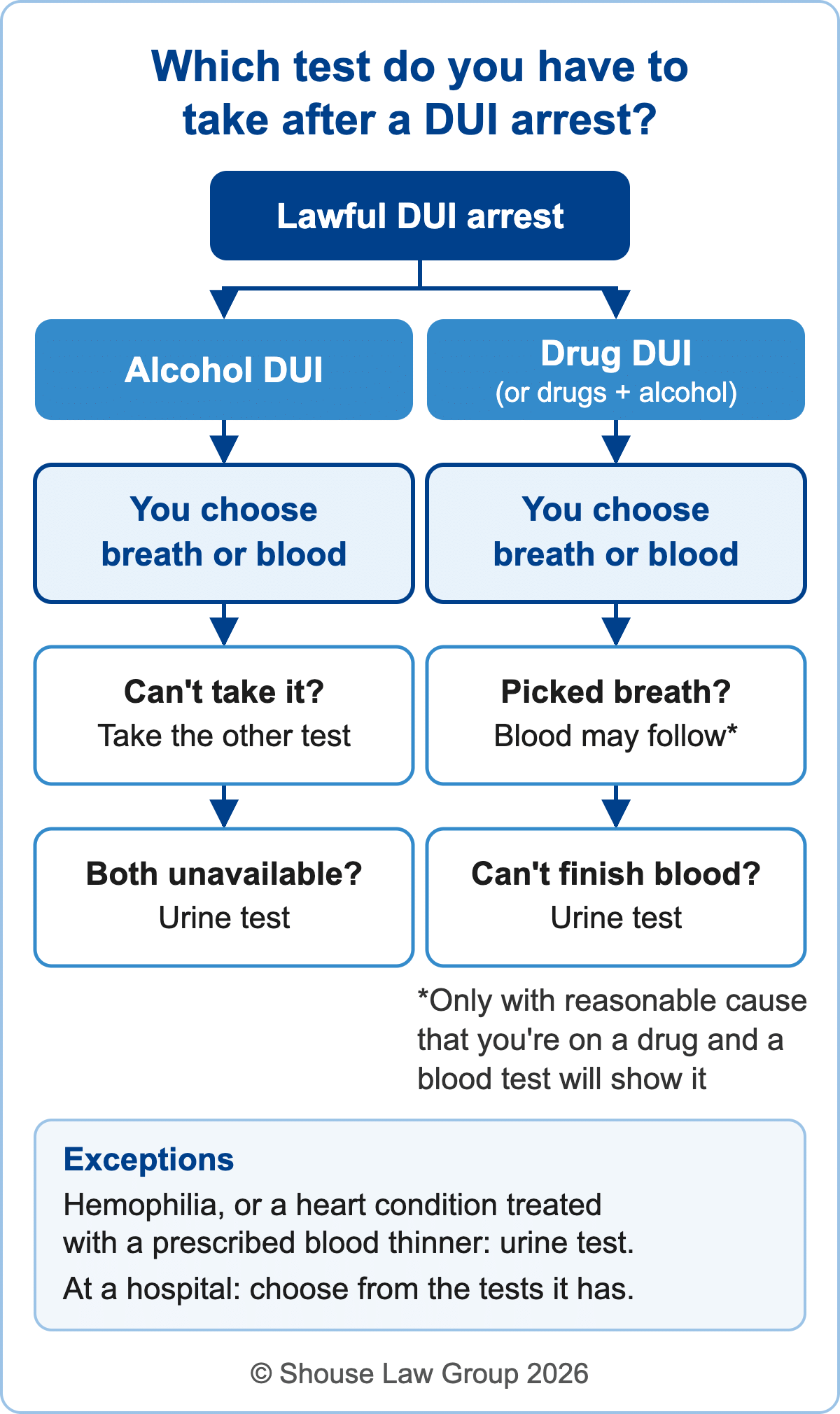
This chart shows which test applies in each situation:2
3. What must the officer tell you?
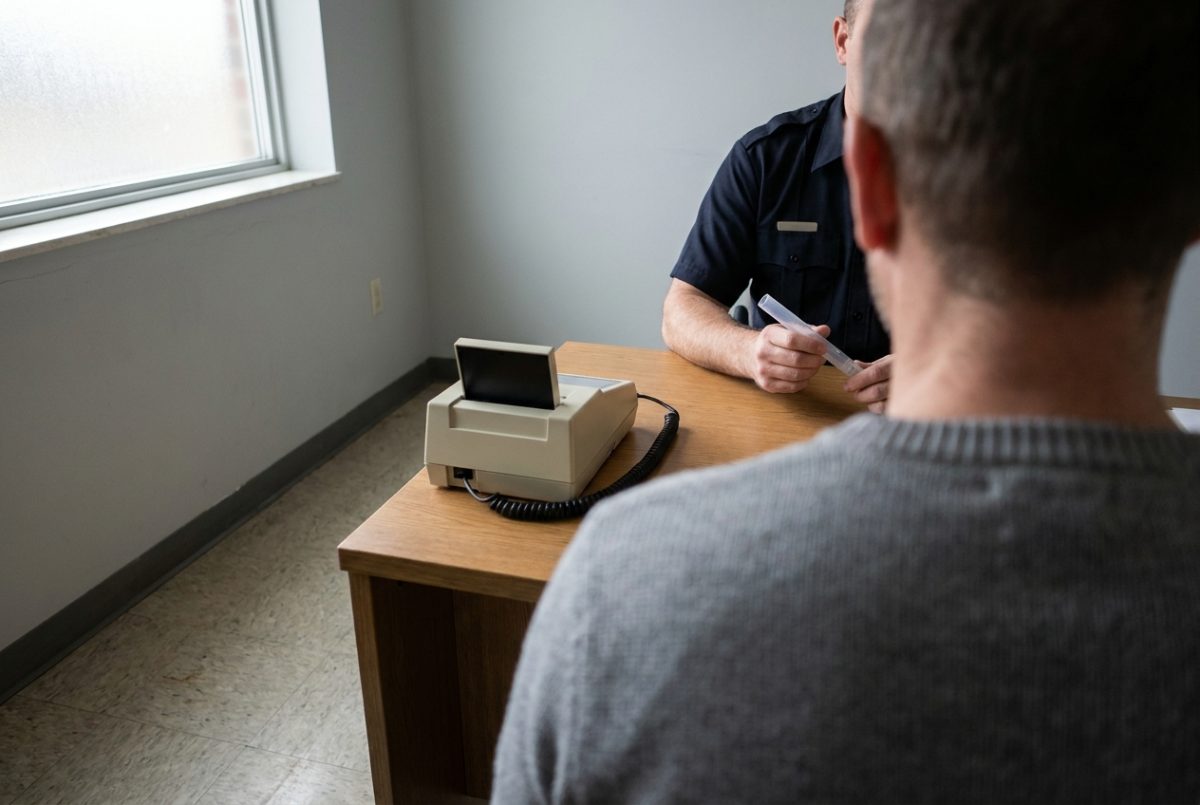
Before you decide, the officer must give you these warnings:6
- Your choice: you may choose a breath or blood test.
- License loss: refusing or not finishing a test means a 1-year suspension, or a 2- or 3-year revocation if you have prior DUI-related offenses.
- Jail: refusing or not finishing a breath or urine test means a fine and mandatory jail time if you are convicted of DUI.
- No lawyer: you have no right to a lawyer before you decide or while you take the test.
- Court: your refusal can be used against you in court.
These warnings matter. At a DMV refusal hearing, one of the questions is whether you were told your license would be suspended or revoked if you refused.7 If the officer skipped that warning, the DMV should not uphold a refusal suspension.
4. What counts as a refusal?
The law covers both refusing a test and failing to complete one.8 In practice, a “refusal” can be:
- Saying no to every test offered.
- Not finishing a test, for example not blowing long enough into the breath machine.
- Conditions: saying you will test only after you talk to a lawyer, since the law gives you no right to a lawyer first.
- Demanding a warrant before a blood test.
Example: Maria is arrested for DUI in Los Angeles. When the officer asks her to choose breath or blood, she says she won’t take any test until she has spoken to her lawyer. Because she has no right to a lawyer at that stage, the officer can treat her answer as a refusal.
Insisting on a warrant can still be used against you. In People v. Bolourchi (2024), a California appeals court held that a jury may treat a driver’s refusal to give blood unless police first got a warrant as evidence of “consciousness of guilt.”9 The jury instruction on this point is CALCRIM 2130, which the court upheld.
What is not a refusal
If you are physically unable to complete the test you chose, the law requires you to take the other test, not to be treated as refusing.3 We often see “refusals” that were really confusion: a driver who was hurt in a crash, frightened, or who did not understand the warning. Those facts can be a defense at the DMV hearing.
5. What are the penalties for refusing?
A refusal has three separate consequences: the DMV takes your license, the court can add jail time if you are convicted of DUI, and the refusal can be used as evidence.
License suspension or revocation (DMV)
The DMV acts on the refusal whether or not you are ever convicted of DUI. How long you lose your license depends on your record in the 10 years before the refusal:10
| Your record in the last 10 years | License penalty for refusing |
|---|---|
| No qualifying priors | 1-year suspension |
| 1 prior DUI, wet reckless, vehicular manslaughter conviction, or earlier DUI-related DMV suspension | 2-year revocation |
| 2 or more of those | 3-year revocation |
If you also lose your license over the DUI conviction itself, the two penalties run at the same time.10 Commercial drivers face more: refusing on two separate occasions means a lifetime disqualification from driving a commercial vehicle.11 See our page on commercial driver DUI.
Extra jail time if you are convicted (court)
If you are convicted of DUI and you refused a breath or urine test, the court must add jail time:12
| DUI conviction | Added jail for a breath or urine refusal |
|---|---|
| 1st DUI (probation) | The 48-hour-to-6-month jail term that is normally optional becomes required |
| 1st DUI causing injury (VC 23153) | 48 continuous hours |
| 2nd DUI, with or without injury | 96 hours |
| 3rd DUI | 10 days |
| 4th or later DUI | 18 days |
The prosecutor must charge the refusal and prove it (“pled and proven”), so it can be fought like any other allegation.12
Refusing a blood test does not add jail
Since January 1, 2019, the jail add-on does not apply if you refused a blood test.13 The change came after the U.S. Supreme Court’s 2016 ruling in Birchfield v. North Dakota, which held that drivers “cannot be deemed to have consented to submit to a blood test on pain of committing a criminal offense.”14 A blood-test refusal still costs you your license through the DMV.
The refusal as evidence
At trial, the prosecutor can tell the jury that you refused and argue that you did so because you knew you were impaired (see section 4).9
6. Can police force a blood test?
Usually only with a warrant. A blood draw is a search, and the U.S. Supreme Court held in Missouri v. McNeely (2013) that alcohol leaving the bloodstream “does not constitute an exigency in every case” that justifies skipping a warrant.15 In Birchfield, it held that police may require a breath test without a warrant after a DUI arrest, but not a blood test.16
Saying no matters. In People v. Balov (2018), a California appeals court explained that choosing “no” withdraws your implied consent, so police then need a warrant or another legal basis to take your blood.17 If you say yes, the blood test is treated as voluntary consent.
Unconscious drivers
VC 23612 treats an unconscious person as not having withdrawn consent.18 The Fourth Amendment still applies, but in Mitchell v. Wisconsin (2019) a plurality of the U.S. Supreme Court said that when a driver is unconscious and can’t take a breath test, the emergency exception “almost always permits a blood test without a warrant.”19
7. Is the roadside PAS test different?
Yes. The preliminary alcohol screening (PAS) test is the handheld breath test given at the roadside before an arrest. It is an investigative tool to help the officer decide whether there is probable cause to arrest you. For most adult drivers it is optional, and the officer must tell you so. Taking it does not replace the breath or blood test after an arrest.20
Different rules apply if you are under 21 or on probation for a DUI. In those cases the officer is directed to request a PAS test when there is reasonable cause to believe you violated the zero-tolerance or probation alcohol limits.21
A missing PAS warning won’t necessarily help you at the DMV. In Kazelka v. Department of Motor Vehicles (2025), a California appeals court declined “to interpret such silence as a mandate to exclude PAS testing evidence,” so PAS results can still be used at the hearing.22
8. How do you fight a refusal suspension?
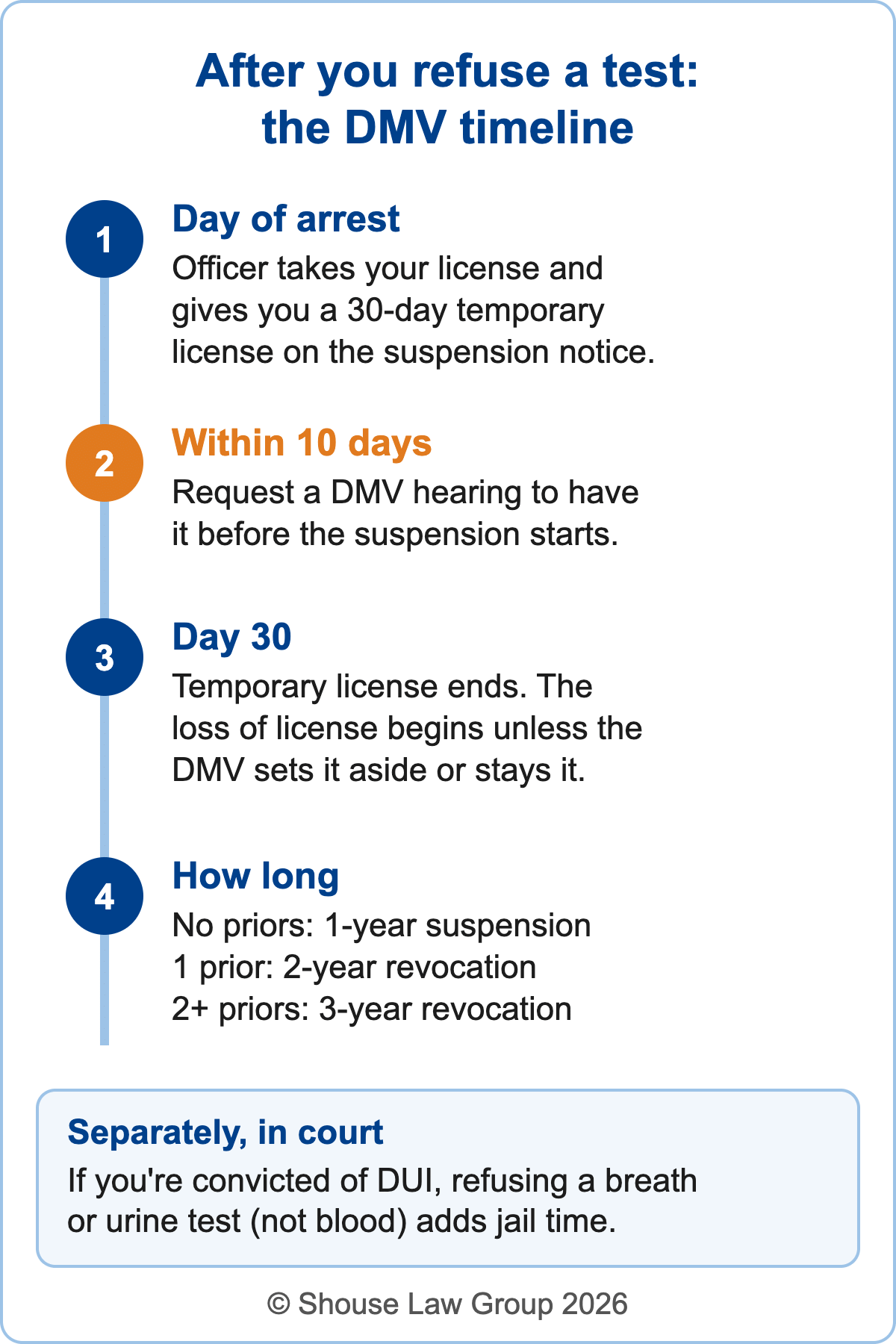
You fight it at a DMV hearing, and the clock starts at your arrest. The officer’s notice works as a temporary license for 30 days. You have 10 days from receiving the notice to request a hearing if you want it held before the suspension takes effect.23 See our guide to DMV hearings.
This timeline shows the key dates:23
The 4 questions at the hearing
The DMV may uphold a refusal suspension only if it finds all four of these:7
- The officer had reasonable cause to believe you were driving under the influence.
- You were placed under arrest.
- You refused, or did not complete, the test after the officer asked.
- You were told your license would be suspended or revoked if you refused (unless you were unconscious).
Common defenses
- No lawful arrest or reasonable cause: if the stop or arrest was unlawful, the test request falls with it.
- An incomplete warning: the officer never told you about the license penalty.
- No real refusal: you were confused, injured or physically unable to finish the test.
- Not a motor vehicle: in Beale v. Department of Motor Vehicles (2026), a California appeals court held that the DMV could not suspend the driver’s license of a man who refused a blood test after riding an electric bicycle, because the refusal laws don’t reach “a bicyclist who is not required to have a license in the first place.”24
- In court: the jail add-on must be charged and proven, and it never applies to a blood-test refusal.12
Example: Ana rides her e-bike home from a bar in San Jose and is stopped by police. She refuses a blood test. She can still be charged with cycling under the influence, but the DMV can’t suspend her driver’s license for the refusal, because an e-bike is not a motor vehicle.
In our experience at refusal hearings, the officer’s sworn statement is often the weak point: it may leave out what the driver was actually told, or describe a “refusal” that the recording doesn’t support.
The California Supreme Court is also reviewing when a DMV hearing officer’s ties to the DMV violate a driver’s right to a fair hearing (Romane v. Department of Motor Vehicles, S291093).
9. Questions and answers
What is Vehicle Code 23612?
It is California’s implied consent law. If you are lawfully arrested for DUI, you are treated as having agreed to a breath or blood test, and refusing brings license and court penalties.
What happens if I refuse a breath test in California?
The DMV suspends your license for 1 year, or revokes it for 2 or 3 years if you have priors. If you are convicted of DUI, the court must also add jail time, starting at 48 hours and rising to 18 days depending on your record.
Can I refuse a blood test and take a breath test instead?
In an alcohol case, yes: you choose breath or blood. In a drug case, an officer with reasonable cause can require a blood test after a breath test. Refusing a blood test does not add jail, but it still costs you your license.
Do I have to take the roadside PAS test?
For most adults, no: it is optional, and the officer must say so. Different rules apply if you are under 21 or on DUI probation.
How long do I have to fight a refusal suspension?
You have 10 days from receiving the suspension notice to request a DMV hearing if you want it held before the suspension starts. The temporary license on the notice lasts 30 days.
Talk to a California DUI lawyer
If you refused a test after a DUI arrest, the 10-day DMV deadline is already running. Our California DUI defense lawyers can request the hearing, review the officer’s report and fight both the suspension and the criminal case. Contact us for a free consultation.
Related reading: refusing a breathalyzer in California, what happens if you violate implied consent law, and how California’s implied consent law works.
Legal references:
- California Vehicle Code 23612(a)(1)(A), (C) VC: “A person who drives a motor vehicle is deemed to have given his or her consent to chemical testing of his or her blood or breath … if lawfully arrested for an offense allegedly committed in violation of Section 23140, 23152, or 23153.” “The testing shall be incidental to a lawful arrest and administered at the direction of a peace officer having reasonable cause to believe the person was driving a motor vehicle in violation of Section 23140, 23152, or 23153.”
- California Vehicle Code 23612 VC (subdivisions (a) through (i)).
- California Vehicle Code 23612(a)(2) VC: “the person has the choice of whether the test shall be of his or her blood or breath and the officer shall advise the person that he or she has that choice. If the person arrested either is incapable, or states that he or she is incapable, of completing the chosen test, the person shall submit to the remaining test.” In a drug case, a person who chooses a breath test “may also be requested to submit to a blood test if the officer has reasonable cause to believe that the person was driving under the influence of a drug … and if the officer has reasonable cause to believe that a blood test will reveal evidence of the person being under the influence. The officer shall state in his or her report the facts upon which those beliefs are based.”
- California Vehicle Code 23612(a)(3), (d)(2) VC: “If both the blood and breath tests are unavailable, the person shall be deemed to have given his or her consent to chemical testing of his or her urine and shall submit to a urine test.”
- California Vehicle Code 23612(b)-(c) VC: “A person who is afflicted with a heart condition and is using an anticoagulant under the direction of a licensed physician and surgeon is exempt from the blood test required by this section, but shall submit to, and complete, a urine test.”
- California Vehicle Code 23612(a)(1)(D), (a)(4) VC: the officer “shall also advise the person that he or she does not have the right to have an attorney present before stating whether he or she will submit to a test or tests, before deciding which test or tests to take, or during administration of the test or tests chosen, and that, in the event of refusal to submit to a test or tests, the refusal may be used against him or her in a court of law.”
- California Vehicle Code 13353(d) VC (issues at the hearing: reasonable cause, arrest, refusal or failure to complete, and “[w]hether … the person had been told that his or her driving privilege would be suspended or revoked if he or she refused to submit to, or did not complete, the test or tests”).
- California Vehicle Code 13353(a) VC: “If a person refuses the officer’s request to submit to, or fails to complete, a chemical test or tests pursuant to Section 23612 …”
- People v. Bolourchi (2024) 103 Cal.App.5th 243, 249, modified 103 Cal.App.5th 1009: “If, following a valid arrest for such an offense, a motorist refuses to cooperate in the taking of a blood test unless a warrant is first obtained, may the jury at the motorist’s ensuing DUI trial draw an adverse inference of consciousness of guilt based on that refusal? Our answer is yes.”
- California Vehicle Code 13353(a)(1)-(3), (f) VC (1-year suspension; 2-year revocation within 10 years of a separate violation of Section 23103 as specified in 23103.5, 23140, 23152, 23153, Penal Code 191.5 or 192.5(a), or a prior suspension or revocation under 13353, 13353.1 or 13353.2; 3-year revocation for two or more; runs concurrently with suspensions from the same arrest).
- California Vehicle Code 13353(b) VC: the department “shall disqualify the person from operating a commercial motor vehicle for the rest of his or her lifetime.”
- California Vehicle Code 23577(a)-(b) VC; California Vehicle Code 23538(a)(1) VC. “The willful refusal or failure to complete the breath or urine test required pursuant to Section 23612 shall be pled and proven.”
- California Vehicle Code 23577(c) VC (amended by Stats. 2018, ch. 177 (AB 2717), effective January 1, 2019): “The penalties in this section do not apply to a person who refused to submit to or complete a blood test pursuant to Section 23612.”
- Birchfield v. North Dakota (2016) 579 U.S. 438, 477: “motorists cannot be deemed to have consented to submit to a blood test on pain of committing a criminal offense.”
- Missouri v. McNeely (2013) 569 U.S. 141, 165: “in drunk-driving investigations, the natural dissipation of alcohol in the bloodstream does not constitute an exigency in every case sufficient to justify conducting a blood test without a warrant.”
- Birchfield v. North Dakota (2016) 579 U.S. 438, 474: “the Fourth Amendment permits warrantless breath tests incident to arrests for drunk driving.” Blood tests “are significantly more intrusive.”
- People v. Balov (2018) 23 Cal.App.5th 696, 702 (review dismissed Aug. 28, 2019): “Choosing the ‘no’ option acts to withdraw the driver’s implied consent and establishes that the driver does not give actual consent.” (Internal quotation marks and citation omitted.)
- California Vehicle Code 23612(a)(5) VC: “A person who is unconscious or otherwise in a condition rendering him or her incapable of refusal is deemed not to have withdrawn his or her consent …”
- Mitchell v. Wisconsin (2019) 588 U.S. 840, 843 (plurality opinion): “the exigent-circumstances rule almost always permits a blood test without a warrant.”
- California Vehicle Code 23612(h)-(i) VC: “The officer shall advise the person of that fact and of the person’s right to refuse to take the preliminary alcohol screening test.”
- California Vehicle Code 13388(a) VC (drivers under 21); California Vehicle Code 13389(a) VC (drivers on DUI probation): “the officer shall request that the person take a preliminary alcohol screening test.”
- Kazelka v. Department of Motor Vehicles (2025) 109 Cal.App.5th 1239, 1249: section 23612(i) “is silent as to the consequence of an officer’s failure to do so. We decline to interpret such silence as a mandate to exclude PAS testing evidence.”
- California Vehicle Code 23612(f) VC (“The temporary driver’s license shall be an endorsement on the notice of the order of suspension and shall be valid for 30 days from the date of arrest”); California Vehicle Code 13558(b) VC: “If the person wishes to have a hearing before the effective date of the order of suspension or revocation, the request for a hearing shall be made within 10 days of the receipt of the notice of the order of suspension or revocation.”
- Beale v. Department of Motor Vehicles (2026) 120 Cal.App.5th 782, 796-797: “the fact that an administrative process exists that can result in the suspension of a driver’s license for a person driving a car under the influence of alcohol or drugs does not necessarily mean that the same process would apply to suspend the driver’s license of a bicyclist who is not required to have a license in the first place.”