
Quick summary
California Penal Code 25400 makes it a crime to carry a concealed firearm, such as a handgun, on your person or in a vehicle without a license. It is usually a misdemeanor with up to 1 year in county jail, but it is a felony if you have a prior felony, the gun is stolen, you are an active gang member or you aren’t allowed to have guns.
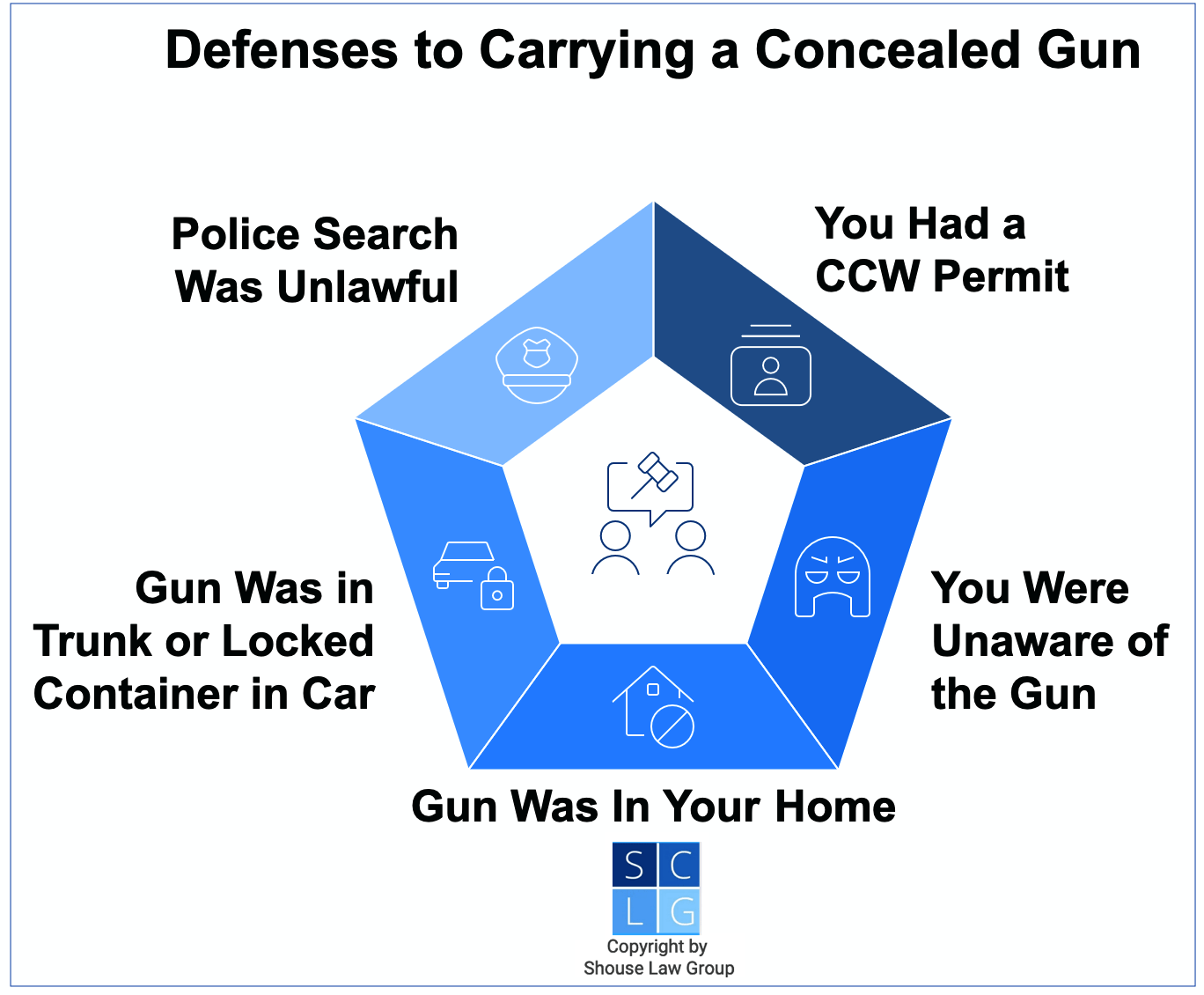
- Defenses: You didn’t know the gun was there, it was locked in the trunk or a locked container, you have a CCW license, or police found it in an illegal search.
- Gun rights: Since 2024, even a misdemeanor conviction under most parts of PC 25400 brings a 10-year ban on owning guns. A felony conviction brings a lifetime ban.
- Example: Carlos drives with an unloaded pistol in his glove box. Because a glove box isn’t a “locked container,” he can be charged under PC 25400.

California Penal Code § 25400 PC makes it a crime to carry a concealed firearm:
- on your person, or
- in a vehicle.1
Even with a CCW license, you can’t carry a gun in many “sensitive places” in California.
Carrying a concealed gun is usually a misdemeanor punishable by up to one year in jail and/or a $1,000 fine. It is a felony, with 16 months, two years or three years in county jail and up to $10,000, if:
- you have a prior felony conviction (or a prior conviction for certain firearm crimes),
- you knew or had reason to believe the gun was stolen,
- you are an active participant in a criminal street gang, or
- you weren’t in lawful possession of the gun or are barred from having guns.
Carrying a concealed firearm is a wobbler (it can be charged as a misdemeanor or a felony) if either:
- you were previously convicted of a crime against a person or property, or of a narcotics or dangerous drug crime, or
- the gun was loaded (or you had ammunition for it readily available), and you are not listed with the Department of Justice as its registered owner.
A conviction can also carry a minimum jail term of three months if you have certain prior convictions.
A 25400 PC charge is different from carrying a loaded firearm (25850 PC) and openly carrying an unloaded handgun (26350 PC).
In this article, our California criminal defense lawyers explain the law on carrying concealed weapons. Click a topic to jump to that section.
- 1. Elements of 25400 PC
- 2. Defenses
- 3. Exemptions
- 4. Penalties
- 5. Immigration Consequences
- 6. Expungements
- 7. Gun Rights
- 8. Constitutionality
- Frequently Asked Questions
- Additional Reading
1. Elements of 25400 PC
To convict you of carrying a concealed firearm under California Penal Code 25400 PC, the prosecutor must prove beyond a reasonable doubt that:
- you carried a firearm capable of being concealed on your person, or in a vehicle you controlled or were riding in,
- you knew you were carrying the firearm, and
- it was substantially concealed.2
Meaning of “concealed”
PC 25400 covers a gun that is largely hidden, even if you can still tell it’s a gun.
Example: In one California case, an officer saw a four- or five-inch narrow bulge in a man’s rear pants pocket and suspected it was a gun. The gun still counted as concealed.3
Concealed carry includes keeping a gun in your pocket, purse, briefcase or any other container you carry.

A gun carried openly in a belt holster is not concealed under PC 25400. But openly carrying a gun is usually illegal under other California laws.4

Which guns are covered
PC 25400 applies to a “firearm capable of being concealed upon the person.” That means any device that:
- is designed to be used as a weapon,
- fires a projectile by the force of an explosion or other combustion, and
- has a barrel less than 16 inches long (or a longer barrel designed to be swapped for one under 16 inches).5
So PC 25400 covers pistols, revolvers and other handguns, as well as short-barreled rifles and shotguns. Standard rifles and shotguns with barrels of 16 inches or more aren’t covered by this section (though other laws apply to them).
Pellet guns and BB guns, which use air pressure rather than combustion, are not firearms under this definition.
2. Defenses
Here at Shouse Law Group, we have represented thousands of people charged with gun crimes, including 25400 PC cases. In our experience, the following seven defenses can be very effective with prosecutors, judges and juries.
1) You did not know you were carrying the firearm
If you don’t know a gun is on you or in your car, you are not guilty of violating PC 25400. Someone else may have put a gun in your:
- jacket,
- purse,
- briefcase, or
- vehicle.
Your lawyer can look for surveillance video or witnesses showing someone else put it there.
2) The gun was in the trunk or a locked container in your vehicle
If you may lawfully have a gun, you aren’t guilty of carrying it concealed in a vehicle if it is in:
- the trunk, or
- a locked container in the car (a glove box doesn’t count).6
In many 25400 PC cases, we see that the officer’s own dash cam or body cam footage confirms that the gun was stored properly. For more, see our article on how to transport firearms in a vehicle in California.
3) You have a license to carry a concealed weapon
PC 25400 does not apply to someone with a valid California license to carry a concealed handgun.7 Showing your valid CCW license usually ends the case, unless you were carrying in a place where licensees still can’t carry.
4) The gun was at your home, business or private property
If you are otherwise allowed to have a gun, you can carry it, openly or concealed, in:
- your home,
- your place of business, or
- private property you own or lawfully possess.8
A vehicle usually doesn’t count as a place of business. A California appeals court held that a bounty hunter’s vehicle was not his “place of business” under this rule.9
5) The police found the gun in an illegal search
Many weapons charges start when an officer stops someone for something else, such as speeding, illegal parking, or matching the description of a suspect. During the stop or a pat-down, the officer finds a gun.

Your Fourth Amendment rights protect you from unreasonable searches and seizures. In general, police may search you only if:
- they have a valid search warrant,
- you consent, or
- an exception applies, such as a pat-down for weapons based on reasonable suspicion that you are armed and dangerous, or a vehicle search based on probable cause.10
Evidence found in an illegal search can’t be used against you. Your lawyer can file a motion to suppress. If the judge agrees, the prosecutor may be left without enough evidence to go forward.
6) You carried the gun because of a restraining order
California law says carrying a concealed gun is justified if you reasonably believe you are in grave danger because of circumstances that led to a current court restraining order against someone who was found to threaten your life or safety. (This may not apply to mutual restraining orders.)11 This is a narrow form of self-defense.
7) The police committed misconduct
Police misconduct includes an officer who:
- plants a gun on you or in your car,
- writes in a report that a gun was hidden when it was carried openly,
- testifies falsely,
- coerces a confession, or
- violates your civil rights in another way.
If misconduct is suspected, your lawyer can file a Pitchess motion to see whether others have made similar complaints about the officer. Proof of misconduct can lead the prosecutor or judge to dismiss the case, or a jury to find you not guilty.
3. Exemptions
California law exempts some people from PC 25400 in certain situations. These include (but are not limited to):
- peace officers (active or honorably retired, with conditions),
- members of the U.S. military on duty,
- guards and messengers of common carriers and banks while on duty,
- members of target shooting clubs at or going to and from target ranges, and
- licensed hunters and fishers while hunting or fishing or going to and from those activities.12
Most of these exemptions come with conditions, such as that the gun be unloaded or used only during certain activities.
4. Penalties
The penalties for violating PC 25400 depend on the facts and your criminal record, as shown in this table:13
| Carrying a concealed firearm | California penalties |
|---|---|
| No aggravating circumstances | Misdemeanor: up to 1 year in county jail (or misdemeanor probation) and/or up to $1,000. |
| A prior conviction for a crime against a person or property, or a narcotics or dangerous drug crime; or the gun was loaded (or ammunition was readily accessible) and you aren’t the DOJ-registered owner | Wobbler. Misdemeanor: up to 1 year in county jail and/or up to $1,000. Felony: 16 months, 2 years or 3 years in county jail and/or up to $1,000. |
| A prior felony (or a prior conviction under certain firearm laws); the gun was stolen and you knew or should have known; you are an active gang participant; or you weren’t in lawful possession or are barred from having guns | Felony: 16 months, 2 years or 3 years in county jail and/or up to $10,000. |
Mandatory minimum jail time
A conviction carries a minimum of three months in county jail if you have a prior felony conviction (or a prior conviction under certain firearm laws). The jail term must be between three and six months if you have a prior misdemeanor conviction for:
- assault with a firearm or semiautomatic firearm (245(a)(2)-(3) or 245(d) PC),
- shooting at an inhabited dwelling or vehicle (246 PC), or
- brandishing a firearm (417(a)(2) or 417(c) PC).14
A court can skip the minimum jail time only in unusual cases where the interests of justice require it, and it must state its reasons on the record.15
The gun can also be confiscated.16 For more, see our article on the penalty for carrying a concealed weapon without a permit.
5. Immigration Consequences
For a non-citizen in California, a PC 25400 conviction is a firearm offense that can lead to deportation.17 See our article on crimes that lead to deportation.
6. Expungements
If you get probation for a PC 25400 conviction, you may be able to expunge it once you:
- successfully complete probation, or
- have probation ended early.
An expungement helps with most job background checks, but it does not restore your gun rights.18
7. Gun Rights
Since January 1, 2024, a misdemeanor conviction in California under PC 25400(c)(5), (6) or (7), which covers most misdemeanor cases, means you can’t own or have a gun for 10 years.19 A minor who is made a ward of the juvenile court for this offense can’t own or possess a gun until age 30.20
A felony conviction under PC 25400 brings a lifetime gun ban.21
If you were convicted of a felony under the wobbler part of the law (see section 4), you may be able to restore your gun rights by asking the court to reduce the felony to a misdemeanor under PC 17(b). The 10-year misdemeanor ban may then still apply. Otherwise, the main way to restore gun rights after a felony is a governor’s pardon.22
8. Constitutionality
In 2022, the U.S. Supreme Court held in New York State Rifle & Pistol Association v. Bruen that states can’t require people to show a special need (“good cause”) to get a license to carry a gun in public.23 California responded with Senate Bill 2, effective January 1, 2024, which removed the good cause requirement but added stricter license rules and a long list of “sensitive places” where licensees can’t carry.24
PC 25400 itself remains in force. California appeals courts have continued to uphold convictions under California’s carry laws for people who didn’t have a license.25 Litigation over SB 2’s sensitive-places list is ongoing. After the U.S. Supreme Court struck down Hawaii’s similar private-property default rule in Wolford v. Lopez (June 2026), California’s version of that rule is not being enforced.
Frequently Asked Questions
Is carrying a concealed firearm a felony or a misdemeanor?
It depends on the case. In California, a PC 25400 violation is usually a misdemeanor, but it is a felony if you have a prior felony, the gun is stolen, you are an active gang participant, or you aren’t allowed to have guns.
Does 25400 PC apply if the gun is unloaded?
Yes. California’s PC 25400 bans carrying a concealed handgun on your person or in a vehicle whether it is loaded or unloaded. To transport a handgun in a car, keep it in the trunk or a locked container, not in a pocket or glove box.
Does my CCW permit protect me from 25400 PC charges?
Generally, yes. A valid California CCW license exempts you from PC 25400. But under SB 2 (PC 26230), licensees still can’t carry in many “sensitive places,” such as bars, parks and stadiums, and carrying there is a separate crime.
Can I keep a gun in my car’s glove compartment?
No. Under California law, a glove compartment doesn’t count as a “locked container,” even if it locks. A handgun kept there can lead to a PC 25400 charge. Use a separate locked container or the trunk.26
Additional Reading
For more in-depth information, see these scholarly articles:
- Concealed carry bans and the American college campus: a law, social sciences, and policy perspective – Contemporary Justice Review.
- New evidence on the impact of concealed carry weapon laws on crime – International Review of Law and Economics.
- The Decision to Carry: The Effect of Crime on Concealed-Carry Applications – Journal of Human Resources.
- Concealed Carry through Common Use: Extending Heller’s Constitutional Construction – George Washington Law Review.
- Defiance, Concealed Carry, and Race – Law and Contemporary Problems.
Learn more about California gun laws.
Legal references:
- California Penal Code 25400 PC. Full text (as of November 2026):
(a) A person is guilty of carrying a concealed firearm when the person does any of the following:
(1) Carries concealed within any vehicle that is under the person’s control or direction any pistol, revolver, or other firearm capable of being concealed upon the person.
(2) Carries concealed upon the person any pistol, revolver, or other firearm capable of being concealed upon the person.
(3) Causes to be carried concealed within any vehicle in which the person is an occupant any pistol, revolver, or other firearm capable of being concealed upon the person.
(b) A firearm carried openly in a belt holster is not concealed within the meaning of this section.
(c) Carrying a concealed firearm in violation of this section is punishable as follows:
(1) If the person previously has been convicted of any felony, or of any crime made punishable by a provision listed in Section 16580, as a felony.
(2) If the firearm is stolen and the person knew or had reasonable cause to believe that it was stolen, as a felony.
(3) If the person is an active participant in a criminal street gang, as defined in subdivision (a) of Section 186.22, under the Street Terrorism Enforcement and Prevention Act (Chapter 11 (commencing with Section 186.20) of Title 7 of Part 1), as a felony.
(4) If the person is not in lawful possession of the firearm or the person is within a class of persons prohibited from possessing or acquiring a firearm pursuant to Chapter 2 (commencing with Section 29800) or Chapter 3 (commencing with Section 29900) of Division 9 of this title, or Section 8100 or 8103 of the Welfare and Institutions Code, as a felony.
(5) If the person has been convicted of a crime against a person or property, or of a narcotics or dangerous drug violation, by imprisonment pursuant to subdivision (h) of Section 1170, or by imprisonment in a county jail not to exceed one year, by a fine not to exceed one thousand dollars ($1,000), or by both that imprisonment and fine.
(6) If both of the following conditions are met, by imprisonment pursuant to subdivision (h) of Section 1170, or by imprisonment in a county jail not to exceed one year, by a fine not to exceed one thousand dollars ($1,000), or by both that fine and imprisonment:
(A) The pistol, revolver, or other firearm capable of being concealed upon the person is loaded, or both it and the unexpended ammunition capable of being discharged from it are in the immediate possession of the person or readily accessible to that person.
(B) The person is not listed with the Department of Justice pursuant to paragraph (1) of subdivision (c) of Section 11106 as the registered owner of that pistol, revolver, or other firearm capable of being concealed upon the person.
(7) In all cases other than those specified in paragraphs (1) to (6), inclusive, by imprisonment in a county jail not to exceed one year, by a fine not to exceed one thousand dollars ($1,000), or by both that imprisonment and fine.
(d) (1) Every person convicted under this section who previously has been convicted of a misdemeanor offense enumerated in Section 23515 shall be punished by imprisonment in a county jail for at least three months and not exceeding six months, or, if granted probation, or if the execution or imposition of sentence is suspended, it shall be a condition thereof that the person be imprisoned in a county jail for at least three months.
(2) Every person convicted under this section who has previously been convicted of any felony, or of any crime made punishable by a provision listed in Section 16580, if probation is granted, or if the execution or imposition of sentence is suspended, it shall be a condition thereof that the person be imprisoned in a county jail for not less than three months.
(e) The court shall apply the three-month minimum sentence as specified in subdivision (d), except in unusual cases where the interests of justice would best be served by granting probation or suspending the imposition or execution of sentence without the minimum imprisonment required in subdivision (d) or by granting probation or suspending the imposition or execution of sentence with conditions other than those set forth in subdivision (d), in which case, the court shall specify on the record and shall enter on the minutes the circumstances indicating that the interests of justice would best be served by that disposition.
(f) A peace officer may arrest a person for a violation of paragraph (6) of subdivision (c) if the peace officer has probable cause to believe that the person is not listed with the Department of Justice pursuant to paragraph (1) of subdivision (c) of Section 11106 as the registered owner of the pistol, revolver, or other firearm capable of being concealed upon the person, and one or more of the conditions in subparagraph (A) of paragraph (6) of subdivision (c) is met. - CALCRIM No. 2520 (Carrying Concealed Firearm on Person); CALCRIM Nos. 2521-2522 (concealed firearm within vehicle).
- People v. May (1973) 33 Cal.App.3d 888 (“a bulge in his right rear pants pocket. The bulge was four or five inches long and fairly narrow”).
- Penal Code 25400(b) PC (“A firearm carried openly in a belt holster is not concealed”); Penal Code 25850 PC; Penal Code 26350 PC.
- California Penal Code 16530(a) PC; Penal Code 16520 PC.
- California Penal Code 25610 PC; Penal Code 16850 PC (“locked container” “does not include the utility or glove compartment of a motor vehicle”).
- California Penal Code 25655 PC.
- California Penal Code 25605(a) PC (“place of residence, place of business, or on private property owned or lawfully possessed”).
- People v. Wooten (1985) 168 Cal.App.3d 168 (defendant’s vehicle “was not his ‘place of business’” as a bounty hunter).
- Terry v. Ohio (1968) 392 U.S. 1; Schneckloth v. Bustamonte (1973) 412 U.S. 218; Mapp v. Ohio (1961) 367 U.S. 643; Penal Code 1538.5 PC.
- California Penal Code 25600(a) PC: “A violation of Section 25400 is justifiable when a person who possesses a firearm reasonably believes that person is in grave danger because of circumstances forming the basis of a current restraining order issued by a court against another person who has been found to pose a threat to the life or safety of the person who possesses the firearm.”
- California Penal Code 25450-25655 PC, including 25450, 25620, 25630, 25635 and 25640.
- Penal Code 25400(c) PC; Penal Code 18 PC; Penal Code 672 PC.
- Penal Code 25400(d) PC; Penal Code 23515 PC.
- Penal Code 25400(e) PC.
- California Penal Code 25700 PC.
- 8 U.S.C. 1227(a)(2)(C).
- California Penal Code 1203.4 PC.
- California Penal Code 29805(f) PC (convictions “on or after January 1, 2024, of a misdemeanor violation of paragraph (5), (6), or (7) of subdivision (c) of Section 25400”).
- California Penal Code 29820 PC.
- California Penal Code 29800 PC.
- Penal Code 17(b) PC; Penal Code 4852.17 PC; Penal Code 4854 PC.
- New York State Rifle & Pistol Assn. v. Bruen (2022) 597 U.S. 1.
- Senate Bill 2 (2023), Stats. 2023, ch. 249; Penal Code 26150 PC; Penal Code 26230 PC.
- People v. Bey (2025) 108 Cal.App.5th 144 (rejecting a Second Amendment challenge to California’s carry laws by an unlicensed defendant).
- California Penal Code 16850 PC.