
Quick summary
In California, a dog that bites a person must be isolated and watched for at least 10 days after the bite to rule out rabies. This dog bite quarantine is required by Title 17, section 2606 of the California Code of Regulations and can take place at the owner’s home or at a shelter, vet or kennel.
- Vaccinated dogs too: The quarantine applies even if the dog is vaccinated. A dog held at a shelter or vet can be released after 5 days if a vet finds no signs of illness.
- What a healthy 10 days means: If the dog stays healthy for 10 days, it could not have passed rabies to you through the bite.
- Breaking quarantine: An owner who hides the dog or breaks the quarantine order can be charged with a misdemeanor.
In this article, our California dog bite lawyers answer 9 common questions about dog bite quarantine:
- 1. Why are dogs quarantined after a bite?
- 2. How long is dog bite quarantine in California?
- 3. Who must report a dog bite?
- 4. How does animal control investigate a bite?
- 5. Will the dog stay home or go to a shelter?
- 6. How does the quarantine end?
- 7. What if the owner breaks quarantine?
- 8. What should you do if a dog bit you?
- 9. Frequently asked questions
1. Why are dogs quarantined after a bite?
In California, a dog is quarantined after a bite to find out whether it could have given you rabies. A dog that has rabies in its saliva gets sick and usually dies within days. So if the dog stays healthy and alive for 10 days after the bite, it could not have been shedding the virus when it bit you.1
That 10-day watch spares many bite victims from rabies shots. Rabies is almost always fatal once symptoms start, so doctors take any chance of exposure seriously.
Which animals carry rabies in California?
In California, bats are by far the most common source of rabies. In 2023, 179 of the 202 rabid animals found in the state were bats (88.6%). Skunks (19) and foxes (4) made up most of the rest, and no rabid dogs or cats were found that year.2 Rabies in dogs is rare here because most dogs are vaccinated. But a dog that fought a skunk or caught a bat can still be infected, which is why every bite is checked.
2. How long is dog bite quarantine in California?
In California, a dog that bites a person must be isolated and observed for at least 10 days after the day of the bite.3 The quarantine applies to vaccinated and unvaccinated dogs alike. A current rabies shot does not exempt the dog, because no vaccine is perfect and the watch costs little compared with the risk.
The 5-day vet release option
California law has one exception that shortens the wait. If the dog is held at a pound, veterinary hospital or other approved facility under a vet’s observation, the local health officer may release it after 5 days. The vet must examine the dog on day 5 or later and certify that it shows no signs of any disease.4
This option does not apply to a dog quarantined at home.
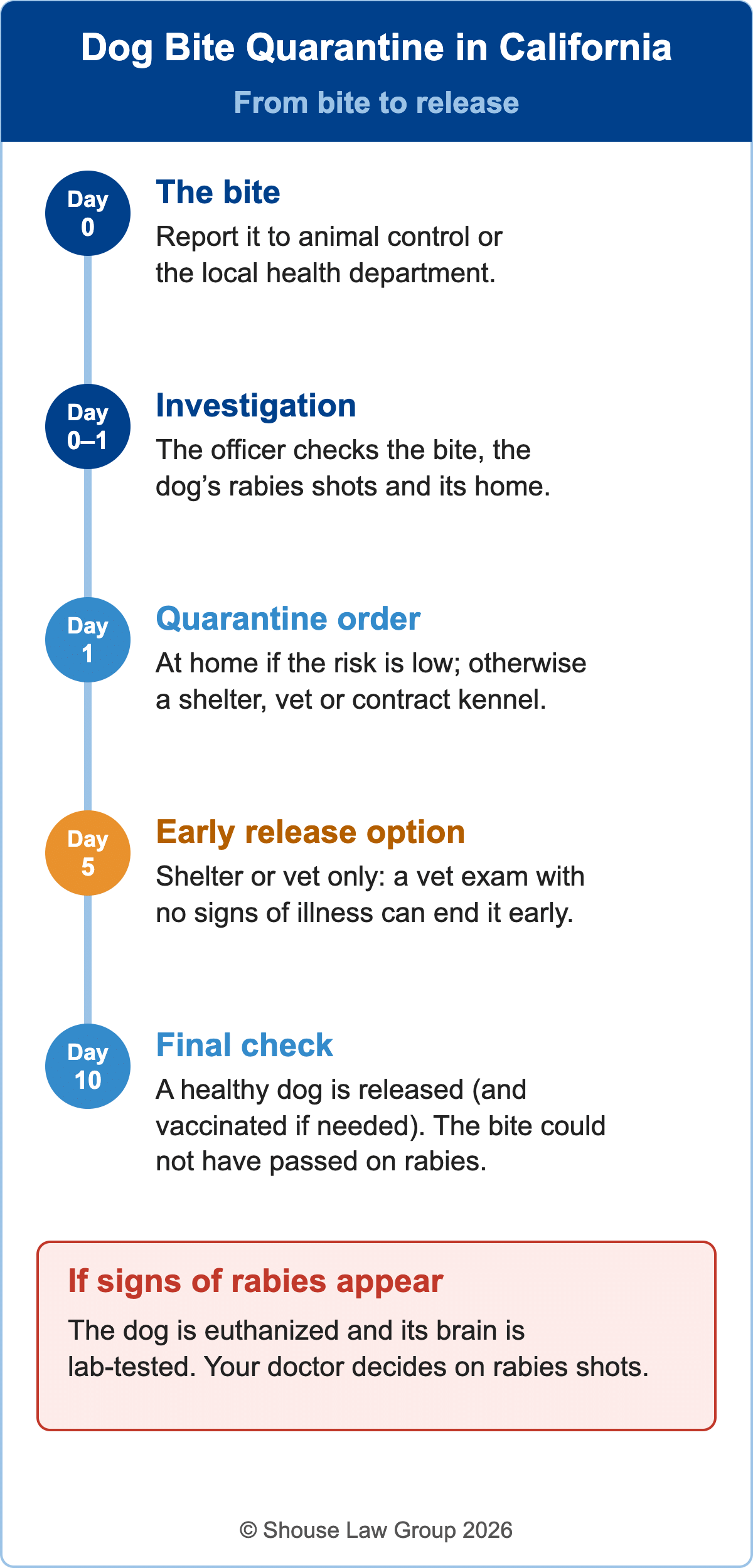
The chart below shows how a typical California dog bite quarantine unfolds, from the day of the bite to release.
3. Who must report a dog bite?
In California, every bite on a person by a dog or other animal that can carry rabies must be reported to the local health officer, whether or not the animal seems sick.5 That rule applies in every county, because the state declares all 58 counties “rabies areas” each year and has done so every year since 1987.6 It applies even when the dog bit a trespasser or was defending its owner. (A trespasser’s right to sue is a separate question; see trespassers as dog bite victims.)
In practice, you can report a bite to your local animal control agency or health department. Doctors who treat a bite usually report it too; see do doctors have to report dog bites?
Where to report a dog bite in California’s largest counties
Where you report depends on where the bite happened. Here is where to start in some of California’s largest counties (as of November 2026):
| Where the bite happened | Where to report |
|---|---|
| Los Angeles County (unincorporated areas and contract cities) | LA County Animal Care and Control or the LA County Department of Public Health |
| Long Beach, Pasadena or Vernon | That city’s own health department or animal agency (Long Beach Animal Care Services; Pasadena Humane Society) |
| San Diego County | San Diego County Department of Animal Services (owners must report bites under County Code 62.615) |
| Orange County | OC Animal Care |
| Sacramento County (unincorporated areas) | Sacramento County Animal Care Services, (916) 368-PETS (7387) |
| San Francisco | San Francisco Animal Care and Control; police also take bite reports |
Elsewhere, call your city or county animal control agency. If you’re not sure who covers your area, the county health department can tell you.
4. How does animal control investigate a bite?
In California, animal control or health department staff try to contact everyone involved as soon as possible, ideally within 24 hours of the report.7 They talk to you (or your parent, if you’re a child), the dog’s owner and any witnesses.
What the officer gathers
The officer will usually record:
- Your account: where and how the bite happened, and how badly you were hurt.
- The dog’s details: breed, age, license and rabies vaccination history.
- The owner’s details: name, address and their version of events.
- Past incidents: any earlier bites or reports about the dog.
- The home: whether the owner can safely confine the dog.
This bite report becomes an official record. In our experience, it is often one of the most useful pieces of evidence in a later injury claim, because it pins down the date, place and owner while memories are fresh.
What raises or lowers rabies concern
California health officials weigh these factors when deciding how risky a bite is:8
| Raises rabies concern | Lowers rabies concern |
|---|---|
| Unprovoked bite | Bite was provoked (for example, the dog was stepped on or teased) |
| Strange or aggressive behavior | Dog seems normal and healthy |
| Young (juvenile) dog | Adult dog |
| Bites to the face, head, neck or spine; several or deep bites | A single, shallow bite on an arm or leg |
| No proof of a current rabies vaccine | Current rabies vaccine on record |
| Recent rabid wildlife (bats, skunks) in the area | No known contact with wildlife |
5. Will the dog stay home or go to a shelter?
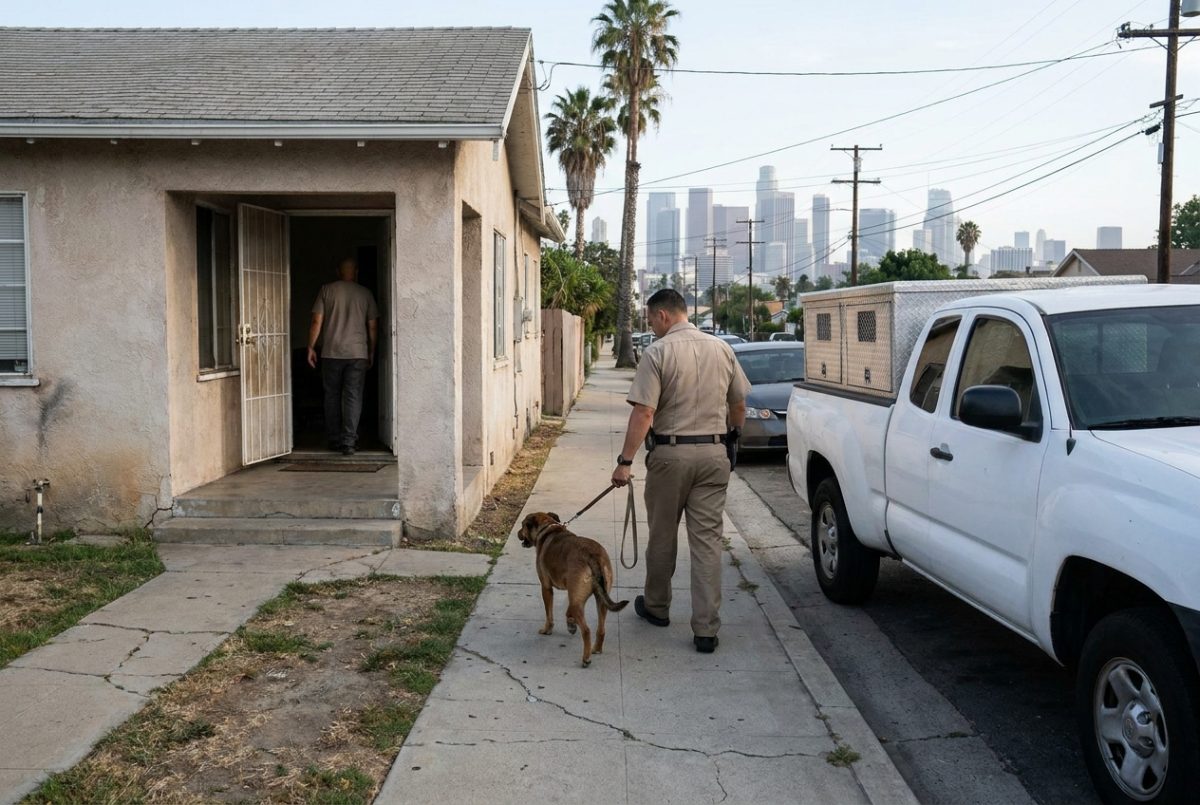
In California, the local health officer or animal control officer decides where the dog is quarantined. The owner has no right to a home quarantine. State guidance calls quarantine at a shelter or other professionally staffed place the ideal for all biting dogs, and limits home quarantine to bites where the rabies risk is low.9 In practice, many counties allow a home quarantine for a first, minor bite by a vaccinated dog.
Shelter, vet or kennel quarantine
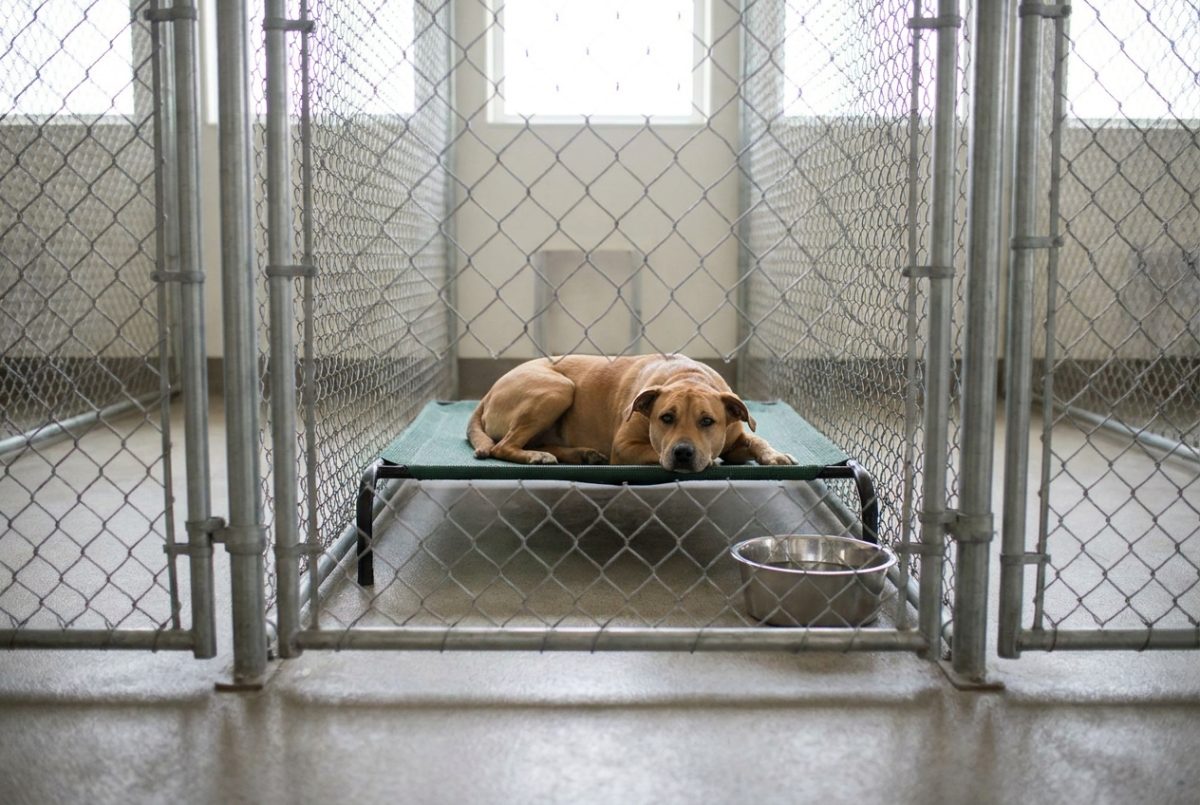
A higher-risk dog is held at an animal shelter, a vet’s office or a kennel under contract with animal control. Staff watch it daily for signs of rabies, and it is housed alone with no contact with other animals.
Home quarantine
A low-risk dog may stay home if the owner can keep it strictly confined, either indoors or in a securely fenced yard, away from other people and animals. Usually just one responsible adult cares for the dog. The owner signs the order and must report any illness or change in behavior. Officers may make unannounced checks, and a dog that isn’t properly confined can be moved to a facility.
Who pays for the quarantine?
The dog’s owner, not you. State guidance says a dog moved to a facility because the owner didn’t follow a home-quarantine order may be held at the owner’s expense.10 Shelter fees vary by city and county.
This flowchart shows the questions officers usually ask when deciding between home and shelter quarantine in California.
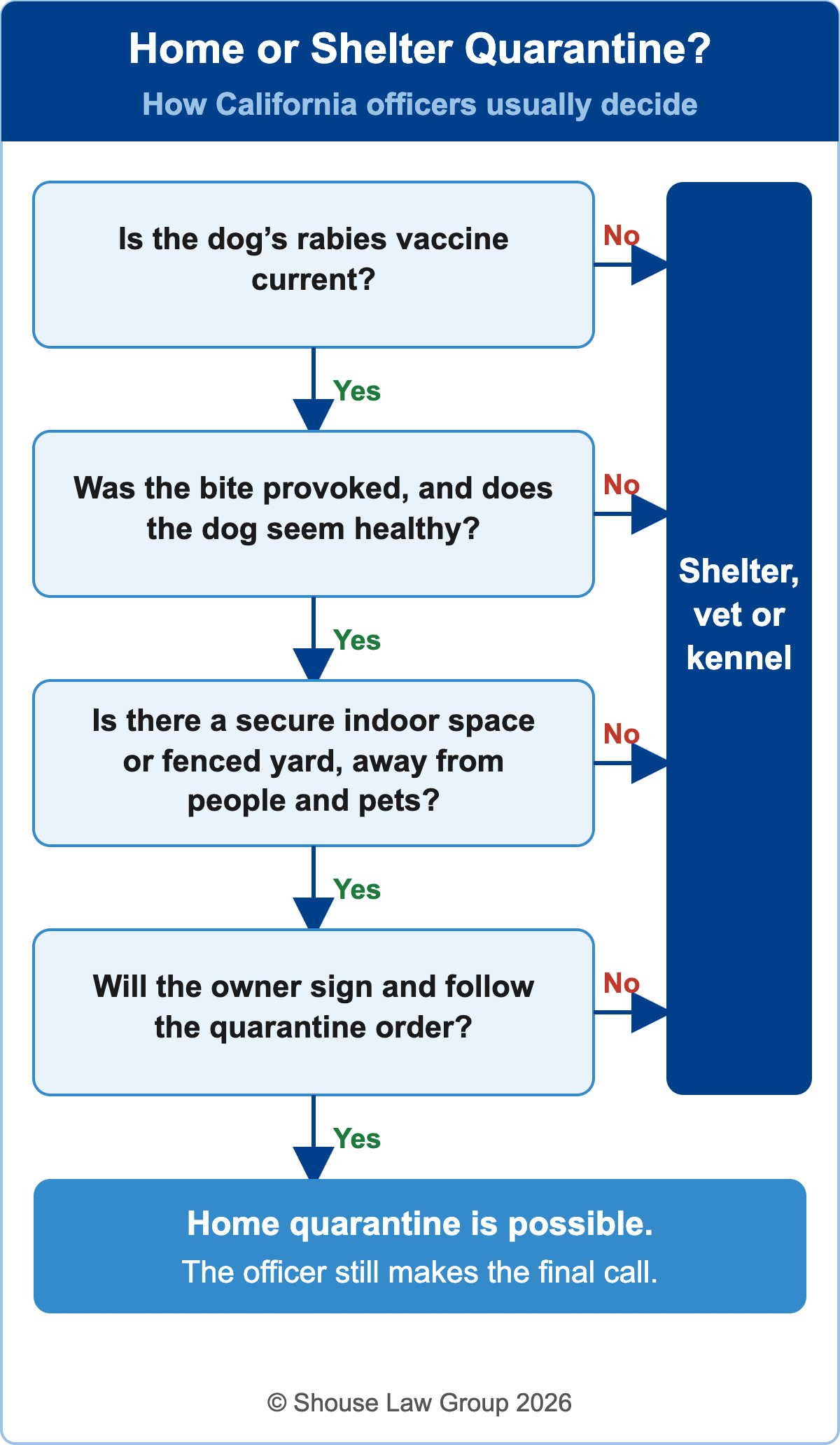
Example: Maria’s vaccinated Labrador nips a delivery driver in Pasadena after the driver steps on its paw. Because the bite was provoked, the dog is current on its shots and Maria has a fenced yard, the officer lets Maria quarantine the dog at home for 10 days.
6. How does the quarantine end?
In California, only the local health officer (usually acting through animal control) can release a dog from quarantine.11 The dog is checked at the end of the period, ideally by a vet.
- If the dog stays healthy: it goes home. If it wasn’t vaccinated, it gets a rabies shot before release. You should be told that the dog was healthy and could not have passed on rabies.12
- If the dog shows signs of rabies: it is euthanized and its brain is tested at a public health lab. Rabies can only be confirmed by that lab test.13 Your doctor will decide whether you need rabies shots.
A dog that passes quarantine can still face a separate dangerous or vicious dog hearing if the bite was serious or it has bitten before.
7. What if the owner breaks quarantine?
In California, an owner who hides a dog that bit someone, or who breaks a quarantine order, commits a misdemeanor. There are two separate crimes:
| What the owner did | Law | Maximum penalty |
|---|---|---|
| Willfully concealed where the dog is, or who owns it, to prevent the quarantine | Health and Safety Code 121705 | Up to 6 months in county jail and/or a fine of up to $1,000 |
| After notice, violated the quarantine order, or failed to produce the dog when the health officer demanded it | Health and Safety Code 121710 | Up to 1 year in county jail and/or a fine of $100 to $1,000 per day of violation |
The concealment law says that a person who “willfully conceals information about the location or ownership of an animal subject to rabies, that has bitten or otherwise exposed a person to rabies, with the intent to prevent the quarantine or isolation of that animal … is guilty of a misdemeanor.”14 Because it sets no specific penalty, California’s default misdemeanor penalty applies.15 The quarantine-order law sets its own, higher penalty.16
Example: After his dog bites a neighbor’s child, John drives the dog to his brother’s house in another county so animal control can’t find it. John can be charged under Health and Safety Code 121705, and the child may need rabies shots because the dog can’t be watched.
8. What should you do if a dog bit you?
If a dog bit you in California, the quarantine protects your health, and the paperwork it creates can support an injury claim. Take these steps:
- Get medical care. Wash the wound with soap and water and see a doctor. Ask whether you need rabies shots; the answer often depends on whether the dog can be found and watched.
- Report the bite. Call animal control or the health department (see the table in section 3) and get the report number.
- Identify the dog and owner. Get names, an address and the dog’s description. A dog that can’t be found can’t be quarantined.
- Ask for the quarantine result. Follow up with animal control after 10 days and tell your doctor.
- Keep records. Save photos of your injuries, medical bills and the bite report.
- Watch your deadline. You generally have 2 years from the bite to sue; see the dog bite statute of limitations.
Example: A stray dog bites Ana at a Los Angeles park and runs off. Animal control can’t find it, so the dog can’t be quarantined. Ana’s doctor recommends a full course of rabies shots, and those costs become part of her damages if the owner is later identified.
Your right to compensation
Under California’s strict liability dog bite law (Civil Code 3342), a dog’s owner is usually liable for a bite in a public place or lawfully in a private place, even if the dog never bit anyone before. The cost of rabies shots, other medical care, lost wages and pain and suffering can all be part of your dog bite damages. Most claims are paid by the owner’s homeowners or renters insurance; see also what if the owner has no insurance.
One thing we often see: insurers point to a clean quarantine result as proof the bite was “minor.” A healthy dog rules out rabies, not the harm the bite caused.
Can you sue animal control?
Usually not. In Danielson v. County of Humboldt, a California appeals court held that a county was immune from a dog-attack victim’s lawsuit, even though its officers had dealt with the same dogs before, including earlier 10-day quarantines. The court found that state and county rules on impounding unlicensed or unvaccinated dogs did not create a mandatory duty the county could be sued for breaking.17 Your claim is normally against the dog’s owner and their insurance.
9. Frequently asked questions
Can a dog be quarantined at home after a bite?
Yes, in many cases. In California, the health officer or animal control officer may allow a home quarantine if the rabies risk is low and the owner can keep the dog strictly confined, away from other people and animals, for at least 10 days.
Do vaccinated dogs have to be quarantined?
Yes. In California, a dog that bites a person must be quarantined for at least 10 days even if its rabies vaccine is current.
What happens if I don’t quarantine my dog after a bite?
In California, violating a quarantine order after notice is a misdemeanor punishable by up to 1 year in jail and a fine of $100 to $1,000 per day. Animal control can also take the dog and finish the quarantine at a shelter.
Who pays for dog bite quarantine?
In California, the dog’s owner pays. A dog moved to a shelter because the owner didn’t follow a home quarantine may be held at the owner’s expense, and fees vary by county.
What happens to a dog that bites a child?
In California, it is quarantined for at least 10 days like any other biting dog. A serious bite can also lead to a dangerous or vicious dog hearing, which can end in restrictions or, in rare cases, euthanasia.
Does a dog have to be quarantined if it bites another dog?
California’s 10-day rule covers bites on people. A dog bitten by an animal that is rabid or suspected of rabies faces a longer quarantine: 6 months, or 30 days after an immediate booster shot if its vaccines were current.18 Some cities and counties also require dog-on-dog bites to be reported. See what happens when a dog bites another dog.
Call us for help
If you or your child was bitten by a dog in California, our California dog bite attorneys can help you get the bite report and quarantine records, deal with the owner’s insurance company and protect your deadline. Contact us for a free consultation.
Legal references:
- California Department of Public Health, Investigation, Management, and Prevention of Animal Bites in California (3d ed. 2014), p. 23: suspicion of rabies “can be eliminated if the dog or cat remains healthy and alive 10 or more days after a bite incident.”
- California Department of Public Health, Rabies Surveillance in California, Annual Report 2023 (March 2025), pp. 4–6: 202 rabid animals, including 179 bats (88.6%), 19 skunks and 4 foxes; “Rabies was confirmed in no domestic animals in California in 2023.”
- California Code of Regulations, Title 17, § 2606(b)(2): any animal that bites a person “shall be isolated in strict confinement in a place and manner approved by the local health officer and observed for at least 14 days (dogs and cats 10 days) after the day of infliction of the bite.” Under § 2606(b)(3), this isolation is mandatory in declared rabies areas.
- California Code of Regulations, Title 17, § 2606(b)(2) (see note 3 above): dogs held “under observation of a licensed veterinarian, in a pound, veterinary hospital, or other adequate facility … may be released from isolation by the local health officer after five days of veterinary observation” if the vet, examining the dog “on the fifth day or more after infliction of the bite,” certifies “that there are no clinical signs or symptoms of any disease.”
- California Code of Regulations, Title 17, § 2606(a) (see note 3 above): in declared rabies areas, “the local health officer shall be notified when any person is bitten by an animal of a species subject to rabies, whether or not the animal is suspected of having rabies.”
- California Health and Safety Code 121585 (a rabies area declaration lasts one year unless renewed); California Department of Public Health, Annual Declaration of Rabies Areas (all 58 counties); CDPH, Rabies Surveillance in California, Annual Report 2023 (see note 2 above), p. 3: “The Director has declared all 58 counties in California as rabies areas every year since 1987.”
- CDPH, Investigation, Management, and Prevention of Animal Bites in California (see note 1 above), p. 9: “All parties should be contacted as soon as possible, ideally within 24 hours of receiving the report.”
- CDPH, Investigation, Management, and Prevention of Animal Bites in California (see note 1 above), pp. 13–17: “Younger (juvenile) animals are considered to present a greater risk of rabies than older (adult) animals”; “Bites to the face, head, neck, or spine represent a more exigent risk of rabies.”
- CDPH, Investigation, Management, and Prevention of Animal Bites in California (see note 1 above), pp. 24–25: “Quarantine at an animal shelter or other professionally staffed premises is the ideal for all biting dogs and cats”; home isolation is for cases where “the risk of rabies is assessed to be low,” with contact limited to “the minimum number (ideally 1) of responsible adults.”
- CDPH, Investigation, Management, and Prevention of Animal Bites in California (see note 1 above), pp. 24–25 (compliance checks, including unannounced inspections; a noncompliant animal may be moved to a facility at the owner’s expense).
- CDPH, Investigation, Management, and Prevention of Animal Bites in California (see note 1 above), p. 27 (only the local health officer may release an animal from quarantine).
- CDPH, Investigation, Management, and Prevention of Animal Bites in California (see note 1 above), p. 27: “a rabies vaccine should be administered prior to release from quarantine” if the animal is not currently vaccinated; bite victims should be told the animal remained healthy.
- California Code of Regulations, Title 17, § 2606(b)(1), (4) (see note 3 above) (a clinically suspected rabid animal may be euthanized with the health officer’s permission for laboratory testing; specimens must be examined in an approved public health laboratory).
- California Health and Safety Code 121705: “Any person who willfully conceals information about the location or ownership of an animal subject to rabies, that has bitten or otherwise exposed a person to rabies, with the intent to prevent the quarantine or isolation of that animal by the local health officer is guilty of a misdemeanor.”
- California Penal Code 19: “Except in cases where a different punishment is prescribed by any law of this state, every offense declared to be a misdemeanor is punishable by imprisonment in the county jail not exceeding six months, or by fine not exceeding one thousand dollars ($1,000), or by both.”
- California Health and Safety Code 121710: “Any person who, after notice, violates any order of a local health officer concerning the isolation or quarantine of an animal of a species subject to rabies, that has bitten or otherwise exposed a person to rabies or who, after that order, fails to produce the animal upon demand of the local health officer, is guilty of a misdemeanor, punishable by imprisonment in the county jail for a period not to exceed one year, or by fine of not less than one hundred dollars ($100), nor more than one thousand dollars ($1,000) per day of violation, or by both fine and imprisonment.”
- Danielson v. County of Humboldt (2024) 103 Cal.App.5th 1, 22–23 (the county’s alleged duties under Health and Safety Code 121690(d)–(e) and its county code to impound unlicensed or unvaccinated dogs were not mandatory duties under Government Code 815.6; the county was immune).
- California Code of Regulations, Title 17, § 2606(c) (see note 3 above): an animal bitten by a known or suspected rabid animal “shall be quarantined … for a period of six months or destroyed,” except that a dog with a qualifying current vaccination may be revaccinated within 48 hours and quarantined for 30 days.