
Last Reviewed

California Labor Code 512 entitles non-exempt employees to an unpaid, 30-minute lunch break for every five hours worked per work day. Furthermore, non-exempt employee must be permitted to leave the worksite to have their lunch break.
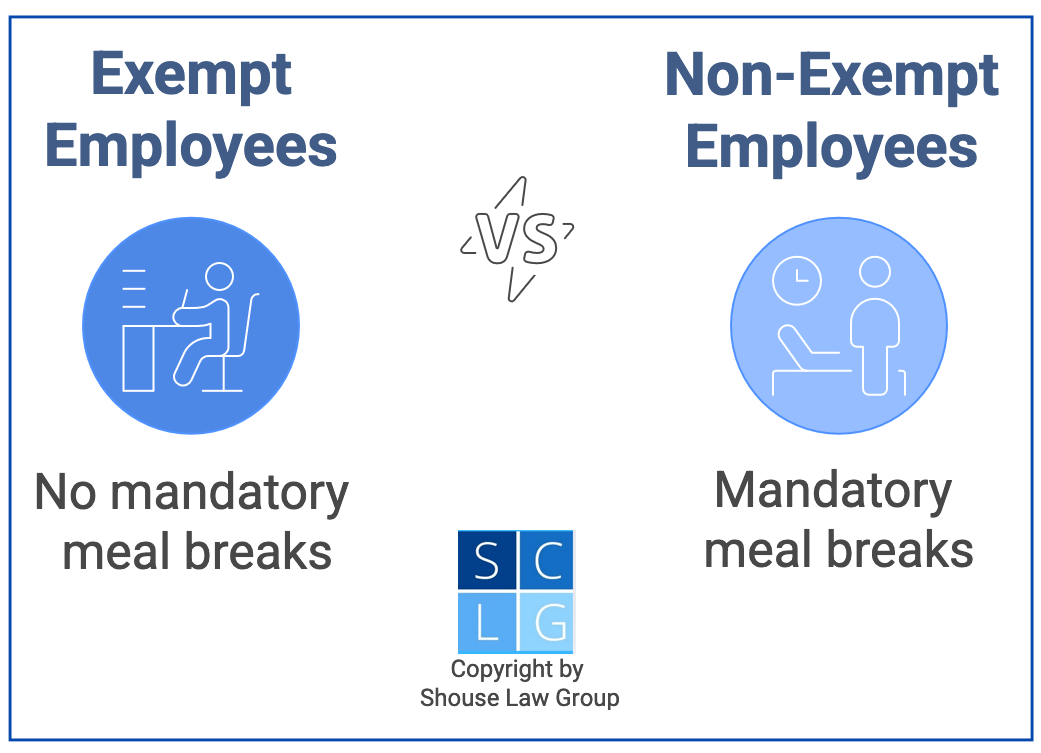
Mandatory meal breaks are one of the benefits of being non-exempt, along with overtime pay and paid rest breaks.
In this article, our Los Angeles labor and employment law attorneys will address the following key issues regarding California lunch break laws.
- 1. Waiving Lunch Breaks
- 2. No Pay for Lunch Breaks
- 3. Working During Lunch Breaks
- 4. Exceptions for Certain Jobs
- 5. Employer Violations and Penalties
- 6. Exempt Employees and Independent Contractors
- Frequently Asked Questions
- Additional Resources
1. Waiving Lunch Breaks
If you are a non-exempt employee in California and work more than five hour but no more than six hours in a work day, you may waive your meal break. Though once you work more than six hours, you cannot waive it.
Meanwhile, if you work more than 10 hours but no more than 12 hours in a work day, you may waive one of your two meal breaks. Though after more than 12 hours of work, both meal breaks are required.1
The following table summarizes when non-exempt employees are entitled to meal breaks and when they are waivable.
| Hours Worked | Required Meal Breaks |
| Up to 5 hours | No lunch break required |
| More than 5 hours to 6 hours | 30-minute lunch break which is waivable by employee |
| More than 6 hours to 10 hours | 30-minute lunch break required |
| More than 10 hours to 12 hours | Two 30-minute meal breaks required, and one is waivable by employee |
| More than 12 hours | Two 30-minute meal breaks required |
Example: Alan is scheduled to work 11 hours and 30 minutes at a retail job during the holiday season. Alan’s employer is required to provide two 30-minute meal breaks during Alan’s shift.
However, Alan and Alan’s employer may both agree that Alan will waive the second meal break as long as Alan did not waive the first meal break.
2. No Pay for Lunch Breaks
If you are a non-exempt employee in California, your employer is generally not required to pay you for your 30-minute meal break.
Many workers prefer leaving early over taking an unpaid lunch break. Though remember, you cannot waive your first lunch break if you work six or more hours.
As discussed in the next section, you must get paid your standard rate if you remain on “on duty” or “on call” during your meal period.2
3. Working During Lunch Breaks
If you are a non-exempt employee in California, your employer generally may not require you to continue working or to stay at the work facility during your lunch break – even if work is busy. An “on duty” lunch break is permitted only where:
- The nature of the work prevents you from being relieved of all duties; and
- You are paid your standard rate of pay during the lunch break; and
- You agree in writing to remain on-site during meal periods, and the agreement states that you may revoke it in writing at any time.
Note that employers are not required to make sure you take your lunch break. If you voluntarily continue to work during a meal break, your employer is not responsible.3
Example: April works at a shoe store. April goes on her lunch break. After a couple of minutes, a large group of shoppers comes into the store looking to buy shoes. April’s boss tells April she needs to come back immediately and that she can take her lunch later.
April’s boss has effectively denied April’s lunch break in violation of California labor laws. However, if April decides to skip her lunch break to earn a sales commission, April’s employer may not be responsible because April voluntarily decided to continue working.

Non-exempt employees in California are typically not paid during their lunch breaks.
4. Exceptions for Certain Jobs
California’s five-hour and 10-hour meal break rules apply to the majority of non-exempt workers, but there are exceptions for certain industries that operate under unique, fast-paced, or high-stakes conditions. Often, these exemptions are valid only if the workers are covered by a qualifying Collective Bargaining Agreement (CBA) that guarantees alternative protections, premium pay, and binding arbitration for disputes.
Water Corporations
Signed into law in 2025, SB 693 amended Labor Code Section 512 to add employees of “water corporations” to the list of exempt industries. Because water utility workers must frequently respond to unpredictable infrastructure emergencies to ensure public health, this law allows them to bypass the strict five-hour meal break rule. Condition:
This exemption only applies if the employees are covered by a valid CBA that explicitly outlines a negotiated meal break procedure.
Most other public utility companies, such as electric and gas, also have their own meal break rules under a CBA.7
The Motion Picture Industry
Under IWC Wage Order 12, employees working in the motion picture and television industry are not bound by the standard five-hour rule. Instead, these employees may work up to six hours before their employer is legally required to provide a 30-minute meal break.
Healthcare Professionals
Under IWC Wage Order 5, the healthcare industry has distinct waiver rules to accommodate long hospital shifts. Normally, an employee can only waive their second meal break if their total shift is 12 hours or less.
However, qualifying healthcare employees working shifts exceeding 12 hours can legally agree to waive one of their two required meal breaks via a voluntary written agreement.
Construction, Commercial Drivers, and Security Officers
Under Labor Code Section 512(e), several distinct occupations are entirely exempt from standard state meal break requirements if they operate under a qualifying collective bargaining agreement. This includes:
- Construction workers,
- Commercial motor vehicle drivers,
- Security officers, and
- Employees of electrical and gas corporations.
If the CBA for these workers specifies its own rules for wages, hours, and meal periods, the union-negotiated contract supersedes the standard California Labor Code meal break laws.4
5. Employer Violations and Penalties
If you are a non-exempt employee in California, Labor Code 226.7 requires that your employer pay you one hour’s wages for each lunch break you were denied. This is true whether:
- You were required to stay on duty during the lunch break, or
- You were required to be on-site during the lunch break, or
- Your lunch break was completely cancelled.
In addition, you are also entitled to interest on your unpaid wages, called a “prejudgment interest.” If there was a contract, the interest rate is 10% per year. Otherwise, the interest rate is 7% (unless a statute specifies a higher rate).
If your employer refuses to pay you, you can file a complaint with the California Labor Commission. If they cannot resolve the matter, you can then file a wage and hour lawsuit.
Depending on your case and how many other employees are affected, you can also consider bringing a wage and hour class action lawsuit and/or filing a claim under the Private Attorney General Act (PAGA).5
6. Exempt Employees and Independent Contractors
Exempt Employees
Some employees who are exempt from the standard lunch break laws include persons employed in administrative, managerial, executive, or professional capacities.
In order to be considered an exempt employee in California, employees must meet the following requirements:
- Spend more than one-half of their work time performing intellectual, managerial, or creative work;
- Customarily and regularly exercise discretion and independent judgment in performing those job duties; and
- Earn a monthly salary equivalent to at least twice the California minimum wage for full-time employment.
In general, exempt employees are salaried while non-exempt employees are paid hourly.
Independent Contractors
California lunch break laws also generally do not apply to workers who qualify as independent contractors. However, some employers wrongly misclassify employees as independent contractors in order to avoid meal break and overtime obligations.6
Example: Johnson is hired by an employer for an “independent contractor” job. Johnson enters into a contract for the job, describing his position as an independent contractor. Johnson’s employer tells Johnson that he is an independent contractor and not eligible for a lunch break.
However, because of the control Johnson’s employer has over the job, Johnson would be considered an employee. Johnson may be eligible for a lunch break under California labor laws despite the terms of the contract and the employer’s statements.

In California, non-exempt employees generally must be allowed to leave the work premises during their lunch hour.
Frequently Asked Questions
When am I legally entitled to a meal break in California?
In California, non-exempt employees are entitled to a 30-minute, uninterrupted, and unpaid meal break if they work more than 5 hours in a work day. If you work more than 10 hours in a single day, you are entitled to a second 30-minute meal break.
Can I waive my meal break so I can go home early?
In California, you can waive your meal break only under very specific conditions.
If your total shift for the day is 6 hours or less, you and your employer can mutually agree to waive your 30-minute lunch break. If your shift is over 6 hours, the meal break cannot legally be waived.
What happens if my employer interrupts my lunch break to ask me a quick work question?
Under California law, a meal break must be completely duty-free and uninterrupted. If your employer asks you to perform any work duties during your 30-minute break, it is considered a violation.
Under California Labor Code 226.7(c), your employer is penalized and must pay you one additional hour of pay at your regular rate of compensation for that workday.
Is it a violation if my employer gives me my lunch break, but not until the 7th hour of my shift?
Yes. California law requires that your first meal break be provided before the end of your fifth hour of work. If your employer forces you to take a late lunch, they have violated the law.
Even if you eventually got your 30 minutes, Labor Code 226.7(c) dictates that your employer still owes you a penalty of one hour of premium pay at your regular rate for failing to provide the break on time.
Can my boss force me to stay on the company premises during my unpaid lunch break?
Not in California. Because standard meal breaks are unpaid, you must be relieved of all duties and be completely free to leave the workplace. If your employer requires you to stay on the premises, the break is considered “on-duty.”
On-duty meal breaks are only legal in very limited circumstances, must be paid, and require a written agreement. If these conditions aren’t met, your employer owes you the one-hour penalty pay.
Additional Resources
For more information, refer to the following:
- California Labor and Workforce Development Agency (LWDA) – An executive branch agency working to promote equitable and safe worksites, provide benefits, and encourage good employment for everyone who wants to work.
- California Labor Commissioner’s Office – Also called the Division of Labor Standards Enforcement (DLSE), this agency enforces labor laws by fighting wage theft and retaliation.
- California Civil Rights Department (CRD) – California agency tasked with fighting workplace discrimination.
- California Division of Workers’ Compensation – Agency tasked with overseeing the administration of workers’ comp claims.
- U.S. Department of Labor – A federal agency to protect and enforce employment laws, including protecting job seekers and retirees.
Legal References:
- California Labor Code 512 LC. See also Murphy v. Kenneth Cole Productions, Inc. (2007) 40 Cal.4th 1094 (“Employees denied their rest and meal periods face greater risk of work-related accidents and increased stress, especially low-wage workers who often perform manual labor.”).
- Same. See Brinker Restaurant Corp. v. Super Ct. (2012) 53 Cal. 4th 1004 (“On the most contentious of these, the nature of an employer’s duty to provide meal periods, we conclude an employer’s obligation is to relieve its employee of all duty, with the employee thereafter at liberty to use the meal period for whatever purpose he or she desires, but the employer need not ensure that no work is done.”)
- Same. Bono Enterprises, In. v. Bradshaw (1995) 32 Cal.App.4th 968 (“An employee must be paid for all hours during which he or she is subject to the employer’s control, including meal periods.” This includes meal times where the employer requires the employee to remain at the work site or facility during the meal period, even where the employee is relieved of all work duties during the meal period.”). Donohue v. AMN Services, LLC (2021) 11 Cal.5th 58. Ferra v. Loews Hollywood Hotel (2021) 11 Cal.5th 858. 8 C.C.R 11040. Estrada v. Royalty Carpet Mills, Inc. (Cal.App.4th. 2022) 76 Cal. App. 5th 685. Godfrey v. Oakland Port Services Corp. (2014) 230 Cal. App. 4th 1267. Boyd v. Bank of Am. Corp. (C.D.Cal. 2015) 109 F.Supp. 3d 1273.
- See note 1.
- Labor Code 226.7 LC. Kim v. Reins International Cal., Inc. (2020) 9 Cal.5th 73. Kirby v. Immoos Fire Protection, Inc. (2012) 53Cal.4th 1244. Carrington v. Starbucks Corp. (2018) 30 Cal.App.5th 504 (“Moreover, [worker] was not required to show that Starbucks’s policies universally precluded employees from taking all meal breaks. What is required—and what [worker] established here—is that Starbucks’s generally applicable policies resulted in noncompliance with meal period requirements.”). Naranjo v. Spectrum (2022) 13 Cal. 5th 93. 8 C.C.R 11040. Safeway v. Superior Court, (2015) 238 Cal.App.4th 1138.
- Labor Code 515 LC. Labor Code 3353 LC.