
Colorado Revised Statute § 18-4-105 C.R.S. prohibits fourth-degree arson. This crime comprises knowingly or recklessly starting a fire that either:
- places any person in danger of death or serious bodily injury or
- endangers the building or occupied structure of another person or entity.
If someone is endangered, fourth-degree arson is a class 4 felony, carrying two to six years in prison (plus three years of parole) and/or $2,000 to $500,000 in fines. Otherwise, the penalties depend on the value of the property endangered.
In this article, our Denver criminal defense attorneys will explain the following topics regarding fourth-degree arson in Colorado law:
- 1. Elements of C.R.S. 18-4-105
- 2. Defenses
- 3. Penalties
- 4. Arson Degrees
- Frequently Asked Questions
- Additional Reading
1. Elements of C.R.S. 18-4-105
For you to be convicted of fourth-degree arson in Colorado, prosecutors have to prove beyond a reasonable doubt the following two elements:
- You knowingly or recklessly started or maintained a fire or caused an explosion, and
- It placed another person in danger of death or serious bodily injury, or it placed another’s building or occupied structure in danger of any damage.
What makes fourth-degree arson different from other degrees is that there does not have to be any injuries or property damage.1 The risk does not have to be imminent, and any endangerment to property can be minor.2
Whether a fire or explosion endangered someone or their property is a question the jury will have to decide.
Your State of Mind
To be guilty of 4th-degree arson, it is not necessary that you acted knowingly. It is enough you started or maintained the fire recklessly.3
Therefore, you can violate C.R.S. 18-4-105 even if you did not foresee the consequences and were unaware of the danger you caused.4
Note that if firefighters respond to the blaze – and are therefore seriously endangered themselves – that can trigger fourth-degree arson charges as well.5
Endangered Property
C.R.S. 18-4-105 applies when a fire or explosion threatens a building or occupied structure.
A building is something that was designed to house people, animals, or property.6 It does not have to be occupied when threatened by the fire. Examples of buildings include a:
- Dwelling,
- Garage,
- Truck trailer,7 and
- Mobile home.8
Meanwhile, an occupied structure is an area or enclosure where there are currently people or animals.9 Examples include a:
- Campground,
- Car, and
- Outdoor dog kennels.10

Fourth-degree arson charges apply only when people are in serious danger or property is threatened.
2. Defenses
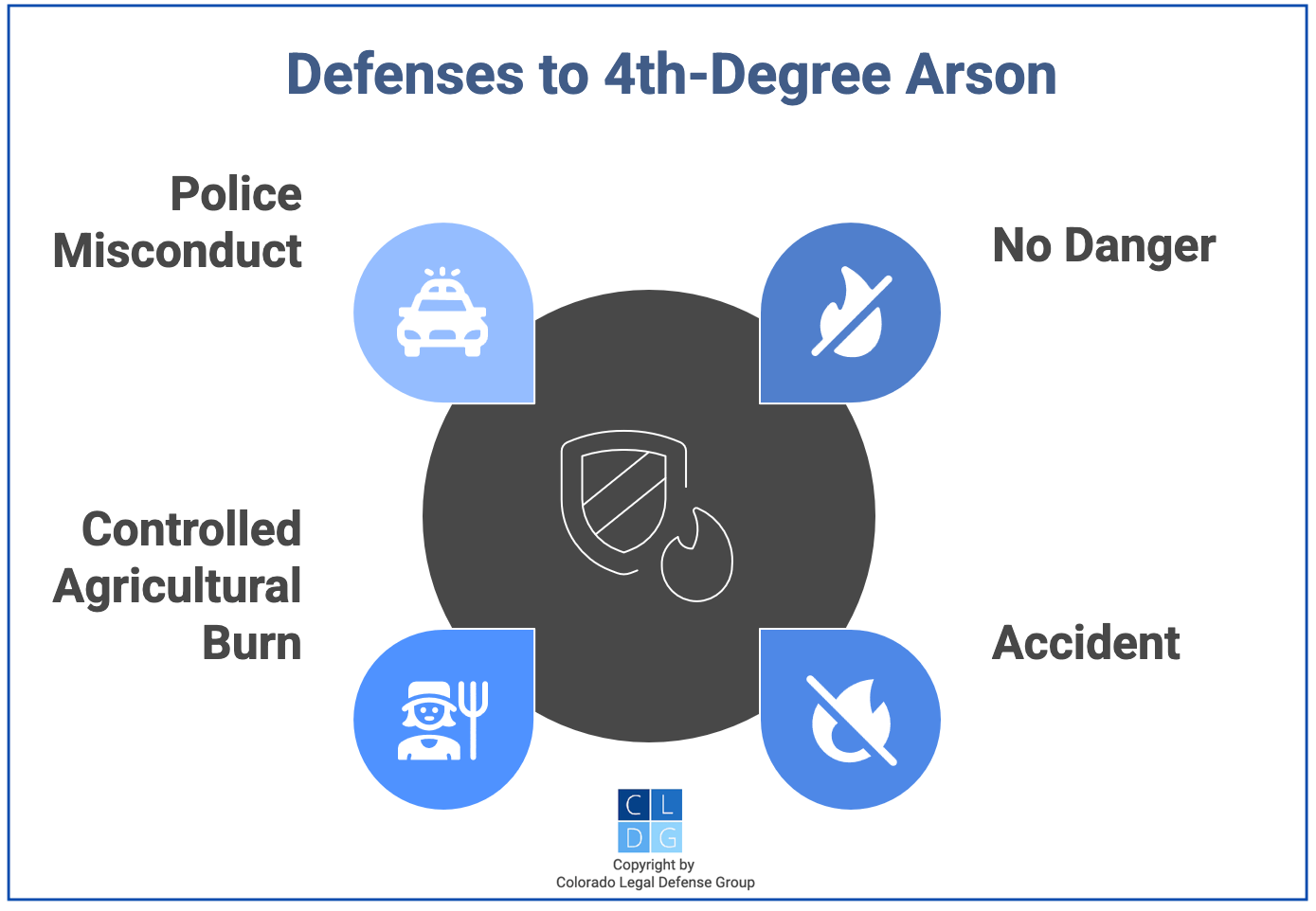
Here at Colorado Legal Defense Group, we have represented countless people charged with arson, including fourth-degree arson. In our experience, the following four defenses have proven very effective at getting C.R.S. 18-4-105 charges reduced or dismissed.
- There was no danger. If neither property nor people were put in danger, you cannot be liable for fourth-degree arson. Additionally, if only property was imperiled, the penalties for a conviction are lower.
- The fire was an accident. Fourth-degree arson requires the fire or explosion to be at least recklessly set. You cannot be held liable for fourth-degree arson if the fire was an honest accident.
- You were performing a controlled agricultural burn. Reasonable and controlled farming techniques that clear the land of crop residue and weeds by setting them on fire is not arson.
- The police committed misconduct. Typical examples are unlawful searches or coerced confessions.
Common evidence in these cases are video surveillance, eyewitnesses, and certified fire expert testimony.
3. Penalties
As discussed above, fourth-degree arson in Colorado is a class 4 felony if a person is endangered with death or serious bodily injury. This carries:
- 2 to 6 years in prison (plus 3 years of parole) and/or
- $2,000 to $500,000.
If no one is endangered, the punishment for fourth-degree arson turns on the value of the property endangered, as the following table shows:
|
Value of Property |
Colorado 4th-Degree Arson Penalties |
| Less than $300 | Petty offense: Up to 10 days in jail and/or a fine of up to $300 |
| $300 to less than $1,000 | Class 2 misdemeanor: Up to 120 days in jail and/or a fine of up to $750 |
| $1,000 to less than $2,000 | Class 1 misdemeanor: Up to 364 days in jail and/or a fine of up to $1,000 |
| $2,000 to less than $5,000 | Class 6 felony: 1 year to 18 months in prison and/or $1,000 to $100,000 |
| $5,000 to less than $20,000 | Class 5 felony: 1 to 3 years in prison and/or $1,000 to $100,000 |
| $20,000 to less than $100,000 | Class 4 felony: 2 to 6 years in prison and/or $2,000 to $500,000 |
| $100,000 to less than $1,000,000 | Class 3 felony: 4 to 12 years in prison and/or $3,000 to $750,000 |
| $1,000,000 or more | Class 2 felony: 8 to 24 years in prison and/or $5,000 to $1,000,000 |
Judges can also order you to pay restitution to the victim.11
Fourth-degree arson is treated as a class 4 felony in Colorado.
4. Arson Degrees
Colorado law has four degrees of arson, as the following table spells out (from most serious to least serious):
|
Colorado Arson Crime |
Penalties (generally)* |
| First degree (C.R.S. 18-4-102): Knowingly damaging someone else’s building or occupied structure with fire or explosives. | Of an occupied structure – Class 3 felony: 4 to 12 years in prison and/or $3,000 to $750,000.
Of a building – Class 4 felony: 2 to 6 years in prison and/or $2,000 to $500,000. |
| Second degree (C.R.S. 18-4-103): Knowingly burning property other than a building or occupied structure without the owner’s consent. | A felony, misdemeanor, or petty offense depending on the value of the endangered property. |
| Third degree (C.R.S. 18-4-104): Intentionally setting fire in order to defraud someone. | Class 5 felony: 1 to 3 years in prison and/or $1,000 to $100,000. |
| Fourth degree (C.R.S. 18-4-105): Knowingly or recklessly endangering someone else or their property by setting a fire. | If someone is endangered – Class 4 felony: 2 to 6 years in prison and/or $2,000 to $500,000.
If no one is endangered – A felony, misdemeanor, or petty offense depending on the value of the endangered property. |
| * In addition to jail and/or fines, you could also have to pay the victim restitution for the property damage and/or medical bills. | |
A common Colorado crime related to arson is criminal mischief (C.R.S. 18-4-501), which is also called vandalism or the destruction of property. It can be a petty offense, misdemeanor, or felony depending on the case.
Frequently Asked Questions
What is the difference between fourth-degree arson and other arson charges in Colorado?
Fourth-degree arson is the least serious arson charge. It only requires that you knowingly or recklessly started a fire that endangered someone or their property – no actual damage or injury needs to occur. First and second-degree arson require actually damaging buildings or property, while third-degree arson involves intent to defraud someone.
Can I be charged with fourth-degree arson if the fire was an accident?
No, you cannot be convicted of fourth-degree arson for a true accident. The law requires that you either knowingly or recklessly started the fire. If the fire was an honest accident that you could not have reasonably prevented, this is a valid defense against arson charges.
What penalties will I face for fourth-degree arson in Colorado?
Penalties depend on whether people were endangered. If someone was put in danger of death or serious injury, it is a class 4 felony with two to six years in prison and fines up to $500,000. If only property was endangered, penalties range from a petty offense (up to 10 days in jail) to a class 2 felony (eight to 24 years in prison) depending on the property’s value.
What counts as “endangering” someone or their property for arson charges?
Endangering means putting people at risk of death or serious injury, or putting buildings/occupied structures at risk of any damage. The danger does not have to be immediate, and property damage can be minor. Buildings include homes, garages, and mobile homes, while occupied structures are areas where people or animals are currently present, like cars or campgrounds.
Additional Reading
For more in-depth information on arson laws, refer to these scholarly articles:
- The Evolution of Fire Investigation and its Impact on Arson Cases – Criminal Justice.
- The Metamorphosis of the Law of Arson – Missouri Law Review.
- Assessment, Treatment and Sentencing of Arson Offenders: An Overview – Psychiatry, Psychology, and Law.
- Legal Aspects of Arson – Journal of Criminal Law, Criminology & Police Science.
- The Crime of Arson – Journal of Criminal Law & Criminology.
Legal References:
- C.R.S. 18-4-105 – Fourth degree arson.
(1) A person who knowingly or recklessly starts or maintains a fire or causes an explosion, on his own property or that of another, and by so doing places another in danger of death or serious bodily injury or places any building or occupied structure of another in danger of damage commits fourth degree arson.
(2) Fourth degree arson is a class 4 felony if a person is thus endangered.
(3) Fourth degree arson is:
(a) A petty offense if only property is thus endangered and the value of the property is less than three hundred dollars;
(b) A class 2 misdemeanor if only property is thus endangered and the value of the property is three hundred dollars or more but less than one thousand dollars;
(c) A class 1 misdemeanor if only property is thus endangered and the value of the property is one thousand dollars or more but less than two thousand dollars;
(d) A class 6 felony if only property is thus endangered and the value of the property is two thousand dollars or more but less than five thousand dollars;
(e) A class 5 felony if only property is thus endangered and the value of the property is five thousand dollars or more but less than twenty thousand dollars;
(f) A class 4 felony if only property is thus endangered and the value of the property is twenty thousand dollars or more but less than one hundred thousand dollars;
(g) A class 3 felony if only property is thus endangered and the value of the property is one hundred thousand dollars or more but less than one million dollars; and
(h) A class 2 felony if only property is thus endangered and the value of the property is one million dollars or more.
(4) Repealed.(5) It shall not be an arson offense pursuant to this section if:
(a) A person starts and maintains a fire as a controlled agricultural burn in a reasonably cautious manner; and
(b) No person suffers any of the following as a result of the fire:
(I) Bodily injury;
(II) Serious bodily injury; or
(III) Death.
(6) For purposes of this section, “controlled agricultural burn” means a technique used in farming to clear the land of any existing crop residue, kill weeds and weed seeds, or reduce fuel buildup and decrease the likelihood of a future fire.
- People v. Garcia, Supra.
- People v. Garcia, Supra.
- Copeland v. People (Colo. 2000) 2 P.3d 1283.
- Copeland v. People, Supra
- C.R.S. 18-4-101(1).
- People v. Simien (Colo.App. 1983) 671 P.2d 1021.
- People ex rel. VanMeveren v. District Court (Colo. 1980) 619 P.2d 494.
- C.R.S. 18-4-101(1).
- People v. Moyer (Colo. 1981) 635 P.2d 553.
- CRS 18-4-105. Before March 1, 2022, if property worth $100 or more was endangered (and no person was endangered), 4th degree arson was a class 2 misdemeanor carrying 3 to 12 months in jail and/or $250 to $1,000 in fines. If the property was worth $99 or less (and no person was endangered), then 4th degree arson was a class 3 misdemeanor carrying up to 6 months in jail and/or $50 to $750 in fines. SB21-271.