
Quick summary
California Vehicle Code 23572 adds mandatory jail to a DUI sentence when a child under 14 was a passenger in your car. For a first DUI, that means 48 extra hours in county jail, even if you get probation.
3 key things to know:
- The extra jail grows with each DUI: 48 hours, 10 days, 30 days or 90 days.
- The prosecutor must charge it and prove it. A plea to a lesser offense such as “wet reckless” avoids it.
- Prosecutors may charge child endangerment (Penal Code 273a) instead, which carries much longer probation. You can’t be punished under both for the same incident.

In this article, our California DUI defense lawyers answer 7 common questions about a DUI with a child in the car:
- 1. What happens if you get a DUI with a child in the car?
- 2. How much extra jail does VC 23572 add?
- 3. VC 23572 or child endangerment?
- 4. Defenses to a DUI with a child in the vehicle
- 5. License, custody and CPS
- 6. What if a child is hurt or killed?
- 7. Questions and answers
1. What happens if you get a DUI with a child in the car?
If you’re convicted of DUI and a child under 14 was riding in your car, the judge must add extra jail time to your sentence. This is called a sentence enhancement: it isn’t a separate crime, but it adds punishment on top of the DUI.1

What the prosecutor must prove
The enhancement applies only when all of these are true:
- You are convicted of DUI under Vehicle Code 23152 (driving under the influence or with a BAC of 0.08% or more).
- A minor under 14 was a passenger in the vehicle “at the time of the offense.”1
- The prosecutor “pled and proven” it: the complaint must allege the child passenger, and the prosecution must prove it beyond a reasonable doubt or you must admit it.2
In plain terms, the judge can’t add the extra jail at sentencing if the prosecutor never charged it.
What doesn’t matter
The enhancement applies no matter:
- whether you meant to put the child at risk,
- how high your blood alcohol level was, or
- how well you were driving.
What it doesn’t cover
VC 23572 applies only to a DUI conviction under Vehicle Code 23152. It doesn’t apply to a DUI causing injury under VC 23153, or to a plea to “wet reckless” (Vehicle Code 23103.5).1
Example: Maria is stopped on her way home with her 10-year-old son in the back seat. Her blood test shows a BAC of 0.10%, and it’s her first DUI. If she’s convicted of DUI with the child enhancement, she faces the usual first-DUI penalties plus 48 continuous hours in county jail.
2. How much extra jail does VC 23572 add?
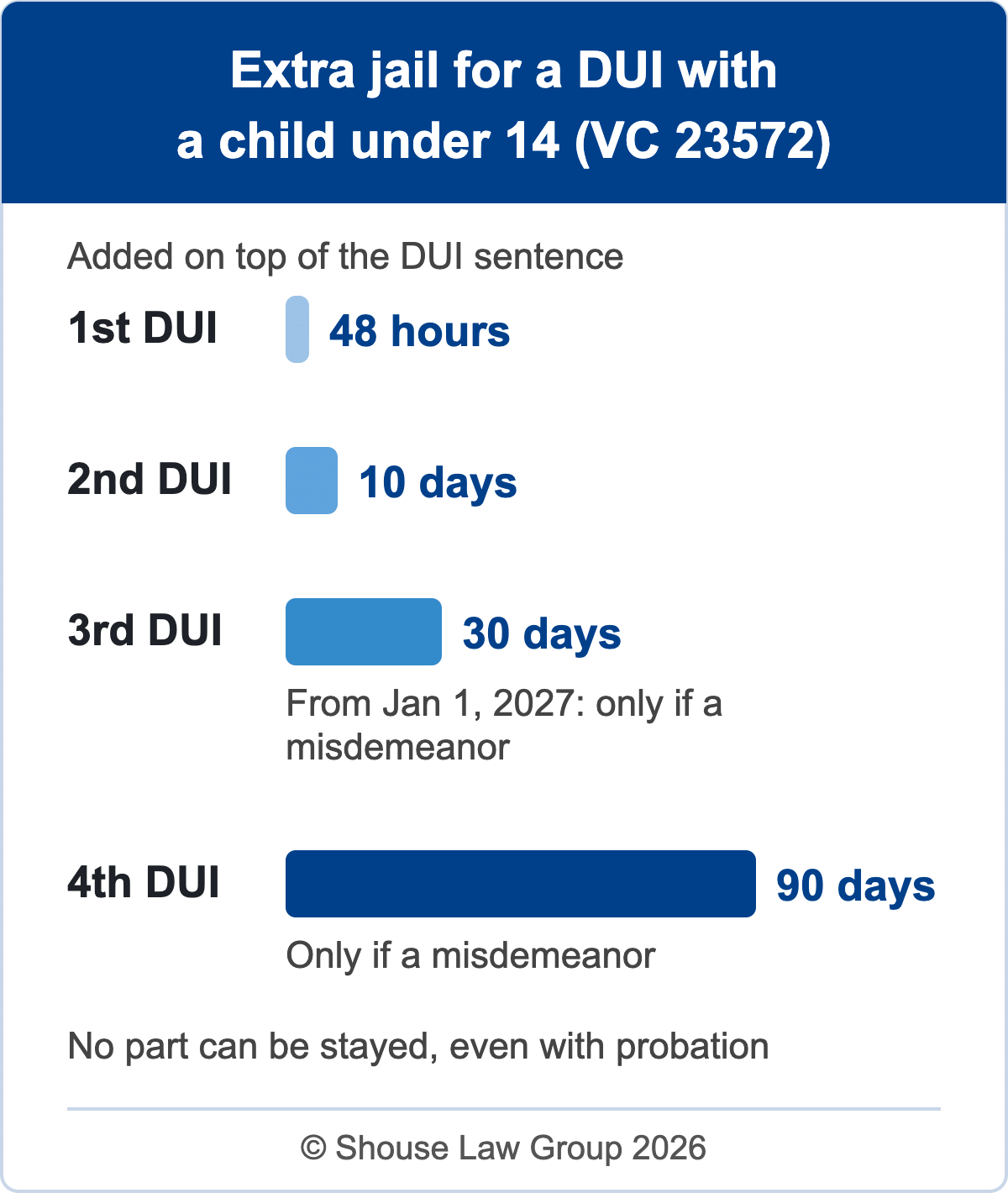
The extra jail depends on how many DUIs you have within 10 years:1
| DUI offense | Extra jail for a child under 14 in the car |
|---|---|
| 1st DUI | 48 continuous hours |
| 2nd DUI | 10 days |
| 3rd DUI | 30 days (from Jan 1, 2027, only if punished as a misdemeanor) |
| 4th DUI | 90 days, only if punished as a misdemeanor |
The extra jail can’t be suspended
The statute says the extra time applies “whether or not probation is granted, no part of which may be stayed.”1 That means the judge must order it even if you get probation, and can’t put any of it on hold. For a first DUI, the 48 hours must be “continuous,” so it can’t be split over separate days.
A change for third DUIs in 2027
A new law, AB 1546, takes effect on January 1, 2027. It lets prosecutors charge a third DUI within 10 years as either a misdemeanor or a felony. After that date, the 30-day child enhancement applies only when a third DUI is punished as a misdemeanor.3 A third DUI charged as a felony faces felony sentencing instead (see felony DUI).
This is on top of the DUI sentence
The extra jail is added to the normal DUI penalties. For a first DUI, those usually include 3 to 5 years of informal probation, fines and assessments of roughly $1,500 to $2,000 (as of November 2026), DUI school, a license suspension and possibly an ignition interlock device. See our page on first-offense DUI penalties for the details. A first DUI is a misdemeanor.
3. VC 23572 or child endangerment?
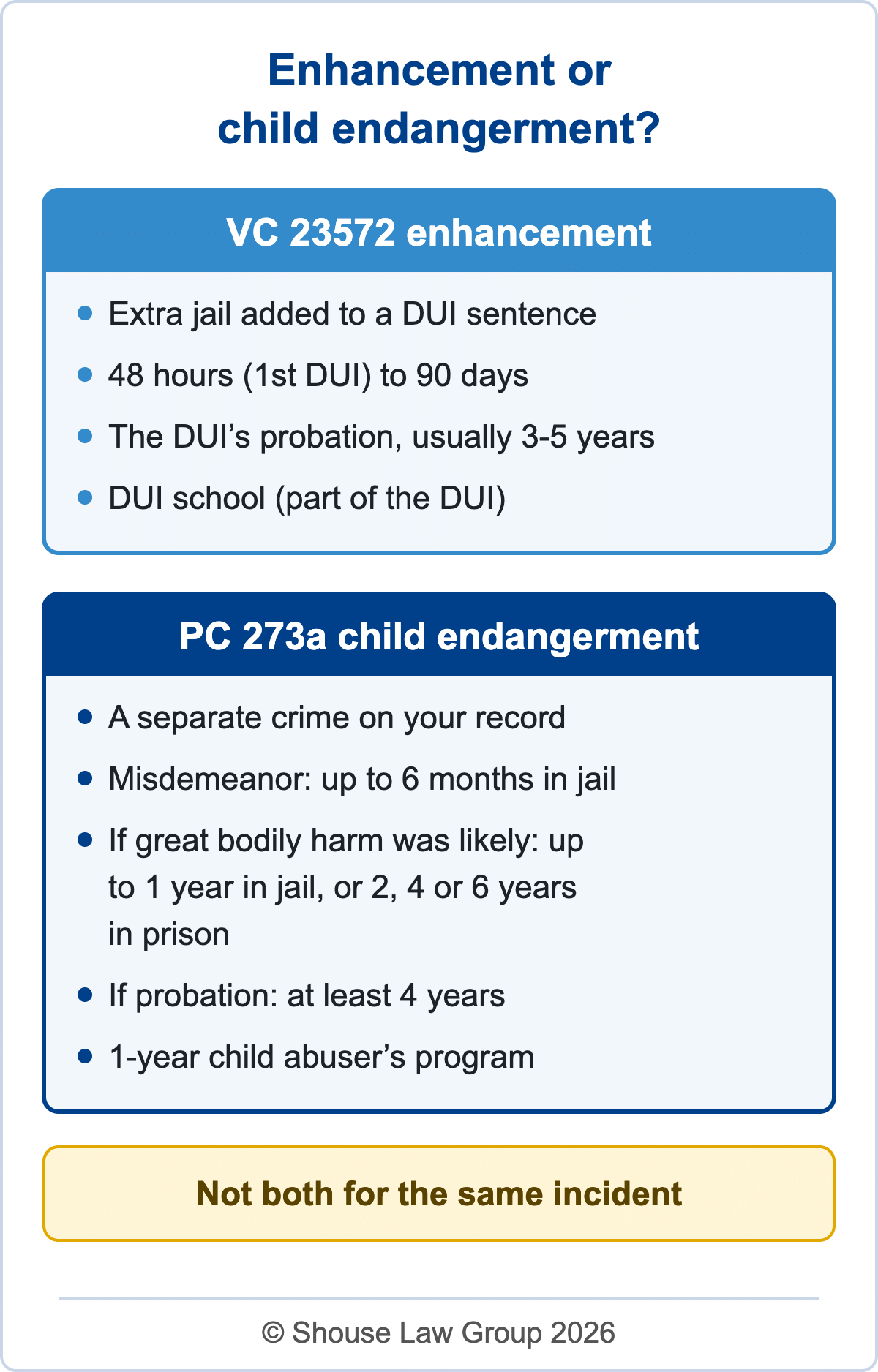
Prosecutors who see a child in the car may also charge child endangerment under Penal Code 273a. But you can’t receive the VC 23572 enhancement if you’re also convicted of child endangerment “arising out of the same facts and incident.”4 So the two usually end up as an either-or choice in plea talks.
What the prosecutor must prove for child endangerment
For child endangerment while caring for a child, the jury instruction requires proof that:5
- while having care or custody of a child, you willfully caused or permitted the child to be placed in a situation where the child’s person or health was endangered, and
- you were criminally negligent when you did so.
“Criminal negligence” means more than ordinary carelessness. In People v. Valdez, the California Supreme Court held that criminal negligence is the standard for felony child endangerment.6 The question is whether your conduct was a gross departure from how a careful person would act, not just whether you made a mistake.
Child endangerment penalties
Child endangerment can be charged two ways:7
- When great bodily harm or death was likely: a “wobbler,” punishable by up to 1 year in county jail, or 2, 4 or 6 years in state prison as a felony.
- Otherwise: a misdemeanor, punishable by up to 6 months in jail and a fine of up to $1,000.
Why the choice matters
If you get probation for child endangerment, the law requires at least 48 months of probation, a protective order, and at least one year of a child abuser’s treatment program.8 A DUI with the VC 23572 enhancement usually means a few extra days in jail but no year-long child abuse program.
In our experience, prosecutors will sometimes drop a child endangerment count in exchange for a plea that includes the VC 23572 enhancement.
4. Defenses to a DUI with a child in the vehicle
We have defended many people charged with DUI with a child in the car. These are the defenses we use most, each tied to something the prosecutor must prove.
You weren’t guilty of DUI
No DUI conviction means no enhancement. We look closely at the evidence of impairment: breath tests can be thrown off by medical conditions, blood samples can be mishandled, and officers often give field sobriety tests or preliminary breath tests the wrong way. A plea to a lesser charge such as wet reckless also avoids the enhancement.
The passenger was 14 or older
The law applies only to a passenger “under 14 years of age.”1 Officers sometimes guess a child’s age. A birth certificate or other record showing the passenger was at least 14 defeats the enhancement.
The child wasn’t in the car while you were driving
The child must have been a passenger “at the time of the offense.”1 If the child got into the car only after you had parked, or was picked up by someone else before you drove, the enhancement shouldn’t apply.
The enhancement wasn’t charged
Because the child passenger must be “pled and proven,” the judge can’t add the extra jail if the complaint never alleged it.2
The stop or arrest was illegal
Police need a legal reason to stop you and probable cause to arrest you. We review dashcam and body camera video for mistakes. If the stop or arrest was illegal, we can file a motion to suppress evidence. If the judge excludes the key evidence, the prosecutor may not be able to prove the DUI at all.
5. License, custody and CPS
Your driver’s license
The child enhancement doesn’t change the DMV side of a DUI: the license suspension and any ignition interlock requirement follow the underlying DUI. See our pages on ignition interlock devices and DMV hearings.
What happens to the child at the arrest
If you’re arrested with a child in the car, officers usually let you call the other parent or another relative to pick the child up. If no one is available, police may place the child in temporary protective custody, and child protective services may follow up.
Custody and family court
In a custody dispute, a family court deciding what’s best for a child must consider “the habitual or continual abuse of alcohol” by either parent. The court may ask for corroboration such as reports from law enforcement agencies and courts.9 A DUI arrest report with a child in the car can become part of that picture, so it’s worth talking to a lawyer early if custody is an issue.
6. What if a child is hurt or killed?
If a child passenger is injured, prosecutors usually charge DUI causing injury (VC 23153) and often felony child endangerment. If a child dies, the possible charges include:
- vehicular manslaughter while intoxicated or gross vehicular manslaughter while intoxicated (Penal Code 191.5),10
- vehicular manslaughter (Penal Code 192(c)),11 and
- in some cases, “Watson” DUI murder, a form of second-degree murder.
Ordinary involuntary manslaughter under Penal Code 192(b) doesn’t apply to deaths caused while driving.11
7. Questions and answers
Is a DUI with a child in the car a felony?
Not by itself. VC 23572 adds jail to a DUI, and a first or second DUI is usually a misdemeanor. It can become a felony if the child is hurt or if prosecutors charge felony child endangerment.
Can I get both VC 23572 and child endangerment?
Not for the same incident. If you’re convicted of child endangerment under Penal Code 273a for the same facts, the VC 23572 enhancement can’t be imposed.
Does VC 23572 apply if my passenger was 15?
No. It applies only to passengers under 14. Prosecutors could still consider child endangerment for an older minor.
Will CPS get involved?
It can. If no family member can pick up the child at the arrest, police may place the child in temporary protective custody, and child protective services may follow up.
Does a wet reckless plea avoid the enhancement?
Yes. VC 23572 applies only to a DUI conviction under Vehicle Code 23152, so a plea to wet reckless avoids the extra jail.
Charged with a DUI with a child in the car? Our California DUI defense lawyers can review the evidence, the charges and your options, including whether the enhancement or a child endangerment charge can be avoided. Call us or contact us online for a free consultation.
Legal references:
- California Vehicle Code 23572(a) VC: “If any person is convicted of a violation of Section 23152 and a minor under 14 years of age was a passenger in the vehicle at the time of the offense, the court shall impose the following penalties in addition to any other penalty prescribed: (1) … imprisonment of 48 continuous hours in the county jail, whether or not probation is granted, no part of which shall be stayed.”
- California Vehicle Code 23572(b) VC: “The driving of a vehicle in which a minor under 14 years of age was a passenger shall be pled and proven.”
- AB 1546 (2025-2026 Reg. Sess.), Stats. 2026, ch. 444, amending Vehicle Code 23546 and 23572: “(3) If a person is convicted of a violation of Section 23152 that is punished as a misdemeanor under Section 23546, the punishment shall be enhanced by an imprisonment of 30 days in the county jail…”
- California Vehicle Code 23572(c) VC: “No punishment enhancement shall be imposed pursuant to this section if the person is also convicted of a violation of Section 273a of the Penal Code arising out of the same facts and incident.”
- CALCRIM 821 (Child Abuse Likely to Produce Great Bodily Harm or Death): “The defendant, while having care or custody of a child, willfully caused or permitted the child to be placed in a situation where the child’s person or health was endangered…” and “The defendant was criminally negligent…”
- People v. Valdez (2002) 27 Cal.4th 778, 780: “We reaffirm criminal negligence is the appropriate standard…”
- California Penal Code 273a(a)-(b) PC; see also Penal Code 19 (misdemeanor punishment).
- California Penal Code 273a(c) PC: “If a person is convicted of violating this section and probation is granted, the court shall require the following minimum conditions of probation: (1) A mandatory minimum period of probation of 48 months…”
- California Family Code 3011(a)(4): “The habitual or continual illegal use of controlled substances, the habitual or continual abuse of alcohol, or the habitual or continual abuse of prescribed controlled substances by either parent.”
- California Penal Code 191.5 PC.
- California Penal Code 192(b) PC: “This subdivision shall not apply to acts committed in the driving of a vehicle.”