
Quick summary
California Vehicle Code 21200 gives bicycle riders the same rights and duties as drivers of vehicles on the road. Cyclists must obey traffic signals, stop signs and other rules of the road, except rules that by their nature can’t apply to a bike.
- Penalties: A bike ticket is usually an infraction with a fine that depends on which rule was broken. It generally should not add points to your driving record.
- Cycling under the influence: Riding a bike on a highway while impaired violates VC 21200.5, with a fine of up to $250 and a 1-year license suspension for riders 13 to 20.
- Defenses: The officer was mistaken, or an emergency forced you to break the rule.
- Example: Diego rides his bike through a red light in San Diego. He can be ticketed just as a driver would be, because VC 21200 applies the red-light law to cyclists.
The text of the statute reads:
21200. (a) (1) A person riding a bicycle or operating a pedicab upon a highway has all the rights and is subject to all the provisions applicable to the driver of a vehicle by this division, including, but not limited to, provisions concerning driving under the influence of alcoholic beverages or drugs, and by Division 10 (commencing with Section 20000), Section 27400, Division 16.7 (commencing with Section 39000), Division 17 (commencing with Section 40000.1), and Division 18 (commencing with Section 42000), except those provisions which by their very nature can have no application.
(2) A person operating a bicycle on a Class I bikeway, as defined in subdivision (a) of Section 890.4 of the Streets and Highways Code, has all the rights and is subject to all the provisions applicable to the driver of a vehicle pursuant to Section 20001, except those provisions which by their very nature can have no application.
(b) (1) A peace officer, as defined in Chapter 4.5 (commencing with Section 830) of Title 3 of Part 2 of the Penal Code, operating a bicycle during the course of his or her duties is exempt from the requirements of subdivision (a), except as those requirements relate to driving under the influence of alcoholic beverages or drugs, if the bicycle is being operated under any of the following circumstances: (A) In response to an emergency call. (B) While engaged in rescue operations. (C) In the immediate pursuit of an actual or suspected violator of the law.
(2) This subdivision does not relieve a peace officer from the duty to operate a bicycle with due regard for the safety of all persons using the highway.1
Under this California bicycle law, cyclists must, for example:
- follow traffic signals,
- obey speed limits,
- stop at stop signs, and
- ride on the right-hand side of the road.
In this article, our California auto accident attorneys explain:
- 1. What VC 21200 does
- 2. Penalties
- 3. Legal defenses
- 4. Traffic school
- 5. Criminal charges
- 6. Ignoring a ticket
- 7. Cycling under the influence
- Additional resources
1. What VC 21200 does
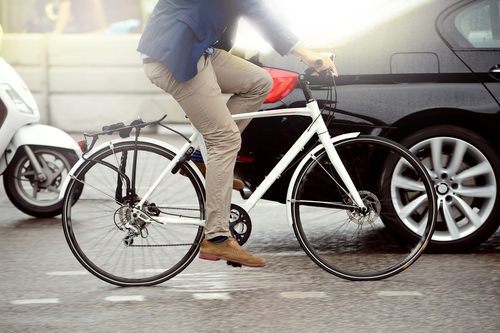
In California, Vehicle Code 21200(a) gives bicycle riders (and pedicab operators) on a road all the rights, and all the duties, of vehicle drivers. That includes the rules of the road, the ban on riding under the influence, and the duty to stop after a collision. The only exceptions are rules that by their very nature can’t apply to a bicycle, such as rules about seat belts or license plates.2
The duty to stop after an accident that injures someone also applies to cyclists on Class I bikeways (paved bike paths separated from the road).3
VC 21200(b) exempts peace officers on bicycles from these rules (except the rules on riding under the influence) when they are:
- responding to an emergency call,
- engaged in rescue operations, or
- in immediate pursuit of an actual or suspected lawbreaker.
Even then, the officer must still ride with due regard for everyone’s safety.4
2. Penalties
A cyclist who breaks a rule of the road can get a ticket and must pay a fine. The amount depends on which law was violated. Most moving violations carry the same base fine for cyclists as for drivers (often $35, about $234 after assessments and fees as of 2026).5
California’s DMV point system counts traffic convictions “involving the safe operation of a motor vehicle.” Because a bicycle isn’t a motor vehicle, a bike ticket generally should not add points to your driving record.6 If a point does appear, a traffic lawyer can help you challenge it.

3. Legal defenses
If you get a ticket while cycling, you don’t have to plead guilty. You can challenge it with a legal defense. Two common defenses are:
- an emergency forced you to break the rule; and
- the officer made a mistake about what happened.
Whatever the defense, back it up with credible evidence, such as:
- witnesses,
- photographs, and
- helmet-camera, dashcam or surveillance video.
4. Traffic school
You don’t have to attend traffic school for a bicycle ticket, but you may be able to choose it if:7
- you have a valid driver’s license;
- you were not operating a commercial vehicle; and
- the ticket is for a moving-violation infraction.
If you choose traffic school, you still pay the fine (plus a traffic school fee), but the conviction stays confidential.
5. Criminal charges
Most bicycle violations are infractions under California law, not crimes, so they don’t carry jail time. The main exceptions are cycling under the influence (section 7 below) and serious offenses such as leaving the scene of an injury accident.
6. Ignoring a ticket
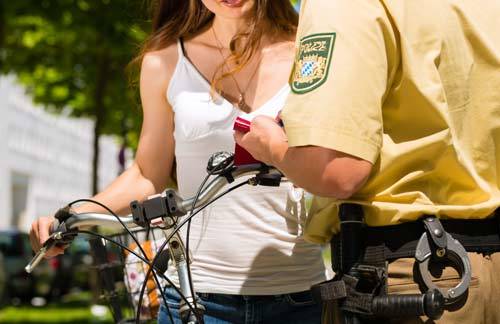
When you get a traffic ticket in California, you sign a written promise to appear in court. If you willfully break that promise, you violate Vehicle Code 40508, no matter how the original ticket turns out.8 “Willfully” means on purpose; you don’t have to intend to break the law.9 VC 40508 also covers willfully failing to pay bail installments or a fine on time.
A VC 40508 violation is a misdemeanor punishable by up to 6 months in county jail and/or a fine of up to $1,000.10 The court can also add a civil assessment of up to $100.11
7. Cycling under the influence
Cycling under the influence (CUI) is illegal in California under Vehicle Code 21200.5.12 To convict you, the prosecutor must prove that:
- you rode a bicycle;
- you rode it on a highway (any public road); and
- while riding, you were under the influence of alcohol, drugs, or both.
Anyone arrested for CUI may ask for a blood, breath or urine test, and the officer must have it done.
The penalty for CUI is a fine of up to $250, with no jail time. If you were 13 to 20 years old, the court must also suspend your driver’s license for 1 year (or delay your eligibility for one if you don’t have a license yet).13
Example: Kevin, 19, rides his bike home from a party after several beers and is stopped for weaving across lanes. If he is convicted of CUI, he faces a fine of up to $250 and a 1-year suspension of his driver’s license.
CUI penalties are far lighter than California’s DUI penalties, but a CUI conviction is still treated as a criminal conviction on your record.
Additional resources
For bicycle safety tips, see:
- National Highway Traffic Safety Administration – the federal agency responsible for vehicle safety standards and reducing traffic injuries and deaths.
- Go Safely California – a traffic safety campaign by the California Office of Traffic Safety.
- CalBike – the California Bicycle Coalition, an advocacy group promoting safer bicycling.
- Visit California – the state’s official tourism organization.
- California DMV – the DMV’s guide for bicyclists and pedestrians.
Legal references:
- California Vehicle Code 21200 VC (as of November 2026; last amended by AB 1755, effective January 1, 2019).
- Vehicle Code 21200(a)(1) (see note 1 above).
- Vehicle Code 21200(a)(2); Vehicle Code 20001.
- Vehicle Code 21200(b).
- Judicial Council of California, Uniform Bail and Penalty Schedules, 2026 Edition (Category 2: “$35 + $123 + $75 = $233”; county totals vary slightly).
- California Vehicle Code 12810(f): “any other traffic conviction involving the safe operation of a motor vehicle upon the highway shall be given a value of one point.”
- California Vehicle Code 42005; Vehicle Code 1808.7.
- California Vehicle Code 40508(a)-(b).
- CALCRIM No. 2240 (Failure to Appear).
- California Penal Code 19.
- California Penal Code 1214.1(a).
- California Vehicle Code 21200.5: “it is unlawful for any person to ride a bicycle upon a highway while under the influence of an alcoholic beverage or any drug, or under the combined influence of an alcoholic beverage and any drug. … A conviction of a violation of this section shall be punished by a fine of not more than two hundred fifty dollars ($250).”
- California Vehicle Code 13202.5(a).