
You will likely face more severe DUI penalties if you drive drunk and contribute to a car accident (as opposed to if you drive while intoxicated and avoid a collision).
DUI penalties will also likely grow more severe if you help cause a DUI accident and the accident results in someone getting injured or killed. In general, your penalties will grow harsher as the injuries in your case become more serious.
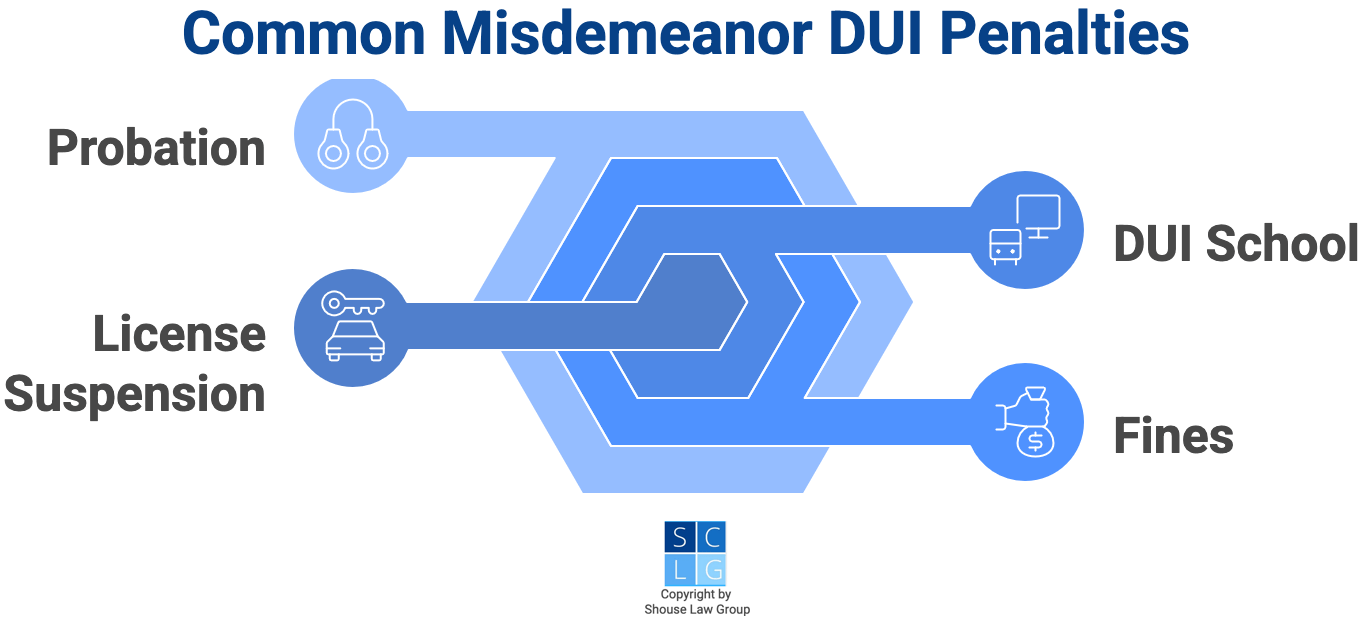
Note that the DUI laws of most states say that a first-time DUI case or a first offense of DUI with no injuries is punishable by:
- a misdemeanor charge on your record,
- jail time from a few days up to 6 months,
- a driver’s license suspension for up to 6 months,
- fines, and
- probation (between 3 to 5 years).
1. DUI with No Injury
If you drive drunk and help cause an accident that does not cause any type of injury, you will likely face an otherwise normal DUI charge.
With these types of DUI accident cases, you will usually face the same drunk driving penalties as if no accident took place. However, the prosecutor might recommend that the judge impose a sentence closer to the maximum penalty range.
Example: Joe gets in a drunk driving accident in Miami, FL while driving his motor vehicle while intoxicated. The accident, though, is only a fender bender where no one gets injured.
Under Florida law, Florida Statutes 316.193 (2022), a few possible penalties for DUI include jail time for up to six months, a fine between $500 to $1,000, and installation of an ignition interlock device (IID) for up to six months.
Here, a prosecutor would likely file criminal charges against Joe of regular DUI. Though the prosecutor could also recommend that Joe receive a sentence near the high end of the penalties authorized under Florida law.
This request could include jail time close to six months (as opposed to just a few days), a fine of $1,000 (as opposed to $500), installation of an IID for a full six months, and probation for four years.
Most DUIs without injuries are treated as misdemeanors.
2. DUI with Minor Injury
In this scenario, a prosecutor will likely charge you with the crime of “DUI causing injury.” Most jurisdictions treat this DUI offense as a more serious crime than a regular DUI/DWI.
Prosecutors generally have to prove the following to secure a DUI conviction in these cases:
- you drove a motor vehicle while under the influence of drugs and/or alcohol1, and
- in doing so, you caused an accident that led to a minor injury.2
Many jurisdictions consider a DUI causing minor injury a wobbler offense, meaning it can lead to either misdemeanor or felony charges. Some potential penalties include:
- custody in county jail or even state prison,
- a fine in the amount of several thousands of dollars, and
- a driver’s license suspension for several years.3
Note that the meaning of “minor injury” will likely depend on:
- the facts of your case and
- the laws of the state in which you are convicted of DUI in.
Typically, though, a minor injury may include something like whiplash, a laceration, or bruising.

Depending on the state, a first-time DUI often carries no jail if you complete all probation terms.
3. DUI with Serious Injury
Some states have a specific statute addressing DUI with serious injury, while other states would instead charge you with:
- aggravated assault,
- endangerment, or
- reckless driving causing injury.4
No matter the statute under which you are charged, you will likely face more severe criminal penalties than with the other forms of DUI as discussed above. For example, you could face such serious consequences as:
- years in jail or prison,
- a driver’s license revocation, and
- felony probation.

Following a DUI arrest, you usually can choose between taking a breath test or blood test.
4. DUI with Death
This is perhaps the most serious DUI crime that you can commit, and most states charge it as:
- vehicular homicide or
- vehicular manslaughter.
In general, you commit vehicular homicide if you:
- drive a motor vehicle recklessly or while under the influence of drugs and/or alcohol, and
- in doing so, you contribute to an accident that results in the death of some person (either a passenger, other motorist, or pedestrian).5
Penalties for this crime can include:
- years in state prison,
- thousands of dollars in fines, and
- a driver’s license revocation.

Typical DUI penalties include fines, a license suspension, and DUI School.
5. Defenses
Just because you were intoxicated and involved in an accident does not mean your intoxication caused the accident. For you to be convicted of DUI causing injury or death, prosecutors have the burden to prove beyond a reasonable doubt that you:
- drove under the influence of alcohol and/or drugs and
- contributed to the accident.
If you were not responsible for the accident, you likely will only face a DUI charge without any type of aggravating circumstances.
Not causing an accident is one type of DUI defense that you can raise in these cases. You should consult with a DUI lawyer to learn of others.
Anyone arrested for DUI is advised to hire an attorney to represent them in court.
Additional Resources
For more information, refer to the following:
- Alcoholics Anonymous – 12-step program for overcoming alcoholism.
- Drunk Driving Overview – NHTSA page on drunk driving statistics and prevention.
- Impaired Driving: Get the Facts – CDC fact sheet on impaired driving.
- Driving Under the Influence (DUI) – California DMV page on driver license suspension for DUIs.
- MADD – Non-profit organization devoted to stopping drunk driving.
Legal References:
- A prosecutor can prove that you were under the influence via the results of field sobriety tests, or breathalyzer tests if your blood alcohol content (BAC) was at or above the legal blood alcohol level (which is usually 0.08%).
- See, for example, California Vehicle Code 23153 VC. See also People v. Meno (Cal.App. 2024) .
- See, for example, California Vehicle Code 23556 VC. See also Tellez v. Superior Court (2020), 56 Cal. App. 5th 439.
- See, for example, Missouri Statutes 577.010.
- See, for example, Colorado Revised Statutes 18-3-106.
