
Quick summary
Driving on a suspended license in California is a crime under Vehicle Code 14601.1 when you know your license is suspended or revoked. A first offense is a misdemeanor punishable by up to 6 months in jail and a $300 to $1,000 fine, though it can also be charged as an infraction.1
3 key things to know:
- The prosecutor must show you knew about the suspension, but a jury may assume you knew if the DMV mailed you a notice that didn’t come back.
- A second offense within 5 years means 5 days to 1 year in jail and a $500 to $2,000 fine, and your car can be impounded for 30 days.
- Starting January 1, 2027, the DMV stops suspending licenses for missing a traffic court date, and existing suspensions of that kind end that day.

In this article, our California criminal defense attorneys answer 11 common questions about driving on a suspended license:
- 1. What does VC 14601.1 prohibit?
- 2. What must the prosecutor prove?
- 3. Which suspended-license law applies to me?
- 4. Is it a misdemeanor or an infraction?
- 5. What are the penalties in California?
- 6. What are the best defenses?
- 7. What happens after you’re stopped?
- 8. Will the January 2027 law change help me?
- 9. Immigration, guns and expungement
- 10. Related offenses
- 11. Frequently asked questions
1. What does VC 14601.1 prohibit?
California Vehicle Code 14601.1(a) makes it a crime to drive while your driving privilege is suspended or revoked, if you know about the suspension. It is the “catch-all” suspended-license law. It covers every reason for a suspension that isn’t covered by Vehicle Code 14601, 14601.2 or 14601.5. The key part of the statute reads:
No person shall drive a motor vehicle when his or her driving privilege is suspended or revoked for any reason other than those listed in Section 14601, 14601.2, or 14601.5, if the person so driving has knowledge of the suspension or revocation.2
In plain terms, if your license is suspended for something like a missed court date, unpaid child support or no insurance, and you drive anyway, you can be charged under VC 14601.1. The full text of the statute is in the legal references at the end of this article.
Suspended vs. revoked
A suspension takes away your driving privilege for a set time or until you meet certain conditions. A revocation ends it, and you must reapply for a license later. VC 14601.1 treats driving under either one the same way. See our article on suspended vs. revoked licenses.

2. What must the prosecutor prove?
In California, the prosecutor must prove two things beyond a reasonable doubt to convict you under VC 14601.1:3
1) You drove while your driving privilege was suspended or revoked
This means your privilege to drive was actually suspended or revoked on the day you drove. It also covers people who never had a license. In People v. Matas, a California court held that drivers who were never issued a license could still be charged once the DMV suspended their driving privilege.4
A suspension also doesn’t end on its own when the suspension period runs out. In People v. Gutierrez, the court held that the license stays suspended until you complete the DMV’s reinstatement steps.5
Example: John’s license was suspended for one year after a DUI arrest. The year passes, but John never completes the DMV’s steps to get his license back. When he drives in Los Angeles a month later, he is still driving on a suspended license.
2) You knew your license was suspended or revoked
In California, you’re guilty only if you knew about the suspension. But the prosecutor doesn’t have to show you read the notice. A jury may decide you knew if the People prove that:6
- the DMV mailed you a notice of the suspension or revocation,
- it went to the most recent address you gave the DMV (or a newer address from you, a court or the police), and
- it was not returned to the DMV as undeliverable or unclaimed.
The jury doesn’t have to make that finding, and you can offer evidence that you never got the notice. It’s also on you to tell the DMV when you move.7 The rule used to be stricter for the prosecution. Older cases required proof that you actually knew, but the Legislature changed that in 1968 and 1994.8
Example: Maria moved from Fresno to Long Beach but never gave the DMV her new address. A suspension notice went to her old address and was never returned. If she is stopped in Long Beach, a jury may find she knew about the suspension, even though she says she never saw the letter.
3. Which suspended-license law applies to me?
In California, the reason your license was suspended decides which law applies and how harsh the penalty is. VC 14601.1 covers any reason not listed in the other four laws.
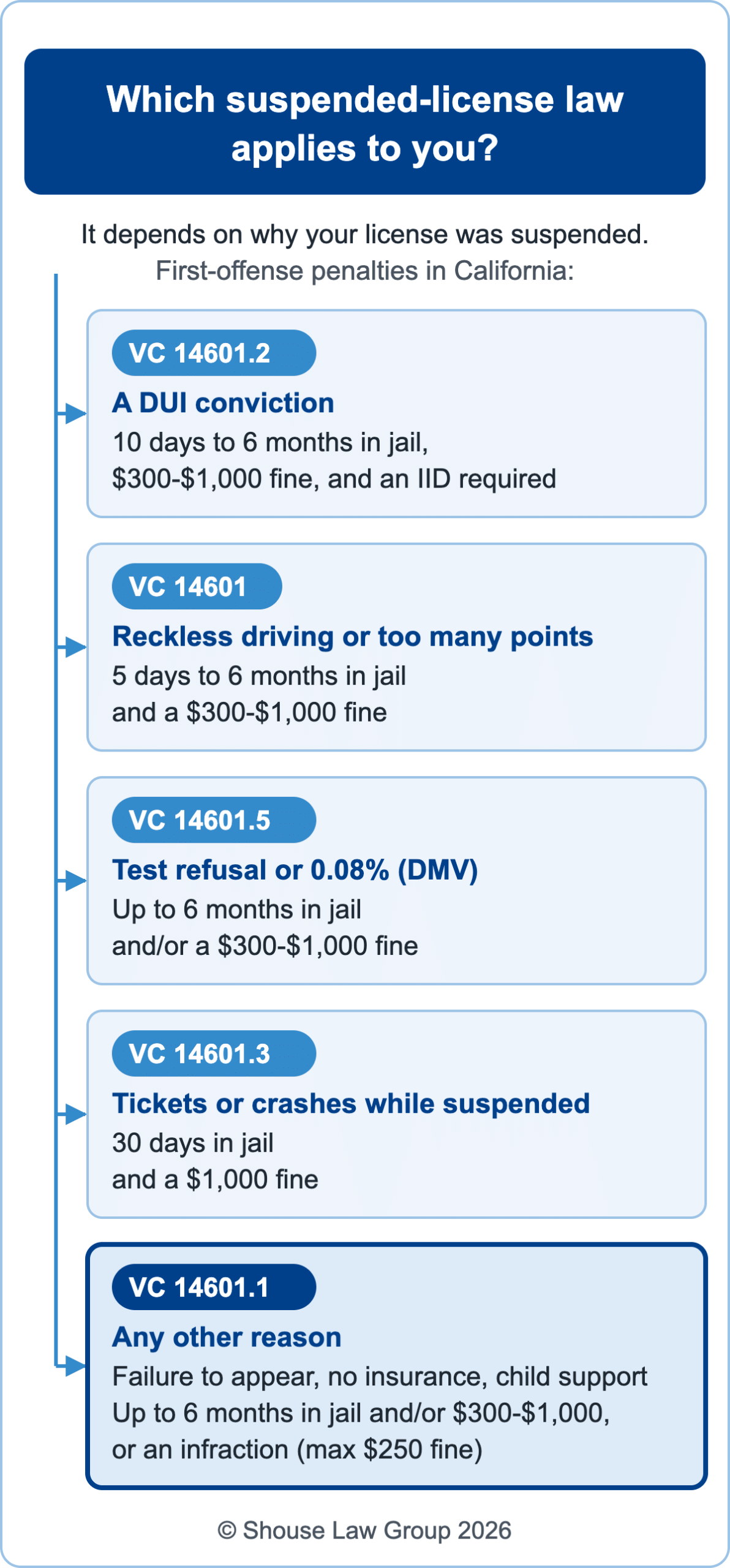
- Vehicle Code 14601 covers suspensions for reckless driving or for being a negligent operator (too many points), plus a few other DMV reasons.9
- Vehicle Code 14601.2 covers suspensions after a DUI conviction.10
- Vehicle Code 14601.5 covers DMV suspensions after a DUI arrest, for refusing a chemical test or testing at 0.08% or more.11
- Vehicle Code 14601.3 is a separate crime for building up a bad driving record while suspended: two or more 2-point convictions, three or more 1-point convictions, or three or more reportable accidents within 12 months.12
- Vehicle Code 14601.1 covers everything else, such as suspensions for no insurance, unpaid child support or missing a traffic court date.
4. Is it a misdemeanor or an infraction?
In California, VC 14601.1 is a “wobblette.” The prosecutor can file it as a misdemeanor or as an infraction, and a judge can reduce it to an infraction. As an infraction, the most you can be fined is $250, and there is no jail.13
The other suspended-license laws (VC 14601, 14601.2, 14601.3 and 14601.5) are misdemeanors. None of them is a felony on its own.
In our experience, getting your license reinstated before your court date often makes prosecutors more willing to reduce a 14601.1 charge to an infraction or to driving without a license (VC 12500).
5. What are the penalties in California?
In California, the penalty for driving on a suspended license depends on why your license was suspended and whether you have a prior conviction within 5 years. This table shows the jail time and fines for each law:14
| Law | Why the license was suspended | First offense | Repeat offense within 5 years |
|---|---|---|---|
| VC 14601.1 | Any reason not covered by the other laws (for example, no insurance, unpaid child support, missed court date) | Up to 6 months in jail and/or a $300–$1,000 fine, or an infraction (max $250) | 5 days to 1 year in jail and a $500–$2,000 fine |
| VC 14601 | Reckless driving, negligent operator (too many points) and certain other DMV reasons | 5 days to 6 months in jail and a $300–$1,000 fine | 10 days to 1 year in jail and a $500–$2,000 fine |
| VC 14601.2 | DUI conviction | 10 days to 6 months in jail, a $300–$1,000 fine and an ignition interlock device | 30 days to 1 year in jail and a $500–$2,000 fine |
| VC 14601.5 | Chemical test refusal or 0.08% DMV suspension | Up to 6 months in jail and/or a $300–$1,000 fine | 10 days to 1 year in jail and a $500–$2,000 fine |
| VC 14601.3 | Habitual traffic offender (tickets or accidents while suspended) | 30 days in jail and a $1,000 fine | 180 days in jail and a $2,000 fine (within 7 years) |
Court fees and penalty assessments are added on top of these fines, so the total you pay is usually much higher than the base fine.
Probation instead of jail
A judge can often grant misdemeanor (summary) probation instead of all or part of the jail time. In California, misdemeanor probation can last up to 1 year.15 Some laws still require jail time as a condition of probation. Under VC 14601.2, for example, a first offense requires at least 10 days in county jail.16
Ignition interlock for DUI-related suspensions
A conviction under VC 14601.2 requires an ignition interlock device (IID) on any vehicle you own or drive. The DMV won’t reinstate your license until it gets proof the IID is installed.17
Vehicle impound and DMV points
When police find you driving on a suspended license in California, they can arrest you and impound your car. An impounded car is held for 30 days, and you pay the towing and storage fees.18 A conviction also adds 2 points to your DMV driving record.19 More points can lead to a new suspension as a negligent operator.
6. What are the best defenses?
In California, you can fight a suspended-license charge with a good legal defense. We often see suspensions that were based on a notice mailed to an old address, or that should already have been lifted. Common defenses include:
1) You didn’t know about the suspension
If the DMV’s notice came back as undeliverable, went to the wrong address, or was never sent, the jury can’t rely on the mailing to find that you knew. Your lawyer can get your DMV record to check where and when the notice was sent.
This defense has a catch. In People v. Spence, a California court held that a driver who didn’t know about his suspension could still be convicted of driving without a valid license under Vehicle Code 12500, which doesn’t require knowledge.20 That charge can also be a misdemeanor or an infraction, so winning on knowledge often leads to a lesser charge rather than no charge.
2) Your license wasn’t actually suspended
The DMV makes mistakes. A suspension may have been entered in error, or you may have already cleared it. Your lawyer can compare your DMV record with the court’s and the DMV’s own notices. Keep in mind that a suspension doesn’t end just because time passed; you must complete the reinstatement steps.21 Our article on how to get your license back after a suspension explains the steps.
3) You were driving within a restricted license
If the DMV or a court gave you a restricted license (for example, to drive to work or a DUI program), driving within those limits is not a crime. You break the law only if you drive outside the restriction.22
4) The police stop was illegal
Officers need a legal reason, such as a traffic violation, to pull you over. If the stop was illegal, your lawyer can ask the court to throw out the evidence found because of it, including the officer’s check of your license.
5) Necessity
In California, necessity is a complete defense. It applies if you drove in an emergency to prevent significant harm to yourself or someone else, you had no adequate legal alternative, and your driving didn’t create a greater danger than the one you avoided.23
Example: Ana’s license is suspended for unpaid child support. Late at night her toddler stops breathing, no ambulance can come quickly, and no one else can drive. Ana drives her child to the nearest emergency room. She can argue necessity.
One thing we’ve found: your DMV driving record often decides these cases, so we request it right away.
7. What happens after you’re stopped?
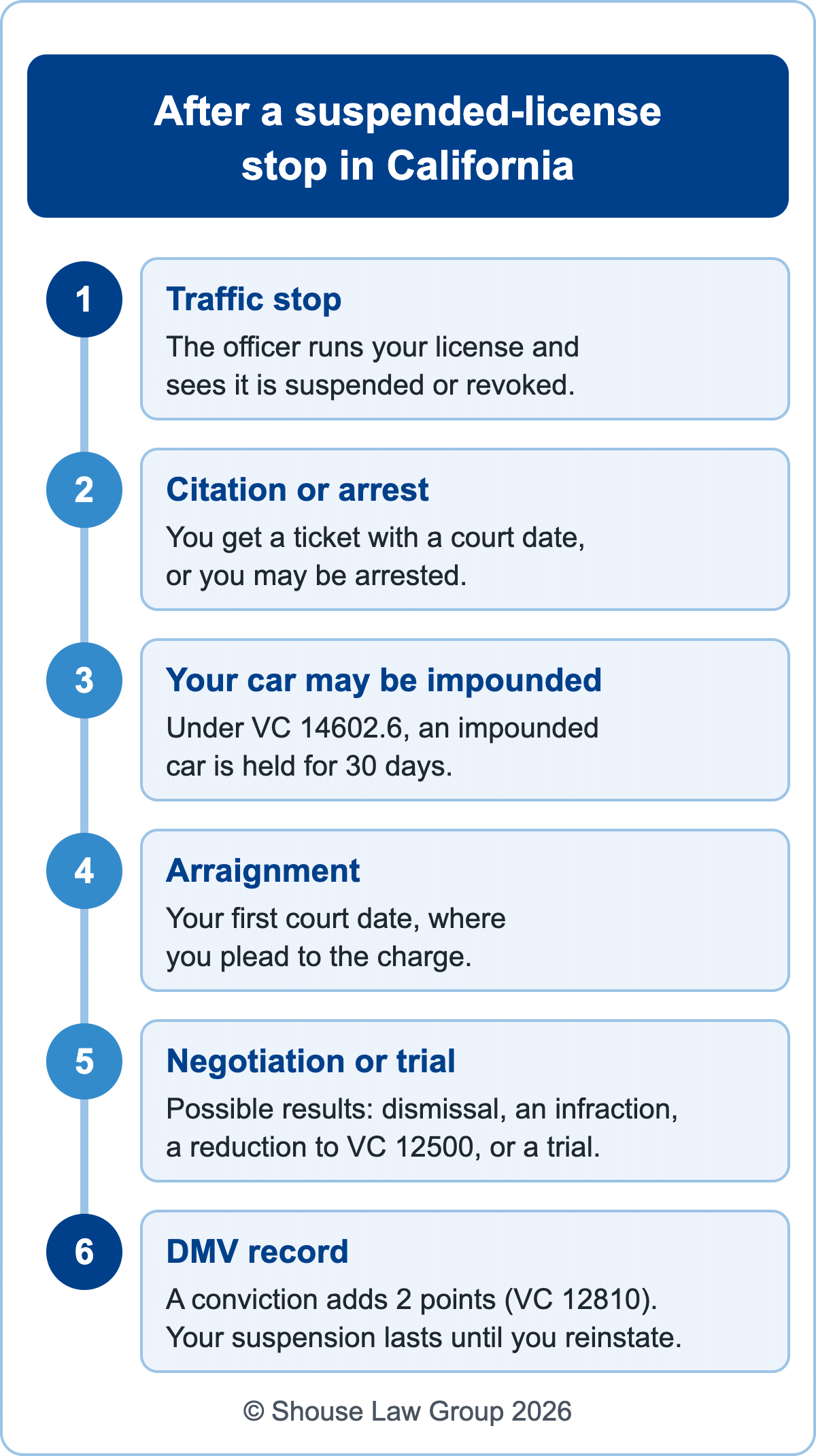
In California, a suspended-license case usually moves through these steps:
- The stop. An officer pulls you over and checks your license.
- Citation or arrest. You may get a ticket with a court date, or you may be arrested.
- Impound. Your car may be impounded for 30 days.24
- Arraignment. At your first court date you enter a plea. Many people talk to a lawyer before this date.
- Negotiation or trial. Possible results include a dismissal, a reduction to an infraction or to VC 12500, or a trial.
- DMV record. A conviction adds 2 points, and your suspension continues until you reinstate.
8. Will the January 2027 law change help me?
Starting January 1, 2027, the California DMV can no longer suspend your license because you missed a court date on a traffic ticket. Under Assembly Bill 2746, any suspension the DMV issued for that reason before January 1, 2027 ends on that date.25
This matters if your only suspension was for a missed traffic court date. After January 1, 2027, that suspension is gone. But other suspensions, such as those for a DUI, no insurance or unpaid child support, don’t end. Before you drive, check your license status with the DMV. A charge for driving before January 1, 2027 is still based on the law in effect when you drove.
Example: Luis’s license was suspended in 2025 because he missed a traffic court date in San Diego. He has no other suspensions. On January 1, 2027, that suspension ends, so driving in February 2027 is not driving on a suspended license.
9. Immigration, guns and expungement
Immigration consequences
A plain suspended-license conviction in California usually isn’t treated as a crime involving moral turpitude. But federal immigration authorities have treated a DUI committed while knowingly driving on a suspended license as one.26 If you aren’t a U.S. citizen, talk to a lawyer before you plead to any driving charge, because some convictions can lead to deportation or make you inadmissible.
Gun rights
In California, a suspended-license conviction doesn’t take away your right to own or possess a gun. The misdemeanors that trigger a gun ban are listed in the Penal Code, and none of them is a Vehicle Code offense.27
Expungement
You can usually get a suspended-license conviction expunged once you finish probation or your sentence, even if you had a probation violation along the way.28 An expungement doesn’t remove the conviction or the points from your DMV record.
10. Related offenses
- Driving without a license (VC 12500) makes it a crime to drive without a valid license. It can be a misdemeanor or an infraction.
- Failing to present a license (VC 12951) makes it a crime to drive without your license on you, or to refuse to show it to an officer.
- Unlawful use of a license (VC 14610) covers things like lending your license to someone or using a suspended or altered license.
- Driving on a suspended license causing injury (VC 14601.4) applies when someone is hurt by a driver whose license was suspended for DUI.
- Driving without proof of insurance (VC 16028(a)) often comes with a suspended-license stop. See our full list of California Vehicle Code offenses.
11. Frequently asked questions
Is driving on a suspended license a felony in California?
No. In California, driving on a suspended or revoked license is a misdemeanor under VC 14601 through 14601.5, and VC 14601.1 can even be charged as an infraction. Penalties go up if you have a prior conviction within 5 years.
Is VC 14601.1 a misdemeanor or an infraction?
It can be either. California Penal Code 19.8 lets the prosecutor or judge treat VC 14601.1 as an infraction, with a fine of no more than $250 and no jail.
Will my car be impounded for driving on a suspended license in California?
It can be. Under Vehicle Code 14602.6, police can impound your car, and an impounded car is held for 30 days at your expense.
How much is the fine for driving on a suspended license in California?
For a first VC 14601.1 offense, the base fine is $300 to $1,000, plus court fees and penalty assessments. A second offense within 5 years carries a $500 to $2,000 fine.
Can I go to jail for a first offense?
Yes, but it isn’t required under VC 14601.1, which allows up to 6 months in county jail. If your suspension was for a DUI conviction (VC 14601.2), a first offense means at least 10 days in jail.
Does my license suspension end automatically in California?
No. A California suspension continues until you complete the DMV’s reinstatement steps, even after the suspension period ends. Driving before you reinstate is still driving on a suspended license.
Call us for help
If you or a loved one has been charged with driving on a suspended license, our California criminal defense attorneys offer free consultations. Call us or fill out the form on this page, and we’ll review your DMV record and your options.
Legal references:
- California Vehicle Code 14601.1 VC. Full text (as of November 2026):
(a) No person shall drive a motor vehicle when his or her driving privilege is suspended or revoked for any reason other than those listed in Section 14601, 14601.2, or 14601.5, if the person so driving has knowledge of the suspension or revocation. Knowledge shall be conclusively presumed if mailed notice has been given by the department to the person pursuant to Section 13106. The presumption established by this subdivision is a presumption affecting the burden of proof.
(b) Any person convicted under this section shall be punished as follows:
(1) Upon a first conviction, by imprisonment in the county jail for not more than six months or by a fine of not less than three hundred dollars ($300) or more than one thousand dollars ($1,000), or by both that fine and imprisonment.
(2) If the offense occurred within five years of a prior offense which resulted in a conviction of a violation of this section or Section 14601, 14601.2, or 14601.5, by imprisonment in the county jail for not less than five days or more than one year and by a fine of not less than five hundred dollars ($500) or more than two thousand dollars ($2,000).
(c) Nothing in this section prohibits a person from driving a motor vehicle, which is owned or utilized by the person’s employer, during the course of employment on private property which is owned or utilized by the employer, except an offstreet parking facility as defined in subdivision (d) of Section 12500.
(d) When the prosecution agrees to a plea of guilty or nolo contendere to a charge of a violation of this section in satisfaction of, or as a substitute for, an original charge of a violation of Section 14601.2, and the court accepts that plea, except, in the interest of justice, when the court finds it would be inappropriate, the court shall, pursuant to Section 23575, require the person convicted, in addition to any other requirements, to install a certified ignition interlock device on any vehicle that the person owns or operates for a period not to exceed three years.
(e) This section also applies to the operation of an off-highway motor vehicle on those lands to which the Chappie-Z’berg Off-Highway Motor Vehicle Law of 1971 (Division 16.5 (commencing with Section 38000)) applies as to off-highway motor vehicles, as described in Section 38001. - California Vehicle Code 14601.1 VC(a) (see note 1 above for the full text).
- CALCRIM No. 2220, Driving With Suspended or Revoked Driving Privilege (2025 ed.): “then you may, but are not required to, conclude that the defendant knew” of the suspension.
- People v. Matas (1988) 200 Cal.App.3d Supp. 7, 10: “the suspension of driving privileges is separate and apart from the licensing of respondent to operate a motor vehicle.”
- People v. Gutierrez (1998) 65 Cal.App.4th Supp. 1, 6 (the Legislature intended that a license “remain suspended after the mandatory suspension period” until the reinstatement requirements are met).
- CALCRIM No. 2220 (see note 3 above).
- California Vehicle Code 13106 VC(a): “It is the responsibility of a holder of a driver’s license to report changes of address to the department pursuant to Section 14600.”
- People v. Spence (2005) 125 Cal.App.4th 710, 722 (the knowledge presumption was added in 1968 and made “conclusively presumed” on mailed notice in 1994, superseding In re Murdock (1968) 68 Cal.2d 313).
- California Vehicle Code 14601 VC(a)-(c).
- California Vehicle Code 14601.2 VC(a), (d), (e) and (h).
- California Vehicle Code 14601.5 VC(a), (d) and (e).
- California Vehicle Code 14601.3 VC(a) and (e).
- California Penal Code 19.8 PC(a)(1)(E) (lists “Sections 5201.1, 12500, 14601.1, 27150.1, and 40508 of the Vehicle Code”) and (a)(2) (infraction fine of no more than $250); see also Penal Code 17(d).
- Vehicle Code 14601.1 VC(b); 14601 VC(b); 14601.2 VC(d); 14601.3 VC(e); 14601.5 VC(d) (see notes 2 and 9 above).
- California Penal Code 1203a PC(a): misdemeanor probation is “for a period not to exceed one year” unless the offense sets its own probation length.
- Vehicle Code 14601.2 VC(e) (see note 10 above).
- Vehicle Code 14601.2 VC(h) (see note 10 above).
- California Vehicle Code 14602.6 VC(a)(1): “A vehicle so impounded shall be impounded for 30 days.”
- California Vehicle Code 12810 VC(e): “A conviction of a violation of Section 14601, 14601.1, 14601.2, 14601.3, or 14601.5 shall be given a value of two points.”
- People v. Spence (2005) 125 Cal.App.4th 710, 720: section 12500 “covers all individuals who drive without a valid license”; unlike the 14601 family, it has no knowledge requirement (see note 8 above).
- Gutierrez, 65 Cal.App.4th Supp. at 6 (see note 5 above).
- California Vehicle Code 14601.2 VC(b) and 14601.5 VC(b) (driving is a crime only if not “in full compliance with the restriction”) (see notes 10 and 11 above).
- CALCRIM No. 3403, Necessity (2025 ed.).
- Vehicle Code 14602.6 VC(a)(1) (see note 18 above).
- Assembly Bill 2746 (Stats. 2022, ch. 800), Sec. 27: “Any suspension of a person’s driving privilege issued by the Department of Motor Vehicles pursuant to Section 13365 or Section 13365.2 of the Vehicle Code prior to January 1, 2027, shall be terminated on January 1, 2027.” See also Vehicle Code 13365 VC (in effect only until January 1, 2027).
- Matter of Lopez-Meza, 22 I&N Dec. 1188 (BIA 1999) (Arizona aggravated DUI committed while knowingly driving on a suspended license is a crime involving moral turpitude).
- California Penal Code 29805 PC (the list of misdemeanors that trigger a 10-year firearm ban does not include any Vehicle Code offense).
- California Penal Code 1203.4 PC and 1203.4a PC.