
Quick summary
Under California self-defense law, you may use reasonable force to protect yourself or someone else if you reasonably believe you face an imminent threat of being hurt. California has no “stand your ground” statute, but its jury instructions say you don’t have to retreat before defending yourself.
- Deadly force: Only when you reasonably fear death, great bodily injury or a forcible and atrocious crime such as rape or robbery.
- In your home: The law presumes your fear was reasonable when an intruder forced their way in, but not on your porch or yard, or against someone running away.
- In court: The prosecutor must prove beyond a reasonable doubt that you didn’t act in self-defense.
- Example: David can yell at a man breaking into his car or pull him away, but he can’t shoot him. Deadly force is never allowed just to protect property.

In this article, our California criminal defense lawyers answer 13 common questions about self-defense in California:
- 1. What is self-defense in California?
- 2. What do you have to show?
- 3. Can you shoot an intruder in your home?
- 4. Is California a stand-your-ground state?
- 5. When can you use deadly force?
- 6. Can you defend someone else?
- 7. Can you defend your property?
- 8. What if you started the fight?
- 9. What is imperfect self-defense?
- 10. Can you defend yourself against the police?
- 11. How does self-defense work in court?
- 12. What should you do after defending yourself?
- 13. Questions people ask
1. What is self-defense in California?
In California, self-defense is a legal justification: if you used reasonable force because you reasonably believed you or someone else was about to be hurt, you did not commit a crime. California has recognized this right since 1872, when the Penal Code said that a person about to be injured, or anyone helping them, may lawfully resist a crime.1
Self-defense can be a complete defense to charges such as assault (Penal Code 240), battery (Penal Code 242), assault with a deadly weapon (Penal Code 245(a)(1)), domestic battery (Penal Code 243(e)(1)) and murder (Penal Code 187). A killing in lawful self-defense is a “justifiable homicide” under Penal Code 197.2
Where the law comes from
California’s self-defense rules come from a handful of statutes and the jury instructions judges read at trial:
- Penal Code 692–694: the right to resist a crime against yourself, your family, your property or another person.
- Penal Code 197: when a killing is justifiable, including in self-defense.
- Penal Code 198: a “bare fear” isn’t enough; the fear must be one a reasonable person would have.
- Penal Code 198.5: California’s Castle Doctrine for intruders in your home.
- Penal Code 199: a person whose killing was justified must be acquitted.
- CALCRIM 505 and 3470: the jury instructions that spell out what self-defense requires.
Self-defense compared with related defenses
This table compares self-defense with three related rules in California:
| Rule | Where it applies | How much force | Result |
|---|---|---|---|
| Self-defense (CALCRIM 505, 3470) | Anywhere you have a right to be | Only what’s reasonably necessary; deadly force only against death, great bodily injury or a forcible and atrocious crime | Not guilty |
| Castle Doctrine (Penal Code 198.5) | Inside your residence, against someone who unlawfully and forcibly entered | Deadly force; the law presumes your fear was reasonable | Not guilty unless the prosecutor overcomes the presumption |
| Defense of property (CALCRIM 3475, 3476) | Your home, land or belongings | Reasonable, non-deadly force only | Not guilty if the force was reasonable |
| Imperfect self-defense (CALCRIM 571) | Killings where your fear was real but unreasonable | Any force used in that honest belief | Murder reduced to voluntary manslaughter |
2. What do you have to show?
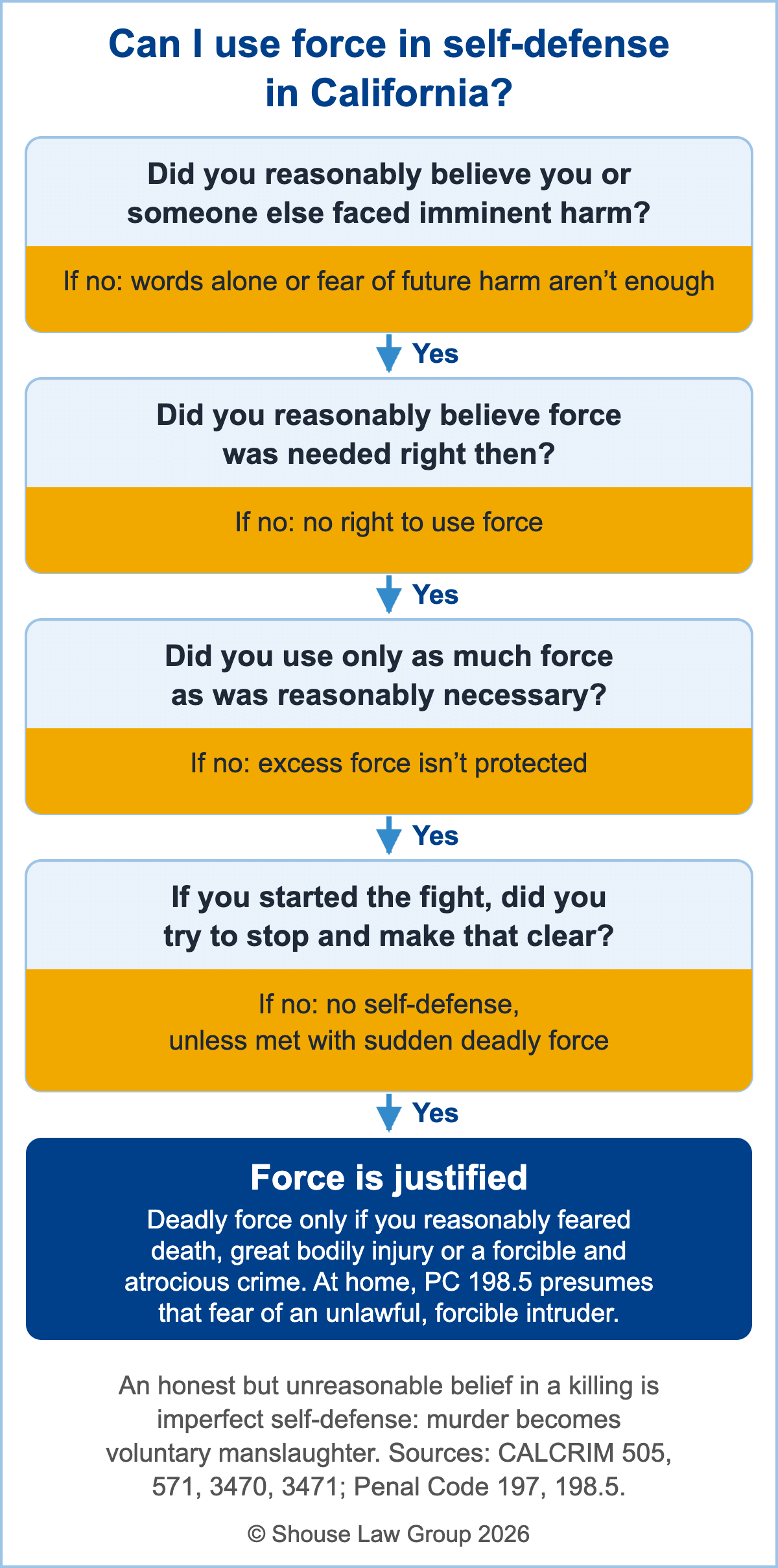
In California, self-defense has three parts. Under jury instruction CALCRIM 3470, you acted in lawful self-defense if:3
- You reasonably believed that you (or someone else) were in imminent danger of suffering bodily injury or of being touched unlawfully;
- You reasonably believed that the immediate use of force was necessary to defend against that danger; and
- You used no more force than was reasonably necessary to defend against that danger.
The danger must be imminent
“Imminent” means the danger is happening now or about to happen. Words alone, or fear of something that might happen later, aren’t enough. As the California Supreme Court put it, fear of future harm will not do, “no matter how great the fear and no matter how great the likelihood of the harm.”4
The danger doesn’t have to be real. What matters is whether a reasonable person in your position would have believed it was real. For example, someone who points a realistic toy gun at you can create a reasonable fear of being shot.
Your belief must be reasonable
The jury judges reasonableness by asking what a reasonable person in your situation, knowing what you knew, would have believed. Earlier threats can matter. A jury may consider threats the other person made against you, and even threats from third parties if you reasonably connected them to the person you defended yourself against.5
Your force must match the threat
You may use only as much force as a reasonable person would think necessary. A shove doesn’t justify a knife. If you use more force than the threat called for, the self-defense claim can fail, even if you were attacked first.
You can also defend against a battery, which is any unlawful touching done in a harmful or offensive way. A California appeals court has said it would be “ludicrous” to deny a person the right to resist an ongoing battery with reasonable force.6

Example: At a bar in San Diego, a stranger grabs Maria’s shoulder and won’t let go. She shoves him away and walks out. Maria reasonably feared an unlawful touching, and a shove was a reasonable response, so she acted in self-defense.
Self-defense can apply to animals, too. In People v. Lee, a woman walking her dog fired her handgun to scare off two unleashed dogs. A California appeals court reversed her conviction because the jury should have been told about self-defense: attacking dogs “may very well impart a reasonable belief” that the person needs to defend herself.7
3. Can you shoot an intruder in your home?
Often, yes. California’s “Castle Doctrine,” Penal Code 198.5, presumes that you reasonably feared death or great bodily injury when you used deadly force against an intruder who unlawfully and forcibly entered your home. Here is the full statute:
Any person using force intended or likely to cause death or great bodily injury within his or her residence shall be presumed to have held a reasonable fear of imminent peril of death or great bodily injury to self, family, or a member of the household when that force is used against another person, not a member of the family or household, who unlawfully and forcibly enters or has unlawfully and forcibly entered the residence and the person using the force knew or had reason to believe that an unlawful and forcible entry occurred. As used in this section, great bodily injury means a significant or substantial physical injury.8
In plain English, the law assumes your fear was reasonable, so you don’t have to prove it.
The 4 conditions
The presumption applies only if all four of these are true:
- You were inside your residence when you used the force.
- The intruder entered unlawfully and forcibly, for example by breaking a window or kicking in a door.
- The intruder was not a member of your family or household.
- You knew or had reason to believe that an unlawful and forcible entry had happened.
It’s a presumption, not a free pass. The prosecutor can try to overcome it with evidence that you didn’t actually have a reasonable fear.9
Not your porch, yard or driveway
The Castle Doctrine covers the inside of your home, not the area around it. In People v. Wilson (2021), a California appeals court held that the presumption didn’t apply to a stabbing on the steps to a front porch, because the person stabbed hadn’t forced his way into the residence.10 On a porch or in a yard, the ordinary self-defense rules apply instead.
Not an intruder who is running away
Your right to use force lasts only as long as the danger does. Once an intruder runs away or is no longer a threat, you can no longer use force against them.11
Example: At 2 a.m., John hears glass break and finds a stranger climbing through his kitchen window in Fresno. John shoots him. Because the stranger forced his way into the home, the law presumes John’s fear was reasonable. If the stranger had already turned and run back out to the street, the presumption wouldn’t protect a shot fired at him there.
For more on the Castle Doctrine, see our article on the Castle Doctrine vs. stand your ground.
4. Is California a stand-your-ground state?
In practice, yes, though there’s no statute that says so. California’s stand-your-ground rule comes from its jury instructions. CALCRIM 3470 tells jurors that you don’t have to retreat, and that you may stand your ground and defend yourself “even if safety could have been achieved by retreating.”12
Some online summaries say a California jury may still consider whether you could have safely retreated. That’s not how the instruction reads: if the three elements of self-defense are met, a safe way out doesn’t take away your right to defend yourself.
The rule has limits. It doesn’t help someone who started the fight or agreed to fight (see section 8), and your force must still be reasonable.
Did AB 1333 change California’s self-defense law?
No. Assembly Bill 1333, introduced in February 2025, would have changed parts of California’s self-defense rules, but it never passed its house of origin and died on January 31, 2026, under the California Constitution’s deadline for bills introduced in the first year of a session. California’s self-defense law is unchanged.13
5. When can you use deadly force?
In California, you can use deadly force only if you reasonably believe you (or someone else) are in imminent danger of being killed, suffering great bodily injury, or being the victim of a forcible and atrocious crime.14 Forcible and atrocious crimes include murder, rape, robbery and mayhem (Penal Code 203).
A “bare fear” is not enough. Penal Code 198 requires that the circumstances be enough to make a reasonable person afraid, and that you acted out of that fear alone.15
Great bodily injury means a significant or substantial physical injury, such as broken bones or a serious wound. If you kill someone in a situation that doesn’t meet this standard, you may face charges of murder or manslaughter (Penal Code 192). For more, see our article on killing in self-defense in California.
Can you use a gun in self-defense?
Yes, if the deadly force rules above are met. A gun is deadly force, so you may fire it only when you reasonably fear death, great bodily injury or a forcible and atrocious crime. Self-defense doesn’t make it legal to own or carry a gun you aren’t otherwise allowed to have. Our article on legal self-defense weapons in California explains which weapons you can own and carry.
6. Can you defend someone else?
Yes. California law lets you defend another person using the same three-part test, even a stranger.16 You must reasonably believe the other person is in imminent danger, that force is needed right away, and you may use only as much force as is reasonably necessary.
Example: In a Los Angeles parking garage, Ana sees a man punching a woman who is on the ground. Ana pulls him off and pushes him away. She reasonably believed the woman faced imminent harm and used reasonable force, so she acted in defense of another.
Self-defense and defense of others often come up in domestic violence cases, including charges of corporal injury to a spouse (Penal Code 273.5), where one person may have been protecting themselves or a child.
7. Can you defend your property?
Yes, but only with reasonable force. In California, you may use reasonable force to protect your property from imminent harm, and you may use reasonable force to remove a trespasser who refuses to leave after you ask.17
Never deadly force for property alone
You can’t use deadly force just to protect things. In People v. Ceballos (1974), a homeowner set a “spring gun” in his garage that shot a teenager trying to break in. The California Supreme Court upheld his conviction, noting that the law in general does not allow deadly force “solely for the protection of property.”18
Making a trespasser leave
Under CALCRIM 3475, you may first ask a trespasser to leave. If they don’t leave within a reasonable time and they appear to pose a threat to the property or to the people there, you may use reasonable force to make them go.19
Example: David sees a man breaking into his car in his Sacramento driveway. He can yell at him, block his way, or pull him away from the car. He cannot shoot him, because the car is property and the man isn’t threatening anyone.
8. What if you started the fight?
If you started a fight or agreed to fight (called “mutual combat”), you generally can’t claim self-defense. Under CALCRIM 3471, you get the right back only if you:20
- Actually and in good faith tried to stop fighting;
- Made that clear by words or conduct, so a reasonable opponent would understand you wanted to stop; and
- Gave your opponent a chance to stop fighting.
There is one exception. If you used only non-deadly force and the other person suddenly escalated to deadly force, you may defend yourself with deadly force if you couldn’t withdraw from the fight first.
Example: Two friends outside a bar in Oakland agree to settle an argument with their fists. After a minute, Luis puts his hands up, says “I’m done,” and backs away. If the other man pulls a knife and comes after him anyway, Luis may defend himself, because he clearly tried to stop and gave the other man a chance to stop too.
9. What is imperfect self-defense?
Imperfect self-defense applies when you killed someone because you actually believed you were in imminent danger and needed deadly force, but at least one of those beliefs was unreasonable.21 It’s sometimes called the “Flannel Doctrine.”
Imperfect self-defense doesn’t lead to an acquittal. Instead, it reduces murder to voluntary manslaughter, because an honest belief in the need to defend yourself means you didn’t act with malice aforethought. The California Supreme Court restated the rule in 2023: the belief must be in imminent danger, and fear of future harm isn’t enough.22
Imperfect self-defense requires that:23
- You actually believed you were in imminent danger of being killed or suffering great bodily injury;
- You actually believed the immediate use of deadly force was necessary; and
- At least one of those beliefs was unreasonable.
It isn’t available if your own wrongful conduct, such as starting a physical attack, created the situation in which the other person was justified in using force against you.
10. Can you defend yourself against the police?
Only against excessive force. In California, you must not use force to resist an arrest when you know, or should know, that a peace officer is arresting you, even if you believe the arrest is unlawful.24 Challenge an unlawful arrest in court, not on the street.
But if an officer uses unreasonable or excessive force, you may use reasonable force to defend yourself.25 An officer using excessive force isn’t lawfully performing their duties, which can also be a defense to charges such as resisting arrest (Penal Code 148).
Officers have their own limits. Under Penal Code 835a, an officer may use deadly force only when the officer reasonably believes, based on the totality of the circumstances, that it is necessary to defend against an imminent threat of death or serious bodily injury, or to stop certain fleeing felony suspects.26
11. How does self-defense work in court?
You don’t have to prove you acted in self-defense. Once there is some evidence of self-defense, such as your testimony, a witness or a video, the judge tells the jury about it, and the prosecutor must prove beyond a reasonable doubt that you did not act in self-defense.27 If the prosecutor can’t, the jury must find you not guilty. In a homicide case, a justified killing means you must be fully acquitted.28
Self-defense can also matter before trial. Your lawyer can show the evidence to the prosecutor before charges are filed, and prosecutors sometimes decline to file charges when the evidence of self-defense is strong.
Evidence that helps a self-defense claim
In our experience defending people who acted in self-defense, the evidence that persuades prosecutors and juries is usually concrete: 911 calls, surveillance and phone video, photos of your injuries, and proof of the other person’s earlier threats. Evidence that can help includes:
- 911 calls and dispatch recordings, especially your own call right after the incident;
- Video from security, doorbell, phone or body cameras;
- Medical records and photos of your injuries;
- Witnesses who saw who started it;
- Prior threats or violence by the alleged victim.

We often see self-defense cases turn on small details, like who moved first on a video or what was said on a 911 call.
12. What should you do after defending yourself?
What you do in the first hours after using force in California can shape whether you’re charged. These steps help protect you:
- Get to safety and call 911. Ask for police and medical help, and say you were attacked.
- Keep your statement short. Tell officers you were attacked and will cooperate after you speak with a lawyer. You have the right to remain silent.
- Save video and messages. Ask neighbors and businesses for camera footage quickly; many systems record over it within days.
- Photograph your injuries and get medical care, even for minor ones.
- Write down witnesses’ names and phone numbers.
- Call a criminal defense lawyer before you give a detailed statement.
One thing we’ve found: people who acted in self-defense often hurt their case by talking too much in the first interview, before they’ve calmed down.
13. Questions people ask
Can I shoot someone who breaks into my house in California?
Often, yes. Under Penal Code 198.5, if someone unlawfully and forcibly enters your home and you know it, the law presumes you reasonably feared death or great bodily injury. The presumption doesn’t cover your porch or yard, family or household members, or an intruder who is running away.
Do I have to retreat before defending myself in California?
No. California’s jury instructions say you may stand your ground and defend yourself even if you could have safely retreated, as long as you meet the other requirements of self-defense. This doesn’t apply if you started the fight or agreed to fight.
Can I use deadly force to protect my property in California?
No. California law lets you use reasonable force to protect property or remove a trespasser, but never deadly force to protect property alone. Deadly force is allowed only against a threat of death, great bodily injury or a forcible and atrocious crime.
Can I claim self-defense if I started the fight?
Usually not. In California, you regain the right to self-defense only if you genuinely tried to stop, made that clear, and gave the other person a chance to stop, or if your non-deadly force was met with sudden deadly force you couldn’t escape.
Can I be charged with a crime even if I acted in self-defense?
Yes. California police and prosecutors can still file charges, and self-defense is then decided by a judge or jury. Once there’s evidence of self-defense, the prosecutor must prove beyond a reasonable doubt that you did not act in self-defense.
Can I defend myself against a police officer in California?
Only against excessive force. You may not use force to resist an arrest you know is being made by a peace officer, even an unlawful one, but you may use reasonable force to defend yourself if the officer uses unreasonable or excessive force.
Call us for help
If you’ve been charged with a crime after defending yourself, our California criminal defense lawyers can review the evidence and explain your options. Contact us for a free consultation.
Free official resources
- California Criminal Jury Instructions (CALCRIM), 2026 edition, the Judicial Council of California’s official jury instructions (free copy on Justia).
- California Penal Code, California Legislative Information.
- California Courts Self-Help Guide.
Legal references:
- California Penal Code 692 PC: “Lawful resistance to the commission of a public offense may be made: 1. By the party about to be injured; 2. By other parties.” See also Penal Code 693 and Penal Code 694.
- California Penal Code 197 PC: “Homicide is also justifiable when committed by any person in any of the following cases: (1) When resisting any attempt to murder any person, or to commit a felony, or to do some great bodily injury upon any person.”
- CALCRIM No. 3470, Right to Self-Defense or Defense of Another (Non-Homicide) (2026 edition).
- People v. Humphrey (1996) 13 Cal.4th 1073, 1082: “Fear of future harm—no matter how great the fear and no matter how great the likelihood of the harm—will not suffice.”
- People v. Minifie (1996) 13 Cal.4th 1055, 1065: “evidence of third party threats is admissible to support a claim of self-defense …”
- People v. Myers (1998) 61 Cal.App.4th 328, 335: “To hold otherwise would lead to the ludicrous result of a person not being able to lawfully resist or defend against a continuing assault or battery”
- People v. Lee (2005) 131 Cal.App.4th 1413, 1430: “they may very well impart a reasonable belief that the person who is attacked by the dogs needs to defend himself or herself”
- California Penal Code 198.5 PC (as of November 2026).
- CALCRIM No. 3477, Presumption That Resident Was Reasonably Afraid of Death or Great Bodily Injury: “The People have the burden of overcoming this presumption.”
- People v. Wilson (2021) 67 Cal.App.5th 819, 830: “Here the victim had not forced entry into the residence; he was on the steps to the porch when he was stabbed.” See also People v. Brown (1992) 6 Cal.App.4th 1489 (unenclosed front porch).
- CALCRIM No. 3474, Danger No Longer Exists or Attacker Disabled: “The right to use force in (self-defense …) continues only as long as the danger exists or reasonably appears to exist.”
- CALCRIM No. 3470, Right to Self-Defense or Defense of Another (Non-Homicide): “A defendant is not required to retreat. He or she is entitled to stand his or her ground and defend himself or herself … This is so even if safety could have been achieved by retreating.”
- Assembly Bill 1333 (2025-2026 Reg. Sess.), bill status; Cal. Const., art. IV, § 10(c) (bills introduced in the first year of a session that don’t pass their house of origin by January 31 of the second year are dead).
- CALCRIM No. 505, Justifiable Homicide: Self-Defense or Defense of Another.
- California Penal Code 198 PC: “A bare fear of the commission of any of the offenses mentioned in subdivisions 2 and 3 of Section 197 … is not sufficient to justify it.”
- California Penal Code 694 PC (any other person may make lawful resistance in aid of the person about to be injured).
- CALCRIM No. 3476, Right to Defend Real or Personal Property.
- People v. Ceballos (1974) 12 Cal.3d 470, 483: “at common law in general deadly force could not be used solely for the protection of property.”
- CALCRIM No. 3475, Right to Eject Trespasser From Real Property.
- CALCRIM No. 3471, Right to Self-Defense: Mutual Combat or Initial Aggressor.
- CALCRIM No. 571, Voluntary Manslaughter: Imperfect Self-Defense or Imperfect Defense of Another—Lesser Included Offense.
- People v. Thomas (2023) 14 Cal.5th 327, 386: “[Imperfect self-defense] occurs when a defendant acts in the actual but unreasonable belief that he or she is in imminent danger of great bodily injury or death.”
- People v. Por Ye Her (2009) 181 Cal.App.4th 349, 352 (elements of imperfect self-defense under CALCRIM 571).
- California Penal Code 834a PC: “If a person has knowledge, or by the exercise of reasonable care, should have knowledge, that he is being arrested by a peace officer, it is the duty of such person to refrain from using force or any weapon to resist such arrest.”
- CALCRIM No. 2670, Lawful Performance: Peace Officer: “If a peace officer uses unreasonable or excessive force while (arresting or attempting to arrest …) a person, that person may lawfully use reasonable force to defend himself or herself.”
- California Penal Code 835a PC, subdivision (c)(1): “a peace officer is justified in using deadly force upon another person only when the officer reasonably believes, based on the totality of the circumstances, that such force is necessary …”
- CALCRIM No. 3470, Right to Self-Defense or Defense of Another (Non-Homicide): “The People have the burden of proving beyond a reasonable doubt that at least one of the three elements of (self-defense …) listed above is not met in this case.”
- California Penal Code 199 PC: “The homicide appearing to be justifiable or excusable, the person indicted must, upon his trial, be fully acquitted and discharged.”