SEARCH SITE:
888.327.4652 | 24/7 Fraud Consultations

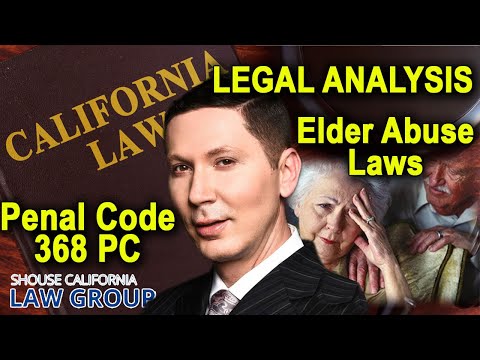
California Elder Abuse Laws
Penal Code 368 PC

California "elder abuse" law covers a variety of crimes and can occur in a variety of situations. "Elder abuse" can be in the form of


  • physical abuse (infliction of unjustifiable pain or injury on a senior victim),


  • emotional abuse (sometimes seen in the form of mental suffering through isolation or ridicule),


  • neglect and endangerment (willfully placing the elder or dependent adult in a situation where his/her health or safety is endangered)

  • and/or


  • financial fraud (which is discussed in our related article on California Senior Fraud & Elder Financial Abuse),


when it is directed at anyone over 65 years of age.1


Because California elder abuse law is complex...and is an area of the law that is ripe for false accusations and wrongful arrests...it is important to consult with an attorney who has experience handling these types of offenses.

Having prosecuted and successfully defended against California elder abuse crimes, our criminal defense lawyers understand the most effective ways to fight your elder abuse charges.

In an effort to help you better understand the specifics of California elder abuse law, our Los Angeles criminal defense attorneys2 will address the following:

What is Elder Abuse?

How Do Prosecutors Prove that I am Guilty of Elder Abuse?

Penalties, Punishment, and Sentencing for Penal Code 368 PC

How Do I Defend Against California Elder Abuse Charges?

California Elder Abuse Law and Related Offenses

If, after reading this article, you have additional questions, we invite you to contact us at Shouse Law Group.

In addition, you may find helpful information in our related articles on California Elder Abuse Involving Nursing Homes, California Senior Financial Fraud, Medi-Cal Fraud, Penal Code 242 PC Battery, Penal Code 261 PC Rape, Penal Code 187 PC Murder, Penal Code 192 PC Involuntary Manslaughter, Penal Code 422 Criminal Threats, and California Domestic Violence Law.

What is Elder Abuse?

Elder abuse (sometimes interchangeably referred to as "senior abuse") is on the rise, affecting people from every social, economic, and ethnic background. Those accused of violating California elder abuse laws are typically either family members of (or caregivers for) the alleged elderly victim.

Under California Penal Code 368, elder abuse consists of


  • physical abuse (which includes inflicting physical injuries and/or sexual abuse, neglect, abandonment, and abduction),


  • financial abuse (which is committed via fraud or theft), or


  • any other treatment that results in physical and/or mental pain or suffering.3


Why do elders receive increased protection?


The California Legislature first addressed elder abuse in the early 1980's. The Legislature acknowledged in 1982 that "dependent adults" are frequently confused, medicated, and/or otherwise mentally or physically impaired. Because of this...and the related fact that they are therefore less able to protect themselves and/or to understand or report criminal conduct...they should receive special legal protection.4

Then in 1983...in response to a request from the Santa Ana Police Department...the Legislature enacted Penal Code 368 PC. Law enforcement agencies requested this statute because they didn't have a Penal Code section that allowed them to prosecute those who were reportedly abusing or neglecting "dependent adults".5

Recognizing that "dependent adults" are often as vulnerable as children when it comes to being abused, lawmakers simply used the same language that they had previously used for child abuse statutes, simply replacing the word "child" with the term "dependent adults".6

Finally in 1986, the Legislature amended Penal Code 368 PC to include "elders" as well as dependent adults. This amendment expanded the scope of coverage from "dependent adults" who, because of age, were unable to care for their own personal needs, now to any person over 65, regardless of his/her mental or physical abilities.7

Today, both classes of persons receive this special protection under California elder abuse law.8


Reporting and prosecuting criminal elder abuse charges


Many prosecuting agencies have special units that handle California's elder abuse charges. These units "vertically" prosecute these special cases, which means that a specially trained deputy prosecutor will oversee the entire case, from beginning to end.

Many of these agencies (such as the Orange County District Attorney's Office) provide telephone numbers to their elder abuse units so that the public can directly report suspected criminal activity. However, most elder abuse cases are referred to these agencies by the police.

The police receive elder abuse complaints from a variety of sources...from concerned family members or friends of the alleged elderly victim...from Adult Protective Services...and from doctors or other caregivers.

Once the prosecuting agency receives the report, it must decide whether to file or reject the charges...or whether to instruct a detective to investigate the allegations further.

As Riverside criminal defense lawyer Michael Scafiddi explains9, "Elder abuse allegations...like many other California crimes...are frequently directed at innocent individuals. Sometimes the alleged elderly victim is confused and makes unfounded claims. Sometimes an angry or jealous family member reports another family member in order to gain control over the senior citizen's finances. And sometimes well-meaning friends or family report a caregiver without sufficient justification."


Who decides which agency prosecutes a reported elder abuse case?


It depends. Factors include


  • where the alleged elder abuse takes place,


  • whether the offense is a felony or a misdemeanor, and


  • the exact type of abuse that is alleged.

Some special elder abuse enforcement units will only prosecute felony senior abuse allegations. Similarly, some agencies will only handle misdemeanor elder abuse allegations. Some, like the California Attorney General, will only handle California elder abuse cases that involve nursing homes or other residential treatment facilities.

And while physical, emotional, and financial elder abuse are all prosecuted as criminal acts, some of the elder abuse task forces limit themselves even within these areas.

The Los Angeles District Attorney's Elder Abuse Unit, for example, only prosecutes allegations of financial elder abuse if the monetary amount reportedly taken is either in the "thousands of dollars" range or involved a very sophisticated level of fraud or theft.

An on that note, this article focuses on physical elder abuse. Our articles on California financial senior fraud and California elder abuse cases that involve nursing homes are accessible by "clicking" on these respective links.

Similarly, this article only addresses California's criminal elder abuse laws. It is important to recognize that violating California's elder abuse laws can subject an offender to both civil and criminal penalties.

If someone is suing you for personal injury or wrongful death charges arising out of allegations of senior abuse, it is advisable to speak with a California civil defense attorney as well.

How Do Prosecutors Prove that I am Guilty of Violating California Elder Abuse Law?

In order to convict you of violating California's elder abuse laws under Penal Code 368 PC, the prosecutor must prove the following facts (otherwise known as "elements of the crime"):


  1. that you willfully or negligently either (a) personally subjected an elder to unjustifiable physical pain or mental suffering or (b) allowed another person to do so,


  2. that your conduct occurred under circumstances that were likely to produce great bodily injury or death, and


  3. that you knew or reasonably should have known that the alleged victim was an elder.10

∗The above elements are for felony elder abuse cases. If the prosecution has charged you with misdemeanor elder abuse, in lieu of the second element, the prosecutor must prove that your conduct occurred under circumstances that may have endangered the life or health of the elder.11

Let's take a closer look at some of these elements to better understand California elder abuse law.


Willfully


If you do something willfully, you do it deliberately or on purpose.

For example, if you intentionally hit an elder patient out of frustration, you have willfully abused that individual.

With respect to elder abuse, the act can be either willful or negligent.


Criminal negligence


Criminal negligence is more than ordinary carelessness or a mistake in judgment. For purposes of violating California's elder abuse law, you act negligently when you act so unreasonably that your actions reflect a disregard for human life.12

For example, a helpless 79-year-old mother resided with her daughter. During a two-week period, the daughter reportedly failed to feed, clean, or move her mother, leaving her literally to rot away. The daughter was convicted of California Penal Code 368 felony elder abuse because her conduct was "criminally negligent".13

It is important to understand that prosecutors can only convict you of elder abuse by criminal negligence if you have a legal duty to act.

This is one of the reasons why we say that elder abuse law is complex. Even thought it might appear as though you have a legal duty to intervene, that's not always the case...which is why consulting with a California criminal defense attorney who has expertise defending elder abuse cases is critical.

Take, for example, a case where an elderly father was found dead in his bedroom in his son's home. The victim was found lying on a mattress that was rotted through from constant wetness (exposing the metal springs). He also had bed sores on 1/6 of his body. The forensic pathologist determined that he had died from septic shock due to the sores, caused by malnutrition, dehydration, and severe neglect. 14

Prosecutors filed charges against the elderly man's two sons (who resided in the home), as well as the man's daughter who did not live there, but who occasionally visited and who expressed concern about her father's condition.

The Supreme Court of California held that...while the daughter certainly had a moral duty to report her father's abuse...she had no legal duty to control her brother's behavior, and therefore wasn't guilty of Penal Code 368 PC. Based on that reasoning, the court reversed her conviction for elder abuse. 15

Unjustifiable pain or mental suffering


Unjustifiable pain or mental suffering is just that...pain or suffering that isn't necessary or that is excessive under the circumstances.16


Circumstances likely to produce great bodily harm


"Great bodily harm" means a significant or substantial injury. It does not refer to trivial or insignificant harm.

However, it is important to understand that it isn't necessary that the elder actually suffer great bodily harm...only that the elder be placed in a situation where he/she was likely to suffer such an injury.17

For example, if you are a caregiver, and refuse to give your elderly patient anymore of his necessary heart medications, the effects may not be immediate. However, withholding the drugs is likely to cause a substantial injury...and would therefore be enough to charge you with felony elder abuse.

Penalties, Punishment, and Sentencing for California Penal Code 368 PC

Elder abuse is a "wobbler" which means that prosecutors can charge it either as a misdemeanor or as a felony. The most important considerations in making this decision include


  1. the facts of your specific case, and


  2. your criminal history.


Misdemeanor elder abuse


If convicted of California Penal Code 368 misdemeanor elder abuse, you face:


  • informal probation (otherwise known as summary probation),


  • a maximum one-year county jail sentence,


  • a maximum fine of $6,000 (or $10,000 for a second or subsequent offense),


  • restitution to the victim, and


  • counseling.18


Felony elder abuse


If convicted of California Penal Code 368 felony elder abuse, you face:


How Do I Defend Against California Elder Abuse Charges?

Elder abuse charges are often falsely alleged against innocent people. Sometimes these allegations are intentionally fraudulent. But other times, these false charges result because seniors frequently suffer from conditions and diseases that mimic the signs of physical abuse and neglect.

To compound this problem further, social workers, police, and even doctors, aren't always trained to distinguish between signs of abuse and signs of accident, illness, or age...but they are required to report suspected abuse.21

If any of these individuals (or other "mandated reporters") fail to report suspected abuse or neglect, they can face their own criminal charges...but face no ramifications if they are wrong.22 As a result, often times these people report suspected abuse with little support or investigation in an effort to protect themselves against criminal liability.

Fortunately, there are a variety of defenses that a California criminal defense lawyer can present on your behalf in an effort to either reduce or dismiss your elder abuse charges. The following are some of the most common.


The injury was the result of an accident


If you didn't willfully injure the elder victim and your conduct didn't rise to the level of criminal negligence, prosecutors can't convict you of violating California elder abuse law.

This means that if you accidentally injure an elder...perhaps you unintentionally drop her while you are transferring her from her wheel chair to her bed, which causes her to break her hip...you aren't guilty of elder abuse.


False accusations / wrongful arrest


As previously stated, there are a number of reasons why someone may have falsely accused you of elder abuse. Sometimes jealous family members accuse a caregiver of abuse, because the elder has bestowed large sums of money or other gifts upon that individual. Perhaps the allegations were honestly made, but the injuries simply weren't the result of abuse.


Mistaken identity


Along these same lines, you may have been falsely accused based on a case of mistaken identity. It could very well be that the senior in question was abused...just not by you. If, for example, you are the primary caregiver, others would probably assume that you were responsible.

Similarly, if, for example, you and your elderly parent were at odds about the elder's estate...and soon after the argument, the elder showed signs of abuse...other family members may incorrectly assume that you were the abuser.


Insufficient evidence


In order to convict you of elder abuse, the prosecutor must prove "beyond a reasonable doubt" that you are guilty. This means that there is no reasonable explanation for the elder's injuries other than the fact that you abused him or her.

If there is nothing to corroborate the alleged abuse or neglect, your California criminal defense attorney may be able to cast a reasonable doubt as to your guilt.

Many times defense lawyers will call in an expert to testify that the alleged signs of abuse were more consistent with illness or age. Sometimes an expert (or other witnesses) will testify that the elder is paranoid, delusional, or even senile, and that his/her accusations are not based on real facts.

If you are accused of neglecting the elder (which placed him in a harmful situation), you could bring in evidence to demonstrate how you've routinely cared for him. Provide receipts for drugs, heating and air conditioning bills, records from doctor visits...anything revealing that you are not guilty of neglect, but rather have more than adequately cared for the alleged elder victim.

And even if you are guilty of elder abuse...and there's no way to get around that fact...try to gain empathy and explain that


The abuse was an isolated incident


Anyone who has cared for an elderly person...especially an elderly relative...understands the physical and emotional demands that you face on a regular (if not daily) basis.

If you can convince the judge, prosecutor, and/or jury that your actions were an isolated (and unintentional) event, triggered by an emotional breakdown, you may garner sympathy...and a lesser or reduced charge and/or sentence.

California Elder Abuse Law and Related Offenses

Depending on the circumstances of the alleged offense, there are a variety of crimes that may be closely related to Penal Code 368, either because


  1. they share elements with elder abuse, or


  2. because they are frequently committed in connection with elder abuse.

Examples of these offenses include (but are by no means limited to) the following:


Penal Code 242 PC "battery"


California Penal Code 242 PC battery is the unlawful and willful use of force or violence upon another23. If you intentionally commit physical elder abuse, prosecutors could charge you with both elder abuse and battery.


Penal Code 261 PC "rape"


If you have nonconsensual sexual intercourse with an elder, accomplished by means of force, threats, or fraud, prosecutors could charge you with California Penal Code 261 PC rape24 and elder abuse.

This offense usually arises when someone finds out that another person is having sex with an elder who is incapacitated or incapable of giving consent. That said, typical "rape" scenarios also take place with elders who are too weak to fight the attack.

Similarly, if you engage in nonconsensual sexual acts (other than intercourse) with an elder who is dependent on others due to his/her declining mental/physical abilities, prosecutors could charge you with elder abuse and Penal Code 288 lewd or lascivious acts25.

Penal Code 187 PC "murder" / Penal Code 192 PC "involuntary manslaughter"

If you are accused of willfully killing an elder...or are accused of causing the death of an elder due to your criminal negligence...prosecutors could charge you with elder abuse and either California Penal Code 187 PC murder26 or California Penal Code 192 PC involuntary manslaughter27.


Penal Code 422 "criminal threats"


If you


  1. threaten to harm an elder,


  2. the elder is actually placed in fear, and


  3. you actually carry out your threat and inflict an injury on the elder,

prosecutors could charge you with elder abuse and California Penal Code 422 PC criminal threats28.


California domestic violence laws


If you are accused of elder abuse and the elder is your spouse, significant other, parent, grandparent, or roommate, prosecutors could charge you with elder abuse under California's domestic violence laws29.

As you can see, violating California's elder abuse laws subjects you to a variety of offenses and a variety of penalties. As a result, it is imperative that you consult with a defense attorney who understands the complex issues that California elder abuse charges often trigger.

If you have additional questions about senior abuse, or you would like to discuss your case confidentially with one of our California criminal defense attorneys, we invite you to contact us at Shouse Law Group.

We have local criminal law offices in Los Angeles, San Diego, Riverside, Orange County, San Bernardino, Ventura, San Jose, the San Francisco Bay area, and several nearby cities to conveniently serve you.

Online Resource:

Helpguide.org- Provides warning signs, risk factors, prevention, and help for dealing with elder abuse

A Citizen's Guide to Reporting and Preventing Elder Abuse

Warning Signs, Risk Factors and Prevention of Elder Abuse

California Department of Aging - Long Term Care Ombudsman Program

Legal References:

1California Penal Code 368 -- Elder abuse. ("(b)(1) Any person who knows or reasonably should know that a person is an elder or dependent adult and who, under circumstances or conditions likely to produce great bodily harm or death, willfully causes or permits any elder or dependent adult to suffer, or inflicts thereon unjustifiable physical pain or mental suffering, or having the care or custody of any elder or dependent adult, willfully causes or permits the person or health of the elder or dependent adult to be injured, or willfully causes or permits the elder or dependent adult to be placed in a situation in which his or her person or health is endangered, is punishable by imprisonment in a county jail not exceeding one year, or by a fine not to exceed six thousand dollars ($6,000) upon a first conviction or a fine not to exceed ten thousand dollars ($10,000) upon a second or subsequent conviction, or by both that fine and imprisonment, or by imprisonment in the state prison for two, three, or four years... (d) Any person who is not a caretaker who violates any provision of law proscribing theft, embezzlement, forgery, or fraud, or who violates [California Penal Code] Section 530.5 proscribing identity theft, with respect to the property or personal identifying information of an elder or a dependent adult, and who knows or reasonably should know that the victim is an elder or a dependent adult, is punishable by imprisonment in a county jail not exceeding one year, or in the state prison for two, three, or four years, when the moneys, labor, goods, services, or real or personal property taken or obtained is of a value exceeding four hundred dollars ($400); and by a fine not exceeding one thousand dollars ($1,000), by imprisonment in a county jail not exceeding one year, or by both that fine and imprisonment, when the moneys, labor, goods, services, or real or personal property taken or obtained is of a value not exceeding four hundred dollars ($400). (e) Any caretaker of an elder or a dependent adult who violates any provision of law proscribing theft, embezzlement, forgery, or fraud, or who violates [California Penal Code] Section 530.5 proscribing identity theft, with respect to the property or personal identifying information of that elder or dependent adult, is punishable by imprisonment in a county jail not exceeding one year, or in the state prison for two, three, or four years when the moneys, labor, goods, services, or real or personal property taken or obtained is of a value exceeding four hundred dollars ($400), and by a fine not exceeding one thousand dollars ($1,000), by imprisonment in a county jail not exceeding one year, or by both that fine and imprisonment, when the moneys, labor, goods, services, or real or personal property taken or obtained is of a value not exceeding four hundred dollars ($400)...(g) As used in this section, "elder" means any person who is 65 years of age or older.")

2Our Los Angeles criminal defense attorneys have local criminal law offices in Beverly Hills, Burbank, Glendale, Lancaster, Long Beach, Los Angeles, Pasadena, Pomona, Torrance, Van Nuys, West Covina, and Whittier.

3California Welfare and Institutions Code 15610.07 -- Elder abuse. ( "'Abuse of an elder or a dependent adult' means either of the following: (a) Physical abuse, neglect, financial abuse, abandonment, isolation, abduction, or other treatment with resulting physical harm or pain or mental suffering. (b) The deprivation by a care custodian of goods or services that are necessary to avoid physical harm or mental suffering.")

4People v. Heitzman (1994) 9 Cal.4th 189, 201. ("The first of several reports on elder abuse commissioned by the House of Representatives was released in 1981 (see House Select Com. on Aging, 97th Cong., 1st Sess., Elder Abuse: An Examination of a Hidden Problem (Com. Print 1981)), and in its wake, the subject received much congressional attention and national publicity. (Note, Elder Abuse and the States' Adult Protective Services Response (1991) 42 Hastings L.J. 861, 869.) California lawmakers responded to the newly documented evidence of elder abuse in 1982 with legislation recognizing "that dependent adults may be subject to abuse, neglect, or abandonment and that this state has a responsibility to protect such persons." (Former Welf. & Inst. Code, § 15600, added by Stats. 1982, ch. 1184, § 3, p. 4223.)")

5See same at 202. ("In 1983, the Legislature passed the state's first law focusing exclusively on those 65 years of age or older, requiring elder care custodians and other specified professionals to report instances of elder abuse. (Welf. & Inst. Code, §§ 9380-9386, added by Stats. 1983, ch. 1273, § 2 and repealed by Stats. 1986, ch. 769, § 1.3, eff. Sept. 15, 1986.) That same year, Senate Bill No. 248, 1983-1984 Regular Session, was introduced at the request of the Santa Ana Police Department. An analysis of the bill prepared for the Senate Committee on the Judiciary indicates that the goal of the legislation was to aid in the prosecution of people who harm or neglect dependent adults. (Sen. Com. on Judiciary, Analysis of Sen. Bill No. 248 (1983-1984 Reg. Sess.) p. 2.) According to this document, law enforcement agencies receiving reports concerning suspected abuse or neglect of dependent adults were having difficulty finding Penal Code sections under which they could prosecute such cases. ( Ibid.)")

6See same. ("The solution proposed by the bill was to establish the same criminal penalties for the abuse of a dependent adult as those found in sections 273a and 273d for child abuse. (Sen. Com. on Judiciary, Analysis of Sen. Bill No. 248, supra, at p. 1.) When drafting the new legislation, the bill's author lifted the language of the child abuse statutes in its entirety, replacing the word "child" with "dependent adult" throughout. (See id at. pp. 2-3.)")

7See same at 203. ("Later, in conjunction with legislation designed to consolidate the two sets of conflicting reporting laws for elder abuse and dependent adult abuse, a 1986 amendment to [California Penal Code] section 368(a) [PC elder abuse] made the section expressly applicable to elders as well as dependent adults. (Stats. 1986, ch. 769, § 1.2, p. 2531, urgency measure eff. Sept. 15, 1986.) Although the amendment was intended merely to conform the definition of "dependent adult" in the Penal Code to the definition of "dependent adult" in the Welfare and Institutions Code (see Sen. Judiciary Com. Rep. on Assem. Bill No. 3988 (1985-1986 Reg. Sess.)), it appears to have, at the same time, broadened the class of persons protected by the statute. "Elder" is defined as "any person who is 65 years of age or older." ([California Penal Code] § 368, subd. (d).) The preamendment definition of "dependent adult" referred to "any person who, because of any mental disability due to birth defect, physical disorder, or advanced age, is unable to properly provide for his or her own personal needs with regard to his or her physical health, food clothing or shelter ...." Thus, following the 1986 amendment, any elder, regardless of whether he or she could properly provide for his or her personal needs, was protected by the [California elder abuse] statute.")

8California Welfare and Institutions Code 15600. ("(a) The Legislature recognizes that elders and dependent adults may be subjected to abuse, neglect, or abandonment and that this state has a responsibility to protect these persons. (b) The Legislature further recognizes that a significant number of these persons are elderly. The Legislature desires to direct special attention to the needs and problems of elderly persons, recognizing that these persons constitute a significant and identifiable segment of the population and that they are more subject to risks of abuse, neglect, and abandonment. (c) The Legislature further recognizes that a significant number of these persons have developmental disabilities and that mental and verbal limitations often leave them vulnerable to abuse and incapable of asking for help and protection.")

See also California Penal Code 368 -- Elder abuse. ("(a) The Legislature finds and declares that elders and dependent adults are deserving of special consideration and protection against crimes, not unlike the special protections provided for minor children, because elders and dependent adults may be confused, on various medications, mentally or physically impaired, or incompetent, and therefore less able to protect themselves, to understand or report criminal conduct, or to testify in court proceedings on their own behalf.")

9Riverside criminal defense lawyer Michael Scafiddi is a former police officer who now uses that inside knowledge to help defend clients accused of violating California elder abuse laws. He practices criminal defense primarily in the San Bernardino and Riverside Counties, and makes appearances at the Murrieta Southwest Justice Center and in Banning, Fontana, Joshua Tree, Barstow, and Victorville.

10 California Jury Instructions - Criminal (CALJIC 9.38) Elder abuse. ("In order to prove this crime, each of the following elements must be proved: [1] A person willfully, or willfully and as a result of criminal negligence, inflicted unjustifiable physical pain or mental suffering on [an elder] [a dependent adult];] [or] [1] A person willfully caused or, willfully and as a result of criminal negligence, permitted [an elder] [a dependent adult] to suffer unjustifiable physical pain or mental suffering;] [or] [1] A person who had care or custody of an [an elder] [a dependent adult] [a.] [willfully caused or, willfully and as a result of criminal negligence, permitted the person or health of the [elder] [dependent adult] to be injured;] [or] [b.] [willfully caused or, willfully and as a result of criminal negligence, permitted the [elder] [dependent adult] to be placed in a situation in which his or her person or health is endangered;]] [2] The perpetrator's conduct occurred under circumstances likely to produce great bodily harm or death [; and [3] The perpetrator knew or reasonably should have known the other person was [an elder] [a dependent adult]].")

11CALJIC 16.172 -- Elder abuse. ("In order to prove this crime, each of the following elements must be proved: [1] A person willfully, or willfully and as a result of criminal negligence inflicted unjustifiable physical pain or mental suffering on [an elder] [a dependent adult][.]] [; or] [1] A person willfully caused or willfully and as a result of criminal negligence permitted [an elder] [a dependent adult] to suffer unjustifiable physical pain or mental suffering[.]] [; or] [1] A person who had care or custody of [an elder] [a dependent adult]: [a] Willfully caused or willfully and as a result of criminal negligence permitted the person or health of the [elder] [dependent adult] to be injured[.]] [; or] [b] Willfully caused or as a result of criminal negligence permitted the [elder] [dependent adult] to be placed in a situation in which his or her person or health may be endangered][.]] [; and [2] The perpetrator knew or reasonably should have known that the other person was [an elder] [a dependent adult].]")

12People v. Superior Court (Holvey) (1988) 205 Cal.App.3d 51, 61. (Disapproved on other grounds.) ("Although [California Penal Code] section 273a does not require a specific intent, it does require proof of criminal negligence. Criminal negligence "means that the defendant's conduct must amount to a reckless, gross or culpable departure from the ordinary standard of due care; it must be such a departure from what would be the conduct of an ordinarily prudent person under the same circumstances as to be incompatible with a proper regard for human life." ( People v. Peabody (1975) 46 Cal.App.3d 43, 48-49, 119 Cal.Rptr. 780.) The same proof is required for a conviction under section 368. Real parties in interest's argument that many of their practices result in pain and injury and they would be unable to distinguish criminal acts from good-faith acts or acts resulting in only civil liability is unavailing. To violate [California Penal Code] section 368 [PC "elder abuse" law], their conduct must be 'a reckless, gross or culpable departure from the ordinary standard of due care.'")

13People v. Manis (1992) 10 Cal.App.4th 110, 114. ("As so construed, the statute clearly reaches the conduct of appellant. By any standard, appellant's action in permitting her mother to literally rot away in appellant's house, from simple lack of food or water and untreated infections resulting from failure to move the victim out of a chair for a week at a time, would be considered "criminal[ly] negligen[t]." Since criminal negligence only arises from a gross violation of an already existing duty of care-a duty clearly assumed by appellant with respect to her helpless mother's care while the mother lived in appellant's house, the statute would not reach the conduct of a passerby who noticed such a situation but did nothing. Of course, such a passerby would have a moral, if not a legal, duty to report the problem to competent authority.")

14People v. Heitzman (1994) 9 Cal.4th 189, 194. ("On December 3, 1990, police were summoned to the house, where they discovered Robert dead in his bedroom. His body lay on a mattress that was rotted through from constant wetness, exposing the metal springs. The stench of urine and feces filled not only decedent's bedroom, but the entire house as well. His bathroom was filthy, and the bathtub contained fetid, green-colored water that appeared to have been there for some time...At the time of his death, decedent had large, decubitus ulcers, more commonly referred to as bed sores, covering one-sixth of his body. An autopsy revealed the existence of a yeast infection in his mouth, and showed that he suffered from congestive heart failure, bronchial pneumonia, and hepatitis. The forensic pathologist who performed the autopsy attributed decedent's death to septic shock due to the sores which, he opined, were caused by malnutrition, dehydration, and neglect.")

15See same at 215. ("Furthermore, given defendant's failure to intercede on her father's behalf under the egregious circumstances presented here, we can well understand the prosecution's decision to charge defendant under [California Penal Code] section 368(a) [California's elder abuse law]. Because the People presented no evidence tending to show that defendant had a legal duty to control the conduct of either of her brothers, however, we reverse the judgment of the Court of Appeal with directions to reinstate the trial court's order dismissing the charges against defendant.")

16People v. Curtiss (1931) 116 Cal.App.Supp. 771, 300 P. 801, 804. ("By the use of the word "unjustifiable," the Legislature intended to make use of the antonym of "justifiable," and to designate as criminal the infliction of physical pain or mental suffering upon a child, which could not be defended, or vindicated, or which was not exculpable, excusable, or authorizable, under the circumstances. The standard thus set up is not abstract. It is concrete. The concept by which it shall be determined whether the punishment is or is not unjustifiable is a fluid one-like the concept by which the action of the "reasonable man" serves as a criterion in determining the violations of duty which amount to negligence. As in that instance, the test is "external and objective."") Although this case specifically deals with child abuse, courts frequently use child abuse and other domestic violence cases to interpret California elder abuse law under Penal Code 368 PC.

17 People v. Cortes (1999) 71 Cal.App.4th 62, 80. ("For a defendant to be guilty of violating [California Penal Code] section 273a, subdivision (a), his conduct must be willful and it must be committed under circumstances "likely to produce great bodily harm or death." (See People v. Lee (1991) 234 Cal.App.3d 1214, 1221, 286 Cal.Rptr. 117.) "Great bodily harm refers to significant or substantial injury and does not refer to trivial or insignificant injury." (CALJIC No. 9.37.) However, there is no requirement that the victim suffer great bodily harm. ( People v. Jaramillo (1979) 98 Cal.App.3d 830, 835, 159 Cal.Rptr. 771.)") And, as stated above in endnote 16, even though this case specifically deals with child abuse, courts frequently use child abuse and other domestic violence cases to interpret California elder abuse law.

18California Penal Code 368 -- Elder abuse. ("(b)(1) Any person who knows or reasonably should know that a person is an elder or dependent adult and who, under circumstances or conditions likely to produce great bodily harm or death, willfully causes or permits any elder or dependent adult to suffer, or inflicts thereon unjustifiable physical pain or mental suffering, or having the care or custody of any elder or dependent adult, willfully causes or permits the person or health of the elder or dependent adult to be injured, or willfully causes or permits the elder or dependent adult to be placed in a situation in which his or her person or health is endangered, is punishable by imprisonment in a county jail not exceeding one year, or by a fine not to exceed six thousand dollars ($6,000) upon a first conviction or a fine not to exceed ten thousand dollars ($10,000) upon a second or subsequent conviction, or by both that fine and imprisonment, or by imprisonment in the state prison for two, three, or four years... (c) Any person who knows or reasonably should know that a person is an elder or dependent adult and who, under circumstances or conditions other than those likely to produce great bodily harm or death, willfully causes or permits any elder or dependent adult to suffer, or inflicts thereon unjustifiable physical pain or mental suffering, or having the care or custody of any elder or dependent adult, willfully causes or permits the person or health of the elder or dependent adult to be injured or willfully causes or permits the elder or dependent adult to be placed in a situation in which his or her person or health may be endangered, is guilty of a misdemeanor. A second or subsequent violation of this subdivision is punishable by a fine not to exceed five thousand dollars ($5,000), or by imprisonment in a county jail not to exceed one year, or by both that fine and imprisonment...(k) In any case in which a person is convicted of violating these provisions, the court may require him or her to receive appropriate counseling as a condition of probation. Any defendant ordered to be placed in a counseling program shall be responsible for paying the expense of his or her participation in the counseling program as determined by the court. The court shall take into consideration the ability of the defendant to pay, and no defendant shall be denied probation because of his or her inability to pay.")

19California Penal Code 667.5 -- Prior prison terms; enhancement of prison terms for new offenses. ("(c) For the purpose of this section, "violent felony" shall mean any of the following: (8) Any felony in which the defendant inflicts great bodily injury on any person other than an accomplice... ")

See also California Penal Code 667 -- Habitual criminals; enhancement of sentence; amendment of section (otherwise known as California's Three Strikes Law). ("(b) It is the intent of the Legislature in enacting subdivisions (b) to (i), inclusive, to ensure longer prison sentences and greater punishment for those who commit a felony and have been previously convicted of serious and/or violent felony offenses.")

20California Penal Code 368 -- Elder abuse. ("(b)(1) Any person who knows or reasonably should know that a person is an elder or dependent adult and who, under circumstances or conditions likely to produce great bodily harm or death, willfully causes or permits any elder or dependent adult to suffer, or inflicts thereon unjustifiable physical pain or mental suffering, or having the care or custody of any elder or dependent adult, willfully causes or permits the person or health of the elder or dependent adult to be injured, or willfully causes or permits the elder or dependent adult to be placed in a situation in which his or her person or health is endangered, is punishable by imprisonment in a county jail not exceeding one year, or by a fine not to exceed six thousand dollars ($6,000) upon a first conviction or a fine not to exceed ten thousand dollars ($10,000) upon a second or subsequent conviction, or by both that fine and imprisonment, or by imprisonment in the state prison for two, three, or four years. (2) If in the commission of an offense described in paragraph (1), the victim suffers great bodily injury, as defined in [California Penal Code] Section 12022.7, the defendant shall receive an additional term in the state prison as follows: (A) Three years if the victim is under 70 years of age. (B) Five years if the victim is 70 years of age or older. (3) If in the commission of an offense described in paragraph (1), the defendant proximately causes the death of the victim, the defendant shall receive an additional term in the state prison as follows: (A) Five years if the victim is under 70 years of age. (B) Seven years if the victim is 70 years of age or older...(k) In any case in which a person is convicted of violating these provisions, the court may require him or her to receive appropriate counseling as a condition of probation. Any defendant ordered to be placed in a counseling program shall be responsible for paying the expense of his or her participation in the counseling program as determined by the court. The court shall take into consideration the ability of the defendant to pay, and no defendant shall be denied probation because of his or her inability to pay.")

See also California Penal Code 672 -- Offenses for which no fine prescribed; fine authorized in addition to imprisonment. ("Upon a conviction for any crime punishable by imprisonment in any jail or prison, in relation to which no fine is herein prescribed, the court may impose a fine on the offender not exceeding one thousand dollars ($1,000) in cases of misdemeanors or ten thousand dollars ($10,000) in cases of felonies, in addition to the imprisonment prescribed.")

21California Welfare and Institutions Code 15630 -- Mandated reporters, suspected elder abuse. This section defines "mandated reporters" as ("(a) Any person who has assumed full or intermittent responsibility for the care or custody of an elder or dependent adult, whether or not he or she receives compensation, including administrators, supervisors, and any licensed staff of a public or private facility that provides care or services for elder or dependent adults, or any elder or dependent adult care custodian, health practitioner, clergy member, or employee of a county adult protective services agency or a local law enforcement agency...") The code further goes on to detail the reporting procedures for such an individual who suspects that a violation of California's elder abuse law has taken place.

See also California Penal Code 11160 -- Reporting duties for suspected elder abuse. ("(a) Any health practitioner employed in a health facility, clinic, physician's office, local or state public health department, or a clinic or other type of facility operated by a local or state public health department who, in his or her professional capacity or within the scope of his or her employment, provides medical services for a physical condition to a patient whom he or she knows or reasonably suspects is a person described as follows, shall immediately make a report in accordance with subdivision (b)...") This section then goes on to describe the reporting details for suspected elder abuse.

22 See California Welfare and Institutional Code 15630, endnote 21 above.

See also California Penal Code 11161.9 -- Immunity from liability. ("(a) A health practitioner who makes a report in accordance with this article shall not incur civil or criminal liability as a result of any report required or authorized by this article.")

See also California Penal Code 11162 -- Violation for failing to report suspected elder abuse. ("A violation of this article is a misdemeanor , punishable by imprisonment in a county jail not exceeding six months, or by a fine not exceeding one thousand dollars ($1,000), or by both that fine and imprisonment.")

23California Penal Code 242 PC Battery - ("A battery is any willful and unlawful use of force or violence upon the person of another.")

24California Penal Code 261 PC -- Rape. Rape is an act of sexual intercourse accomplished with a person not the spouse of the perpetrator, under any a variety of circumstances that include force, fear, fraud, or when a person is incapable, because of a mental disorder or developmental or physical disability, of giving legal consent, and this is known or reasonably should be known to the person committing the act.

25California Penal Code 288 -- Lewd or lascivious acts. This section punishes those who commit lewd acts on a child or on a dependent person. "Dependent persons" include elders if the victimized individual is over 65 and whose physical or mental abilities have significantly diminished because of age.

26 California Penal Code 187 -- Murder. ("(a) Murder is the unlawful killing of a human being, or a fetus, with malice aforethought.")

27California Penal Code 192(b) -- Involuntary manslaughter. ("Manslaughter is the unlawful killing of a human being without malice. It is of three kinds:...(b) Involuntary--in the commission of an unlawful act, not amounting to felony; or in the commission of a lawful act which might produce death, in an unlawful manner, or without due caution and circumspection. This subdivision shall not apply to acts committed in the driving of a vehicle.") If one's criminal negligence caused an elder's death under California elder abuse law, he/she would also be charged with involuntary manslaughter under this section.

28 California Penal Code 422 -- Criminal threats. ("Any person who willfully threatens to commit a crime which will result in death or great bodily injury to another person, with the specific intent that the statement, made verbally, in writing, or by means of an electronic communication device, is to be taken as a threat, even if there is no intent of actually carrying it out, which, on its face and under the circumstances in which it is made, is so unequivocal, unconditional, immediate, and specific as to convey to the person threatened, a gravity of purpose and an immediate prospect of execution of the threat, and thereby causes that person reasonably to be in sustained fear for his or her own safety or for his or her immediate family's safety, shall be punished by imprisonment in the county jail not to exceed one year, or by imprisonment in the state prison.") Although the defendant need not carry out the threat in order to be convicted of this offense, he/she would need to actually harm the elder in order to be convicted of Penal Code 368 PC California elder abuse law.

29California domestic violence laws punish a variety of offenses that are committed against one's family member or other protected persons. Penalties for violating California domestic violence laws often include counseling, restraining orders, fines, and a county jail or state prison sentence.

California Fraud Law Explained.....
Our Fraud Attorneys In the News.....
Call Us for Help | 888.327.4652

If you or a loved one faces misdemeanor or felony charges, contact our California criminal defense attorneys for help. We'd be glad to meet with you for a free consultation at one of our local criminal law offices in Los Angeles, San Francisco, Van Nuys, Pasadena, Long Beach, Orange County, Rancho Cucamonga, San Bernardino or Riverside.

Burbank Office:
3500 West Olive Ave.
3rd Floor
Burbank, CA 91505
(818) 904-5863

Glendale Office:
450 North Brand
6th Floor
Glendale, CA 91203
(818) 904-5863

Long Beach Office:
444 West Ocean Blvd.
Suite 800
Long Beach, CA 90802
(562) 633-8155

Los Angeles Office:
5670 Wilshire Blvd.
Suite 1350
Los Angeles, CA 90036
(310) 860-5605

Newport Beach Office:
4590 MacArthur Blvd
5th Floor
Newport Beach, CA 92660
(949) 644-4692

Pasadena Office:
790 East Colorado Blvd.
9th Floor
Pasadena, CA 91101
(626) 345-0983

Rancho Cucamonga Office:
3200 Guasti Road
Suite 100
Ontario, CA 91761
(909) 483-2814

Riverside Office:
4480 Main Street
Riverside, CA 92501
(951) 734-5216
 

San Bernardino Office:
432 N Arrowhead Ave
San Bernardino, CA 92401
(909) 863-5500

San Francisco Office:
101 California Street
Suite 2450
San Francisco CA 94111
(415) 333-0300

Santa Ana Office:
500 North State College Blvd.
Suite 1100
Orange, CA 92868
(714) 288-9455

Van Nuys Office:
14500 Roscoe Blvd.
4th Floor
Van Nuys, CA 91402
(818) 904-5863

Ventura Office:
2625 Townsgate Road
Suite 330
Westlake Village, CA 91361
(805) 648-1680

If you'd like further assistance...

Join us to discuss your criminal case at any of our
local offices: You can also contact us 24/7 at
888.327.4652 for a free consultation

West Covina Office:
100 N. Barranca Ave
West Covina, CA 91791
(626) 345-0983
 

Copyright © 2010 Shouse Law Group - Criminal Defense Partners - California Elder Abuse Defense Lawyers - San Bernardino County Elderly Abuse Defense Attorney - Los Angeles County Elder Financial Fraud Defense Law Firm - All rights reserved.

Southern California Elder Abuse Defense Attorney Disclaimer: The elder abuse, elderly abuse, financial fraud, elder financial fraud, fraud, criminal fraud, fraud defense, or other legal defense information presented at this site should not be considered formal legal advice nor the formation of a lawyer or attorney client relationship. Our fraud defense law firm serves the following communities, among others: Los Angeles County, California, Agoura, Alhambra, Bellflower, Beverly Hills, Burbank, Calabasas, Century City, Chatsworth, Compton, Culver City, Diamond Bar, Downey, El Segundo, Encino, Glendale, Glendora, Hermosa Beach, Hidden Hills, Hollywood, Huntington Park, Inglewood, Los Angeles Lawyer, La Canada, Long Beach, Los Angeles Attorney, Malibu, Manhattan Beach, Marina Del Rey, Norwalk, Palos Verdes, Pasadena, Pomona, Rancho Palos Verdes, Redondo Beach, Rolling Hills, San Dimas, San Fernando, San Marino, San Pedro, Santa Clarita, Sierra Madre, Santa Monica, South Gate, South Pasadena, Sylmar, Torrance, Universal City, Valencia, Van Nuys, West Covina, West Hollywood, Walnut, Westchester, Westlake Village, Whittier, Woodland Hills, California, Orange County Elder Abuse Attorney and Financial Fraud Defense lawyer for Orange County; Attorney and Elder Financial Abuse Fraud Defense lawyer San Bernardino County, California, Ontario, Rancho Cucamonga, Fontana, Redlands, Upland, Riverside, Corona, Norco, Santa Barbara County, Santa Barbara.

© 2010 Shouse Law Group. All rights reserved. We employ Copyscape Premium. Any republishing of copyrighted material without the express written consent of the publisher is prohibited. Such plagiarism is illegal, constitutes professional misconduct and constitutes an infringement of the Digital Millennium Copyright Act.

Sitemap | Las Vegas Nevada Criminal Defense Lawyers | Español

Page copy protected against web site content infringement by Copyscape