
The Colorado crime of DWAI is driving with a blood alcohol content (BAC) above 0.05% but below 0.08%. Short for “driving while ability impaired,” DWAI is a less serious offense than DUI per se, which is driving with a BAC of at least 0.08%.
DWAI also comprises driving while impaired by drugs (“DWAID”). This includes unlawful narcotics as well as recreational marijuana and even prescription or over-the-counter medications.
DWAI is usually a misdemeanor under C.R.S. 42-4-1301(1)(b), but it can be a felony if you have at least three prior DUI or DWAI convictions. Unlike a first-time DUI, a first-time DWAI alone does not cause you to lose your license.
Typical penalties for a first-time DWAI in Colorado include:
- 2 to 180 days in jail,
- 24 to 48 hours of community service,
- 2 years of probation,
- $200 to $500, and
- 8 DMV points.
In this article, our Colorado DUI and DWAI defense lawyers discuss the following topics:
- 1. DWAI vs. DUI
- 2. Proving DWAI
- 3. Penalty Chart
- 4. Defenses
- Frequently Asked Questions
- Additional Reading
Also listen to our informative podcast on Colorado DWAI charges:
1. DWAI vs. DUI
In Colorado, DWAI is a less serious drunk driving charge than DUI per se.
Prosecutors bring DUI per se charges whenever your BAC is at least 0.08%, whether you are impaired or not. In contrast, prosecutors bring DWAI charges only when:
- your BAC is less than 0.08% and
- you appear impaired.
Unlike a DUI conviction, a first-time Colorado DWAI conviction does not trigger a driver’s license suspension. Plus, the fines and community service requirements that a DUI carries are about twice those of a DWAI.1

Colorado DWAI charges are reserved for suspects with a blood alcohol level between 0.05% and 0.08%.
2. Proving DWAI
Under Colorado law, you drive while ability impaired (DWAI) when you are affected by alcohol and/or drugs in “the slightest degree.” In short, your mental or physical ability to operate a vehicle safely is compromised.
Because DWAI requires actual impairment, there is no set BAC level at which you are automatically guilty of DWAI. However, Colorado courts and juries may infer that your “ability is impaired” when your BAC is:
- more than 0.05% but
- less than 0.08%.
Fortunately, we can rebut this inference with other evidence, such as eyewitness testimony and traffic surveillance footage that shows you were driving safely.
Note that if you refuse to submit to a breath or blood test following your DWAI arrest, prosecutors can use your refusal as evidence that you committed DWAI. In addition, a refusal triggers a requirement to complete Level II DUI School, and the Colorado DMV will suspend your license even if your criminal case is eventually dismissed.2
DWAI is a “lesser included offense” of DUI of alcohol or DUI of drugs (DUID).
3. Penalty Chart
DWAI punishments in Colorado increase with each drunk/drugged driving conviction.3 The chart below summarizes the standard sentences.
| Colorado Penalties | First DWAI |
Second DWAI |
Third DWAI | Fourth DWAI |
| Crime class |
Misdemeanor | Misdemeanor | Misdemeanor | Class 4 felony |
| Incarceration | 2 to 180 days | 10 days to 1 year | 60 days to 1 year | 2 to 6 years (plus 3 years of parole) |
| Fines | $200 to $500 | $600 to $1,500 | $600 to $1,500 | $2,000 to $500,000 |
| Community service | 24 to 48 hours | 48 to 120 hours | 48 to 120 hours | n/a |
| Probation | Up to 2 years | 2 years | 2 to 4 years (includes 90 days of alcohol monitoring) | Depends (includes 90 days of alcohol monitoring) |
| Suspended sentence | n/a | 1 year | 1 year | Depends |
| DMV points | 8 points | 8 points | 8 points | 8 points |
| License revocation | none | 1 year | 2 years | 2 years |
All your past drunk/drugged driving convictions count as “priors” no matter:
- whether your past convictions were for DWAI or for DUI, or
- whether they occurred in Colorado or a different U.S. state or territory, or
- how long ago your past convictions occurred.4
See our related article, When can DUI be a felony in Colorado?

DWAI is typically charged as a misdemeanor in Colorado.
4. Defenses
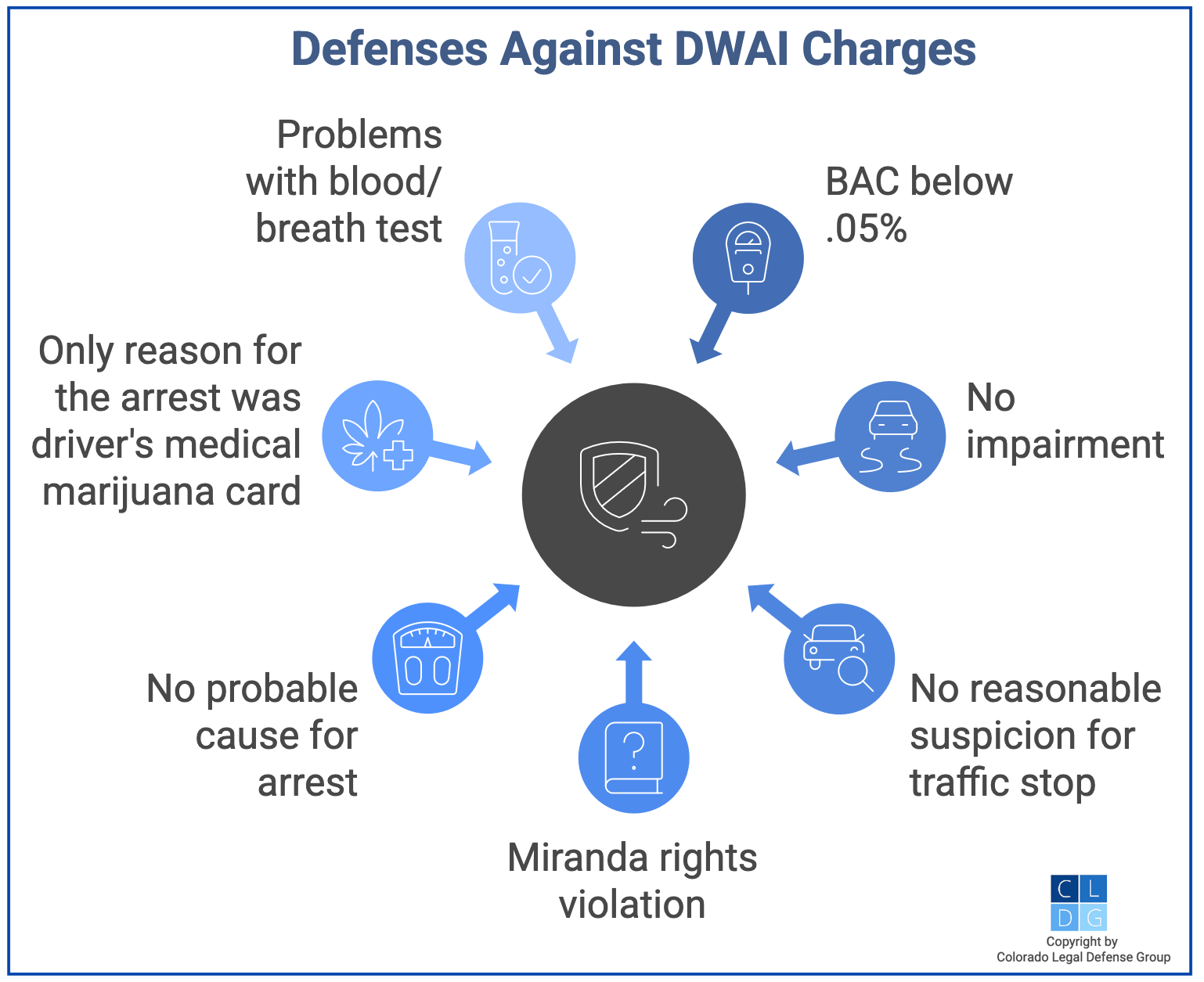
Here at Colorado Legal Defense Group, we have defended literally thousands of clients facing drunk driving allegations. In our experience, the following seven defenses can be very effective in persuading prosecutors to reduce or drop DWAI charges.
- Your BAC was less than 0.05% when you drove.
- Your driving was not impaired by alcohol and/or drugs.
- The officer had no reasonable suspicion for pulling you over.
- Following your arrest, the officer interrogated you without reading your Miranda rights.
- The police lacked probable cause to arrest you.
- You were suspected of DWAI solely because you carried a medical marijuana I.D. card.5
- Your DUI breath test or blood test was done in violation of 5 CCR 1005-2 regulations.
Ultimately, prosecutors have the burden to prove beyond a reasonable doubt that you committed DWAI. If we can show them that their evidence is too unreliable, inconsistent, or insufficient to sustain a conviction, they may agree to lessen or drop the case.
Frequently Asked Questions
What is the difference between DWAI and DUI in Colorado?
DWAI (Driving While Ability Impaired) occurs when your BAC is between 0.05% and 0.08% and you show signs of impairment. DUI requires a BAC of 0.08% or higher. DWAI is generally a less serious offense, and a first-time DWAI does not trigger automatic license suspension like a DUI does.
Will I lose my license for a first DWAI in Colorado?
No, a first-time DWAI conviction alone does not result in license suspension. However, if you refuse a breath or blood test during your arrest, your license will be suspended regardless of the case outcome.
How many points does a DWAI add to my driving record?
A DWAI adds eight points to your driving record in Colorado. This is regardless of whether it is your first offense or a subsequent conviction.
What are the penalties for a first DWAI offense in Colorado?
A first DWAI offense is a misdemeanor that carries two to 180 days in jail, fines of $200 to $500, 24 to 48 hours of community service, and up to two years of probation. A successive DUI or DWAI will carry harsher penalties.
What are my rights during a DWAI stop and interrogation?
You have the right to remain silent and the right to refuse certain tests. In Colorado, you are not required to tell an officer if you have consumed alcohol or drugs, nor are you required to disclose when you last drove.
Crucially, if an officer interrogates you while you are in custody without reading your Miranda Rights, any statements you made may be inadmissible in court. This procedural error is a powerful defense that can often lead to a reduction or dismissal of charges.
What should I do after a DWAI arrest?
Immediately contact a Colorado DUI defense attorney to protect your driving privileges and build your defense.
First your attorney should request a DMV Express Consent hearing within seven days of your arrest (or of receiving blood test results) if your license is at stake. Your attorney will also begin gathering any evidence, such as receipts or witness contact information, that could prove you were not impaired at the time of the stop.
In the meantime, avoid discussing your case with anyone other than your attorney.
Will a DWAI affect getting housing or loans?
Possibly. A DWAI is a criminal conviction that appears on background checks. This can negatively impact housing applications, as many landlords screen for criminal history.
Additionally, certain loan approvals and financial background checks may be affected, as a criminal record can be viewed as a “red flag” regarding personal responsibility or future financial stability.
Can I get a DWAI if I was only using prescription drugs or marijuana?
Yes. This is often referred to as DWAID (driving while ability impaired by drugs). In Colorado, it is unlawful to drive if your ability is impaired to “the slightest degree” by any substance. This includes legal marijuana, prescription medications, and even over-the-counter cold medicine in addition to illegal narcotics.
Unlike alcohol, there is no “automatic” legal limit for most drugs; instead, the state relies on observations from Drug Recognition Experts (DREs) to prove impairment.
Does a DWAI impact my professional license or current job?
A DWAI can have significant “collateral consequences” for your career. If your job involves driving, your employer’s insurance may no longer cover you, leading to termination.
Furthermore, if you hold a professional license (such as in nursing, law, or education), you may be required to report the conviction to your licensing board, which could result in disciplinary action or the suspension of your credentials.
Do DWAI penalties vary by locale?
State law regulates DWAI penalties, so you should expect to receive the same penalties whether your case is in Denver, Colorado Springs, Loveland, Aspen, and anywhere else in the state.
Additional Reading
For more information about Colorado DUI laws, see our informational articles:
- How long does a DWAI stay on your record in Colorado? – A discussion of how drunk/drugged driving convictions are unsealable from your background check
- What’s the difference between DUI and DWAI in Colorado? – A side-by-side comparison of the two most common drunk driving crimes
- What does DWAI stand for in Colorado? – An in-depth look into the laws behind driving while ability impaired
- How many points is a DUI in Colorado? – An examination of how driving under the influence affects your driving record in addition to your criminal record
- Habitual traffic offender in Colorado – Five things to know – Explanation of how serious traffic offenses including DWAI count as an HTO “strike”
Also see NO DUI Colorado, a government website dedicated to educating the public about drunk driving laws and what to do if you get arrested.
Legal References:
- C.R.S. 42-4-1301(1)(g).
“Driving while ability impaired” means driving a motor vehicle or vehicle when a person has consumed alcohol or one or more drugs, or a combination of both alcohol and one or more drugs, that affects the person to the slightest degree so that the person is less able than the person ordinarily would have been, either mentally or physically, or both mentally and physically, to exercise clear judgment, sufficient physical control, or due care in the safe operation of a vehicle.
C.R.S. 42-4-1307(2)(d).“Driving while ability impaired” or “DWAI” means driving a motor vehicle or vehicle when a person has consumed alcohol or one or more drugs, or a combination of both alcohol and one or more drugs, that affects the person to the slightest degree so that the person is less able than the person ordinarily would have been, either mentally or physically, or both mentally and physically, to exercise clear judgment, sufficient physical control, or due care in the safe operation of a vehicle.
- C.R.S. 42-4-1301. People v. Swain (1998) (no movement of the vehicle is required to be guilty of DWAI). Riley v. People (2004) . See also People v. Ambrose (Colo. App. 2021) 506 P.3d 57.
- C.R.S. 42-4-1307. C.R.S. 42-2-127. See also People v. Woodside (Colo. 2023) 529 P.3d 1233. C.R.S. 42-4-1301(1)(b).
A person who drives a motor vehicle or vehicle while impaired by alcohol or by one or more drugs, or by a combination of alcohol and one or more drugs, commits driving while ability impaired. Driving while ability impaired is a misdemeanor, but it is a class 4 felony if the violation occurred after three or more prior convictions, arising out of separate and distinct criminal episodes, for DUI, DUI per se, or DWAI; vehicular homicide, as described in section 18-3-106 (1)(b); vehicular assault, as described in section 18-3-205 (1)(b); or any combination thereof.
- C.R.S. 42-4-1307. See also People v. Burdette (Col.App. 2024) 552 P.3d 1108. See also People v. Schlehuber (Colo.App. 2025) No. 23CA1576 (prior convictions are “intrinsic elements” of a felony DUI/DWAI charge).
- C.R.S. 42-4-1301 (6)(k).