
Last Reviewed
Frequently Asked Questions
Do I have to give two weeks’ notice in California?
Unless your employment contract says otherwise, there is generally no requirement that you give your employer two weeks’ notice (or any notice for that matter) before quitting a job. As an at-will employee, you can quit work at any time and for any reason.
That said, employers who receive two weeks’ notice may be more likely to give you positive references in the future.
What happens if my employer fires me right after I give two weeks’ notice?
In California, your employer can lawfully fire you immediately after you give notice. Since California is an “at-will” employment stat, your employer can end the job at any time without it being wrongful termination.
When will I get my final paycheck if I quit my job?
If you give at least 72 hours’ notice before quitting, your employer must give you your final paycheck on your last day of work. If you quit without any notice, your employer has 72 hours to provide your final paycheck after you leave.
Do I have to follow company policy about giving notice even though California does not require it?
While California law does not require notice, you should check your employment contract and employee handbook. Some contracts may require you to give notice, and company policies may outline specific procedures you need to follow when resigning.
Should I give notice if my workplace has harassment or discrimination?
No, you should leave immediately if you are experiencing illegal activities like discrimination, harassment, bullying, or feel endangered at work. In these situations, it is better to prioritize your safety and speak with a labor law attorney for guidance.
In this article, our Los Angeles labor and employment attorneys go into detail about the following key topics regarding “two weeks notice” norms and job quitting laws in California.
- 1. Quitting without Notice
- 2. Pros and Cons
- 3. When Not to Give Notice
- 4. Exceptions to At-Will Employment
- 5. Resignation Letters
- 6. Final Paychecks
- Additional Resources
1. Quitting without Notice
Employees in California are generally allowed to quit on the spot without notice. This is because under California Labor Code 2922, all employees in the state are presumed to be “at-will.” “At-will” employment means employment can be terminated at:
- any time,
- by either the employer or you, and
- without any early or advance notice to the other party.1
Note, though, that some employment contracts might require you to give notice. Also, your employee handbook may outline procedures you must follow if you wish to quit.
It is in your best interest to check with the company policies to learn more about your legal rights and responsibilities. There is no across-the-board rule, though many companies consider three days of unexplained work absence to be constructive quitting.
2. Pros and Cons
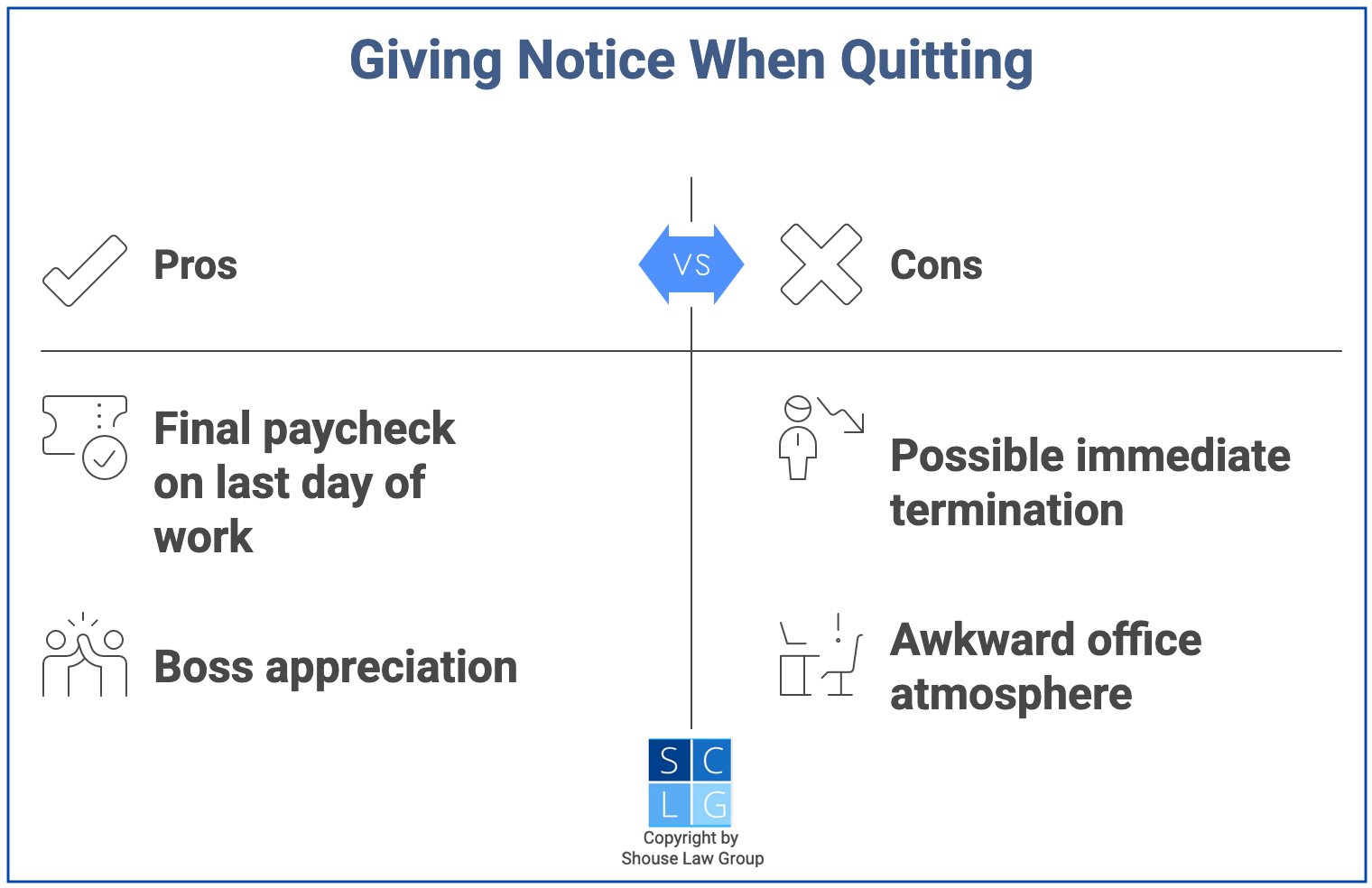
The pros of giving notice when quitting a job in California include:
- Your final paycheck should be given to you at the time you leave (as long as you give 72 hours’ notice);
- Notice gives your employer an opportunity to try to persuade you to stay, which may include a substantial raise or increased benefits; and
- Your employer will likely give you a better reference for future job opportunities; whereas if you leave them in a lurch, they may badmouth you to potential employers.
Meanwhile, the main disadvantage of giving notice relates back to the fact that California is an at-will state: If you give two weeks’ notice, the employer can still go ahead and fire you before the notice period expires. This can take place and even leave you without a wrongful termination claim.2

There is no two weeks’ notice law in California.
3. When Not to Give Notice
Examples of when you should leave your job in California without notice are when the employer breaks the law, such as by engaging in:
- age discrimination,
- employment discrimination,
- race discrimination,
- disability discrimination,
- gender discrimination,
- religious discrimination, or
- medical condition discrimination.
You should also leave without notice when you feel endangered at work, perhaps due to:
- sexual or non-sexual harassment,
- co-worker harassment or harassment by a supervisor,
- bullying, or
- a hostile work environment.
That said, you are advised to speak with a labor law attorney for guidance before taking any action.3
4. Exceptions to At-Will Employment
California law does recognize some exceptions to an at-will employment arrangement. The most common is when an employment contract, including an implied contract, governs an employment relationship.
The terms of the contract may specify:
- when an employer can fire you or terminate your employment, and
- when and how you can leave your work or quit your job.
The contract typically also provides details on:
- your pay or salary,
- the availability of unemployment insurance if employment is terminated,
- work hours,
- your job duties, and
- the length of the employment relationship.4

Resignation letters should be short and polite.
5. Resignation Letters
A resignation letter should be gracious and include all the key information your California employer needs to know, including your final day of work. For example:
Option 1. Standard Professional Resignation
Best for a good relationship where you want to leave on a positive note and help with the transition.
Dear [Manager’s Name],
Please accept this letter as formal notification that I am resigning from my position as [Job Title] at [Company Name]. My last day of employment will be [Your Last Day, ex., Friday, November 17th], which provides the standard two weeks’ notice.
Thank you for the opportunities I’ve had during my time with the company. I am committed to ensuring a smooth transition and will gladly assist with handing over my duties before my departure.
Sincerely,
[Your Name]
[Your Contact Information]
Option 2. Brief Resignation
Best for keeping things strictly professional and to the point without adding emotional fluff.
Dear [Manager’s Name],
Please accept this letter as formal notification that I am resigning from my position as [Job Title] at [Company Name].
As required, I am providing two weeks’ notice. My last day of employment will be [Your Last Day, ex., Friday, November 17th]. Please let me know how I can help wrap up my current projects prior to my departure.
Sincerely,
[Your Name]
[Your Contact Information]
Option 3. Strict Resignation (For a difficult or toxic workplace)
Best for when you simply need to state the facts for HR purposes, with no false gratitude.
Dear [Manager’s Name],
This letter is to formally notify you that I am resigning from my position as [Job Title] at [Company Name].
My last day of employment will be [Your Last Day, ex., Friday, November 17th]. Please provide instructions regarding the return of company property and my final paycheck.
Sincerely,
[Your Name]
[Your Contact Information]
If you bear ill will towards your employer, your resignation letter is usually not the time to air your grievances. Every case is different, but you are advised not to include anything negative in your letter.
6. Final Paychecks
If you resign from your job in California with at least 72 hours’ notice, you should receive your final paycheck on your last day of work. Otherwise, the employer has 72 hours to pay you after you give notice.
Note that there are special extended deadlines for film industry workers, seasonal employees, and certain other occupations.
Your final paycheck must include all unpaid wages owed plus any accrued:
- vacation time,
- commissions, and
- other benefits owed.
If there is a dispute, you can file a wage claim with the California Labor Commissioner’s Office and potentially receive up to 30 days of waiting time penalties in addition to your back pay.5

Many employers appreciate getting as much advanced notice as possible when you quit.
Additional Resources
For more information beyond California’s resignation laws, refer to the following:
- How To Resign From Your Job In The Most Professional Way – Article by Forbes.
- How to Write a Job Resignation Letter – Guide by Business News Daily.
- 3 Best Resignation Letter Examples – Samples and tips provided by The Entrepreneur.
- Top 10 Good Reasons to Quit Your Job – Discussion by financial website, The Balance.
- Why Does Quitting Your Job Still Feel So Hard? – Article by BBC Worklife.
See our related article, Job abandonment in California – What is it and what is the law?
Legal References:
- California Labor Code 2922. See also Turner v. All American Healthcare Services, Inc. (Cal. Ct. App., 2025) No. B334873.
- Same. See, for example, Jones v. Lodge at Torrey Pines Partnership (Ca. 2008) 177 P.3d 232. See also Leshner v. Postmates, Inc. (Superior Court of California, County of San Francisco, 2018) Case No. CGC-17-563417.
- See, for example, Sanchez v. Unemployment Ins. Appeals Bd. (Ca. 1984) 685 P.2d 61.
- See, for example, Scott v. Pacific Gas & Electric Co. (Ca. 1995) 904 P.2d 834; see, for example, Guz v. Bechtel National, Inc. (Ca. 2000) 8 P.3d 1089.
- California Labor Code 201, 202, 203.