

The Private Attorney General Act (or PAGA) is a California law that allows you to bring labor violation claims against your employer or former employer. You act as a “private attorney general” and can pursue civil penalties by standing in the shoes of the State.
Here are five key things to know:
- PAGA gives you the ability to file a lawsuit on behalf of the State of California.
- Depending on your case, labor violations carry penalties ranging from up to $200 per aggrieved employee, per pay period.
- As of June 19, 2024, 65% of these monetary penalties go to the State of California, not workers.
- The 35% that workers share are not meant to make up for unpaid wages – they are just civil penalties.
- To pursue PAGA penalties for a Labor Code violation, you must file a notice with the Labor and Workforce Development Agency (LWDA) within one year of the violation.
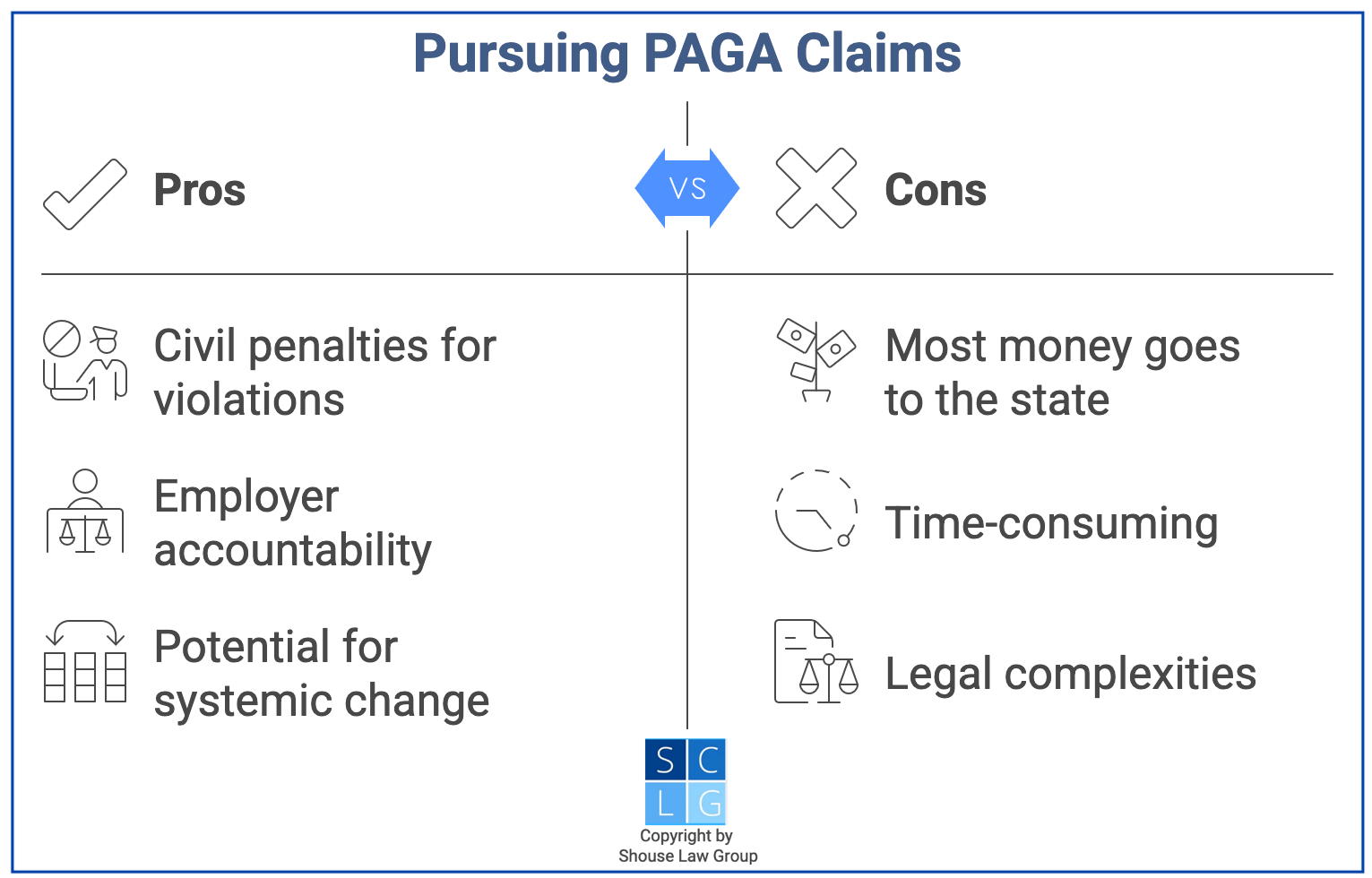
In this article, our California labor and employment lawyers will address the following key issues regarding PAGA claims:
- 1. Eligible Plaintiffs
- 2. Eligible Violations
- 3. How to File
- 4. Statute of Limitations
- 5. Monetary Penalties
- 6. AB-2288 & SB-92
- Additional Resources
1. Eligible Plaintiffs
In California, PAGA lawsuits can be filed by a company’s “aggrieved employees.” You are an aggrieved employee only as to Labor Code violations that you personally suffered.
If you personally suffered a Labor Code violation, you have standing to bring a representative PAGA action on behalf of other affected employees. However, you may seek penalties only for the types of violations that you yourself experienced.
You may have to arbitrate the individual portion of your PAGA claim if you agreed to a valid arbitration agreement (such as in your employment contract). However, representative PAGA claims on behalf of other aggrieved employees cannot be waived (though courts may delay them pending arbitration of your individual PAGA claim).
Note that certain janitorial workers may not bring PAGA claims if they are covered by a qualifying collective bargaining agreement that meets statutory requirements.1
2. Eligible Violations
The Private Attorney General Act authorizes civil penalties for:
- Most California Labor Code violations and
- Certain California Health and Safety Code violations incorporated by statute.2
Wage and hour violations are among the most common issues in PAGA lawsuits.

Aggrieved employees begin the process by filing a PAGA notice of alleged Labor Code violations with the LWDA (California Labor and Workforce Development Agency).
3. How to File
The process of filing a PAGA lawsuit is different from other wage and hour lawsuits.
As an aggrieved employee, you begin by filing a PAGA claim with the California Labor and Workforce Development Agency (LWDA). This filing has to be done online. It costs $75 to file, though the filing fee can be waived in some cases. The filing has to be served on the employer via certified mail, as well.
This puts the employer on notice of the claim. It also gives LWDA an opportunity to investigate and pursue the claim on its own. LWDA has 65 days to decide whether to take the case. If they choose not to, you can file your own PAGA lawsuit.
Once filed, a PAGA claim moves forward as a representative lawsuit. This is different from a class action in that the class does not have to be certified. However, by filing the PAGA lawsuit, you stand in for other employees who have suffered from a labor violation.
As discussed below in section 5, employers may be able to pay lower penalties if they quickly “mitigate” the violation. A possible example is by “making you whole” by paying your unpaid wages and by complying with any other statutory requirements.3
4. Statute of Limitations
PAGA remedies are limited to violations occurring within only one year before filing notice with the LWDA. That is not a long time, so it is vital you seek out legal counsel in California quickly following a violation.4

Employees can file PAGA claims for labor violations
5. Monetary Penalties
When the underlying California Labor Code provision does not specify its own PAGA penalty, the employer’s initial labor violation carries a civil penalty of $100 per aggrieved employee, per pay period. Though there are exceptions:
- Courts have discretion to reduce penalties for technical wage statement violations that cause no confusion or harm. For the specific violation of mis-listing the employer’s name or address on a pay stub, the statute caps the PAGA penalty at $25 per aggrieved employee per pay period.
- For isolated, nonrecurring violations, courts may assess a reduced penalty of $50 per pay period.
- If employers were “proactively compliant” by making reasonable, good-faith compliance efforts, penalties for violations may be capped as low as 15% of the maximum penalty.
- If employers complied (“took all reasonable steps”) within 60 days of receiving a PAGA notice, violations may be capped at 30% of the maximum penalty.
Meanwhile, labor penalties can be as much as $200 per employee, per pay period, if either:
- The court finds that the employer’s conduct that gave rise to the violation was oppressive, malicious, or fraudulent; or
- Within five years prior to the violation, the LWDA or any court found that the employer’s practice that gave rise to the violation was unlawful.
You and your fellow workers do not receive all this money, however. For PAGA notices filed on or after June 19, 2024, 65% of the penalties recovered go to the State of California. The aggrieved employees who brought the claim share only 35% of the penalties. (Successful PAGA claims also recover attorneys’ fees and court costs.)5
Remember, PAGA claims let you recover only civil penalties provided by the statute, not the unpaid wages that led to you bringing the claim. However, some statutes (such as Labor Code 558) incorporate unpaid wages, which are paid directly to employees rather than treated as PAGA penalties. You can also bring separate wage and hour lawsuits to recover unpaid wages.
6. AB-2288 & SB-92
In mid-2024, two California bills became law that made PAGA laws more employer-friendly.
Prior to AB-2288, employers in violation were on the hook for civil penalties of $100 per aggrieved employee per pay period. Now, as discussed in the previous section, many violations may carry lower penalty amounts if the employer took proactive actions to fix the problem.
Prior to SB-92, employers in many cases were not given the time to cure violations before being liable for civil penalties. Now, employers have limited time to cure certain technical violations, primarily wage-statement defects, before certain civil penalties may be imposed.6

Reforms passed in 2024 makes PAGA laws more friendly to employers.
Additional Resources
For more information, refer to the following:
- California Labor & Workforce Development Agency PAGA Resource Page – State agency’s info page explaining the PAGA process.
- PAGA: A Decade of Victories – Overview of PAGA cases from an employee rights organization.
- Lowe’s Ex-Worker Case Leads New Shot for Clarity on PAGA Rulings – recent article by Bloomberg Law.
- PAGA settlements and the unintended consequences on California workers – recent editorial by The Orange County Register.
- California’s two-decade battle over PAGA labor law still rages – recent editorial by Cal Matters.
Legal References:
- California Labor Code 2698 et seq. Arias v. Superior Court, (Cal. 2009) 46 Cal.4th 969. California Labor Code 2699(c). Huff v. Securitas Security Services USA, Inc., (Cal. App. 2018) 23 Cal.App.5th 745 (statutorily modified by AB 2288). See also Sargent v. Bd. of Trustees of the Cal. State Univ. (2021) 61 Cal.App.5th 658 (public entities can face PAGA claims if the underlying statutes create penalties). See also Magadia v. Wal-Mart Associates, Inc. (9th Cir. 2021) 999 F.3d 668 (“[worker] lacked standing to bring the meal-break claim because he did not suffer injury himself“). See also Santos v. El Guapos Tacos (2021) 72 Cal.App.5th 363. Adolph v. Uber Technologies, Inc. (2023) 14 Cal.5th 1104. Betancourt v. Prudential Overall Supply (Cal. App. 2017) 9 Cal.App.5th 439. Iskanian v. CLS Transportation Los Angeles, LLC, (Cal. 2014) 327 P.3d 129. (See also Viking River Cruises, Inc. v. Moriana (2022) 142 S. Ct. 1906 (“The [Federal Arbitration Act/FAA] preempts the rule of Iskanian insofar as it precludes division of PAGA actions into individual and non-individual claims through an agreement to arbitrate.”). SB 646 (janitorial carve-out legislation). See also Leeper v. Shipt, Inc. (Ca. 2025) 566 P.3d 234.
- California Labor Code 2699.3.
- California Labor Code 2699.3(a)(1)(B). See also Crestwood Behavioral Health, Inc. v. Superior Court (2021) 60 Cal.App.5th 1069 (PAGA action venue is where employer committed violations). California Labor Code 2699.3(a)(1)(A). Alcantar v. Hobart Serv. (9th Cir. 2015) 800 F.3d 1047. California Labor Code 2699.3(a)(1)(A). See also Green v. Bank of America, N.A. (9th Cir. 2015) 634 Fed. Appx. 188. Cardenas v. McLane Foodservices, Inc., (C.D. Cal. 2011) 796 F. Supp. 2d 1246. See also Laface v. Ralphs Grocery Store (2022) 75 Cal.App.5th 388 (“PAGA … contains several unique features that we conclude make it unlike any pre-1850 common law action and therefore unsuitable for a trial by jury.”). See also Shaw v. Superior Court (2022) 78 Cal.App.5th 245 (when there are two overlapping PAGA suits, the concurrent jurisdiction doctrine allows the trial court to stay one of them). See also LaCour v. Marshalls of California LLC (Cal.App. 2023) 94 Cal. App. 5th 1172 and Accurso v. In-N-Out Burgers (Cal.App. 2023) A165320 (reducing the preclusive power of PAGA lawsuits).
- California Code of Civil Procedure 340. See Brown v. Ralphs Grocery Co., (Cal. App. 2018) 28 Cal.App.5th 824.
- ZB, N.A. v. Superior Court, (Cal. 2019) 8 Cal.5th 175. California Labor Code 2699(i). See also Turrieta v. Lyft, Inc. (2024) 16 Cal. 5th 664 (holding PAGA plaintiffs lack standing to intervene in overlapping PAGA actions). California Labor Code 558. Prior to June 19, 2024, the penalty split was 75/25, not 65/35. See also
- Assembly Bill 2288 (2024). Senate Bill 92 (2024).