
Last Reviewed

In California, you are entitled to use up to half of your allotted paid sick leave days as kin care leave. This is time off to care for a family member or designated person who is ill or the victim of domestic violence, sexual assault, or stalking.
Examples of kin care leave include:
- Your spouse needs transportation to a medical specialist. You can use your kin care hours to take the morning off and get paid for it.
- Your child has the flu and cannot go to school. You can call out sick using your kin care hours to stay home and care for them without penalty.
- Your parent needs dialysis. You take kin care leave so you can keep getting paid while taking your parent to the hemodialysis clinic.
Your employer cannot take an adverse employment action against you for proper use of kin care leave. If your rights are violated, you may be entitled to such remedies as:
- actual damages or one day’s pay (whichever is greater),
- back pay, and/or
- reinstatement.
In this article, our Los Angeles employment and labor lawyers will discuss the following key issues regarding California kin care leave laws:
- 1. Included Family Members
- 2. Length of Kin Care Leave
- 3. Reasons for Kin Care Leave
- 4. Employer Violations
- Frequently Asked Questions
- Additional Reading
1. Included Family Members
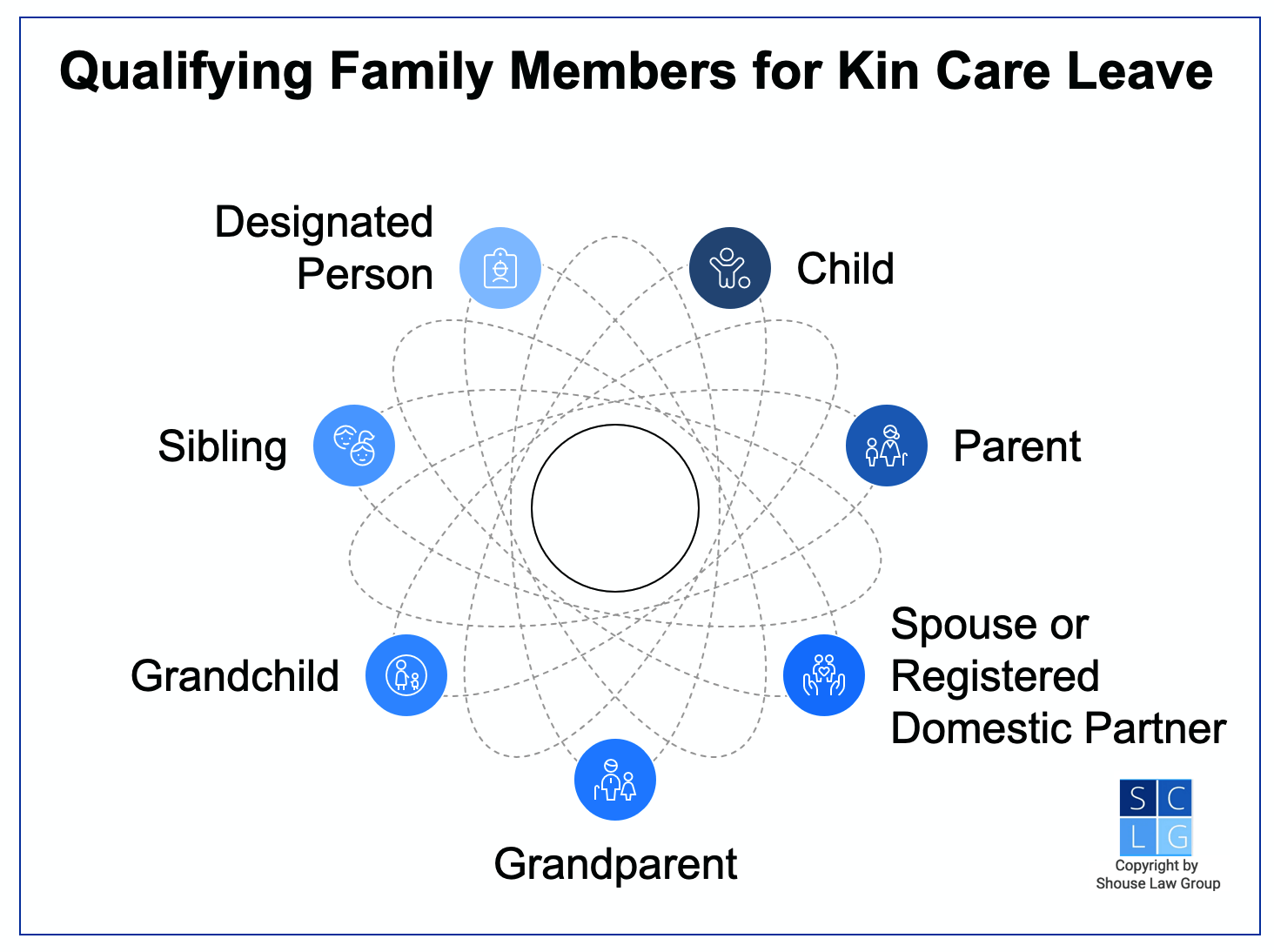
People covered under California’s kin care leave law include your:
- child, whether a biological child, adopted child, foster child, stepchild, legal ward, or a child for whom you stand in loco parentis;
- parent, whether a biological parent, adoptive parent, foster parent, stepparent, parent-in-law, or legal guardian;
- spouse;
- registered domestic partner;
- grandparent;
- grandchild;
- sibling; or
- designated person.
The types of family members were expanded in 2016 and then again in 2022. Suppose an employer claims that the applicable family member is not applicable, even though they fall under one of the above categories: In that case, the employer likely is basing that assertion on an outdated law.1
2. Length of Kin Care Leave
In California, half of your yearly allotted sick leave may be used for kin care.
Effective January 1, 2024, SB 616 increased the minimum guaranteed paid sick leave from three days (24 hours) to 5 days (40 hours) per year. Because kin care law allows you to use up to half of your annually accrued sick leave to care for a family member, this recent expansion means employees are now entitled to use at least 2.5 days (20 hours) specifically for kin care leave.2
There are only a few, rare exceptions to this law. If your employer tells you that you are the exception, an experienced employment law attorney will let you know if the employer is telling the truth.
3. Reasons for Kin Care Leave
In California, you are entitled to take accrued sick time off work in order to:
- seek diagnosis, care, or treatment for an existing health condition of your family member,
- support a family member who was the victim of domestic violence,
- support a family member who was the victim of sexual assault, or
- support a family member who was the victim of stalking.
Supporting a family member may include, but is not limited to:
- assisting in medical care or transportation to medical care,
- seeking court relief,
- relocating their residence, or
- seeking counseling for abuse.3
4. Employer Violations
If you lawfully take off work for kin care in California, your employer may not retaliate against you. Examples include:
- demotions,
- suspensions,
- failure to promote
- wrongful termination, and/or
- refusal to rehire you.
If your employer takes an adverse employment action against you, you can file a complaint with the California Labor Commissioner. (If you are being subjected to discrimination or harassment, you would instead file a complaint with the Civil Rights Department.)
If the state agency cannot resolve the issue, you can file a civil lawsuit against your employer. In addition to back pay and job reinstatement, you may also be able to recover attorneys’ fees.4

Kin care leave is time provided to employees to take time off work to care for a family member.
Frequently Asked Questions
How do CFRA and FMLA interact with kin care?
While the California Family Rights Act (CFRA) and the Family and Medical Leave Act (FMLA) provide unpaid, job-protected leave for serious health conditions, kin care allows you to use your accrued paid sick leave. These laws can overlap.
For instance, you can use kin care concurrently with CFRA/FMLA to ensure you get paid while taking protected time off. However, unlike CFRA/FMLA, kin care can also be used for minor, everyday illnesses—like a child’s common cold—that do not qualify as “serious health conditions.”
What are examples of employer violations of kin care policies?
An employer violates California law when they interfere with or punish you for using your protected kin care leave. Common examples include:
- Counting kin care absences as “points” or “occurrences” in a company attendance disciplinary policy.
- Requiring you to find your own shift replacement before approving the time off.
- Denying the leave because it is to care for a parent-in-law (which is explicitly protected by California law).
- Demoting, writing up, or terminating you for taking the time off.
Do I need a doctor’s note to take kin care leave?
Generally, no. Under California’s paid sick leave laws, employers usually cannot force you to provide a doctor’s note for short absences, as this can be seen as unreasonable interference with your right to take protected leave. If your employer is aggressively demanding medical documentation for a standard kin care absence, they may be violating state labor codes.
See our related article, Can an employer require a doctor’s note in California?
Can I use kin care leave for someone who is not a blood relative?
Yes. California has expanded the definition of “family member” well beyond biological relatives. You can use kin care to support adopted and foster children, step-parents, legal guardians, registered domestic partners, and mothers/fathers-in-law.
Furthermore, as of 2023, you can use kin care for a “designated person”—someone who may not be legally related to you, but whose relationship is the equivalent of family.
When should I contact an employment attorney?
You should contact a California labor law attorney if your employer wrongfully denies your request to use your accrued sick leave for a family member, or if you face retaliation for doing so.
If you were written up, suspended, demoted, or fired after taking kin care leave, an attorney can help you file a claim to recover lost wages, secure reinstatement, and hold your employer accountable.
Additional Reading
For more information, refer to the following:
- Can an employer require a doctor’s note in California? – Article by our California employment law attorneys.
- What’s the Difference? Paid Sick Leave, FMLA, and Paid Family and Medical Leave – Comparison by the U.S. Department of Labor.
- >Paid Sick Leave vs. Vacation vs. PTO: What You Need to Know – Discussion by ADP, a human resources management software and services provider.
- Paid Sick Leave and Job Stability – Scholarly article by Work and Occupations.
- The Growing Costs and Burden of Family Caregiving of Older Adults: A Review of Paid Sick Leave and Family Leave Policies – Scholarly article by The Gerontologist.
See our related article on California Paid Family Leave (PFL).
Legal References:
- California Labor Code 233. California Labor Code § 245.5. See AB 1041. McCarther v. Pacific Telesis Group (2010) 48 Cal. 4th 104.
- California Labor Code 233. California Labor Code 246.
- California Labor Code § 233.
- California Labor Code § 233. See Wood v. Kaiser Foundation Hospitals (2023) 88 Cal. App. 5th 742.