
Quick summary
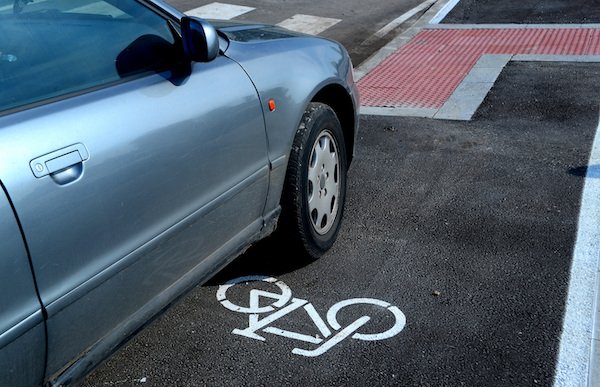
California Vehicle Code 21209 makes it an infraction to drive in a bike lane except to park, to enter or leave the road, or to get ready for a turn within 200 feet of the intersection.
- Penalties: A fine of about $233 with assessments (as of 2026) and 1 point on your California DMV record. There’s no jail.
- Traffic school: You can usually take traffic school to keep the point off your record, once every 18 months.
- Don’t ignore the ticket: Willfully missing your court date is a separate misdemeanor under VC 40508.
- Example: Maria pulls into the bike lane 100 feet before her right turn and signals. That’s legal. Using the bike lane to pass a line of stopped cars is not.
In this article, our California car accident attorneys answer 8 common questions about driving in a bike lane:
- 1. When can you drive in a bike lane in California?
- 2. The penalties for driving in a bike lane
- 3. Legal defenses if a driver violates VC 21209
- 4. Violation of Vehicle Code 21209 VC and traffic school
- 5. Driving on a bicycle lane and criminal charges
- 6. Ignoring a ticket for violating VC 21209
- 7. Violations of VC 21209 and subsequent lawsuits
- 8. Laws related to Vehicle Code 21209 VC
1. When can you drive in a bike lane in California?
In California, you may drive a car in a marked bike lane only for one of three reasons listed in Vehicle Code 21209. The full statute reads:
(a) No person shall drive a motor vehicle in a bicycle lane established on a roadway pursuant to Section 21207 except as follows:
(1) To park where parking is permitted.
(2) To enter or leave the roadway.
(3) To prepare for a turn within a distance of 200 feet from the intersection.
(b) This section does not prohibit the use of a motorized bicycle in a bicycle lane, pursuant to Section 21207.5, at a speed no greater than is reasonable or prudent, having due regard for visibility, traffic conditions, and the condition of the roadway surface of the bicycle lane, and in a manner which does not endanger the safety of bicyclists.
California Vehicle Code 21209.1
In plain terms, you can move into the bike lane to:
- Park where parking is allowed;
- Enter or leave the road, such as turning into a driveway or parking lot; or
- Get ready for a turn, but only within the last 200 feet before the intersection.
Any other driving in the bike lane is a violation, such as using it to pass slow traffic or as an extra lane during rush hour.
Example: John is stuck in traffic on a San Diego street. He swings into the bike lane and drives a full block to reach his turn. Because he entered the lane well before the last 200 feet, he can be ticketed under VC 21209.
Motorized bicycles may use the bike lane
VC 21209 does not stop people from riding a motorized bicycle (a moped-style bike) in a bike lane, as long as they ride at a safe speed that doesn’t put bicyclists at risk.2
2. The penalties for driving in a bike lane
In California, a VC 21209 ticket carries two penalties:
- A fine; and
- A point on your DMV driving record.
The fine is about $233
Driving in a bike lane is a $35 base-fine infraction. After California’s penalty assessments and court fees are added, the total under the Judicial Council’s statewide schedule is about $233 (as of January 2026).3 Counties can set slightly different amounts, so check the courtesy notice from your court.
One point on your DMV record
A conviction under VC 21209 adds one point to your California DMV record, the standard count for a moving violation.4 Insurance companies see these points, and your rates may go up for several years.
Points also add up. The DMV presumes you are a “negligent operator” if you get:
- 4 or more points in 12 months;
- 6 or more points in 24 months; or
- 8 or more points in 36 months.5
A negligent operator can have their license suspended or put on probation. You have the right to a California DMV hearing to fight a negligent operator license suspension before it takes effect.
3. Legal defenses if a driver violates VC 21209
If you get a ticket for driving in a California bike lane, you don’t have to plead guilty or admit fault. You can contest the ticket in traffic court.
Common defenses for driving in a bike lane
The most common defenses to a VC 21209 ticket are:
- An exception applied. You were in the bike lane to park, to enter or leave the road, or within 200 feet of your turn.
- Emergency. You moved into the bike lane to avoid a crash, make way for an ambulance or follow an officer’s direction.
- Officer error. The officer misjudged the distance to the intersection, or the lane wasn’t clearly marked as a bike lane.
Evidence that helps includes:
- Witnesses;
- Photos of the lane markings and intersection;
- Dashcam or surveillance video.
Contact a lawyer for help
You can represent yourself on a traffic ticket. A lawyer can still help in three ways:
- A lawyer can often negotiate a better result, such as a reduced or dismissed charge.
- A lawyer knows how to challenge the officer’s account.
- In most traffic cases, your lawyer can go to court for you, so you don’t have to.
4. Violation of Vehicle Code 21209 VC and traffic school
In California, you don’t have to go to traffic school for a bike lane ticket, but you can usually choose to. If the judge allows it and you finish the course, the conviction stays confidential and no point is added to your record.6
You are usually eligible if:
- You have a valid noncommercial driver’s license;
- You were not driving a commercial vehicle;
- The ticket is for a moving violation that is an infraction; and
- You haven’t used traffic school for another ticket in the past 18 months.
You still have to pay the fine, plus the court’s traffic school fee and the school’s own charge.
5. Driving on a bicycle lane and criminal charges
Driving in a bike lane is not a crime in California. A VC 21209 violation is an infraction under California law, like most traffic tickets.7
An infraction can’t be punished with jail. You also have no right to a jury trial or a court-appointed lawyer for an infraction.8
6. Ignoring a ticket for violating VC 21209
Don’t ignore a California bike lane ticket. If you do, you can be charged with a new offense: failure to appear, per California Vehicle Code 40508.
What counts as a failure to appear
When you get a traffic ticket in California, you sign a written promise to appear. Under California Vehicle Code 40508 VC, it’s a misdemeanor to willfully break that promise. It’s also a misdemeanor to willfully:
- Miss a court date that was continued (postponed);
- Fail to pay bail installments you agreed to;
- Fail to pay a fine on time without a lawful excuse; or
- Fail to follow another condition of the court’s order.9
“Willfully” means on purpose. You don’t have to intend to break the law.10 It also doesn’t matter whether you were guilty of the original ticket. A real mix-up, such as never getting your court notice, can be a defense because the failure wasn’t willful.
Penalties for violating VC 40508
A failure to appear under VC 40508 is a misdemeanor in California. It can be punished by:
- Up to 6 months in county jail; and/or
- A fine of up to $1,000.11
7. Violations of VC 21209 and subsequent lawsuits
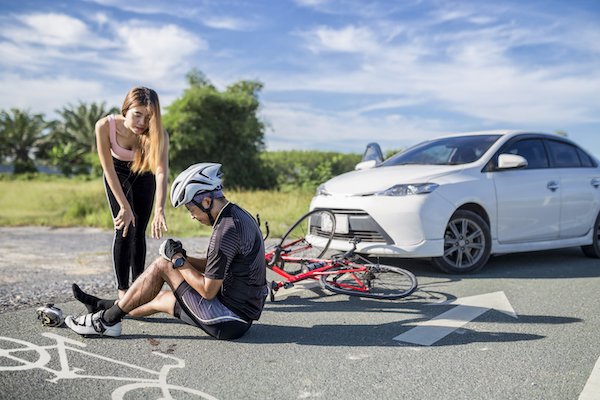
If you drive in a California bike lane and hit a bicyclist, you may face:
- A lawsuit by the bike rider; and
- A finding that you were negligent.
Lawsuits filed by bike riders
Bike crashes are common in California. They can be caused by careless drivers, dangerous road conditions or distracted pedestrians, and bicycle accident lawsuits in California are common too.
A cyclist hit by a car in the bike lane can sue the driver for:
- Medical bills;
- Lost wages;
- Damage to the bicycle; and
- Pain and suffering.
If a bicyclist is killed, their family may be able to bring a California wrongful death lawsuit.
A potential finding of negligence against you
In a California injury case, “negligence” means failing to use reasonable care to avoid harming others. A negligent driver has to pay for the harm they cause.12 (Negligence in a lawsuit is different from criminal negligence, which is a much higher standard.)
Proving negligence in a personal injury case can take work. But in California, you are presumed negligent (“negligence per se”) if you broke a safety law, the violation caused the injury, and the law was meant to protect people like the injured person.13 VC 21209 exists to protect bicyclists, so a driver who hits a cyclist in a bike lane will usually face this presumption. The driver can try to rebut it by showing they acted as a careful person would have.
Under California’s comparative fault laws, fault can also be shared. If the cyclist was partly to blame, for example by riding at night with no light, their damages are reduced by their share of the fault.14
8. Laws related to Vehicle Code 21209 VC
Three California laws are closely related to VC 21209:
- VC 21208, riding bicycles in bike lanes;
- VC 21202, bicyclists riding near the right-hand side of the road; and
- VC 23127, driving unauthorized vehicles on trails and paths.
Riding bicycles in bike lanes (VC 21208)
California Vehicle Code 21208 says that where there is a bike lane, a bicyclist riding slower than the traffic around them must ride in the bike lane.15 A cyclist may leave the bike lane:
- To pass another bike, a vehicle or a pedestrian when it can’t be done safely inside the lane;
- To get ready for a left turn at an intersection or into a driveway;
- When needed to avoid debris or other hazards; or
- When approaching a place where a right turn is allowed.16
A VC 21208 ticket is a $25 base-fine bicycle infraction, about $192 with assessments under the 2026 statewide schedule.17 Bicycle tickets don’t add points to your driving record.
Bicyclists riding near the right-hand side of the road (VC 21202)
Under California Vehicle Code 21202, a bicyclist riding slower than traffic must ride as close as practicable to the right-hand curb or edge of the road.18 The exceptions are:
- Passing another bike or a vehicle going the same way;
- Getting ready for a left turn at an intersection or into a driveway;
- Avoiding hazards, such as parked cars, debris or a lane too narrow for a bike and a car to share safely; and
- Approaching a place where a right turn is allowed.
On a one-way street with two or more lanes, a cyclist may also ride near the left-hand curb. A VC 21202 ticket is also a $25 base-fine bicycle infraction (about $192 with assessments), with no points.
Unauthorized vehicles on trails and paths (VC 23127)
California Vehicle Code 23127 makes it a crime to drive an “unauthorized motor vehicle” on a hiking trail, horseback riding trail or bike path that is properly posted.19 This applies to state, county, city, district and private trails and paths.
A vehicle is “unauthorized” if it’s driven there without written permission from the owner of the trail or path, or the owner’s agent. The trail is properly posted if signs saying no unauthorized motor vehicles are allowed are placed:
- At every entrance and exit; and
- At least every mile along the trail or path.
The law doesn’t apply to emergency or maintenance vehicles on official business, or to bike paths that run right alongside a road for cars.
A violation of VC 23127 is a misdemeanor, which is more serious than an infraction but less serious than a California felony. It can be punished by:
- Up to 6 months in county jail; and/or
- A fine of up to $1,000.20
If you got a ticket for driving in a bike lane, or you were hurt or sued after a bike lane crash, call our California law firm for a free consultation. Our lawyers can explain your options and handle the case in court for you.
Legal references:
- California Vehicle Code 21209 VC (text as of November 2026; last amended 1988).
- California Vehicle Code 21209(b) VC (see note 1 above).
- Judicial Council of California, Uniform Bail and Penalty Schedules, 2026 Edition, Preface, Bail Categories: Category 2 = $35 base fine + $123 additional penalties and surcharge + $75 fees = $233.
- California Vehicle Code 12810(f) VC: “any other traffic conviction involving the safe operation of a motor vehicle upon the highway shall be given a value of one point.”
- California Vehicle Code 12810.5(a) VC: “a person whose driving record shows a violation point count of four or more points in 12 months, six or more points in 24 months, or eight or more points in 36 months shall be prima facie presumed to be a negligent operator of a motor vehicle.”
- California Vehicle Code 42005 VC; California Vehicle Code 1808.7(a) VC: the record of “the first proceeding and conviction … in any 18-month period for completion of a traffic violator school program is confidential …. No violation point count shall be assessed pursuant to Section 12810 if the conviction is confidential.”
- California Vehicle Code 40000.1 VC: “it is unlawful and constitutes an infraction for any person to violate, or fail to comply with any provision of this code ….”
- California Penal Code 19.6 PC: “An infraction is not punishable by imprisonment. A person charged with an infraction shall not be entitled to a trial by jury.”
- California Vehicle Code 40508(a)-(c) VC (amended by AB 1125, effective January 1, 2024): “A person willfully violating their written promise to appear or a lawfully granted continuance of their promise to appear in court … is guilty of a misdemeanor regardless of the disposition of the charge upon which the person was originally arrested.”
- CALCRIM No. 2240, Failure to Appear (Veh. Code, § 40508(a)): “Someone commits an act willfully when he or she does it willingly or on purpose. It is not required that he or she intend to break the law, hurt someone else, or gain any advantage.”
- California Vehicle Code 42002 VC: “Unless a different penalty is expressly provided by this code, every person convicted of a misdemeanor for a violation of any of the provisions of this code shall be punished by a fine of not exceeding one thousand dollars ($1,000) or by imprisonment in the county jail for not exceeding six months, or by both ….”
- California Civil Code 1714(a): “Everyone is responsible, not only for the result of his or her willful acts, but also for an injury occasioned to another by his or her want of ordinary care or skill in the management of his or her property or person ….”
- California Evidence Code 669: “(a) The failure of a person to exercise due care is presumed if: (1) He violated a statute, ordinance, or regulation of a public entity; (2) The violation proximately caused death or injury to person or property; (3) The death or injury resulted from an occurrence of the nature which the statute, ordinance, or regulation was designed to prevent; and (4) The person suffering the death or the injury … was one of the class of persons for whose protection the statute, ordinance, or regulation was adopted.”
- California Civil Code 1714(a) (see note 12 above): responsibility for want of ordinary care applies “except so far as the latter has, willfully or by want of ordinary care, brought the injury upon himself or herself.”
- California Vehicle Code 21208(a) VC: “any person operating a bicycle upon the roadway at a speed less than the normal speed of traffic moving in the same direction at that time shall ride within the bicycle lane ….”
- California Vehicle Code 21208(a)(1)-(4) VC (see note 15 above).
- Judicial Council of California, Uniform Bail and Penalty Schedules, 2026 Edition (see note 3 above), Preface: Category 1 (bicyclist, pedestrian) = $25 + $92 + $75 = $192.
- California Vehicle Code 21202 VC.
- California Vehicle Code 23127 VC: “No person shall operate an unauthorized motor vehicle on any state, county, city, private, or district hiking or horseback riding trail or bicycle path that is clearly marked … with signs at all entrances and exits and at intervals of not more than one mile ….” “Any person who violates this section is guilty of a misdemeanor.”
- California Vehicle Code 42002 VC (see note 11 above).