

California Penal Code § 417 PC makes brandishing a deadly weapon such as a firearm a misdemeanor, carrying up to one year in jail and/or $1,000 in fines. However, brandishing a gun can be charged as a felony if it occurred at a day care or in the presence of law enforcement.
Brandishing means to draw or exhibit the weapon in a threatening manner or to use it in a fight (other than in lawful self-defense). An example is pulling back your jacket to reveal a gun to someone you are having an altercation with.
In this article, our Los Angeles criminal defense attorneys will address the following key issues regarding California brandishing laws.
- 1. Elements of PC 417
- 2. Defenses
- 3. Penalties
- 4. Immigration Consequences
- 5. Expungements
- 6. Gun Rights
- 7. Related Crimes
- Frequently Asked Questions
- Additional Reading
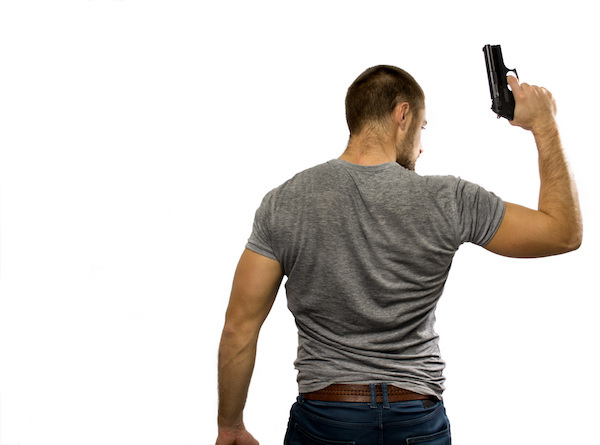
Penal Code 417 makes it a crime to brandish a weapon or firearm.
1. Elements of PC 417
Penal Code 417 makes it a crime to brandish a weapon or firearm.1 For you to be convicted of brandishing a weapon in California, prosecutors have to prove beyond a reasonable doubt the following three elements of the jury instructions:
- You drew or exhibited a deadly weapon or a firearm in the presence of someone else, and
- You did so in a rude, angry or threatening manner, or you used the weapon or firearm in a fight or quarrel, and
- You did not act in self-defense.2
A deadly weapon is any object or weapon that is inherently deadly or can be used to cause death or great bodily injury.3
If you brandish a weapon and cause serious bodily injury, you can be charged with a more serious offense under Penal Code 417.6 PC. If you brandished an imitation firearm, you can be charged under Penal Code 417.4 PC.
Note that it is not necessary for a weapon to be pointed at someone for it to be “deadly.”4
Example: John is arguing with his girlfriend and grabs a hammer and a baseball bat. These objects are deadly weapons under the circumstances, no matter if he points them at his girlfriend or approaches her while waving them in the air.
With regard to firearms, you can be guilty of a crime even if the alleged victim was not aware that you had a gun.5
Example: Jose angrily takes out his concealed carry gun and waves it at a drunken bar patron. While the patron may not have realized there was a gun (because intoxicated), Jose is still guilty of a crime.
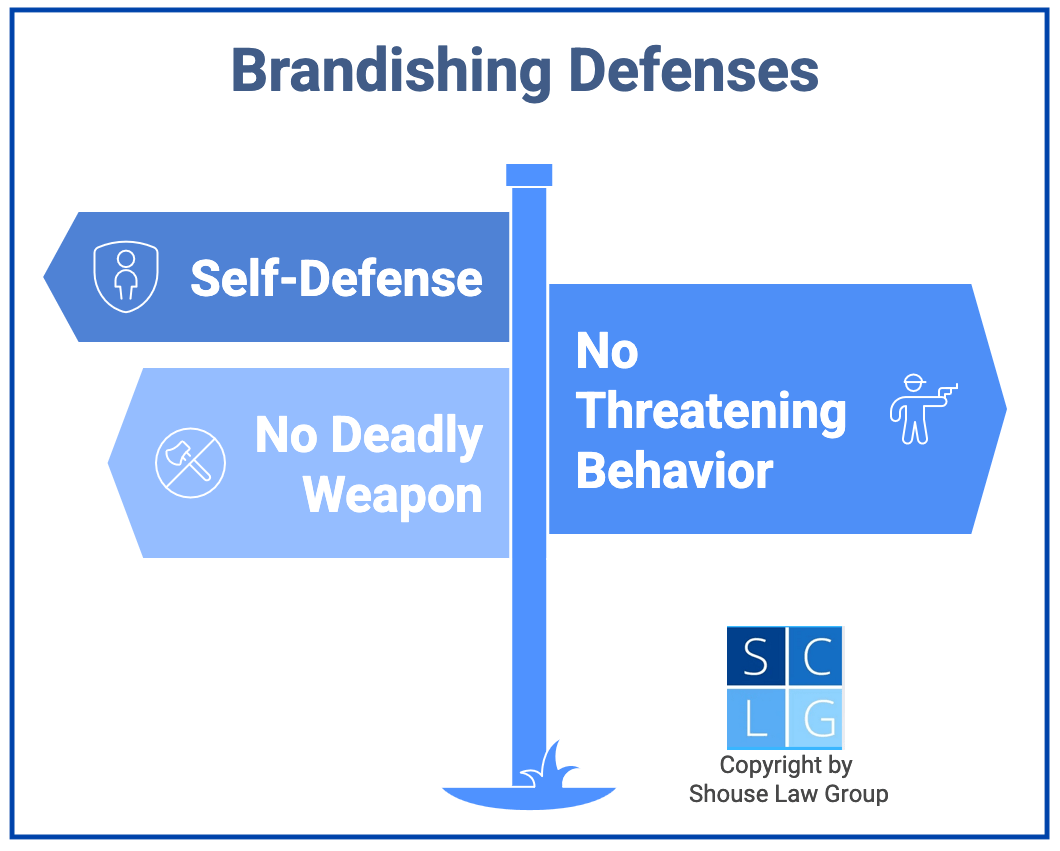
2. Defenses
Here at Shouse Law Group, we have represented literally thousands of people charged with weapons crimes such as brandishing. In our experience, the following three defenses have proven very effective with prosecutors, judges, and juries at getting PC 417 charges reduced or dismissed.
- There was no rude, angry, or threatening behavior; or
- There was no firearm or deadly weapon; or
- You acted in justifiable self-defense or defense of others.
For self-defense to be lawful, you must reasonably believe that you, or another person, are about to suffer imminent harm, and you fight back with no more force than is reasonably necessary to defend against the danger.6
Example: It is appropriate self-defense when Carol points a broken bottle at Mark after he threatens to rape her. Here, the threat makes her believe that she is about to be harmed and the use of a broken bottle is not excessive force under the circumstances.

Brandishing a weapon is typically a California misdemeanor.
3. Penalties
In California, brandishing a weapon or firearm in violation of PC 417 is typically a misdemeanor. The sentence turns on the specifics of the case.7
Brandishing a non-firearm deadly weapon carries at least 30 days in jail. Meanwhile, brandishing a loaded or unloaded handgun carries three months to one year in jail and/or up to $1,000 in fines.8
However, brandishing can be charged as either a felony or a misdemeanor (a “wobbler“) if it occurs:
- with a loaded gun on the grounds of a day care center while open for use or
- with a loaded or unloaded firearm in the presence of an on-duty law enforcement officer (and you know – or should have known – they were an officer).
As a misdemeanor, brandishing at a day care carries three months to one year in jail. As a felony, brandishing at a day care carries 16 months, two years, or three years in jail.9
As a misdemeanor, brandishing in front of law enforcement carries nine to 12 months in jail. As a felony, brandishing in front of law enforcement carries 16 months, two years, or three years in jail.
Finally, brandishing a weapon in the presence of someone cleaning off graffiti or vandalism is a misdemeanor carrying three months to one year in jail.10
4. Immigration Consequences
Even as a misdemeanor, brandishing a weapon in California under PC 417 may have negative immigration consequences. Firearm offenses are often deportable.11
Therefore, if you are a non-citizen charged with brandishing, it is vital you retain experienced counsel to try to get the charge dismissed or reduced to a non-deportable offense.
5. Expungements
If you are convicted of brandishing a weapon in California under PC 417, you are entitled to an expungement of your criminal record provided that you:
- successfully complete probation or
- complete a jail term (whichever is relevant).
Even if you violate a probation term, you could still possibly get the offense expunged if the judge allows it.
Under Penal Code 1203.4, an expungement releases you from virtually “all penalties and disabilities” arising out of the conviction.12
6. Gun Rights
In California, brandishing a firearm is a violent firearm offense. Therefore, you will lose your right to possess or own firearms if you are convicted of:
- one felony PC 417 charge of brandishing a firearm or
- two misdemeanor PC 417 charges of brandishing a firearm.13
Related Crimes
- Assault with a deadly weapon (PC 245a1)
- Assault with a firearm (PC 245a2)
- Assault by means likely to produce great bodily injury (PC 245a4)
- Criminal threats (PC 422)
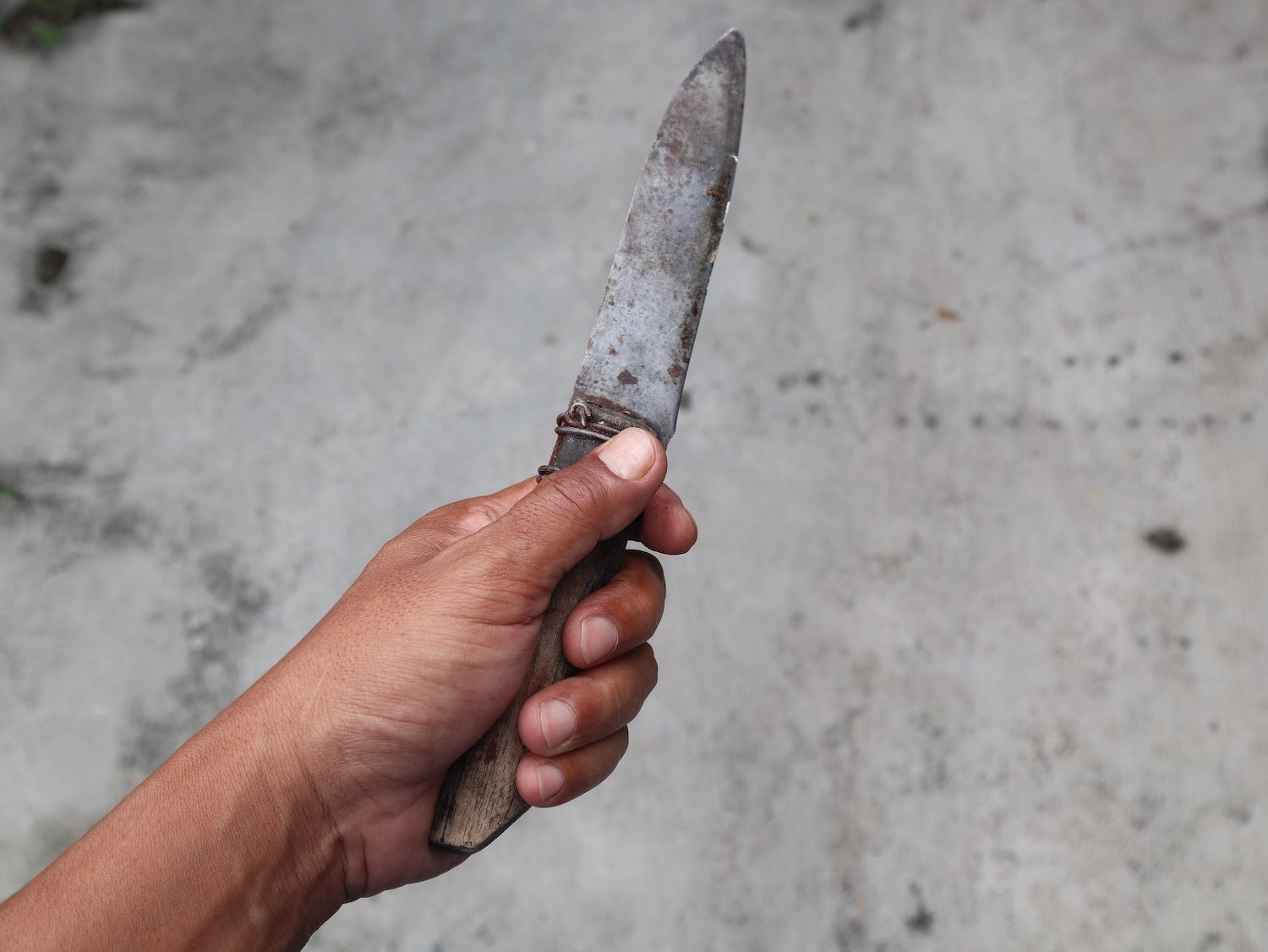
Brandishing convictions can be expunged from your criminal record.
Frequently Asked Questions
Can I be convicted of brandishing if the firearm was unloaded?
Yes. California Penal Code 417 explicitly states that you can be charged with brandishing a firearm “whether loaded or unloaded.” The crime focuses entirely on the threatening display of the weapon and the fear it causes, not its ability to fire at that exact moment.
What happens if I brandish a fake gun or a BB gun?
You can still be charged with a crime even if the gun is not real. While standard PC 417 applies to actual firearms and deadly weapons, brandishing an imitation firearm (such as a realistic toy gun, replica, or BB gun) in a threatening manner so that a reasonable person would fear bodily harm is a separate misdemeanor under California Penal Code 417.4 PC.
Can I draw my gun just to scare someone away from stealing my property?
Generally, no. Under California law, you can only legally brandish a deadly weapon or firearm in lawful self-defense or the defense of another person against imminent bodily harm or death. You are generally not permitted to use the threat of deadly force solely to protect personal property.
Additional Reading
For information on California gun laws, refer to the following:
- Gun Safety Rules – National Rifle Association
- Firearms Q&As – Bureau of Alcohol, Tobacco, Firearms and Explosives
- Handguns Certified for Sale – California Attorney General
- Bureau of Firearms – California Department of Justice
- National Instant Criminal Background Check System (NICS) – Federal Bureau of Investigation
Legal References:
- California Penal Code Section 417 PC. The full text of the statue reads as follows:
(a) (1) Every person who, except in self-defense, in the presence of any other person, draws or exhibits any deadly weapon whatsoever, other than a firearm, in a rude, angry, or threatening manner, or who in any manner, unlawfully uses a deadly weapon other than a firearm in any fight or quarrel is guilty of a misdemeanor, punishable by imprisonment in a county jail for not less than 30 days.
(2) Every person who, except in self-defense, in the presence of any other person, draws or exhibits any firearm, whether loaded or unloaded, in a rude, angry, or threatening manner, or who in any manner, unlawfully uses a firearm in any fight or quarrel is punishable as follows:
(A) If the violation occurs in a public place and the firearm is a pistol, revolver, or other firearm capable of being concealed upon the person, by imprisonment in a county jail for not less than three months and not more than one year, by a fine not to exceed one thousand dollars ($1,000), or by both that fine and imprisonment.
(B) In all cases other than that set forth in subparagraph (A), a misdemeanor, punishable by imprisonment in a county jail for not less than three months.
(b) Every person who, except in self-defense, in the presence of any other person, draws or exhibits any loaded firearm in a rude, angry, or threatening manner, or who, in any manner, unlawfully uses any loaded firearm in any fight or quarrel upon the grounds of any day care center, as defined in Section 1596.76 of the Health and Safety Code, or any facility where programs, including day care programs or recreational programs, are being conducted for persons under 18 years of age, including programs conducted by a nonprofit organization, during the hours in which the center or facility is open for use, shall be punished by imprisonment in the state prison for 16 months, or two or three years, or by imprisonment in a county jail for not less than three months, nor more than one year.
(c) Every person who, in the immediate presence of a peace officer, draws or exhibits any firearm, whether loaded or unloaded, in a rude, angry, or threatening manner, and who knows, or reasonably should know, by the officer’s uniformed appearance or other action of identification by the officer, that he or she is a peace officer engaged in the performance of his or her duties, and that peace officer is engaged in the performance of his or her duties, shall be punished by imprisonment in a county jail for not less than nine months and not to exceed one year, or in the state prison for 16 months, or two or three years.
(d) Except where a different penalty applies, every person who violates this section when the other person is in the process of cleaning up graffiti or vandalism is guilty of a misdemeanor, punishable by imprisonment in a county jail for not less than three months nor more than one year.
(e) As used in this section, “peace officer” means any person designated as a peace officer pursuant to Chapter 4.5 (commencing with Section 830) of Title 3 of Part 2.
(f) As used in this section, “public place” means any of the following:
(1) A public place in an incorporated city.
(2) A public street in an incorporated city.
(3) A public street in an unincorporated area.
- CALCRIM No. 983 – Brandishing Firearm or Deadly Weapon. Judicial Council of California Criminal Jury Instructions (2026 edition). See also People v. Ball (2025) 114 Cal. App. 5th 181.
- See same. California Penal Code 16520 PC. See also People v. Brown (2012) 210 Cal.App.4th 1. People v. Aguilar (1997) 16 Cal.4th 1023. People v. Stutelberg (2018) 29 Cal.App.5th 314. People v. Godwin (1996) 50 Cal.App.4th 1562.
- People v. Sanders (1995) 11 Cal.4th 475.
- People v. McKinzie (1986) 179 Cal.App.3d 789.
- Judicial Council of California Criminal Jury Instruction 3470 — Right to Self-Defense or Defense of Another (Non-Homicide). See also People v. Chen (Cal. App. 4th Dist. 2020) 50 Cal. App. 5th 952.
- California Penal Code 417 PC.
- See same. (For purposes of this section, “daycares” do not include schools, including high schools for being away a certain number of feet of such school property.) See also In re Zorn (1963) 59 Cal.2d 650. See also People v. Strider (2009) 177 Cal.App.4th 1393.
- See same.
- See same.
- See INA 237 (a) (2) (A).
- California Penal Code 1203.4 PC.
- California Penal Code 29800 PC.