

California Penal Code § 12022 PC is a sentencing enhancement that adds one to five years of additional prison time for felony offenses in which you
- are armed with a firearm or
- use a deadly weapon other than a firearm.
This table shows the specific sentencing enhancements and the corresponding term of incarceration:
| Aggravating Factor | PC 12022 Enhancement |
| Armed with firearm in the commission of a felony | 1 year |
| Armed with assault weapon, machine gun, or .50 BMG rifle in commission of a felony | 3 years |
| Used deadly/dangerous weapon in commission of a felony | 1 year |
| Used a deadly/dangerous weapon in commission of felony carjacking | 1, 2, or 3 years |
| Armed with firearm in commission of certain felony drug crimes | 3, 4, or 5 years |
In this article, our Los Angeles criminal defense attorneys will address the following key issues regarding possessing a firearm in the commission of a crime in California.
- 1. Elements of PC 12022
- 2. Penalty for Being Armed
- 3. Penalty for Using a Deadly Weapon
- 4. Defenses
- 5. Related Enhancements
- Frequently Asked Questions
- Additional Reading
1. Elements of PC 12022
For your sentence to be enhanced under California Penal Code 12022 PC, prosecutors have to prove beyond a reasonable doubt that, during the commission of a felony, you either:
- were armed with a firearm or
- used a dangerous or deadly weapon other than a firearm.1
Note that Penal Code 12022 punishes the possession of a firearm during a felony. The actual use of a firearm during the commission of a felony is punished by a different California statute (PC 12022.5).
Also note that this enhancement applies to attempted felonies as well as completed felonies.
2. Penalty for Being Armed
Under PC 12022, the basic enhancement is an additional and consecutive one year in prison for being armed with a firearm during the commission of a felony.
However, you instead face an additional and consecutive three years in prison if the firearm was:
- an assault weapon,
- a machine gun, or
- a .50 BMG rifle.
Finally, being armed with a gun during the commission of certain felony-level drug offenses carries an additional and consecutive prison term of three, four, or five years.3 Though if you did not personally carry a firearm, but you knew that another principal was armed with a gun, then the enhancement will be an additional and consecutive term of one, two, or three years.4

The PC 12022 sentencing enhancement can lead to up to five years of additional prison time.
3. Penalty for Using A Deadly Weapon
Penal Code 12022b says that if you use a deadly or dangerous weapon other than a firearm during the commission of a felony, then you will face an additional and consecutive one year in prison.5
If you used a deadly or dangerous weapon other than a firearm in a felony carjacking (PC 215), then the enhancement will be an additional and consecutive prison term of one, two, or three years.6
4. Defenses
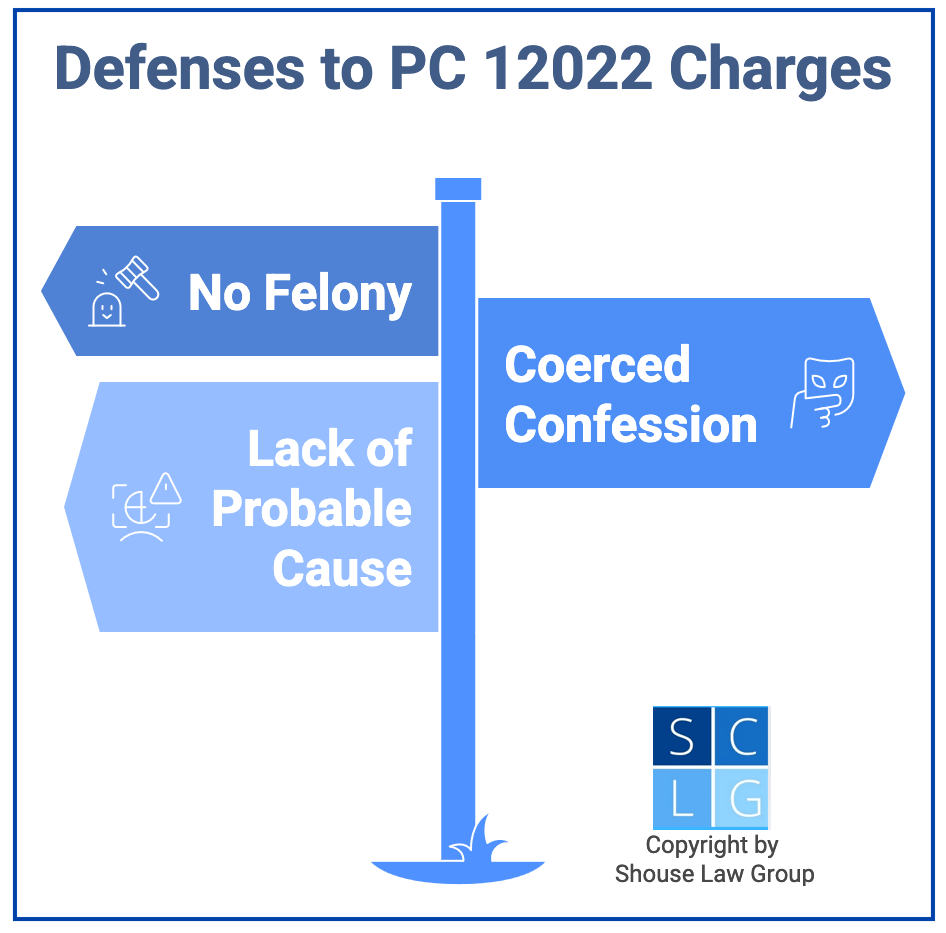
Here at Shouse Law Group, we have represented literally thousands of people charged with felonies involving being armed. In our experience, the following three defenses have proven very effective at getting PC 12022 enhancements dropped.
- There was no felony. Perhaps the underlying offense in your case was just a misdemeanor or an infraction.
- The police coerced your confession. We may be able to get your confession suppressed as evidence if we can show the police used overbearing interrogation measures.
- There was no probable cause. If police arrested you without probable cause that you committed a crime, then any evidence obtained after the false arrest could get excluded from the case. This could lead to the D.A. dismissing your case for lack of proof.
Typical evidence in these cases includes eyewitness accounts and video surveillance.

Penal Code 12022 PC imposes additional prison time for felonies in which you use a firearm or other deadly weapon.
5. Related Enhancements
Possessing Ammunition Designed to Penetrate Metal or Armor – PC 12022.2
California Penal Code 12022.2 PC creates a sentencing enhancement of between one to 10 years if you:
- commit a felony while armed with a firearm and in immediate possession of ammunition designed primarily to penetrate metal or armor or
- wear a body vest during the commission of a violent felony.7
Personally Using Firearms During the Commission of a Felony – PC 12022.5
California Penal Code 12022.5 PC creates a sentencing enhancement of between three to 10 years if you personally use a firearm during the commission or attempted commission of a felony.8
Furnishing with a Firearm During the Commission of a Felony – PC 12022.4
Penal Code 12022.4 PC makes it a crime to furnish, or attempt to furnish, a firearm to someone else for use in a felony.9 Punishment under this enhancement is an additional term of one, two, or three years in prison.10

The enhancements under PC 12022 subject you to a lengthy term in California state prison.
Frequently Asked Questions
Does Penal Code 12022 apply to misdemeanors?
No. This specific sentencing enhancement only applies if you are convicted of an underlying felony offense. If the underlying charge is reduced to a misdemeanor or is dismissed, the PC 12022 enhancement is automatically dropped.
What is the difference between being “armed” and “using” a firearm in California?
Being “armed” (PC 12022) simply means having the weapon knowingly available for offensive or defensive use during the crime, even if it stays in your pocket. “Using” a firearm (covered under a different statute, PC 12022.5) means you actually brandished, fired, or struck someone with it, which carries a much harsher penalty.
Can I get this enhancement if my accomplice had the gun, but I didn’t?
Yes. Under California law, if any principal in the commission of a felony is armed with a firearm, the PC 12022 enhancement can be applied to all participants in the crime—even those who were not personally armed.
Does the firearm have to be loaded to trigger the enhancement?
No. You can still face the PC 12022 sentencing enhancement even if the firearm was unloaded or inoperable at the time the felony was committed, as long as it was available for use.
Additional Reading
For more in-depth information, refer to the following scholarly articles:
- Mandatory Minimum Firearm Penalties: A Source of Sentencing Disparity? – Justice Research and Policy.
- What Do We Know About the Association Between Firearm Legislation and Firearm-Related Injuries? – Epidemiologic Reviews.
- Firearm Laws and Firearm Homicides: A Systematic Review – JAMA Internal Medicine.
- Firearm Instrumentality: Do Guns Make Violent Situations More Lethal? – Annual Review of Criminology.
- Firearm Use in Violent Crime: Examining the Role of Premeditation and Motivation in Weapon Choice – The Journal of Primary Prevention.
Legal References:
- California Penal Code 12022 PC. The language of the code section reads as follows:
(a) (1) Except as provided in subdivisions (c) and (d), a person who is armed with a firearm in the commission of a felony or attempted felony shall be punished by an additional and consecutive term of imprisonment pursuant to subdivision (h) of Section 1170 for one year, unless the arming is an element of that offense. This additional term shall apply to a person who is a principal in the commission of a felony or attempted felony if one or more of the principals is armed with a firearm, whether or not the person is personally armed with a firearm.
(2) Except as provided in subdivision (c), and notwithstanding subdivision (d), if the firearm is an assault weapon, as defined in Section 30510 or 30515, or a machinegun, as defined in Section 16880, or a .50 BMG rifle, as defined in Section 30530, the additional and consecutive term described in this subdivision shall be three years imprisonment pursuant to subdivision (h) of Section 1170 whether or not the arming is an element of the offense of which the person was convicted. The additional term provided in this paragraph shall apply to any person who is a principal in the commission of a felony or attempted felony if one or more of the principals is armed with an assault weapon, machinegun, or a .50 BMG rifle, whether or not the person is personally armed with an assault weapon, machinegun, or a .50 BMG rifle.
(b) (1) A person who personally uses a deadly or dangerous weapon in the commission of a felony or attempted felony shall be punished by an additional and consecutive term of imprisonment in the state prison for one year, unless use of a deadly or dangerous weapon is an element of that offense.
(2) If the person described in paragraph (1) has been convicted of carjacking or attempted carjacking, the additional term shall be in the state prison for one, two, or three years.
(3) When a person is found to have personally used a deadly or dangerous weapon in the commission of a felony or attempted felony as provided in this subdivision and the weapon is owned by that person, the court shall order that the weapon be deemed a nuisance and disposed of in the manner provided in Sections 18000 and 18005.
(c) (1) Notwithstanding the enhancement set forth in subdivision (a), a person who is personally armed with a firearm in the commission of a violation or attempted violation of Section 11351, 11351.5, 11352, 11366.5, 11366.6, 11378, 11378.5, 11379, 11379.5, or 11379.6 of the Health and Safety Code shall be punished by an additional and consecutive term of imprisonment in the state prison for three, four, or five years.
(2) Notwithstanding paragraph (9) of subdivision (h) of Section 1170 of the Penal Code, a defendant convicted of an underlying violation specified in this subdivision who admits an enhancement pursuant to this subdivision or for whom an enhancement pursuant to this subdivision is found true, is punishable by imprisonment in the state prison and not pursuant to subdivision (h) of Section 1170 of the Penal Code.
(d) Notwithstanding the enhancement set forth in subdivision (a), a person who is not personally armed with a firearm who, knowing that another principal is personally armed with a firearm, is a principal in the commission of an offense or attempted offense specified in subdivision (c), shall be punished by an additional and consecutive term of imprisonment pursuant to subdivision (h) of Section 1170 for one, two, or three years.
(e) For purposes of imposing an enhancement under Section 1170.1, the enhancements under this section shall count as a single enhancement.
(f) Notwithstanding any other provision of law, the court may strike the additional punishment for the enhancements provided in subdivision (c) or (d) in an unusual case where the interests of justice would best be served, if the court specifies on the record and enters into the minutes the circumstances indicating that the interests of justice would best be served by that disposition.)
- California Penal Code 12022a2 PC.
- California Penal Code 12022c PC. Proposition 36. See, for example, People v. Bland (1995) 10 Cal.4th 991.
- California Penal Code 12022d PC.
- California Penal Code 12022b1 PC. See, for example, People v. Suarez (Cal. Ct. App., Mar. 2026, No. D084412).
- California Penal Code 12022b2 PC.
- California Penal Code 12022.2 PC.
- California Penal Code 12022.5 PC.
- California Penal Code 12022.4 PC.
- See same.