

Specific intent crimes are misdemeanors or felonies where a prosecutor must prove (and beyond a reasonable doubt) that you intended to commit a certain harm. This means a specific intent is a necessary element of the crime itself.
Examples of specific intent crimes are:
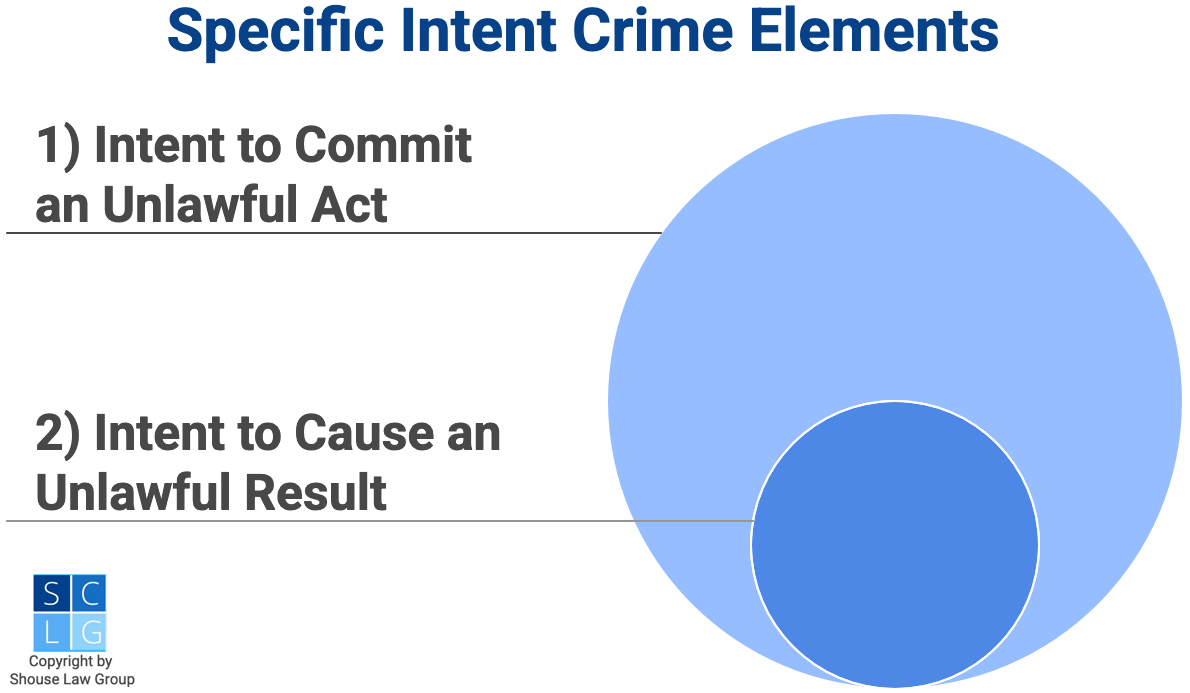
In contrast, general intent crimes are offenses where a prosecutor simply has to show that you committed a criminal act. There is no concern as to whether you actually intended to produce the specific result of that act.
Examples of general intent crimes are:
Often associated with these types of crimes are the topics of:
- actus reus and
- mens rea.
While “actus reus” refers to the physical act of a crime, “mens rea” involves the intent factor of the crime or your mental state.
What is a specific intent crime?
Under common law, there are two general types of crimes in the United States: “specific intent crimes” and “general intent crimes.”
A specific intent crime is one where you must both:
- intend to commit an unlawful act and
- specifically intend to violate the law.1
This means that the focus is largely on your state of mind, and criminal intent becomes a mental element of the crime.
With specific intent crimes, state statutes will give the requisite intent that you must have had when you committed a crime to be guilty of that offense.
California Law
For example, California’s forgery law is listed in state statute Penal Code 470 PC. That law states:
“Every person who, with the intent to defraud, knowing that he or she has no authority to do so, signs the name of another person or of a fictitious person to any of the items listed in subdivision (d) is guilty of forgery.”2 (Emphasis added).
You are only guilty of this offense if you acted with the specific intent to defraud. You would not be guilty if you signed another name on accident or via a prank.
While PC 470 uses the language, “intent to defraud,” other common intents listed in statutes include that you acted:
- knowingly,
- purposely,
- willfully, or
- with recklessness.
If you did not break the law with one of these intent elements, then you cannot be found guilty of a specific intent offense.
Other Examples
A common example of a specific intent crime is first degree murder. You are only guilty of this offense if you actually intended to cause someone’s death. It is not enough for a district attorney to show that you shot, stabbed or poisoned someone. The D.A. must also prove that you did so with the specific intent to kill the victim.
Other examples of specific intent crimes include:
- burglary,
- child molestation,
- theft or larceny, and
- embezzlement.
Defending Against Charges
Since these offenses focus on a particular intent, a common defense is that you did not act with the intent listed in the applicable statute. Consider the crime of forgery again: It is always a defense for an experienced lawyer to say that you are innocent because you did not act with the intent to defraud.

Battery is a common general intent crime.
What is a general intent crime?
A general intent crime is one where you perform some physical act. To secure a conviction of these crimes, a prosecutor does not have to show that you intended to produce the particular result of your act.3
Statutes outlining these crimes typically only refer to some act. There is no mention of any intent to commit a crime.
Examples
A common example of a general intent crime is driving under the influence (DUI). You are guilty of the offense as long as you drove a vehicle while drunk. The prosecutor does not have to show that you actually intended to drive drunk or drove drunk willingly or with a specific purpose.
Other examples of general intent crimes include:
- assault,
- battery, and
- second degree murder.
Defending Against Charges
An experienced criminal defense attorney will typically have to craft a defense based upon the specific facts of a case. Unlike with specific intent crimes, a lawyer or law firm cannot rely on your intent, or lack thereof.
What is “actus reus” and “mens rea?”
While actus reus is a term referring to the physical aspect of a crime, mens rea is one that involves the intent factor behind committing a physical act.4
An actus reus includes voluntary acts, or failures to act, that society has an interest in preventing (for example, making physical contact with a person by punching a victim).5
In contrast, a mens rea pertains to your state of mind. This mental state is often listed in the statute that sets forth a specific crime (for example, purposefully or knowingly).6
All crimes consist of both of these elements and they must occur simultaneously for an offense to occur. Specific intent crimes will involve a specific mens rea. General intent crimes merely require a general intent to commit the underlying criminal act.

Burglary is a common specific intent crime.
Additional Reading
For more in-depth information, refer to these scholarly articles:
- On Strict Liability Crimes: Preserving a Moral Framework for Criminal Intent in an Intent-Free Moral World – Michigan Law Review.
- Intent in the Criminal Law – Law Society Journal.
- On Being Angry and Punitive: How Anger Alters Perception of Criminal Intent – Social Psychological and Personality Science.
- Criminal and legal characteristics of criminal intent – Journal of Financial Crime.
- Concocting Criminal Intent – Georgetown Law Journal.
Legal References
- Black’s Law Dictionary, Sixth Edition. See also U.S. v. Birkenstock (1987) 823 F.2d 1026.
- California Penal Code 470 PC.
- Cornell Law School Legal Information Institute, “General Intent.”
- Black’s Law Dictionary, Sixth Edition.
- See Powell v. Texas (1968) 392 U.S. 514.
- See Staples v. United States (1994) 511 U.S. 600.
