
Quick summary
There is no set average settlement for a back or neck injury after a car accident in California. Most claims settle for somewhere between a few thousand dollars and a few hundred thousand, and the amount depends mainly on how badly you were hurt, what treatment you needed, who was at fault and how much insurance is available.
- What raises the value: Injuries that need surgery, cause nerve damage or leave you with a lasting disability are worth far more than strains and sprains that heal in a few weeks.
- What can cut it: Your own share of fault, being uninsured when the crash happened, medical bills counted at the amounts actually paid, and the other driver’s policy limits.
- Deadlines: You generally have 2 years from the crash to file a lawsuit, or just 6 months to file a claim if a government vehicle or road was involved.
In this article, our California car accident lawyers answer 7 common questions about back and neck injury settlements:
- 1. What is a back or neck injury claim worth?
- 2. What raises or lowers the value?
- 3. Which California rules can shrink it?
- 4. What if I hurt my back or neck before?
- 5. How do insurance limits affect it?
- 6. Common injuries and delayed symptoms
- 7. How long do I have to file?
- 8. FAQ
1. What is a back or neck injury claim worth?
In California, a back or neck injury claim from a car accident is worth what it costs you: your medical bills, lost income and pain and suffering, reduced by the rules in section 3. That’s why no honest lawyer can quote one “average” number.
Rough ranges by type of injury
Law-firm surveys of published settlements give these rough ranges for back and neck injuries:1
| Type of injury | Rough settlement range | Typical treatment |
|---|---|---|
| Whiplash, strains and sprains (soft tissue) | $10,000 to $50,000 | Rest, physical therapy, medication |
| Herniated or bulging disc, chronic pain | $50,000 to $200,000 | MRI, injections, months of therapy |
| Fractures, nerve damage, spinal surgery | $200,000 to $1,000,000 or more | Discectomy, fusion, long recovery |
| Spinal cord injury, paralysis, permanent disability | $500,000 to several million | Lifetime care |
Treat these numbers with caution. Surveys like these are built from settlements that law firms choose to publish, and firms publish their biggest wins, so the “averages” skew high. California figures in particular look inflated: one widely cited survey puts the state’s average neck and back settlement at about $1.7 million, which says more about which cases get publicized than about a typical claim.
Example: Maria is rear-ended at a stoplight in Los Angeles. Her neck is stiff for six weeks, and she has eight physical therapy visits and misses four days of work. A claim like hers usually falls in the soft-tissue range, because her treatment was short and she recovered fully.
2. What raises or lowers the value?
In California, the value of a back or neck injury settlement mainly turns on how serious the injury is and how well your records prove it. Insurance adjusters look at these factors:
- Severity and imaging. An MRI showing a herniated disc or fracture carries far more weight than a complaint of soreness with no objective findings.
- Treatment. Physical therapy, chiropractic care, injections and especially surgery (a discectomy or spinal fusion) raise both your medical bills and your pain and suffering.
- Lost income. Missed work and, if you can’t return to the same job, lost earning capacity.
- Pain and suffering. These non-economic damages cover chronic pain, lost sleep and the things you can no longer do.
- Evidence of fault. Photos, the police report, witness statements and dashcam or surveillance video.
- Gaps in treatment. Waiting weeks to see a doctor, or stopping therapy early, lets the insurer argue you weren’t badly hurt.
Insurers often estimate pain and suffering by multiplying your economic losses by a number between about 1.5 and 5. Our post on the car accident settlement formula walks through that math step by step.
In our experience, the cases that settle for the most are the ones where the medical records tell a clear, unbroken story from the day of the crash to the last appointment.
3. Which California rules can shrink it?
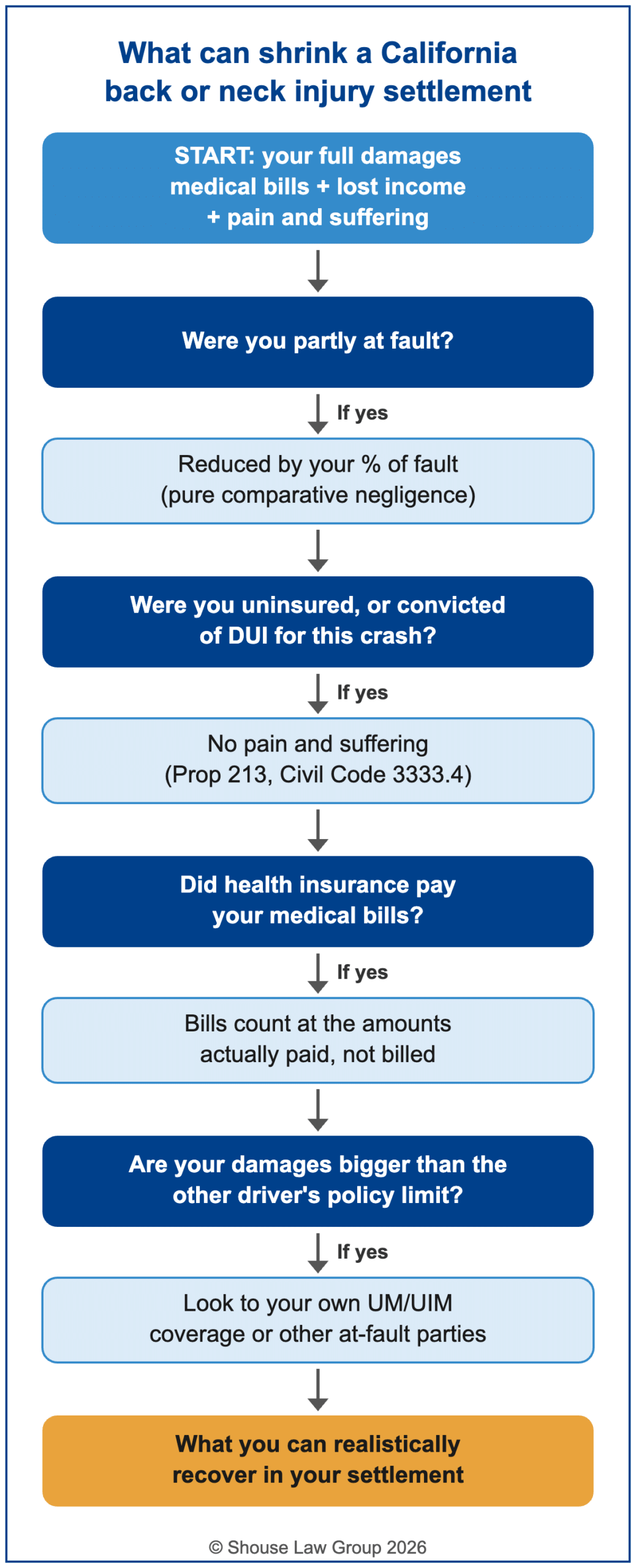
California has several rules that can reduce a back or neck injury settlement even when your injuries are serious. Insurance adjusters know them well, so it helps if you do too.
Your own share of fault
California follows “pure” comparative negligence. If you were partly at fault for the crash, your damages go down by your percentage of fault, but you can still recover something even if you were mostly to blame.2 See our page on comparative negligence in California.
Example: John’s back injury damages total $100,000, but a jury finds he was 20% at fault for changing lanes without signaling. He recovers $80,000.
Being uninsured (Proposition 213)
Under California’s Proposition 213, you can’t recover pain and suffering after a car accident if you own a vehicle in the crash that wasn’t insured, if you were driving and can’t show proof of insurance, or if you were driving drunk and were convicted of DUI for that crash.3 You can still recover medical bills and lost wages. One exception: an uninsured vehicle owner who was hit by a driver convicted of DUI can still recover pain and suffering. Our California car insurance law page covers Prop 213 in more detail.
Example: Luis lets his insurance lapse. A driver runs a red light in Fresno and hits him, herniating a disc in his lower back. Luis can recover his medical bills and lost pay, but not pain and suffering.
Medical bills count at what was paid
In California, if health insurance paid your medical bills, you can recover only the amounts actually paid or still owed, not the full amount the hospital billed.4 That can make a big difference, because providers’ list prices are often several times what insurers pay.
The rule is different if you treat on a medical lien. In Pebley v. Santa Clara Organics, a California appeals court held that an injured driver who had health insurance but chose to treat outside his plan could show the jury his full medical bills as evidence of their value.5 Our post on medical liens explains how lien-based treatment works.
Future medical costs can be trimmed too. In Audish v. Macias (2024), a California appeals court allowed the defense to point out that the injured driver would qualify for Medicare at 65 and what Medicare would pay for his future care, as evidence of what that care is reasonably worth.6
More than one at-fault party
If two or more drivers caused your injuries, each one pays pain and suffering only in proportion to their own share of fault (Proposition 51). Economic losses such as medical bills and lost wages can still be collected in full from any of them.7
4. What if I hurt my back or neck before?
In California, an earlier back or neck problem doesn’t stop you from recovering. You can’t be paid for the condition you already had, but you are entitled to compensation for everything the crash made worse.8
The at-fault driver also takes you as they find you. If an old injury made you more likely to be hurt, the driver still pays for all the harm the crash caused, even if a healthier person would have walked away.9 Adjusters often argue that your pain comes from the old injury rather than the crash, so medical records from before and after the accident are key.
Example: Joe strained his lower back playing basketball in 2023 and finished physical therapy that spring. In 2025, he is rear-ended and reinjures the same area, and an MRI now shows a herniated disc. The insurer blames the old strain, but Joe can recover for the herniation and the added pain the crash caused.
Our post on whether a car accident can cause degenerative disc disease covers the most common version of this fight.
5. How do insurance limits affect it?
In California, the at-fault driver’s insurance limit is often the real ceiling on a back or neck injury settlement. For policies issued or renewed since January 1, 2025, the legal minimum is $30,000 for one injured person and $60,000 per accident.10
If your damages exceed the other driver’s limits, there are usually three places to look:
- Your own underinsured or uninsured motorist (UM/UIM) coverage. See our page on uninsured motorist coverage.
- Another liable party, such as the driver’s employer if they were working, or a vehicle owner who lent the car.
- The driver’s personal assets, which are often limited.
One thing we’ve found is that many injured people don’t know they bought UM/UIM coverage until we read their own policy with them.
6. Common injuries and delayed symptoms
The most common back and neck injuries after a car accident in California include:
- whiplash and other soft-tissue strains and sprains,
- herniated or bulging discs,
- pinched nerves, sciatica and spinal stenosis,
- facet joint injuries,
- fractures of the cervical (neck), thoracic (mid-back) or lumbar (lower back) spine, and
- spinal cord injuries.
Symptoms often show up hours or days after the crash, once adrenaline wears off. Watch for:
- neck, shoulder or back stiffness and soreness,
- sharp pain when you turn your head or bend,
- headaches,
- loss of range of motion,
- weakness, especially trouble lifting things, and
- tingling or numbness in your arms, hands, legs or feet.
See a doctor even if you feel fine. Delayed treatment is one of the most common reasons insurers give for paying less.
7. How long do I have to file?
In California, you generally have 2 years from the date of the accident to file a personal injury lawsuit.11 If a government agency is involved (for example, a city bus or a dangerous public road), you must first file a government claim within 6 months.12 Our page on the California statute of limitations for personal injury covers the exceptions, and our Government Claims Act page explains the 6-month claim.
8. FAQ
How much is a herniated disc worth after a car accident in California?
Law-firm surveys commonly put herniated disc settlements at about $50,000 to $200,000 without surgery, and higher with surgery. The real number depends on your bills, lost income, fault and the available insurance.
Can I get a settlement for whiplash in California?
Yes. Whiplash is a soft-tissue injury, and law-firm surveys commonly put these settlements at about $10,000 to $50,000. In California, the amount depends on how long treatment lasted, how much work you missed, fault and the available insurance.
Do I get pain and suffering if I was uninsured?
Usually not. Under California’s Proposition 213, an uninsured driver or vehicle owner can recover medical bills and lost wages but not pain and suffering, unless the other driver was convicted of DUI for the crash and you were the uninsured owner.
How long do I have to file a back injury claim in California?
Generally 2 years from the accident to file a lawsuit, and 6 months to file a claim if a government entity is involved.
Call us for help
If you hurt your back or neck in a California car accident, our California personal injury lawyers can review your claim in a free consultation. Learn more about your damages in a personal injury case and how we help with car accident cases.
Legal references:
- Miley Legal Group, “Average Neck and Back Injury Settlement by State: 2025 Data Study” (accessed November 2026), based on 702 settlement amounts that law firms published online: back strains and sprains “$10,000 – $50,000”; herniated discs and chronic back pain “$50,000 – $200,000”; severe spinal cord injuries and paralysis “$200,000 – $1,000,000+”; California average $1,728,491.
- Li v. Yellow Cab Co. (1975) 13 Cal.3d 804, 829: “the contributory negligence of the person injured in person or property shall not bar recovery, but the damages awarded shall be diminished in proportion to the amount of negligence attributable to the person recovering.”
- California Civil Code 3333.4 (Proposition 213): “in any action to recover damages arising out of the operation or use of a motor vehicle, a person shall not recover non-economic losses to compensate for pain, suffering, inconvenience, physical impairment, disfigurement, and other nonpecuniary damages if any of the following applies: (1) The injured person was at the time of the accident operating the vehicle in violation of Section 23152 or 23153 of the Vehicle Code, and was convicted of that offense. (2) The injured person was the owner of a vehicle involved in the accident and the vehicle was not insured as required by the financial responsibility laws of this state. (3) The injured person was the operator of a vehicle involved in the accident and the operator can not establish his or her financial responsibility as required by the financial responsibility laws of this state.” Subdivision (c) makes an exception for an uninsured owner injured by a driver convicted of DUI.
- Howell v. Hamilton Meats & Provisions, Inc. (2011) 52 Cal.4th 541, 566: “an injured plaintiff whose medical expenses are paid through private insurance may recover as economic damages no more than the amounts paid by the plaintiff or his or her insurer for the medical services received or still owing at the time of trial.”
- Pebley v. Santa Clara Organics, LLC (2018) 22 Cal.App.5th 1266, 1269: “We conclude the trial court properly allowed Pebley, as a plaintiff who is treating outside his insurance plan, to introduce evidence of his medical bills.”
- Audish v. Macias (2024) 102 Cal.App.5th 740, 749-750: the trial court did not abuse its discretion “by admitting the limited evidence at issue about Audish’s future eligibility for Medicare and the expected amounts Medicare might pay for Audish’s recommended future medical services.” Review denied August 21, 2024.
- California Civil Code 1431.2(a) (Proposition 51): “the liability of each defendant for non-economic damages shall be several only and shall not be joint. Each defendant shall be liable only for the amount of non-economic damages allocated to that defendant in direct proportion to that defendant’s percentage of fault.”
- CACI No. 3927, Aggravation of Preexisting Condition or Disability (2026 edition): “[Name of plaintiff] is not entitled to damages for any physical or emotional condition that [he/she/nonbinary pronoun] had before [name of defendant]’s conduct occurred. However, if [name of plaintiff] had a physical or emotional condition that was made worse by [name of defendant]’s wrongful conduct, you must award damages that will reasonably and fairly compensate [him/her/nonbinary pronoun] for the effect on that condition.”
- CACI No. 3928, Unusually Susceptible Plaintiff (2026 edition): “You must decide the full amount of money that will reasonably and fairly compensate [name of plaintiff] for all damages caused by the wrongful conduct of [name of defendant], even if [name of plaintiff] was more susceptible to injury than a normally healthy person would have been, and even if a normally healthy person would not have suffered similar injury.”
- California Vehicle Code 16056(a)(2): “for any policy or bond issued or renewed on or after January 1, 2025, if the accident has resulted in bodily injury or death, to a limit, exclusive of interest and costs, of not less than thirty thousand dollars ($30,000) because of bodily injury to or death of one person in any one accident and, subject to that limit for one person, to a limit of not less than sixty thousand dollars ($60,000) because of bodily injury to or death of two or more persons in any one accident….”
- California Code of Civil Procedure 335.1: “Within two years: An action for assault, battery, or injury to, or for the death of, an individual caused by the wrongful act or neglect of another.”
- California Government Code 911.2(a): “A claim relating to a cause of action for death or for injury to person or to personal property or growing crops shall be presented as provided in Article 2 (commencing with Section 915) not later than six months after the accrual of the cause of action.”
