
California car salesmen classified as non-exempt employees are not entitled to an hourly wage. Most are paid on a commission basis or on a “piece rate,” though some also earn an hourly wage in addition to their commission earnings.
Whether you are paid on commission or on an hourly basis can affect your workplace rights. In this article, we will discuss the commission-based pay laws as applied to car salespeople. Also, listen to our informative podcast:
What payment plans are available?
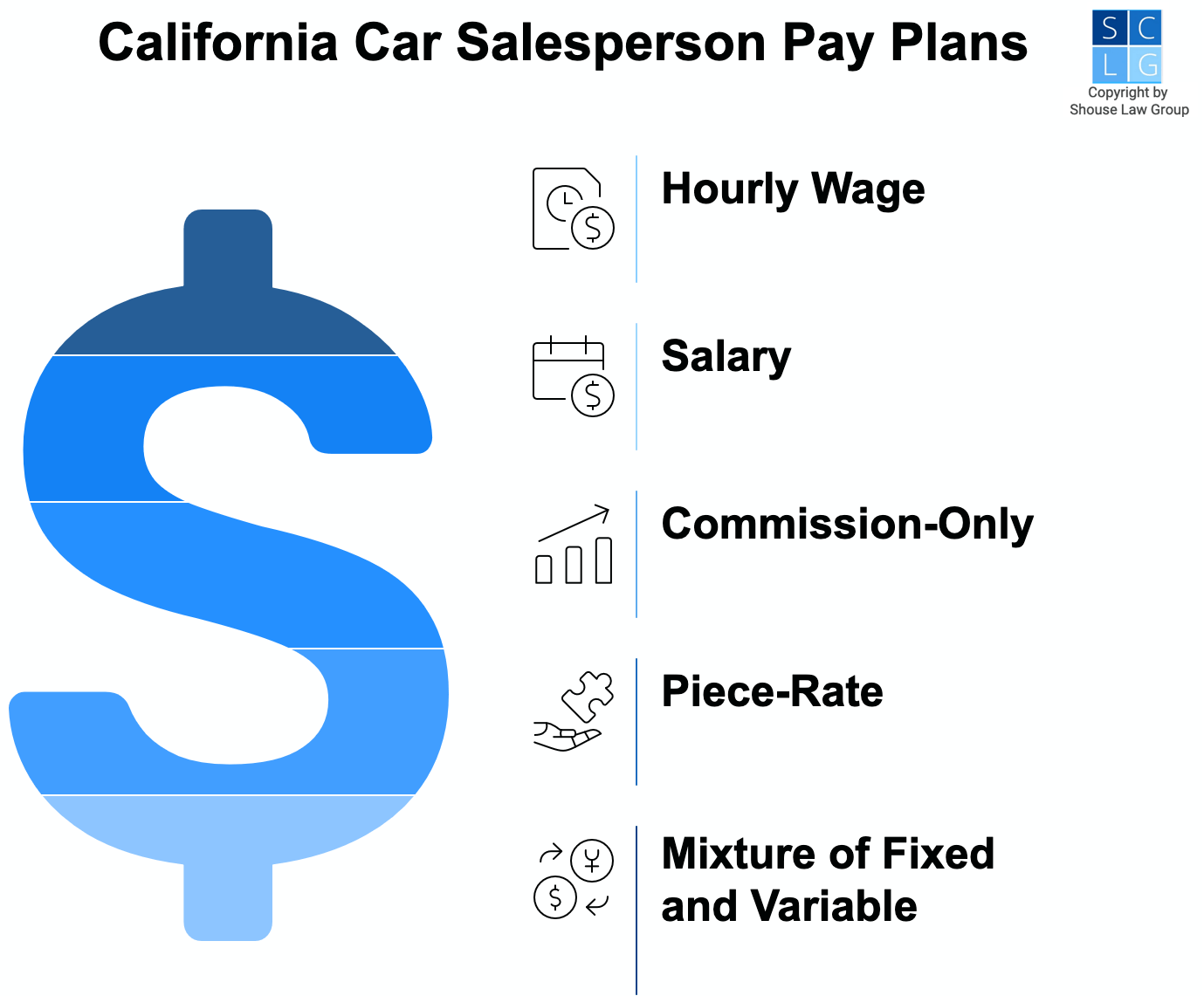
If you are a California car salesperson, you can be paid with any of the following pay plans:
- hourly wage,
- salary,
- commission-only,
- piece-rate, or
- a mixture of hourly or salaried pay and commission pay.
You can also make “spiffs,” or cash prizes from automotive companies or sales managers, for selling specific vehicles that are hard to move.
Many car salespeople are paid at least in part on a commission structure.
A commission is a wage that compensates you for your role in completing the sale of a product or a service, like a car.1 The amount of the commission depends on the value of the sale.2
Many car sales professionals are paid entirely on commission. The terms of the compensation are outlined in the commission agreement.
If you are a California car dealer, these terms typically include:
- how the commission will be calculated from the gross profit of the sale,
- whether the commission is earned from the back end of the sale, like financing or an extended warranty,
- commission differences between selling a new car and a used car,
- when the commission will be paid,
- the conditions that have to be met before the commission from a sale becomes “earned,”
- the minimum commission that can be earned for a sale,
- whether there is a trade-in as a part of the deal that changes the pricing, and
- deductions for selling a vehicle below its sticker price.
Some car salespeople are paid a specific amount of money for each of auto sale. If that amount does not vary with the car’s value, it is “piece-rate” compensation, not commission. 3
For example: Juan works at Car Dealership A in Los Angeles. He sells a $70,000 Porsche, a $40,000 Nissan, and a $15,000 Honda. He is paid $500 for each sale. He is being compensated on a piece-rate basis.
Janet works next door at Car Dealership B. She also sells a $70,000 BMW, a $40,000 Chrysler, and a $15,000 Toyota. She receives $1,000 for her role in selling the BMW and $600 for selling the Chrysler, but only $200 for selling the Toyota. She is receiving commission payments.
Some car salespeople, however, are paid hourly or on a salary. Payment remains the same regardless of how many cars are sold.
Finally, there are plenty of car salespeople in California who make a base hourly or salaried rate, plus commissioned or piece-rate compensation for any sales.

Non-exempt car salesmen are entitled to minimum wage, even if they earn a commission.
Do car dealerships have to pay me a minimum hourly wage?
Even if you earn commission pay, you may be entitled to an hourly rate of at least the minimum wage if you are a non-exempt employee.
If you are non-exempt in California, you are not exempt from labor laws and the Fair Labor Standards Act (FLSA). Therefore, you are entitled to:
Whether you are an exempt or a non-exempt employee depends on whether you are an inside or an outside salesperson.
Only a few car sales professionals are exempt as an outside salesperson. To be exempt in this way, you have to:
- regularly spend more than half of your working time away from the car dealership, and
- sell or obtain orders for products or services.4
Most exempt car salespeople are inside salespeople. To be exempt in this way in California, you have to:
- earn at least 1.5 times the minimum wage, and
- earn more than half of your compensation through commissions.5
If you do not meet these requirements, then you are a non-exempt employee. If you are non-exempt, you are entitled to an hourly wage at least equal to the applicable minimum wage.
How does this impact rest or meal breaks or overtime?
If you are a non-exempt worker at a California car dealership, you are not just entitled to an hourly pay of at least the minimum wage: You are also entitled to overtime and paid meal and rest breaks.

Most car salespeople who are “exempt” are considered inside salespeople.
Additional Reading
For more in-depth information, refer to these scholarly articles:
- Substantive Pay Equality: Tips, Commissions, and How to Remedy the Pay Disparities They Inflict – Yale Law & Policy Review.
- Retail Workers’ Job Experiences: An Analysis of Emotional Labor, Commission Pay, and Stress – Texas State University.
- The symbolic meaning of pay contingencies – Human Resource Management Review.
- Performance pay and worker cooperation: Evidence from an artefactual field experiment – Journal of Economic Behavior & Organization.
- Creating unfairness by mandating fair procedures: the hidden hazards of a pay-for-performance plan – Human Resource Management Review.
