
California’s child labor laws regulate the circumstances under which minors (persons under the age of 18) can work in the state. State laws are supplemented by federal regulations that restrict which occupations may employ minors.
Child labor laws aim to protect children from workplace injuries and exploitation while ensuring they receive an education and fair wages for any work they do. These labor laws also aim to protect children from human trafficking, which preys upon the young and vulnerable.
In this article I discuss these eight key things to know about child labor laws in California:
- the legal working age is 14,
- minors under 14 can still work some jobs,
- minors under 18 cannot work certain jobs,
- to work, minors need to get a California work permit,
- minors still need to go to school if they have not graduated from high school,
- child labor laws regulate how many hours can be worked, and when minors can work,
- the entertainment industry has its own rules, and
- minors have important workplace protections.
1. The Legal Working Age in California Is 14
In general, the legal working age in California is 14. Minors under this age are generally not allowed to work.
However, there are numerous exceptions to these child labor rules that allow young people to gain work experience.
Minors 14 and over face multiple restrictions on when and where they can work. They also need to have a California work permit.1
2. Minors Under 14 Can Work Certain Jobs
Minors aged 13 and younger can still work certain jobs. These jobs do not require a work permit. They include:
- odd jobs, done irregularly and at private homes, like:
- yard work, and
- babysitting;2
- ventures of self-employment, like running a lemonade stand or starting a business,
- working a paper route, and
- agricultural jobs, if the minor is employed by a parent or legal guardian who controls, operates, or owns the premises.3
Minors under 14 can also become child actors. However, this requires a work permit.4
Minors under 14 can also work as outside salespeople, either in a fixed location in the street or by going door-to-door.5 They can also sell newspapers and magazines within 50 miles of where they live.6
These sales jobs do not require a work permit. However, minors doing them must have adult supervision.7
3. Minors Under 18 are Prohibited from Working Certain Jobs
There are specific jobs that state and federal child labor law forbids minors under the age of 18 from working.
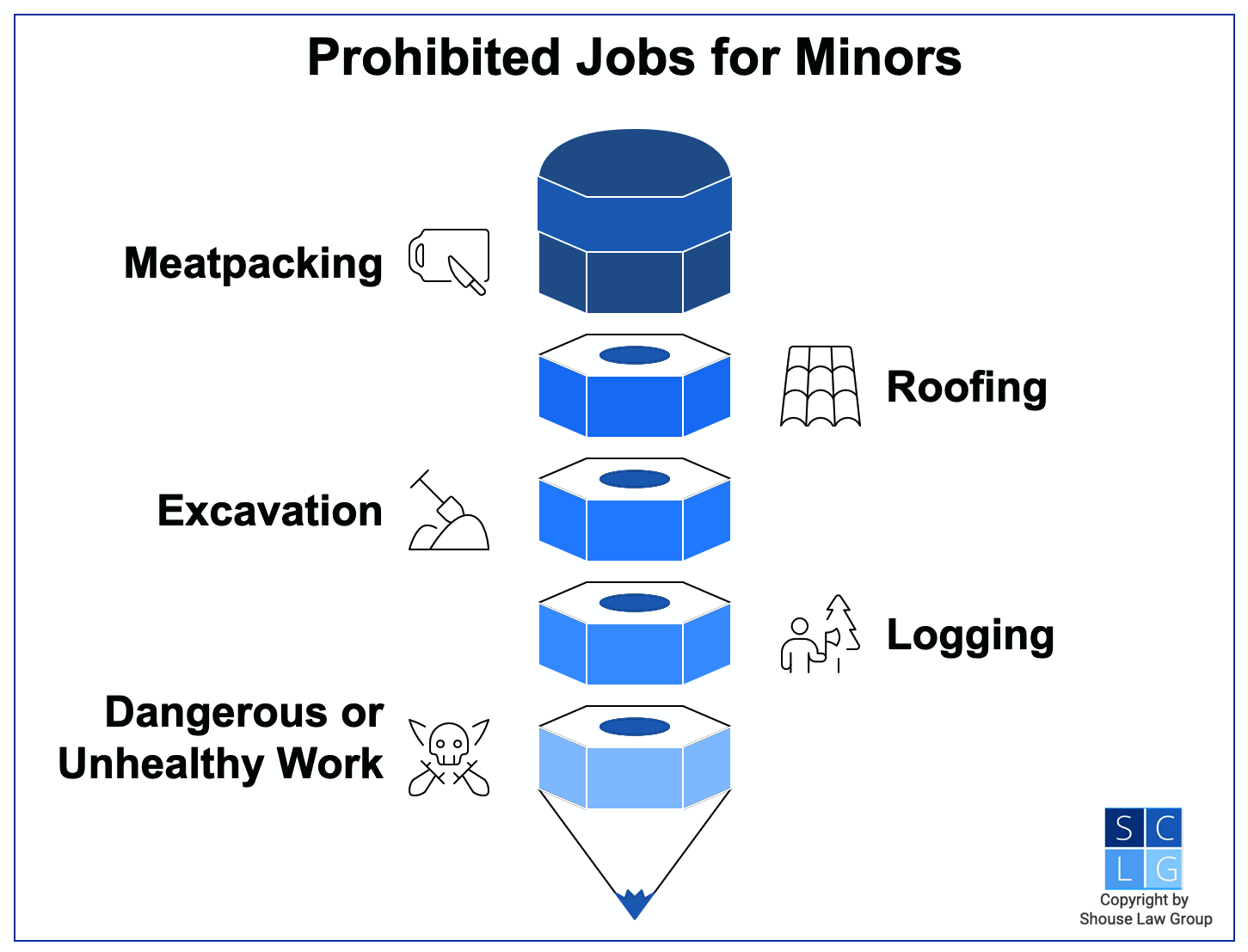
Regulations by the U.S. Department of Labor (DOL) under the federal Fair Labor Standards Act (FLSA) state that minors under 18 cannot work in the following industries:
- meatpacking,8
- roofing,9
- excavation,10 or
- logging.11
They also cannot work in the following hazardous occupations:
- in a sawmill,12
- with bakery machines,13 or
- with power-driven hoisting machines, like a crane.14
Under California’s state child labor laws, minors under 18 cannot perform any work that is dangerous or unhealthy, such as
- on scaffolding,
- in a mine, or
- on a railroad.15
California’s child labor laws also require adult supervision for certain other jobs, like working in a package store.16
4. Minors Generally Need a Work Permit
While there are exceptions, minors generally need a work permit to work in California.
Minors who want a job have to request a permit. They make this request by filing a “Statement of Intent to Employ Minor and Request for Work Permit – Certificate of Age.” This request must be signed by the minor’s parent or legal guardian.17 It is available on the website of the State of California Department of Education (CDE).
The request goes to the minor’s school district office for approval. If approved, school officials issue a Permit to Employ and Work.18 The minor keeps a copy of this Permit. The minor’s employer is also given a copy of the permit. 19
If the job harms the minor’s health or education, or if any additional permit requirements are being violated, the Permit can be revoked.20
California work permits expire 5 days after the start of the following school year.21

Babysitters under 18 do not need work permits.
5. Working Minors Still Need to Attend School
California’s child labor laws require minors who have not yet graduated from high school or received a certificate of proficiency to continue to attend school. School attendance is needed, depending on the minor’s age:
- minors 16 or 17 years old must attend continuation school for at least:
- 15 hours per week if they are not regularly employed, or
- 4 hours per week if they are regularly employed; while
- minors under the age of 16 must go to school on a full-time basis.
6. Child Labor Laws Limit Work Hours
In California, state child labor laws set a limit on the number of hours a minor can work. They also restrict which hours can be worked. These rules depend on:
- whether school is in session,
- whether it is a schoolday, and
- the minor’s age.
For instance, 12 or 13-year-olds are not allowed to work on school days. They can only work on school holidays or school vacations.22
Meanwhile, 16 and 17-year-olds can work up to:
- 48 hours per week,
- 8 hours per workday on non-school days or on days before a non-school day, and
- 4 hours per day on school days.23
7. Entertainment Industry Exceptions
In California, child labor laws have exceptions for the entertainment industry regarding the employment of minors.
The biggest exemption under state law is for young child actors. Minors as young as 15 days old can work as actors.24
However, all minors need to have a work permit to work in the entertainment industry. Those permits can only be issued by the Labor Commissioner at the California Division of Labor Standards Enforcement (DLSE), not by the school district.
8. Workplace Rights for Minors
In addition to child labor laws, minors in California also have rights under state employment law. Most minors are non-exempt workers. This means they have a right to:
- the applicable minimum wage,
- meal and rest breaks, and
- overtime pay.
Most minors also have a right to workers’ compensation for injuries that happen while on the job.
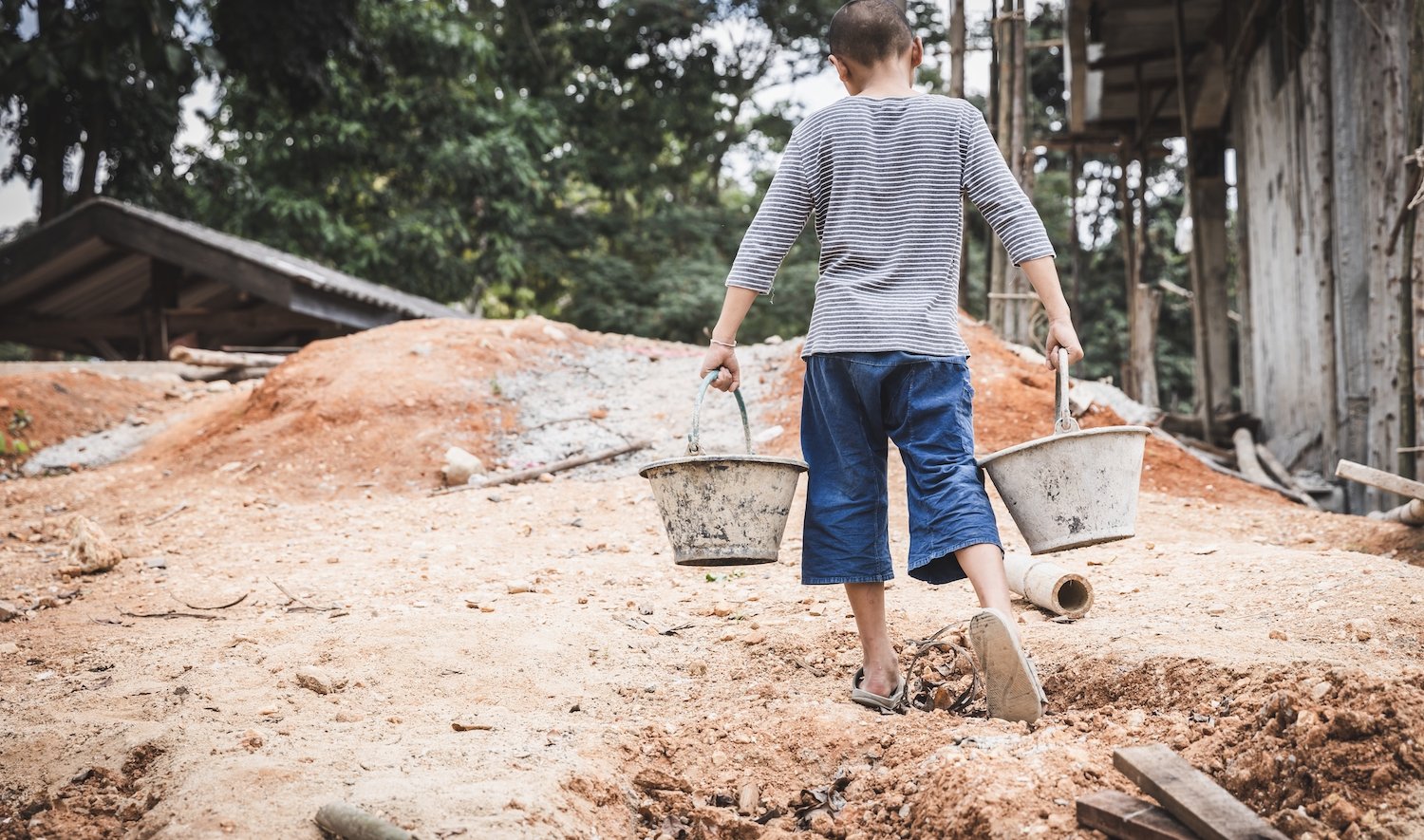
California has very strict child labor laws.
Frequently Asked Questions
What is the new “Child Labor Audit” disclosure law?
As of January 1, 2025, California law (AB 3234) requires any employer who voluntarily conducts a “social compliance audit” to publicize the findings.
If an employer audits their own business to ensure no child labor is occurring, they must post a clear link on their website homepage detailing the audit’s timing, findings on hazardous work, and their official child labor policies.
Do employers need to provide a “Workplace Rights Notice” to minors in 2026?
Yes. Under SB 294, effective February 1, 2026, all California employers must provide every employee (including minors) with an annual “Know Your Rights” notice. This standalone document must explain their rights regarding workers’ compensation, union organizing, and constitutional protections during law enforcement interactions at the workplace.
What is the minimum wage for minors in California for 2026?
Unlike some states, California does not have a lower “sub-minimum wage” for minors. As of January 1, 2026, the state minimum wage is $16.90 per hour for all employees, regardless of age or business size. Employers should also check local city ordinances, as many California cities (like Los Angeles and San Francisco) require even higher rates.
Can employers be fined if a minor does not have a work permit on file?
Absolutely. In California, failing to produce a valid “Permit to Employ and Work” for a minor is considered prima facie evidence of illegal employment. This triggers an immediate $500 fine for the first offense.
Additionally, under new 2024–2025 enforcement protocols, the Department of Labor now often issues penalties per violation rather than per child, which can lead to significantly higher total fines.
Work permits expire five days after the start of each new school year. If a business employs students, they must ensure the minors have their 2025–2026 permits updated and physically on-site for inspection.
Additional Reading
For more in-depth information, refer to these scholarly articles:
- When Play Becomes Work: Child Labor Laws in the Era of “Kidfluencers” – University of Pennsylvania Law Review.
- A Survey of Child Welfare and Labor Trafficking in California – School for Cultural & Social Transformation.
- Sacrificial Lambs of Globalization: Child Labor in the Twenty-First Century – Denver Journal of International Law and Policy.
- State Child Labor Laws and the Decline of Child Labor – Explorations in Economic History.
- Does Child Labor Decline with Improving Economic Status? – The Journal of Human Resources.
- Human Trafficking of Children – Pediatric Annals.
Legal References:
- California Education Code 49110 EC.
- 18 Ops. Cal. Atty. Gen. 114, August 31, 1951.
- California Labor Code 1293.1 and 1394 LAB.
- California Labor Code 1308.5 LAB.
- See California Labor Code 1308.1(a) LAB (children as young as 6 can work these jobs) but also California Education Code 49111 EC (requiring that a child be at least 12 to obtain a work permit).
- California Labor Code sections 1308.1(b) and 1298 LAB.
- 8 California Code of Regulations (CCR) 11706(a).
- 29 Code of Federal Regulations (CFR) 570.61.
- 29 CFR 570.67.
- 29 CFR 570.68.
- 29 CFR 570.54.
- Same.
- 29 CFR 570.52.
- 29 CFR 570.58.
- California Labor Code 1294 LAB.
- California Business and Professions Code 25663(b) BPC.
- California Education Code 49110(c) EC.
- California Education Code 49115 and 49163 EC.
- California Labor Code 1299 LAB.
- California Education Code 49164 EC.
- California Education Code 49118 EC.
- California Education Code 49111 EC.
- California Education Code 49112 and 49116 EC, and California Labor Code 1391 LAB. See also Rodriguez v. Packers Sanitation Services Ltd., LLC (2025) 101 Cal.App.5th 533 (this company has had child labor violation allegations).
- California Labor Code 1308.8 LAB.
