
Quick summary
A Trombetta motion asks a California judge to dismiss your charges, or order another remedy, because police or prosecutors lost or destroyed evidence. It is based on your due process right to a fair trial.
- Clearly helpful evidence: If the evidence’s value to your defense was obvious before it was lost and you cannot get anything comparable, the loss violates due process even without bad faith.
- Potentially useful evidence: If the evidence only might have helped you, you must also show the police acted in bad faith.
- DUI breath tests: Because breath samples are not saved, California police must offer you a blood or urine sample that will be kept.
- Example: You tell an officer that video of a fight will show you did not start it, but police never save it and it is erased. If they knew it mattered, a judge may find bad faith and dismiss the case.

A Trombetta motion asks the judge to dismiss your criminal charges in California, or impose a lesser remedy, because law enforcement destroyed or failed to preserve evidence that could have helped your defense. Losing that evidence can violate your 14th Amendment right to due process and a fair trial.
Other names for Trombetta motions are:
- T-motions,
- Trombetta-Youngblood motions, and
- motions to dismiss because of the spoliation of evidence.
In this article, our California criminal defense attorneys discuss the following topics about Trombetta motions:
- 1. Examples
- 2. How Judges Rule
- 3. Spoliation of Evidence
- 4. Trombetta Advisements
- 5. Related Topics
- Additional Resources
1. Examples
Situations where a California defendant might file a Trombetta motion include:
- After John is arrested for continuous sexual abuse of a child, his lawyer learns the semen samples collected could not be tested because they were stored wrong.
- During a DUI stop, Beth gives the police her prescription for Xanax, but the police later throw it out.
- After Leslie is charged with robbery, her attorney discovers that police lost fingerprints from the crime scene that did not match Leslie’s.
2. How Judges Rule
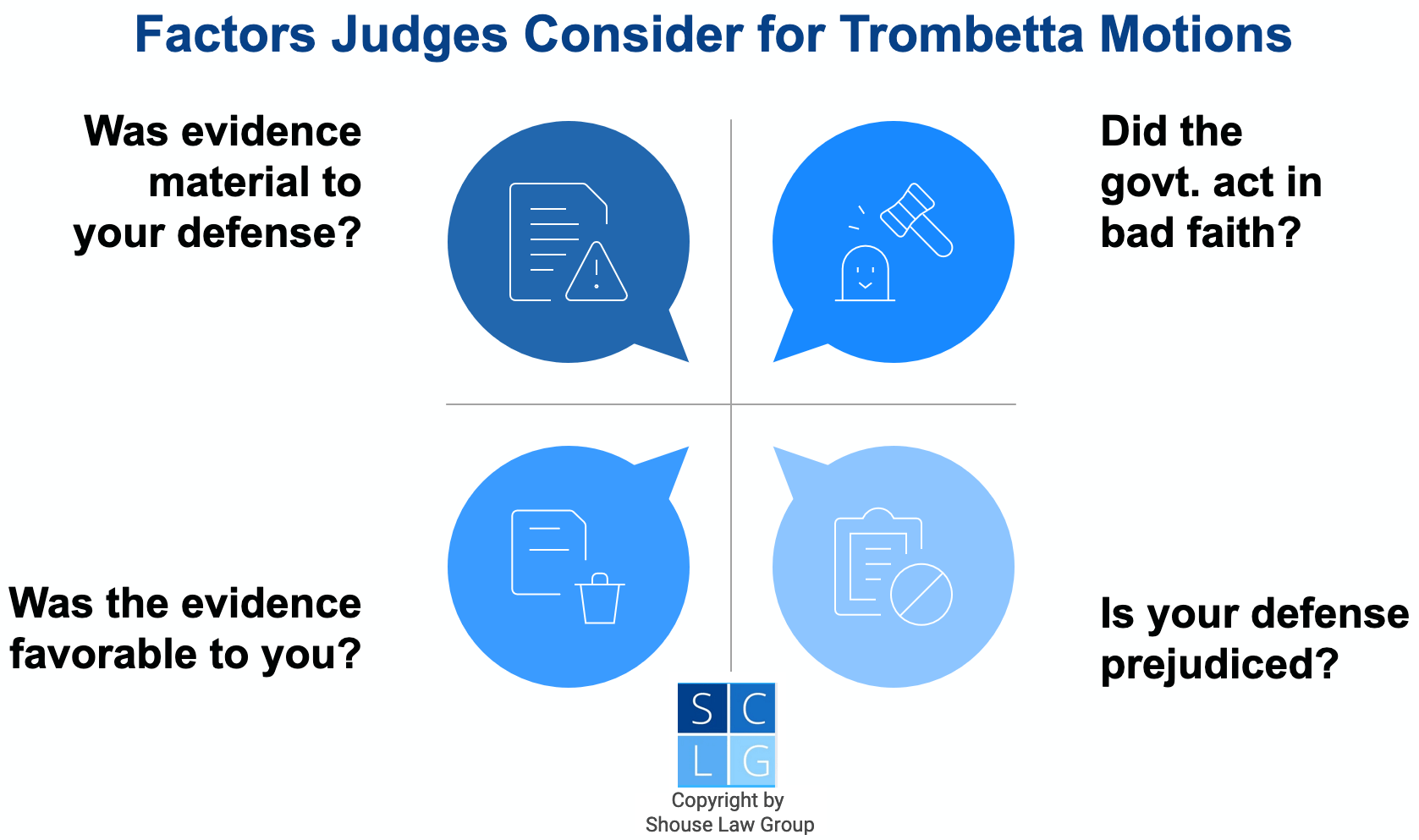
California courts apply two U.S. Supreme Court decisions, California v. Trombetta and Arizona v. Youngblood. Which test applies depends on how valuable the lost evidence was to your defense.1
1) Was the evidence’s value to your defense obvious?
Under Trombetta, the government has a duty to preserve evidence that might be expected to play a significant role in your defense. That duty is violated if the evidence:
- had exculpatory value (it tended to show your innocence) that was apparent before it was lost or destroyed, and
- was of a kind that you cannot get comparable evidence by other reasonably available means.2
If both are true, you do not have to prove the police acted in bad faith. The loss itself can be a due process violation.
“Exculpatory” evidence tends to show you are not guilty. An example in a rape case would be surveillance video showing someone other than you committing the assault.
2) If the evidence was only “potentially useful,” did the government act in bad faith?
Often no one can say for sure what the lost evidence would have shown. For example, a blood or semen sample that was never tested might have helped you, or might not. Under Youngblood, when lost evidence was only “potentially useful,” you must show that the police acted in bad faith.3
“Bad faith” generally means the police knew the evidence could help the defense and let it be destroyed anyway. Ordinary carelessness or an accident is usually not enough.
Example: Sam is arrested for raping his ex-girlfriend. A semen sample is taken, but because of a lab mistake it is not preserved and cannot be tested. Because the sample was ruined by accident, a court would likely find no bad faith.
On the other hand, in one California case, a defendant told an officer at the scene that video of the incident mattered. Police and prosecutors never preserved it, and it was lost. The appeals court upheld the dismissal of the charges against two defendants because of that bad faith.4
If a judge grants a Trombetta motion, the judge decides the remedy. It can be dismissal of the charges or a lesser sanction, such as a jury instruction about the lost evidence.

3. Spoliation of Evidence
“Spoliation” means destroying or hiding evidence, including physical items, digital images and video recordings. In California, it is a crime no matter who does it, including police.
To convict someone of destroying or concealing evidence under Penal Code 135 PC, prosecutors must prove that the person:
- knew the item was about to be produced as evidence in a trial, inquiry or investigation,
- willfully destroyed, erased or concealed it, and
- intended to prevent it from being produced.5
Destroying evidence is a misdemeanor, carrying up to 6 months in jail and/or a fine of up to $1,000.6 Instead of jail, a judge may grant misdemeanor (summary) probation.
You can win a Trombetta motion even if no one is ever charged with destroying the evidence.
4. Trombetta Advisements
If you are arrested for DUI in California and choose an evidentiary breath test, the police must tell you that:
- the breath-testing equipment does not keep a sample of your breath, so no sample will be available later for you or anyone else to test, and
- because of that, you may give a blood or urine sample that will be kept at no cost to you, so it can be tested later.7
This is often called a “Trombetta advisement,” because the Trombetta case involved breath samples that were not saved.
Many people arrested for DUI choose a breath test over a blood test because it is less invasive. But the breath sample is not saved, which makes it harder to challenge the result later. The advisement gives you the chance to provide a blood or urine sample that can be retested.
5. Related Topics
- Franks motion – a motion challenging the truth of the information used to justify a search warrant.
- Serna motion – a motion asking to dismiss criminal charges because of a denial of speedy prosecution or trial.
- Planting or tampering with evidence (141 PC) – planting or tampering with evidence to get someone charged with a crime is a misdemeanor carrying up to 6 months in jail and/or a fine of up to $1,000. If a peace officer does it, it is a felony carrying 2, 3 or 5 years in state prison.8
- Offering false evidence (132 PC) – knowingly offering forged or altered documents as evidence in a legal proceeding is a felony carrying 16 months, 2 years or 3 years in county jail and/or a fine of up to $10,000.9
- Preparing false evidence (134 PC) – preparing false evidence to use it fraudulently in a legal proceeding is a felony carrying 16 months, 2 years or 3 years in county jail and/or a fine of up to $10,000.10
Additional Resources
For more in-depth information, refer to these scholarly articles:
- Probable Cause, Reasonable Suspicion, or Mere Speculation: Holding Police to a Higher Standard in Destruction of Evidence Exigency Cases – Washburn Law Journal.
- Here Today, Gone Tomorrow – Three Common Mistakes Courts Make When Police Lose or Destroy Evidence with Apparent Exculpatory Value – Cleveland State Law Review.
- No Wrong without a Remedy: The Effective Enforcement of the Duty of Prosecutors to Disclose Exculpatory Evidence – Oklahoma City University Law Review.
- Spoliation of Evidence in California – Southwestern University Law Review.
- Linking the Culpability and Circumstantial Evidence Requirements for the Spoliation Inference – Duke Law Journal.
Legal references:
- People v. Alvarez (2014) 229 Cal.App.4th 761, 772-773.
- California v. Trombetta (1984) 467 U.S. 479, 488-489: the evidence “must both possess an exculpatory value that was apparent before the evidence was destroyed, and be of such a nature that the defendant would be unable to obtain comparable evidence by other reasonably available means.”
- Arizona v. Youngblood (1988) 488 U.S. 51, 58: “unless a criminal defendant can show bad faith on the part of the police, failure to preserve potentially useful evidence does not constitute a denial of due process of law.” The Supreme Court reinstated Larry Youngblood’s conviction under this rule. DNA testing later cleared him, and he was exonerated in 2000 (Innocence Project).
- People v. Alvarez, 229 Cal.App.4th at 773 (see note 1 above): “if the best that can be said of the evidence is that it was ‘potentially useful,’ the defendant must also establish bad faith.”
- California Penal Code 135 PC. See also People v. Fields (1980) 105 Cal.App.3d 341.
- California Penal Code 19 PC.
- California Vehicle Code 23614 VC.
- California Penal Code 141(a)-(b) PC; Penal Code 19 PC (see note 6 above).
- California Penal Code 132 PC; Penal Code 18 PC; Penal Code 672 PC.
- California Penal Code 134 PC; Penal Code 18 and 672 PC (see note 9 above).