


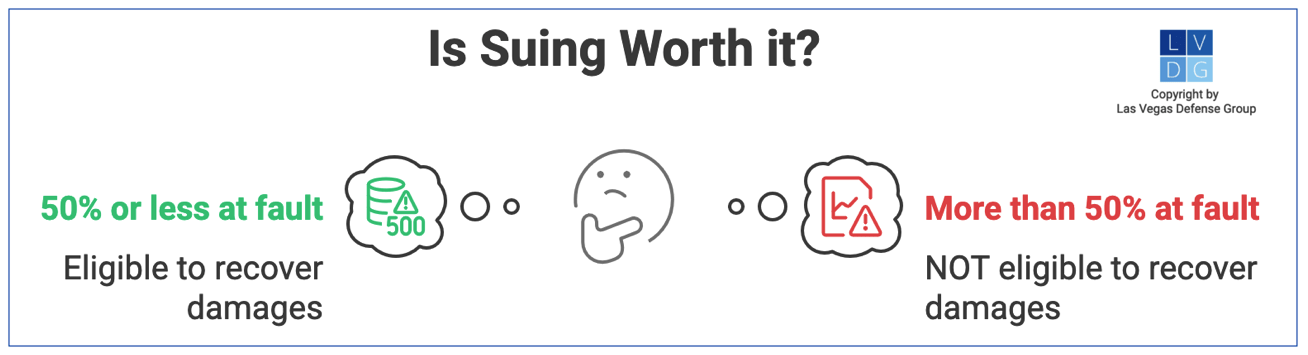
Nevada’s modified comparative negligence law allows you to recover money damages following an accident as long as you were no more than 50% to blame for your injuries. In these “shared fault” cases, the court would just reduce your final payout by your percentage of fault.
Example: You sustain $100,000 worth of damages in a Las Vegas car accident caused by another driver. The court finds you 50% at fault for your injuries because you were eating and texting while driving. Under Nevada’s shared fault laws, you would receive $50,000 in damages (50% of $100,000).
To help you better understand Nevada’s law on shared fault, our Las Vegas personal injury attorneys explain the following:
- 1. “Modified Comparative Negligence” Explained
- 2. Apportioning Blame
- 3. Multiple At-Fault Parties
- 4. Cases That Do Not Use Shared Fault
- 5. Proving Fault
- 6. Negligence Defined
- 7. Contributory Negligence
- 8. Avoiding Fault
- 9. Defending Against Comparative Negligence
- Frequently Asked Questions
- Additional Resources
1. “Modified Comparative Negligence” Explained
Under Nevada’s modified comparative negligence rule, you are entitled to damages when you were 50% or less responsible for your accident injuries.1 NRS 41.141 provides:
In any action to recover damages for death or injury to persons or for injury to property in which comparative negligence is asserted as a defense, the comparative negligence of the plaintiff or plaintiff’s decedent does not bar a recovery if that negligence was not greater than the negligence or gross negligence of the parties to the action against whom recovery is sought.
If the jury finds you were 50% responsible for your injuries, then you will recover something. However, if you are more than 50% at fault, you are entitled to nothing, no matter how serious the injury is.2
Different states have their own version of comparative fault:
|
Modified Comparative Fault |
Pure Comparative Fault |
Contributory Negligence |
|
| Plaintiff’s Recovery | You can recover damages as long as your fault is no more than 50% or under 50%, depending on the state. | You can recover some portion of damages even if you are mostly at fault. | You cannot recover any damages if you are even slightly at fault. |
| Fairness | Largely fair by preventing mostly at-fault plaintiffs from recovering damages. | Can have unfair outcomes by allowing mostly at-fault plaintiffs to recover damages. | Can be unfair by denying recovery to plaintiffs with even a tiny degree of fault. |
| Jurisdictions | 50% states: AR, CO, GA, ID, KA, ME, NE, ND, TN, UT
51% states (such as Nevada): CT, DE, HI, IL, IN, IO, MA, MI, MN, MT, NH, NJ, OH, OK, OR, PA, SC, TX, VT, WV, WI, WY. |
AL, AZ, CA, FL, KY, LA, MS, MO, NM, NY, RI, WA. | AL, DC, MD, NC, VA |
2. Apportioning Blame
If the jury determines that you are entitled to recover damages following an accident in Nevada, the jury will return two verdicts:
- A regular verdict indicating your total damages (without taking into account your fault); and
- A special verdict indicating the percentage of negligence attributable to each party.3
As long as your fault is 50% or less, the judge will then reduce your damages award by the percentage of the accident attributable to you.
Example: Carrie and Delilah are involved in a car accident that causes $100,000 in property damage to Carrie. Carrie sues Delilah. The jury decides that Carrie’s negligence contributed to the accident and that she is 25% at fault while Delilah is 75% at fault.
Under Nevada’s shared fault standard, Carrie will receive a judgment of $75,000 (75% of the total amount) from Delilah. However, let’s say that instead, the jury finds that it was Carrie who was 75% responsible for the accident. Under Nevada law, Carrie recovers nothing because she is more than 50% at fault.
While judges and juries decide fault at trial, in reality, most comparative negligence disputes are argued between your attorney and the insurance adjuster long before a lawsuit is filed. The adjuster will assign a percentage of fault to you in an attempt to lower their settlement offer.
See our related article, Is Nevada a “no-fault state” when it comes to car accidents?

The majority of comparative negligence disputes in car accident cases are resolved between insurance companies, not in court.
3. Multiple At-Fault Parties
The modified comparative negligence rule still applies when there are multiple at-fault parties, but the calculations become a little more complex. The party who is most to blame may have their recovery completely offset by what they owe to the other parties.
If some of the defendants settle with you but others do not, you can take the ones that do not settle to trial. However, the jury will not be told about the settlement(s) that occurred out-of-court.
All the jury decides is the comparative fault of the defendant(s) on trial. Then, if the jury awards you damages, the defendant(s) only pay their percentage of fault.
4. Cases That Do Not Use Shared Fault
Nevada’s comparative negligence laws are inapplicable in the following five types of civil lawsuits:
- strict liability
- intentional torts (such as battery, assault, false imprisonment, and intentional infliction of emotional distress)
- the emission, disposal or spillage of a toxic or hazardous substance
- the concerted acts of the defendants
- an injury to any person or property resulting from a product that is manufactured, distributed, sold, or used in Nevada.
So in these five types of cases, joint and several liability laws apply. This means you may pursue 100% of your damages from just one defendant, even if more than one party caused your injuries. Then, later on, that defendant can seek reimbursement for their overpayment from the other at-fault parties.4

Nevada is a 51% modified comparative negligence state because you are ineligible for damages if you are 51% or more at fault.
5. Proving Fault
Common evidence that can help prove fault in a personal injury case for negligence includes:
- surveillance video of the accident
- eyewitness testimony
- medical records
- expert testimony by doctors, forensic experts, accident reconstruction experts, etc.
- texts, voicemails, emails, and other recorded communications that indicate time/place/intent
- GPS records
- maintenance records
The more evidence you compile, the better chance you have of reaching a favorable settlement without having to go to trial.
6. Negligence Defined
Under Nevada personal injury law, negligence occurs when:
- a person has a duty of care towards you;
- that person breaches this duty of care;
- this breach causes your injuries; and
- your injuries result in damages.
When determining whether a defendant breached their duty of care, a jury would consider whether the defendant acted as a reasonably prudent person would in that situation. If the jury finds that the defendant did fall below the standard of care – and that this failure was the proximate cause of your injuries – then the defendant is liable to you.
Note that defendants can be found negligent even though they never meant to harm you. Intent is irrelevant in negligence cases. What matters is the defendants’ actions (or omissions), and whether they caused your harm.5

Common damages include medical bills, lost wages, and pain and suffering.
7. Contributory Negligence
Nevada has not recognized contributory negligence since 1973. Under this doctrine, if you were even slightly at fault for an accident, you would not be entitled to any recovery whatsoever.6
8. Avoiding Fault
Always remain aware, be careful and follow the law. When you are driving, be sure to follow all the duties imposed on Nevada motorists, such as:
- Never speed.
- Drive at the appropriate speed for the traffic and weather.
- Yield to faster drivers by moving out of the left lane.
- Never tailgate.
- Never text and drive.
- Provide bicyclists at least three feet of space when you pass them.
- Always wear a safety belt.
- Never drive fatigued or while impaired by alcohol or drugs.
- Always signal before changing lanes or turning.
Although you should always wear a safety belt, note that Nevada law prohibits insurance companies from arguing that your compensation should be reduced simply because you were not wearing a seat belt at the time of the crash. Evidence of seat belt non-use (“the seat belt defense”) is generally inadmissible in Nevada civil trials.7
To ensure that you get paid for your damages, you are also advised to carry uninsured / under-insured motorist (UM/UIM) coverage. This covers your losses in case of an accident in which the at-fault driver carries no insurance or insufficient insurance.
9. Defending Against Comparative Negligence
If the defendant in your personal injury lawsuit claims you were partly to blame, they must say so in their response to your initial complaint. This way, you have notice up front, and your attorneys have time to prepare your case.
If the defendant claims comparative negligence too late, then the judge will bar them from using it as a defense.8

An experienced Nevada personal injury attorney can help you recover the maximum payout possible following an accident.
Frequently Asked Questions
What is the 51% rule in Nevada negligence law?
Nevada follows the “51% bar” rule. This means you can recover damages in a personal injury lawsuit as long as you are 50% or less at fault. If you are 51% or more to blame, you recover nothing.
Does Nevada have contributory negligence?
No. Nevada abolished the harsh “contributory negligence” doctrine in 1973. Under the old rule, being even 1% at fault barred you from recovery. Now, you can recover reduced damages even if you were partially at fault.
How are damages calculated in shared fault cases?
The court reduces your total damages by your percentage of fault. For example, if you have $100,000 in damages but are found 30% at fault, you will receive $70,000.
Common damages in these cases include medical bills, lost wages, and pain and suffering.
Can I sue if I wasn’t wearing a seatbelt in Nevada?
Yes. In fact, Nevada law protects you here. Under NRS 484D.495, the defense is prohibited from using your failure to wear a seatbelt as evidence of negligence. They cannot argue that your compensation should be reduced just because you were not buckled up.
Additional Resources
For related information beyond Nevada shared fault laws, refer to our articles on:
- wrongful death – this cause of action allows the family of a deceased victim to sue the at-fault party for burial expenses, loss of support, and other damages.
- medical malpractice – if a healthcare provider caused your injuries, you can sue for unlimited economic damages (though your non-economic damages are capped).
- products liability – if you were injured by a defective product, the manufacturer can be held liable without you having to prove they were negligent.
- dog bites – owners of “dangerous” or “vicious” dogs are liable if they bite you.
- slip-and-falls – falls are one of the most frequent subjects of litigation in Las Vegas casinos.
- statute of limitations – you usually have only two years to bring a personal injury case in Nevada.
Legal References
- Piroozi v. Eighth Judicial District Court (2015) 131 Nev. 1004.
- NRS 41.141.
- Same.
- Same.
- See Perez v. Las Vegas Medical Ctr. (1991) 107 Nev. 1, 805. See also Cox. v. Copperfield (Nev. 2022) 507 P.3d 1216; Detwiler v. Eighth Judicial District Court (Nev. 2021) 486 P.3d 710.
- Joynt v. California Hotel & Casino (1992) 108 Nev. 539.
- NRS 484D.495.
- See also, for example, Natapu v. Caterpillar (Nev. 2025) No. 85841, No. 86010(government accident reports containing legal conclusions about a victim’s fault are inadmissible hearsay).