
Quick summary
Yes, California is an at-will employment state. Under Labor Code 2922, a job with no set end date can be ended by you or your employer at any time, for any reason or no reason, unless an agreement says otherwise. But an at-will firing is still illegal if it breaks a contract or a statute, punishes you for protected activity, or rests on fraud.
- Was a firing illegal? Yes if you were fired for a protected trait (race, sex, age, disability and more), for complaining, taking protected leave or reporting a violation, or in breach of a promise of job security.
- What you can recover: Lost pay and benefits, and in many cases emotional-distress and punitive damages. Some claims also allow getting your job back.
- Deadline: Often 1 to 3 years from the day you’re fired, depending on the claim. Some agency complaints have a 1-year limit (see the deadline timeline).
- Example: Maria’s boss fires her a week after she reports unpaid overtime. Even though she’s at-will, the firing is presumed retaliatory because it came within 90 days.

In this article, our California employment lawyers answer 10 common questions about at-will employment and when firing an at-will employee is illegal:
- 1. Is California an at-will state?
- 2. Who isn’t an at-will employee?
- 3. Exception 1: A contract
- 4. Exception 2: The implied covenant
- 5. Exception 3: Violating public policy
- 6. Exception 4: Fraud and false promises
- 7. Illegal reasons under California statutes
- 8. Was my firing illegal?
- 9. What to do if you were fired
- 10. Frequently asked questions
1. Is California an at-will state?
Yes, California is an at-will employment state. California Labor Code 2922 says:
“An employment, having no specified term, may be terminated at the will of either party on notice to the other. Employment for a specified term means an employment for a period greater than one month.”1
In plain English, if your job has no fixed end date, California law presumes it is at-will.2
What at-will employment means in California
- No reason needed: Your employer can fire you without a reason, a warning or progressive discipline.
- No advance notice needed: “On notice” can mean telling you the same day.
- It works both ways: You can also quit at any time without giving a reason or two weeks’ notice.
- It’s only the default: A contract, a union agreement or a statute can change it.
California is not unusual here. Every U.S. state presumes at-will employment except Montana, which requires good cause once a probationary period ends.3
What at-will employment does not allow
At-will means your employer doesn’t need a good reason. It doesn’t mean your employer can use an illegal one. Courts have recognized four exceptions, explained in sections 3 to 6. California statutes add many more illegal reasons, covered in section 7.
Being at-will also has nothing to do with being a “right-to-work” state, which is about union dues (see the FAQ).
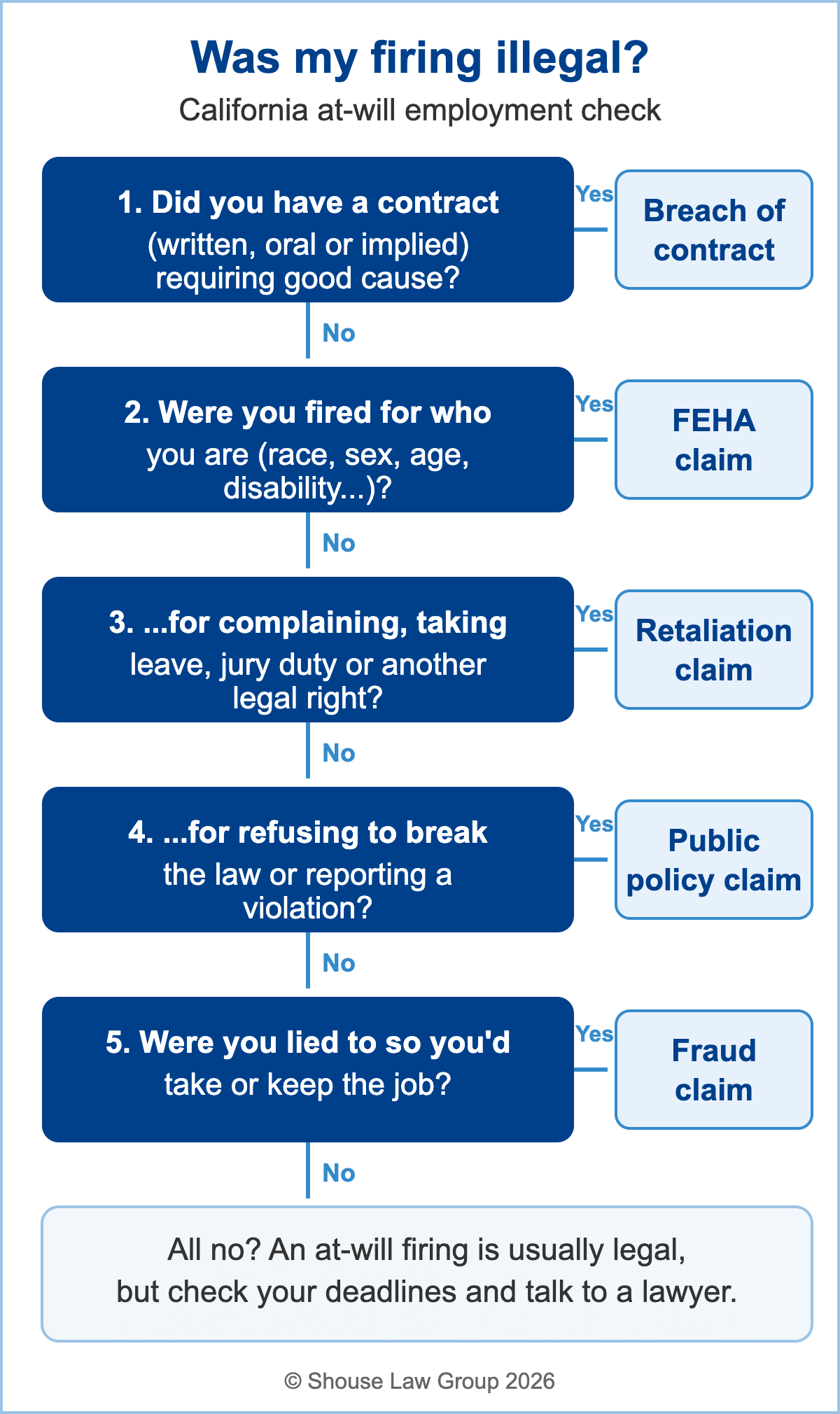
Not sure if an exception applies to you? Start with this chart. A “yes” to any question means you may have a claim worth looking into.
2. Who isn’t an at-will employee?
In California, some workers can only be fired for good cause, or only on terms they agreed to:
- Employees with a fixed-term contract. A contract for a set period longer than one month isn’t at-will. During the term, California law lets the employer end it only for willful breach of duty, habitual neglect or continued inability to do the job, unless the contract says otherwise.4
- Employees with a “for cause” contract or promise. This can be written, spoken or implied (section 3).
- Union members. Most union contracts say workers can be disciplined or fired only for “just cause” and set out a grievance process.
- Most public employees. Civil-service rules and union agreements usually require cause and a hearing before a permanent government employee is fired.
A probationary period doesn’t change the rule: if you’re at-will, you’re at-will during and after probation, unless your employer promised otherwise.
3. Exception 1: A contract
In California, you and your employer can agree to limit the at-will rule. The agreement can be written, spoken or implied by your employer’s conduct.
Signs of an implied contract
California courts look at the whole relationship, including:5
- Your employer’s personnel policies and practices,
- How long you worked there,
- Things your employer said or did that assured you of continued employment, and
- Practices in your industry.
If these show a promise that you’d only be fired for good cause, firing you without good cause breaks that promise. Our page on implied employment contracts covers how to prove one.
Example: Lily has worked as a receptionist at a dental office for 10 years, with excellent reviews. The handbook says employees are fired only for misconduct or poor performance. With no warning, an owner fires her and gives the job to his daughter. Lily may have a claim for breach of an implied contract.
When a signed at-will agreement controls
If you signed an agreement saying your job is at-will, a California court will usually hold you to it. That makes an implied-contract claim much harder.6
4. Exception 2: The implied covenant
Every California employment contract carries an unwritten promise, called the implied covenant of good faith and fair dealing. In plain English: neither side may cheat the other out of what the contract already gives them.
This exception is narrow. If you’re at-will, the covenant can’t stop your employer from firing you without cause. It also can’t add job-security promises that aren’t in your contract.7 What it can do is stop an employer from firing you just to avoid paying something you’ve already earned under the deal, such as a commission, a bonus or a pension that’s about to vest.
Example: James closes a large sale. Under his commission plan, he’ll be paid when the customer pays next month. Two weeks before payment, his employer fires him and keeps the commission. That can break the implied covenant.
A claim for breaking the covenant is a contract claim, so damages are limited to contract losses. Emotional-distress and punitive damages aren’t available on this claim.8
5. Exception 3: Violating public policy
In California, you can sue if you were fired for a reason that violates an important public policy. This is called wrongful termination in violation of public policy.9
Firings that violate public policy
You’re protected if you were fired because you:
- Refused to break the law,
- Performed a legal duty, such as serving on a jury,
- Exercised a legal right or privilege, or
- Reported a suspected violation of law to the government, to the police or to your employer.10
Example: Armen learns his company is paying bribes to a city council member. His boss tells him to disguise the payments in the books. Armen refuses, and a week later he’s laid off. Armen may have a claim for wrongful termination in violation of public policy.
In 2025, a California appeals court applied this rule to lie-detector tests. California Labor Code 432.2 bars employers from requiring a polygraph as a condition of keeping your job. In McDoniel v. Kavry Management, an employee was fired after a required polygraph. The court held that the anti-polygraph law states a fundamental public policy, so he could sue for wrongful discharge.11
What you have to prove
Under California’s jury instruction, you must show that:12
- You were employed by the employer,
- The employer fired you,
- The protected reason (for example, your refusal to break the law) was a substantial motivating reason for the firing,
- You were harmed, and
- The firing was a substantial factor in causing your harm.
Before a jury hears the case, the judge decides whether the policy qualifies. It must be based on a constitutional provision, statute or authorized regulation; benefit the public, not just you; be fundamental and substantial; and be well established when you were fired.13 A minor rule, or one that only protects private interests, won’t qualify.
Whistleblowers
California Labor Code 1102.5 separately protects employees who report what they reasonably believe is a violation of law. That covers reports to a government agency, the police, or a supervisor or other person at work with authority to investigate.14
These claims are easier to prove than many employees expect. You only have to show your report was a contributing factor in the firing. The employer then has to prove, by clear and convincing evidence, that it would have fired you anyway for a legitimate reason.15

6. Exception 4: Fraud and false promises
In California, you can sue for fraud if your employer lied to get you to take or keep a job and you were harmed as a result. This often comes up when someone gives up a job or moves for a new one based on false promises.
What you have to prove
You must show, by a preponderance of the evidence (more likely than not), that:16
- Your employer misrepresented facts, by lying or by hiding important information,
- Your employer knew the statement was false,
- Your employer meant for you to rely on it,
- You reasonably relied on it, and
- You were harmed as a result.
Fraud lets you recover losses from taking the job in the first place, such as giving up your old job or the cost of moving.17 It usually doesn’t cover losses from the firing itself. A lie told to carry out a firing isn’t enough on its own; for those losses you’d need another exception, such as a contract.18
Labor Code 970: false promises to get you to move
California also has a statute aimed at recruiting lies. Labor Code 970 makes it illegal to get someone to move for a job by knowingly lying about the job, how long it will last or the pay. A victim can sue for double damages.19 An appeals court has held that signing an at-will acknowledgment doesn’t defeat this claim.20
Example: Andrew moves from Chicago to San Diego after a company tells him it’s financially stable and expanding his department. In fact, it’s planning to shut that department down. Three months later his job is eliminated. Andrew may be able to sue under Labor Code 970 for double his moving costs and other losses from the move.
7. Illegal reasons under California statutes
Beyond the four court-made exceptions, California statutes make it illegal to fire an at-will employee for many specific reasons. The most common are:
Discrimination
California’s Fair Employment and Housing Act (FEHA) bars firing you because of your race, color, religion, sex, gender identity or expression, sexual orientation, national origin, ancestry, age (40 and over), disability, medical condition, genetic information, marital status, military or veteran status and other protected traits.21 See our pages on employment discrimination and disability discrimination. A discriminatory firing can also support a public-policy claim.22
Retaliation
It’s illegal to fire you for complaining about unpaid wages, discrimination, sexual harassment, safety problems and other violations, or for taking part in an investigation. Our page on whistleblower retaliation covers this in detail.
Since 2024, if you’re fired within 90 days of complaining about unpaid wages or another Labor Code violation, California law presumes the firing was retaliation. Your employer then has to rebut it.23
Protected leave, jury duty and other rights
- Family and medical leave. Firing you for taking job-protected CFRA leave is illegal.24
- Jury duty. Your employer can’t fire you for serving on a jury.25 See jury duty leave.
- Politics. Employers can’t fire you for political activity or to control how you vote.26
- Lawful off-duty conduct. In most cases you can’t be fired for legal conduct off the clock and away from work, including off-duty cannabis use.27
An illegal firing doesn’t have to be a formal termination. If your employer made working conditions so intolerable that you had to quit, you may have a claim for constructive termination.28
Example: Priya, a warehouse worker, files a wage claim with the Labor Commissioner. Six weeks later her shifts are cut to zero and she’s let go “for business reasons.” Because it happened within 90 days of her complaint, the law presumes retaliation. Her employer has to prove the real reason.
8. Was my firing illegal?
For a quick check, go back to the “Was my firing illegal?” flowchart in section 1. A “yes” to any of its questions means you may have a claim worth looking into.
In our experience, many people who think “they can fire me for any reason” have a claim they don’t know about, most often retaliation for a complaint they made weeks earlier.
9. What to do if you were fired
If you think your firing in California was illegal, these steps protect your claim:
- Write down what happened. Note dates, who said what, and any complaint, leave request or report you made before the firing. Keep copies of your pay records, reviews and any written promises.
- Collect your final pay. Wages you’ve earned are due immediately when you’re fired.29
- Check your deadline (below). Missing it can end your case.
- Decide whether an agency filing is needed. A discrimination or harassment claim under FEHA must first go to the California Civil Rights Department (CRD), which will issue a right-to-sue notice on request.30 A public-policy claim needs no agency filing,31 and neither does a Labor Code retaliation claim; a Labor Commissioner complaint is optional.32
- Talk to an employment lawyer before you sign a severance agreement or release.
Deadlines to sue for wrongful termination in California
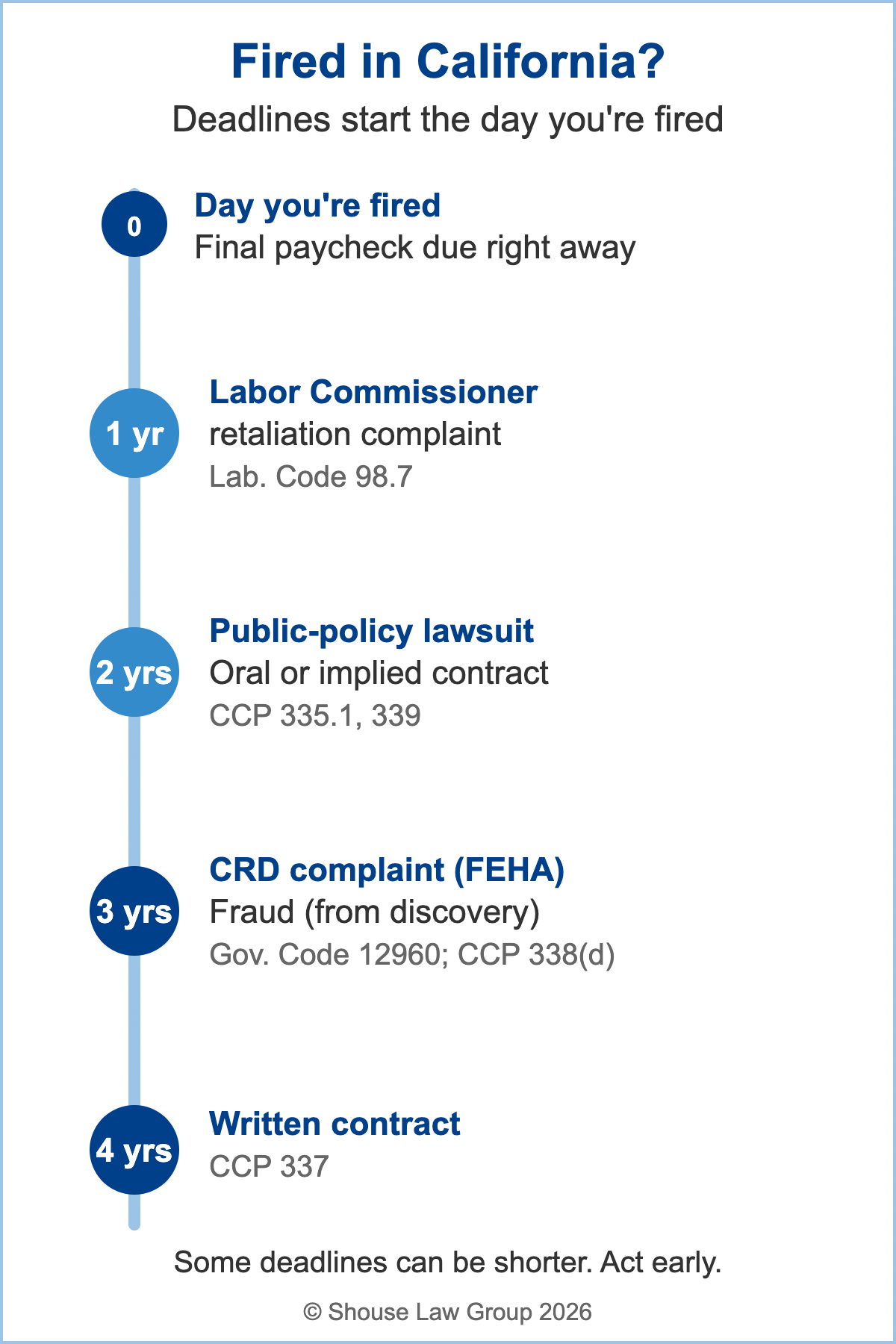
Each kind of claim has its own deadline, counted from the date you were fired:
| Claim | Deadline |
|---|---|
| Retaliation complaint to the Labor Commissioner | 1 year |
| Wrongful termination in violation of public policy | 2 years33 |
| Discrimination or harassment complaint to the CRD (FEHA) | 3 years34 |
| Breach of an oral or implied contract | 2 years35 |
| Breach of a written contract | 4 years36 |
| Fraud | 3 years from when you discover it37 |
After the CRD issues a right-to-sue notice, you generally have one year to file your lawsuit. Our post on the wrongful termination statute of limitations has more detail.
What you can recover
If you win, a jury can award lost pay and benefits, and in many cases damages for emotional distress. Some claims, such as retaliation under the Labor Code or FEHA, also allow getting your job back. Punitive damages require clear and convincing proof that your employer acted with malice, oppression or fraud.38 As noted above, contract and covenant claims are limited to contract damages.

10. Frequently asked questions
Is California an at-will state?
Yes. Under California Labor Code 2922, a job with no set end date is at-will, so you or your employer can end it at any time for any legal reason. A contract, a union agreement or a statute can change that.
How do I know if I was wrongfully terminated in California if it’s an at-will state?
An at-will firing in California is still illegal if it breaks a contract or an earned-benefit promise, violates public policy (such as retaliation for reporting illegal activity), rests on fraud, or violates a statute such as FEHA’s ban on discrimination or the Labor Code’s ban on retaliation.
What counts as an implied contract that protects me from being fired without cause?
In California, an implied promise of job security can come from your employer’s personnel policies, how long you’ve worked there, assurances of continued employment, and industry practice. A signed at-will agreement usually defeats it.
Can I sue for wrongful termination if I was fired for whistleblowing or refusing to do something illegal?
Yes. In California, firing you for refusing to break the law or for reporting a suspected violation can support a claim for wrongful termination in violation of public policy and a whistleblower claim under Labor Code 1102.5.
Can I be fired without warning in California?
Yes, if you’re at-will, California law requires no warning or advance notice for a single firing. Covered employers must give 60 days’ notice of a mass layoff,39 and your final pay is due immediately when you’re fired.

Can I be fired for no reason in California?
Yes. An at-will employee in California can be fired for no reason at all, but not for an illegal reason such as discrimination, retaliation or a reason that violates public policy.
Is California a right-to-work state?
No. “Right-to-work” laws deal with whether union workers can be required to pay union fees; California doesn’t have one. That’s separate from at-will employment. See our post Is California a right-to-work state?
What should I do first if I think I was wrongfully terminated?
Write down what happened, keep your records, and check your deadline. FEHA discrimination claims in California must first go to the Civil Rights Department for a right-to-sue notice, which it issues on request. Public-policy and Labor Code retaliation claims can go straight to court.
If you were fired in California and think it may have been illegal, our California employment lawyers can review your situation in a free consultation. Learn more on our wrongful termination page.
Legal references:
- California Labor Code 2922 LC. Full text (as of November 2026): “An employment, having no specified term, may be terminated at the will of either party on notice to the other. Employment for a specified term means an employment for a period greater than one month.”
- Guz v. Bechtel National, Inc. (2000) 24 Cal.4th 317 (Labor Code 2922 creates a presumption of at-will employment that the parties can change by agreement).
- Montana Code Annotated 39-2-904 (Montana’s Wrongful Discharge from Employment Act requires good cause after a probationary period).
- California Labor Code 2924 LC: “An employment for a specified term may be terminated at any time by the employer in case of any willful breach of duty by the employee in the course of his employment, or in case of his habitual neglect of his duty or continued incapacity to perform it.”
- Foley v. Interactive Data Corp. (1988) 47 Cal.3d 654 (an implied promise not to fire without good cause can be shown by the employer’s personnel policies, the length of service, assurances of continued employment and industry practice).
- Guz, 24 Cal.4th 317 (see note 2 above) (an express at-will agreement generally controls over an implied promise of job security; the implied covenant cannot add job-security terms the parties did not agree to).
- Guz, 24 Cal.4th 317 (see note 2 above) (the covenant cannot add duties or limits beyond the terms the parties actually agreed to; it protects the benefits of the agreement actually made).
- Foley, 47 Cal.3d 654 (see note 5 above) (breach of the implied covenant in an employment contract gives contract damages only, not tort damages).
- Tameny v. Atlantic Richfield Co. (1980) 27 Cal.3d 167 (employee fired for refusing to take part in illegal price fixing may sue in tort).
- Collier v. Superior Court (1991) 228 Cal.App.3d 1117 (reporting suspected illegal conduct to the employer itself is protected).
- McDoniel v. Kavry Management, LLC (2025) 114 Cal.App.5th 949, 964 (the policy of Labor Code 432.2 against required polygraph tests “is ‘substantial’ and ‘fundamental’”). See California Labor Code 432.2 LC.
- California Civil Jury Instructions (CACI) No. 2430, Wrongful Discharge in Violation of Public Policy.
- Stevenson v. Superior Court (1997) 16 Cal.4th 880, 889–890 (the policy must be supported by a constitutional or statutory provision, be “public,” be well established at the time of discharge, and be fundamental and substantial).
- California Labor Code 1102.5 LC (protects employees who disclose information they reasonably believe shows a violation of law, to a government or law enforcement agency or to a person with authority over them).
- California Labor Code 1102.6 LC: once the employee shows the protected activity “was a contributing factor,” “the employer shall have the burden of proof to demonstrate by clear and convincing evidence that the alleged action would have occurred for legitimate, independent reasons even if the employee had not engaged in activities protected by Section 1102.5.” See Lawson v. PPG Architectural Finishes, Inc. (2022) 12 Cal.5th 703, 718 (Section 1102.6, not the federal McDonnell Douglas test, governs these claims).
- Liodas v. Sahadi (1977) 19 Cal.3d 278, 288 (civil fraud is proved by a preponderance of the evidence).
- Lazar v. Superior Court (1996) 12 Cal.4th 631 (an employee fraudulently induced to take a job may sue for fraud, including tort damages).
- Hunter v. Up-Right, Inc. (1993) 6 Cal.4th 1174 (a misrepresentation made to carry out a firing does not support a fraud claim for damages resulting from the termination itself).
- California Labor Code 970 LC (no one may persuade a person to move, within, into or out of California, for work “through or by means of knowingly false representations” about the kind or existence of the work, how long it will last or the pay). Labor Code 972 LC: a violator “is liable to the party aggrieved, in a civil action, for double damages resulting from such misrepresentations.”
- White v. Smule, Inc. (2022) 75 Cal.App.5th 346 (an employee’s signed at-will acknowledgment did not defeat his Labor Code 970 claim based on statements made to recruit him).
- California Government Code 12940 GC (Fair Employment and Housing Act; protected characteristics and retaliation).
- City of Moorpark v. Superior Court (1998) 18 Cal.4th 1143 (disability discrimination can support a common-law wrongful-discharge claim).
- California Labor Code 98.6 LC: “If an employer engages in any action prohibited by this section within 90 days of the protected activity specified in this section, there shall be a rebuttable presumption in favor of the employee’s claim.” (Amended by SB 497, effective January 1, 2024.)
- California Government Code 12945.2 GC (California Family Rights Act).
- California Labor Code 230 LC: “An employer shall not discharge or in any manner discriminate against an employee for taking time off to serve as required by law on an inquest jury or trial jury….”
- California Labor Code 1101 and 1102 LC (political activity and affiliations).
- California Labor Code 96(k) LC (lawful conduct during nonworking hours away from the employer’s premises); Government Code 12954 GC (off-the-job cannabis use).
- Turner v. Anheuser-Busch, Inc. (1994) 7 Cal.4th 1238 (constructive discharge: an employer knowingly makes conditions so intolerable that a reasonable employee would resign).
- California Labor Code 201 LC: “If an employer discharges an employee, the wages earned and unpaid at the time of discharge are due and payable immediately.”
- California Government Code 12965 GC (the Civil Rights Department “shall issue, on request, the right-to-sue notice”).
- Rojo v. Kliger (1990) 52 Cal.3d 65 (an employee need not exhaust FEHA administrative remedies before suing for wrongful discharge in violation of public policy).
- California Labor Code 98.7 LC: a complaint may be filed “within one year after the occurrence of the violation”; “(g) In the enforcement of this section, there is no requirement that an individual exhaust administrative remedies or procedures.”
- California Code of Civil Procedure 335.1 CCP (two years).
- California Government Code 12960(e)(5) GC (three years to file with the Civil Rights Department).
- California Code of Civil Procedure 339 CCP (two years for a contract “not founded upon an instrument of writing”).
- California Code of Civil Procedure 337 CCP (four years for a written contract).
- California Code of Civil Procedure 338(d) CCP (three years for fraud, counted from discovery of the facts).
- California Civil Code 3294 CC (punitive damages require “clear and convincing evidence” of oppression, fraud or malice).
- California Labor Code 1401(a) LC (60 days’ written notice of a mass layoff, relocation or termination at a covered establishment).