
![Are wiretapping and eavesdropping illegal in Colorado? [2022 UPDATES IN DESCRIPTION]](https://www.shouselaw.com/wp-content/plugins/wp-youtube-lyte/lyteCache.php?origThumbUrl=https%3A%2F%2Fi.ytimg.com%2Fvi%2F8pzFYk-2js4%2F0.jpg)
Colorado Revised Statute § 18-9-303 C.R.S. prohibits wiretapping a phone without the consent of at least one party to the conversation.
Similarly, Colorado Revised Statute § 18-9-304 C.R.S. makes it a crime to listen to or record a private in-person conversation – “eavesdropping” – without the consent of at least one party to the conversation.
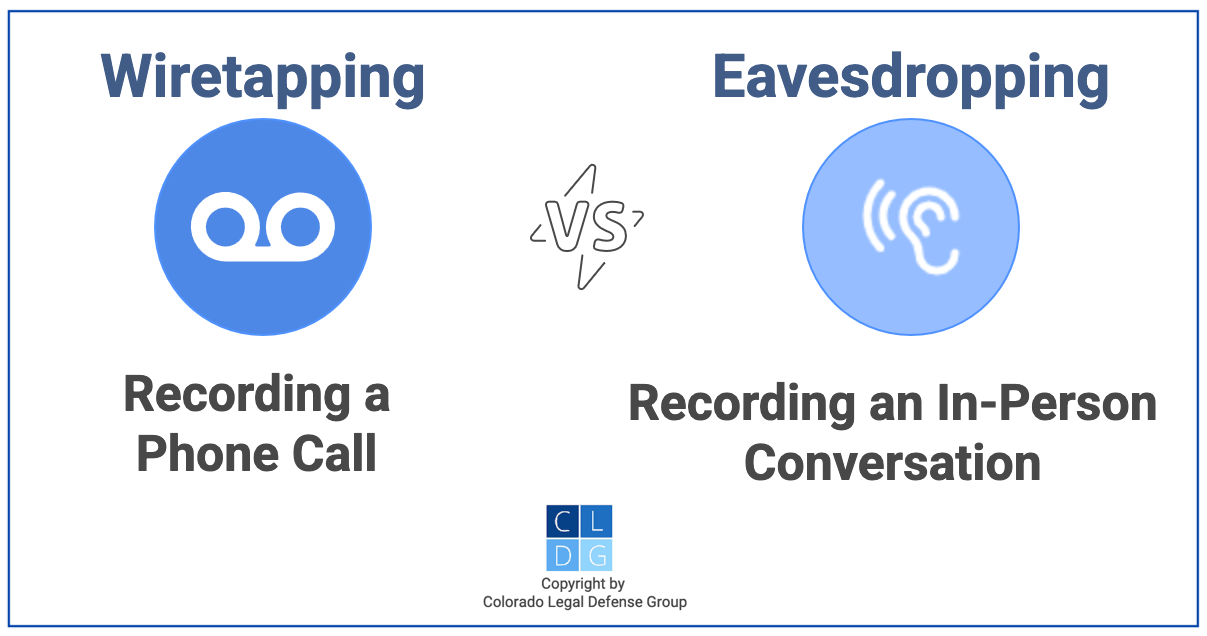
Therefore, Colorado is considered a “one-party consent state” for both wiretapping and eavesdropping because you need at least one participant’s consent to listen to or record the conversation.
In “all-party consent states” such as California, a person would need the permission of every party to a phone call or conversation to lawfully record it.
Unlawful wiretapping or eavesdropping in Colorado is a class 2 misdemeanor, carrying up to 120 days in jail and/or $750.
In this article, our Denver Colorado criminal defense lawyers will address the following key topics:
- 1. Wiretapping
- 2. Eavesdropping
- 3. Penalties
- 4. Defenses
- 5. Related Offenses
- Frequently Asked Questions
- Additional Reading
1. Wiretapping
For you to be convicted of unlawful wiretapping in Colorado under C.R.S. 18-9-303, prosecutors have to prove beyond a reasonable doubt that you either:
- Knowingly overheard or recorded a telephone or electronic communication (or attempted to) without the consent of either sender or receiver; or
- Intentionally listened, read, or recorded an electronic communication for the purpose of committing a crime; or
- Knowingly used or disclosed the contents of any wiretapped conversation; or
- Knowingly helped another person to commit wiretapping.1
Because Colorado is a one-party consent state, you need the permission of at least one party to the conversation to listen in or record the conversation lawfully.
Example: Ann records all her phone calls with her estranged husband in the hopes of catching him saying something she can use against him in family court. Since Ann is a participant to the phone call, she can lawfully record the call without her ex’s consent.
2. Eavesdropping
For you to be convicted of unlawful eavesdropping of a private in-person conversation in Colorado under C.R.S. 18-9-304, prosecutors have to prove beyond a reasonable doubt that you either:
- Knowingly overheard or recorded a conversation without the consent of at least one of the principal parties; or
- Intentionally overheard or recorded a conversation for the purpose of committing an unlawful act; or
- Knowingly used or disclosed the contents of any eavesdropping conversation; or
- Knowingly aided, authorized, agreed with, or permitted any person to commit eavesdropping.
With Colorado being a one-party consent state, you would need permission of at least one party to a private in-person conversation in order to lawfully record it.2
Example: Ann hides in the bushes at her estranged husband’s new house. She records a conversation he is having with his new girlfriend so she can use it against him in family court. Since neither the ex nor his girlfriend consented to having their private conversation recorded, Ann is committing unlawful eavesdropping.

Criminal eavesdropping in Colorado is a class 2 misdemeanor.
3. Penalties
As discussed above, it is a class 2 misdemeanor to commit unlawful wiretapping or eavesdropping in Colorado. The punishment is:
- up to 120 days in jail and/or
- a fine of up to $750.3
Note that it is an entirely separate Colorado crime to manufacture, buy, sell, or possess any instrument or device for wiretapping or eavesdropping purposes. This is only a petty offense, carrying:
- up to 10 days in jail and/or
- a fine of up to $300.4
4. Defenses
Here at Colorado Legal Defense Group, we have represented countless people charged with recording crimes, especially in the age of smartphones. In our experience, the following three defenses have proven very effective with prosecutors, judges, and juries at getting wiretapping or eavesdropping charges reduced or dismissed.
- At least one party to the conversation consented; or
- The conversation occurred in a public place, and neither party had a reasonable expectation of privacy; or
- You did not record the conversation knowingly; perhaps you accidentally pressed the record button without realizing it.
Note that a case of lawful wiretapping can become unlawful based on your actions. For example, let’s say your cordless phone picks up another line’s phone conversation: This is not a crime since you did nothing to cause it. However, if you continue listening to the conversation or then attempt to record it, then it may cross the line into unlawful wiretapping.
Colorado law also lays out six exceptions to criminal wiretapping and eavesdropping laws. These “affirmative defenses” include:
- The acts were done by news agencies using standard equipment for reporting or investigating a public or newsworthy event.
- You used recording equipment on your own property for security or business purposes if notice is given.
- The acts were done by state or federal communications services carrying out necessary communications services, maintenance, or operations.
- The communications were made through a system that is readily accessible to the public.
- You intercepted radio communications for use by the general public.
- The communication were on an authorized frequency within the bands for amateur, citizen band, or general mobile radio services.5

In Colorado, the electronic interception of a private phone conversation is a criminal offense.
5. Related Offenses
- Extortion (Blackmail) – threatening another person to do something, or refrain from doing something, against their will.6
- Telecommunication Crime – the use, possession, or sale of illegal telecommunications equipment or use of telecom equipment without lawful permission.7
- Obstruction of Telephone Service – knowingly interfering with any communication sent by a telegraph or telephone.8
Frequently Asked Questions
Can I record phone calls in Colorado if I am part of the conversation?
Yes, you can record phone calls in Colorado if you are a party to the conversation. Colorado is a “one-party consent state,” which means you only need permission from one person involved in the call – and that person can be yourself.
What happens if I get caught recording someone without permission?
Recording phone calls or private conversations without consent is a class 2 misdemeanor in Colorado. You could face up to 120 days in jail and/or a fine of up to $750.
Is it illegal to record conversations that happen in public places?
Not necessarily. If a conversation occurs in a public place where people don’t have a reasonable expectation of privacy, recording may be legal. However, you still need consent from at least one party to the conversation to be completely safe from charges.
What should I do if I accidentally recorded a conversation?
Accidentally recording a conversation is a valid defense against wiretapping or eavesdropping charges. Colorado law requires that you “knowingly” record without consent. If you can prove it was truly accidental, you may avoid conviction.
Additional Reading
Legal References
- C.R.S. 18-9-303 – Wiretapping prohibited – penalty.
(1) Any person not a sender or intended receiver of a telephone or telegraph communication commits wiretapping if he:
(a) Knowingly overhears, reads, takes, copies, or records a telephone, telegraph, or electronic communication without the consent of either a sender or a receiver thereof or attempts to do so; or
(b) Intentionally overhears, reads, takes, copies, or records a telephone, telegraph, or electronic communication for the purpose of committing or aiding or abetting the commission of an unlawful act; or
(c) Knowingly uses for any purpose or discloses to any person the contents of any such communication, or attempts to do so, while knowing or having reason to know the information was obtained in violation of this section; or
(d) Knowingly taps or makes any connection with any telephone or telegraph line, wire, cable, or instrument belonging to another or with any electronic, mechanical, or other device belonging to another or installs any device whether connected or not which permits the interception of messages; or
(e) Repealed.
(f) Knowingly uses any apparatus to unlawfully do, or cause to be done, any act prohibited by this section or aids, authorizes, agrees with, employs, permits, or intentionally conspires with any person to violate the provisions of this section.
(2) Wiretapping is a class 2 misdemeanor.Other one-party consent states include Alabama, Alaska, Arizona, Arkansas, District of Columbia, Georgia, Hawaii, Idaho, Indiana, Iowa, Kansas, Kentucky, Louisiana, Maine, Minnesota, Mississippi, Missouri, Nebraska, New Jersey, New Mexico, New York, North Carolina, North Dakota, Ohio, Oklahoma, Rhode Island, South Carolina, South Dakota, Tennessee, Texas, Utah, Virginia, West Virginia, Wisconsin, and Wyoming. Meanwhile, all-party consent states include California, Connecticut, Delaware, Florida, Illinois, Maryland, Massachusetts, Michigan, Montana, Nevada, New Hampshire, Oregon, Pennsylvania, Vermont, and Washington. Federal law also follows one-party consent rules pursuant to 18 U.S.C. 2515. See also People v. Mares (Colo. App. 2011) 263 P.3d 699; People v. Braziel (Colo.App. 2024) No. 22CA1146 (unpublished). - C.R.S. 18-9-304 – Eavesdropping prohibited – penalty.
(1) Any person not visibly present during a conversation or discussion commits eavesdropping if he:
(a) Knowingly overhears or records such conversation or discussion without the consent of at least one of the principal parties thereto, or attempts to do so; or
(b) Intentionally overhears or records such conversation or discussion for the purpose of committing, aiding, or abetting the commission of an unlawful act; or
(c) Knowingly uses for any purpose, discloses, or attempts to use or disclose to any other person the contents of any such conversation or discussion while knowing or having reason to know the information was obtained in violation of this section; or
(d) Knowingly aids, authorizes, agrees with, employs, permits, or intentionally conspires with any person to violate the provisions of this section.
(2) Eavesdropping is a class 2 misdemeanor. - C.R.S. 18-9-303. C.R.S. 18-9-304. Prior to March 1, 2022, a first offense of violating CRS 18-9-302 was a class 2 misdemeanor carrying 3 to 12 months in jail and a fine of up to $1,000. Also, eavesdropping was a class 1 misdemeanor, with penalties including 6 to 18 months in jail and a fine of up to $5,000. SB21-271. HB 23-1293.
- C.R.S. 18-9-302 – Wiretapping and eavesdropping devices prohibited – penalty.
Any person who manufactures, buys, sells, or knowingly has in the person’s possession any instrument, device, contrivance, machine, or apparatus designed or commonly used for wiretapping or eavesdropping, as prohibited in sections 18-9-303 and 18-9-304, with the intent to unlawfully use or employ or allow the same to be so used or employed, or who knowingly aids, authorizes, agrees with, employs, permits, or conspires with any other person to unlawfully manufacture, buy, sell, or have the same in the person’s possession is guilty of a petty offense.
- C.R.S. 18-9-305 – Exceptions.
(1) Nothing in sections 18-9-302 to 18-9-304 shall be interpreted to prevent a news agency, or an employee thereof, from using the accepted tools and equipment of that news medium in the course of reporting or investigating a public and newsworthy event; nor shall said sections prevent any person from using wiretapping or eavesdropping devices on his own premises for security or business purposes if reasonable notice of the use of such devices is given to the public.
(2) No part of sections 18-9-302 to 18-9-304 shall apply to the normal use of services, facilities, and equipment provided by a provider of wire or electronic communication service pursuant to its tariffs on file with the public utilities commission of the state of Colorado and with the federal communications commission; and said sections shall not apply to the normal functions of any operator of a switchboard nor to any officer, agent, or employee of a provider of wire or electronic communication service or other person engaged in the business of providing service, equipment, and facilities for communication who performs an otherwise prohibited act if such act is necessary to provide the communication services, equipment, or facilities or is necessary in the construction, maintenance, repair, operations, or use of the same, including the obtaining of billing and accounting information, the protecting of the communication services, equipment, and facilities from illegal use in violation of the tariffs referred to in this subsection (2), the protecting of the provider of wire or electronic communication service from the commission of fraud against it, and the providing of requested information in response to a subpoena or court order issued by a court of competent jurisdiction or on demand of other lawful authority.
(3) It shall not be unlawful under sections 18-9-302 to 18-9-304 for an officer, employee, or agent of any provider of wire or electronic communication service or other person to provide information, facilities, or technical assistance to an investigative or law enforcement officer who, pursuant to section 16-15-102, C.R.S., is authorized to intercept a wire, oral, or electronic communication for that purpose.
(4) A good faith reliance on a court order or the provisions of article 15 of title 16, C.R.S., shall constitute a complete defense to any criminal action brought under provision of sections 18-9-302 to 18-9-304 or any civil action brought under any other law of the state of Colorado. This section shall not be construed in any manner which would allow an investigative or law enforcement officer of the state of Colorado to engage in any wiretapping or eavesdropping without prior authorization by a court of competent jurisdiction under the provisions of article 15 of title 16, C.R.S., except as provided in section 16-15-102 (18), C.R.S.
(4.3) It shall not be unlawful under sections 18-9-302 to 18-9-304 for any person:
(a) To intercept or access an electronic communication made through an electronic communications system that is configured so that such electronic communication is readily accessible to the general public;
(b) To intercept any radio communication which is transmitted by:
(I) Any station for the use of the general public or that relates to ships, aircraft, vehicles, or persons in distress;
(II) Any governmental, law enforcement, civil defense, private land mobile, or public safety communications system, including police and fire, readily accessible to the general public;
(III) A station operating on an authorized frequency within the bands allocated to the amateur, citizens band, or general mobile radio services; or
(IV) Any marine or aeronautical communications system;
(c) To engage in any conduct which is:
(I) Prohibited by section 633 of the federal “Communications Act of 1934”, as amended; or
(II) Excepted from the application of section 705 (a) of the federal “Communications Act of 1934”, as amended, by section 705 (b) of said act;
(d) To intercept any wire or electronic communication, the transmission of which is causing harmful interference to any lawfully operating station or consumer electronic equipment, to the extent necessary to identify the source of such interference; or
(e) For other users of the same frequency to intercept any radio communication made through a system that utilizes frequencies monitored by individuals engaged in the provision or the use of such system, if such communication is not scrambled or encrypted.
(4.5) It shall not be unlawful under sections 18-9-302 to 18-9-304:
(a) To use a pen register or a trap and trace device; or
(b) For a provider of electronic communication service to record the fact that a wire or electronic communication was initiated or completed in order to protect such provider, another provider furnishing service toward the completion of the wire or electronic communication, or a user of that service from fraudulent, unlawful, or abusive use of such service.
(4.7) A person or entity providing an electronic communication service to the public shall not intentionally divulge the contents of any communication other than a communication to such person or entity, or an agent thereof, while in transmission on that service to any person or entity other than an addressee or intended recipient of such communication or an agent of such addressee or intended recipient; except that a person or entity providing electronic communication service to the public may divulge the contents of any such communication:
(a) As otherwise authorized in section 16-15-102 (12), (13), (14), and (16), C.R.S., and subsections (2) and (3) of this section;
(b) With the lawful consent of the originator or any addressee or intended recipient of such communication;
(c) To a person employed or authorized, or whose facilities are used, to forward such communication to its destination; or
(d) Which were inadvertently obtained by the service provider and which appear to pertain to the commission of a crime, if such divulgence is made to a law enforcement agency.
(4.9) It shall not be unlawful for a district attorney or law enforcement officer to listen to a recording of or to read a transcription of the contents of an electronic communication involving a cordless telephone when the district attorney or law enforcement officer has come into possession of such materials from a third party. In order to use such materials as evidence in a prosecution for a crime other than wiretapping or eavesdropping, the district attorney or law enforcement officer shall have a reasonable basis for believing that the recording or transcription is reliable and shall also have separate probable cause based on corroborating evidence to support a reasonable belief that the crime was committed. Nothing in this subsection (4.9) shall preclude a district attorney from prosecuting a person for a violation of section 18-9-303 or 18-9-304.
(5) The exceptions in this section shall be affirmative defenses. - C.R.S. 18-3-207.
- C.R.S. 18-9-309.
- C.R.S. 18-9-306.5.
For more in-depth information, refer to the following scholarly articles:
Also see our related article, What are Colorado laws as to recording conversations?