
Sobriety checkpoints are roadblocks in Colorado where police check you for DUI or DWAI. Every motorist that goes through checkpoints can get stopped and questioned. Though police are only allowed to detain you if you show signs and symptoms of being intoxicated.
The Colorado Department of Transportation posts advance notice of upcoming sobriety checkpoints. They often occur during times of high alcohol consumption. Examples are:
- St. Patrick’s Day,
- The Fourth of July,
- New Year’s Eve,
- Super Bowl Sunday, and
- Any holiday weekend
Upcoming and past DUI checkpoints and blitzes in Colorado
| Sunday, December 31, 2023 | Throughout the state |
| Thursday, August 17 – Wednesday, September 6, 2023 | Throughout the state |
| Friday, June 30 – Tuesday, July 4, 2023 | Throughout the state |
| Saturday, May 27 – Monday, June 5, 2023 | Throughout the state |
| Friday, March 17 – Sunday, March 19, 2023 | Throughout the state |
| Sunday, February 12, 2023 | Throughout the state |
| Dec. 29, 2022 – Jan. 3, 2023 | Throughout the state |
| Saturday, September 17, 2022 | Aurora |
| Saturday, August 20, 2022 | Aurora |
| Friday, July 1 – Monday, July 4, 2022 | Throughout the state |
| Friday, May 27 – Monday, May 30, 2022 | Throughout the state |
Drunk driving is not the only offense police check for at checkpoints. They also routinely issue citations for:
- Driving with an open container of alcohol (42-4-1305 C.R.S.),
- Driving with an open container of marijuana (42-4-1305.5 C.R.S.)
- Driving without a seat belt
To help you better understand your rights before, during and after a Colorado DUI checkpoint, our Colorado DUI defense lawyers discuss the following:
- 1. Are sobriety checkpoints legal?
- 2. When is a Colorado sobriety checkpoint illegal?
- 3. What happens at a DUI checkpoint?
- 4. What happens if the police suspect DUI?
- 5. Can I turn around to avoid a Colorado sobriety checkpoint?
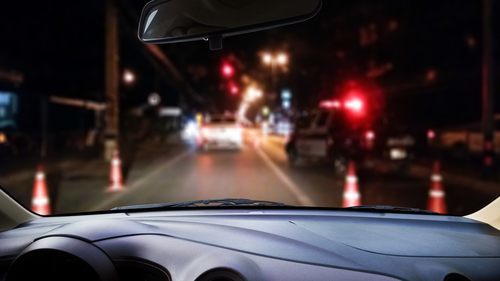
Sobriety roadblocks are legal as long as they follow various rules.
1. Are sobriety checkpoints legal?
Yes, if they are fair and not overly intrusive.
The United States Constitution requires law enforcement agencies to have probable cause to stop you when you are driving. Otherwise, the traffic stop is an unreasonable “seizure” and therefore a violation of constitutional rights under the Fourth Amendment to the U.S. Constitution.
Probable cause for a DUI stop in Colorado exists when a police officer observes:
- A traffic violation,
- A defect in your vehicle that affects safety, or
- A driving pattern that indicates that you may be intoxicated
However, the United States Supreme Court has recognized that drunk and drugged driving are significant threats to public safety. As a result, the Court ruled that DUI checkpoints are an exception to the probable cause rule.1
See our related article, Drug Checkpoints Leaving Colorado.
2. When is a Colorado sobriety checkpoint illegal?
DUI checkpoints are unlawful if they violate the Colorado Department of Transportation (CDOT) guidelines for sobriety checkpoints. DUI roadblocks should:
- Pose as little inconvenience as possible to you,
- Have a consistent, non-discriminatory procedure for choosing which vehicles to stop – for example, every third car,
- Give adequate warning that you are approaching a checkpoint,
- Be adequately staffed and supervised,
- Be in a safe location, and
- Be publicized in advance
The failure to comply strictly with CDOT guidelines does not automatically make a sobriety checkpoint illegal. It all depends on the number of guidelines violated and the seriousness of the non-compliance.
Nine possible violations that could make a DUI roadblock unconstitutional include:
- The police department had no official procedures for roadblocks.
- The roadblock created a traffic hazard.
- The method for selecting which cars to stop was not neutral.
- There was inadequate advance warning of the mobile checkpoint.
- There were inadequate signs of official authority (uniformed officers, marked police vehicles, etc).
- There was no convenient and reasonable procedure for DUI breath testing.
- There was no drug recognition expert (DRE) on site.
- The officers supervising the checkpoint were not adequately trained.
- There was not enough advance publicity of the checkpoint.2
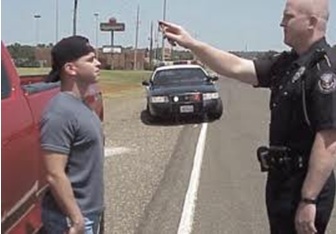
If suspected of DUI at checkpoints, you may be asked by highway patrol to perform field sobriety tests.
3. What happens at a Colorado DUI checkpoint?
First, you should be given plenty of advance warning when you approach a sobriety roadblock. The warning usually takes the form of:
- Signs,
- Lights,
- Uniformed officers, and
- Marked police cars
The agency operating the checkpoint will usually cordon off part of the road. This will force traffic to merge into one or two lanes. An officer will ask you to roll down the window. The officer will then ask to see your license and registration, which you are legally required to produce.
The check will then proceed like an ordinary traffic stop. The officer will try to engage you to see whether:
- you have difficulty producing your driver’s license and registration,
- you smell of alcohol or marijuana,
- there is alcohol, drugs or drug paraphernalia in your vehicle, or
- you show physical signs of intoxication – such as slurred speech, red eyes
If the officer suspects you are inebriated or stoned, a standard DUI investigation may follow.
4. What happens if the police suspect DUI?
If officers suspect DUI, they can ask you to step out of the vehicle. Then they can ask you to take the following tests:
The FSTs and PAS breath tests are optional. You may decline to take them without legal consequences.
If you do take them, the FST results can come into court as evidence of impairment. If you are 21 years old or over, PAS results are admissible to prove the officers had probable cause. (If you are under 21 and are facing only a UDD charge, you must take the roadside breath test.)
Officers that believe you are intoxicated may arrest you for either:
- Driving under the influence of alcohol (DUI) or driving under the influence of drugs (DUID) – 42-4-1301 (1)(a), C.R.S.;
- DUI “per se” (driving with a BAC of .08% or higher) – 42-4-13-1 (2)(a), C.R.S.;
- Driving while ability impaired (DWAI) by alcohol and/or drugs – 42-4-1301 (1)(b), C.R.S.; or
- Underage drinking and driving (UDD) – 42-4-1301 (2)(d)(I), C.R.S.
Upon arrest, you must take an evidentiary breath alcohol test (EBAT) or blood test. Normally, you are allowed to choose which test. Though if the police suspect drug use, you must take a blood, urine, or saliva test.
Refusing to take a chemical test after an arrest has consequences. Two include:
- Automatic revocation of your Colorado driver’s license, and
- Designation as a Colorado “persistent drunk driver” (even if it is your first arrest)
Also, the refusal can be used as evidence of guilt if the case goes to trial.
5. Can I turn around to avoid a sobriety checkpoint?
Yes, you have the legal right to turn around and avoid a DUI roadblock. Though you may not violate any traffic laws in the process. Otherwise, you can be cited for the violation. Then you could also be questioned about drinking as if it were any other traffic stop.

Call our law firm for legal advice. We offer consultations.
For further assistance, please contact us at:
Colorado Legal Defense Group
4047 Tejon Street
Denver, CO 80211
(303) 222-0330
Learn more about Colorado DUI laws. See our related page on Recent DUI checkpoints in Colorado Springs.
In California? See our article on California sobriety roadblocks.
In Nevada? See our article on Nevada sobriety roadblocks.