
If you are convicted of crimes in Colorado, you can pursue post-conviction relief in an attempt to vacate your verdicts or sentences. Also called 35(c) motions, petitions for post-conviction relief spell out to the court all the ways that you were denied your constitutional rights to a fair trial and sentence.
After getting convicted by a trial or plea, you have a limited statute of limitations to file a post-conviction relief motion in Colorado. The time bar depends on the type of offense for which you were convicted:
- Class 1 felonies: No limit
- All felonies except class 1: 3 years;
- Misdemeanors: 18 months
- Petty offenses: 6 months
The statute of limitations starts running after your sentencing date (or after your illegal sentence gets corrected) if you do not file a direct appeal. If you do file a direct appeal, the clock starts after the appeals court issues a mandate formally ending the appeal.
If the court grants your 35(c) motion, the judgment may be set aside and/or the sentence may be lessened or lifted altogether.
Below, our Colorado post-conviction relief attorneys discuss the application process and time frames for filing a 35(c) motion in Colorado. Click on a topic to go to that section.
- 1. Post-Conviction Relief vs. Appeals
- 2. The Grounds
- 3. Filing Late
- 4. How to File
- 5. How the Judge Decides
- 6. When the Judge Decides
- 7. Other Forms of Post-Conviction Relief
- 8. Refiling After Denial
- 9. Immigration Consequences
- Frequently Asked Questions
- Additional Resources
1. Post-Conviction Relief vs. Appeals
With appeals in Colorado, you ask a higher court – the appellate court – to review your case. Whereas with a 35(c) motion, you seek review from the same district court that handled the criminal case.1
For instance, if you are convicted in a trial court (such as Denver Criminal Court), you may seek a direct appeal to the Colorado Court of Appeals and eventually to the Colorado Supreme Court. However, if you are seeking post-conviction relief following a judgment of conviction in Denver Criminal Court, you would stay in Denver Criminal Court.2

People convicted of crimes can file 35(c) motions to argue they were denied due process.
2. The Grounds
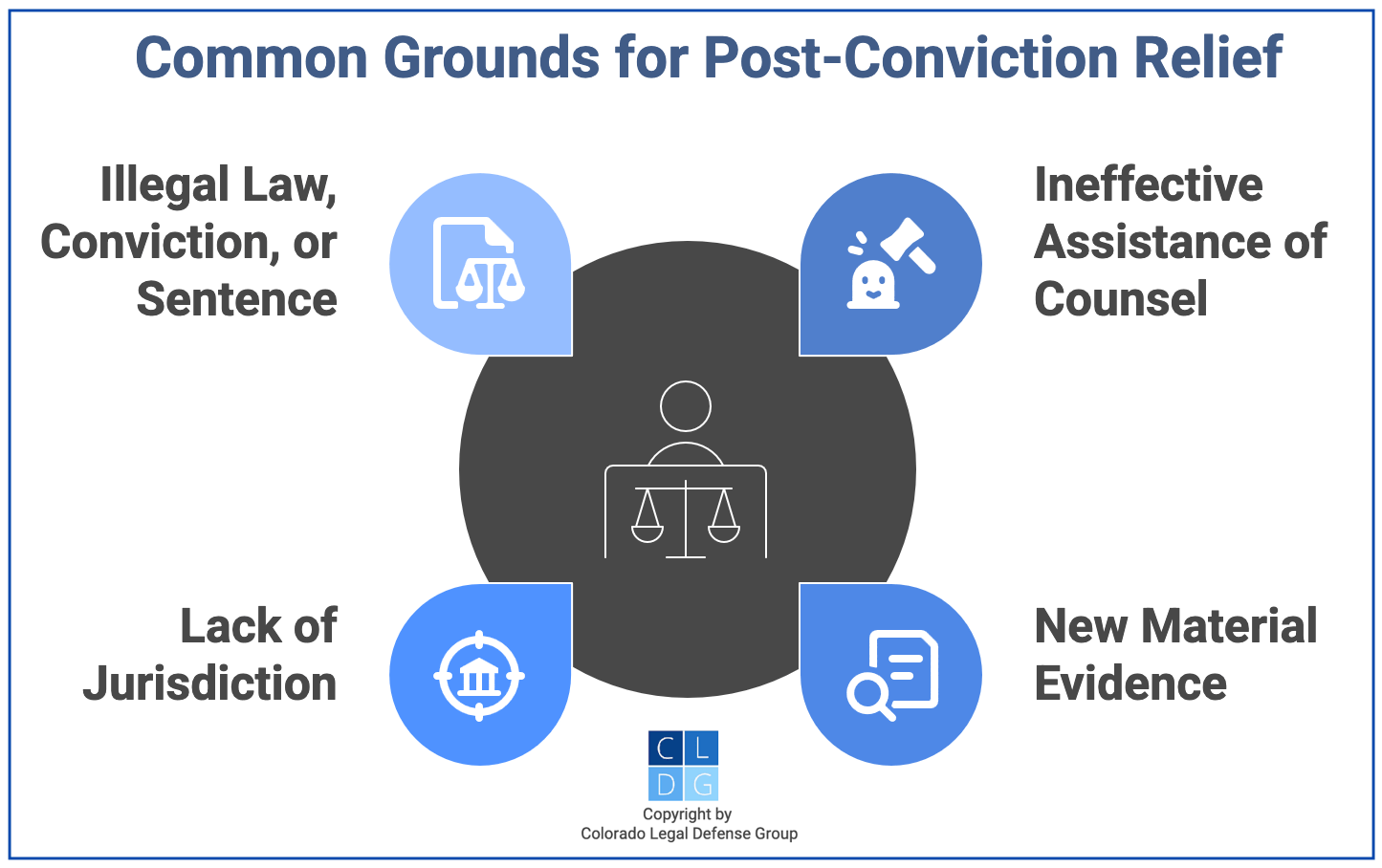
Seven common grounds for post-conviction relief under 35(c) in Colorado include:
- You were illegally convicted or sentenced;
- The statutory law under which you were convicted is illegal;
- Your conduct was legal;
- The court did not have authority (“jurisdiction”) over the case to make an adjudication;
- There is new evidence of “material facts” that could not have been reasonably discovered prior to the conviction;
- The sentence has already been fully served, or there has been an unlawful revocation of parole, probation, and/or conditional release; and/or
- “Collateral attacks” such as prosecutorial misconduct, judicial misconduct, or ineffective assistance of counsel by your private counsel or public defender.
Ineffective assistance of counsel does not mean your attorney was less than perfect. Instead, you just have to show:
- Your lawyer acted in a way that was objectively substandard and therefore denied you the constitutional right to a lawyer, and
- Had a competent attorney represented you, there is a reasonable probability your case would have turned out differently.3
3. Filing Late
If the time limit to file a 35(c) motion has passed in Colorado, you may still be able to bring a 35(c) motion if any of the following excuses is true:
- The court that convicted you did not have jurisdiction over you or your case; and/or
- You missed the filing deadline because you were adjudicated incompetent or were in institutionalized treatment for the mentally ill; and/or
- The circumstances that caused you to miss the filing deadline amounted to “justifiable excuse or excusable neglect.”4
4. How to File
You (or your Denver criminal defense attorney) must fill out the Colorado post-conviction relief form. It is a four-page application, and you may need to attach extra pages explaining why your case requires judicial review. There is no fee to file a 35(c) motion in Colorado.
Finally, the motion needs to be filed with the appropriate court. Note that you must mention all the applicable grounds of relief in just one petition. With rare exceptions, courts will deny any subsequent 35(c) petitions if you could have presented the grounds previously.5
Note that once you file the form with the court, the clerk will send a copy of the 35(c) motion to the prosecuting attorney (unless the court immediately denies the motion).
5. How the Judge Decides
There is no way to be sure how a Colorado judge will rule on a 35(c) motion. The judge in the case has the discretion to grant a 35(c) petition if they believe doing so serves the “interests of justice.” Some of the factors the judge may consider include:
- whether the motion is timely;
- whether the motion states adequate factual or legal grounds for relief;
- whether the motion states legal grounds for relief that are meritorious;
- whether the motion states factual grounds that, if true, entitle you to relief; and
- whether the files and records of the case show to the satisfaction of the court that your factual allegations are true.
The judge has several options if the court finds that you are entitled to post-conviction relief. Depending on the case, the judge may vacate the judgment and/or grant a new trial. Or the judge could impose a new sentence and/or discharge you.
Remember, the burden of proof is on you to prove to the judge by a preponderance of the evidence that you are entitled to 35(c) relief. The state does not have to prove anything.6

There are strict time limits to file for post-conviction relief (except for class 1 felonies).
6. When the Judge Decides
If the Colorado judge decides to deny your 35(c) motion without a hearing, they will issue a written denial within a 63-day time period. If the judge wants to hold a hearing before deciding on the motion, the entire process takes longer.
First, the judge will order the prosecution to file a written response within 35 days. Next, you may file a written reply to the prosecution within 21 days.
Then, the court will hold a hearing where both sides may present arguments and evidence. Finally, the court will usually make a final decision within 63 days of the hearing.7
7. Other Forms of Post-Conviction Relief
Other Colorado post-conviction options you may pursue in addition to or instead of 35(c) motions include:
- Appeals: You may appeal a guilty verdict and/or sentencing to a higher court. No new trial is held; instead, the higher court reviews whether the lower court made any mistakes. The deadline to appeal is 35 days after the judgment.8 Note that you may also appeal the denial of a 35(c) motion.
- Motions for a new trial: If you believe you received an unfair trial, you may file a motion for a new trial. If the judge grants it, the verdict will be set aside and a new trial will be scheduled. The deadline to file 14 days after the verdict, unless new evidence surfaces.9
- 35(b) motions for reduction of sentence: If you believe your sentences were too harsh, you can file a motion for reconsideration. Depending on the strength of your arguments, the judge may impose laxer penalties. The deadline to file is 126 days after the sentencing.10
- 35(a) motion for correction of an illegal sentence: If your sentence was illegal (for example, the court did not have jurisdiction, or it was not authorized by law), you can bring a 35(a) motion asking the court to vacate or lessen it.11
- Federal writ of habeas corpus: This is similar to a 35(c) motion, but in federal court. The deadline to file is one year and 90 days after the Colorado Supreme Court denies your petition to appeal. However, this time limit is put on hold if you filed a 35(c) motion as well.12
There is nothing to lose and everything to gain by pursuing post-conviction relief, so you are encouraged to pursue every avenue possible.
8. Refiling After Denial
If your 35(c) petition is denied in Colorado, you can refile. However, the court will deny it unless it contains new information that was unknowable when the previous 35(c) motion was filed.13
9. Immigration Consequences
Legal aliens convicted of deportable offenses in Colorado might be able to stay in the U.S. if they can get their convictions vacated. Or they may be able to stay if they get their sentences substantially reduced so the conviction no longer qualifies as deportable.
Learn about the criminal defense of immigrants in Colorado.

You are advised to have an attorney compose your 35(c) motion.
Frequently Asked Questions
How long do I have to file for post-conviction relief after my conviction?
The time limit depends on your type of conviction. For Class 1 felonies, there’s no time limit. For other felonies, you have three years. For misdemeanors, you have 18 months, and for petty offenses, you have six months. The clock starts after your sentencing date, or after your appeal ends if you filed one.
What does “ineffective assistance of counsel” mean for post-conviction relief?
Ineffective assistance does not mean your lawyer was imperfect. You must prove two things: first, that your lawyer’s performance was objectively substandard and denied your constitutional right to proper representation, and second, that with a competent attorney, there is a reasonable chance your case would have had a different outcome.
Can I still file for post-conviction relief if I missed the deadline?
Yes, you may still be able to file if certain excuses apply. These include: the court lacked jurisdiction over you or your case, you missed the deadline due to being declared incompetent or institutionalized for mental illness, or the circumstances causing you to miss the deadline amounted to “justifiable excuse or excusable neglect.”
What happens after I file my post-conviction relief motion?
If the judge denies your motion without a hearing, you’ll receive a written denial within 63 days. If the judge wants a hearing, the prosecution has 35 days to respond, you have 21 days to reply, then a hearing is held where both sides present arguments. The court typically decides within 63 days after the hearing.
Additional Resources
If you or a loved one has been wrongly convicted, you can find further information here:
- Colorado Judicial Branch Self-Help: Post-Conviction Relief – Instructions and forms for seeking post-conviction relief.
- National Post-Conviction Project – Advocates for justice reform and assists individuals in post-conviction appeals.
- The Innocence Project – Works to exonerate wrongfully convicted individuals through DNA testing and reforms.
- The Exoneration Project – Provides free legal services to wrongfully convicted individuals seeking exoneration.
- A Just Cause – Supports wrongly accused and convicted individuals, focusing on advocacy and public awareness.
See our related article, Is there a petition for factual innocence in Colorado?
Legal References:
- C.R.S. § 18-1-410; Colorado Rules of Criminal Procedure 35(c).
- Colorado Rules of Criminal Procedure 37.
- Colorado Rules of Criminal Procedure 35(c)(2). Strickland v. Washington (1984) 466 U.S. 688.
- C.R.S. § 16-5-402(1). See also People v. Stovall (Colo.App. 2012) 284 P.3d 151.
- Criminal Procedure 35(c) (3)(VI-VII).
- Criminal Procedure 35(c) (3)(IV).
- Criminal Procedure 35(c) (3)(V).
- Colorado Rules of Criminal Procedure 37.
- Colorado Rules of Criminal Procedure 33.
- Colorado Rules of Criminal Procedure 35(b)(“The court may reduce the sentence provided that a motion for reduction of sentence is filed (1) within 126 days (18 weeks) after the sentence is imposed, or (2) within 126 days (18 weeks) after receipt by the court of a remittitur issued upon affirmance of the judgment or sentence or dismissal of the appeal, or (3) within 126 days (18 weeks) after entry of any order or judgment of the appellate court denying review or having the effect of upholding a judgment of conviction or sentence, or (4) at any time pursuant to a limited remand ordered by an appellate court in its discretion during the pendency of a direct appeal. The court may, after considering the motion and supporting documents, if any, deny the motion without a hearing. The court may reduce a sentence on its own initiative within any of the above periods of time.”).
- Colorado Rules of Criminal Procedure 35(a) (“The court may correct a sentence that was not authorized by law or that was imposed without jurisdiction at any time and may correct a sentence imposed in an illegal manner within the time provided herein for the reduction of sentence.”).
- 28 U.S. Code § 2241.
- Colo. Rul. Crim. Proc. 35(c) (3)(VI-VII).