
Mandatory protection orders (MPOs) in Colorado are court orders that forbid a criminal defendant (“restrained person”) from harassing the alleged victims and witnesses (“protected parties”). Some MPOs prohibit you from contacting these people at all.
Mandatory protection orders are even more drastic in domestic violence cases because they can forbid you from seeing your family while the case is open.
Violation of a protective order is a crime separate and apart from the underlying case that gave rise to the MPO. A first-time MPO violation is a class 1 misdemeanor that carries up to 364 days in jail and/or $1,000 in fines.
Mandatory protection orders should not be confused with civil protection orders (CPOs) like TPOs, PPOs, and ERPOs, discussed later in this article.
Below our Denver criminal defense attorneys will address the following key issues regarding MPOs in Colorado:
- 1. Overview
- 2. Prohibitions
- 3. Duration
- 4. Modifying MPOs
- 5. Penalties
- 6. MPOs vs. CPOs
- Frequently Asked Questions
- Additional Resources
1. Overview
When you are charged with a crime in Colorado, the judge may issue a mandatory protection order (MPO) against you to protect the alleged crime victims and witnesses. The law explicitly prohibits:
- Harassment,
- Molestation,
- Acts meant to intimidate,
- Acts that retaliate against someone with evidence of the crime, and
- Tampering with witnesses.
MPOs are issued during your first court appearance, which is usually your arraignment for the underlying crime. At this point, the judge will inform you of your rights and will tell you not to interact with the alleged victims or witnesses.
Most judges make the mandatory protection order a part of your bail conditions. Violating the protection order breaks the terms of your bail and can lead to:
- stricter bail conditions,
- you remaining in custody during your case,
- additional criminal charges, and/or
- contempt of court.1
2. Prohibitions
The details of a mandatory protection order (MPO) depend on the facts of each Colorado case. Important factors are the crime you are charged with and your criminal background.
In many cases, an MPO prohibits all contact with the alleged crime’s victims and witnesses. In some cases, though, the terms of the order are more detailed and harsh.
People facing domestic violence charges have the harshest mandatory protection orders. The terms of these protection orders often forbid:
- Talking to your spouse, children, or relatives, even if they initiated the contact or consented to it,
- Interacting with relatives in any way, even over the internet, over the phone, through text message or email, or through social media such as Twitter, Instagram or Facebook,
- Indirectly contacting your spouse, children, or relatives, including sending them a message through a friend or leaving a message at their home, office, or vehicle,
- Going in or even near your marital home without law enforcement agency supervision,
- Going near your spouse, children, or relatives, including near their workplace, where they live, or where they often go,
- Getting a friend to harass the victim,
- Drinking alcohol,
- Using drugs,
- Possessing guns, ammunition, or other deadly weapons, and
- Committing any other crime.2
Example: Ralph has been accused of domestic violence. He has been ordered not to contact his girlfriend. He shows up at her doorstep with a bouquet of flowers to say he is sorry. He gets arrested for violating the MPO.
C.R.S. 18-1-1001 permits judges to issue MPOs.
3. Duration
In Colorado, mandatory protection orders remain in effect throughout the court process. They begin at your first court appearance and remain in effect until the case concludes. A case ends when:
- You complete your sentence following a trial verdict or plea deal, or
- The district attorney drops all the charges against you.3
4. Modifying MPOs
The terms of a mandatory protection order can be changed. You or your defense lawyer can request a change by filing a motion with the court.
The process for changing the terms of a mandatory protection order is formal. It must go through the court system and be approved by a judge to be effective.
Until the judge signs off on the motion requesting the change, the terms of the protection order remain in effect. It does not matter if you and the alleged victim can agree to ignore the terms of the order. If you do, you can still get arrested for violating it.
Note that the victim can also ask the judge that the MPO covers additional people not included in the original order, such as their family.4

Protection orders mandate “no contact” with the protected person.
5. Penalties
In Colorado, a first-time violation of an MPO is a class 1 misdemeanor carrying 364 days in jail and/or $1,000. A subsequent violation constitutes an extraordinary risk Class 1 misdemeanor, punishable by
- up to 18 months in jail and/or
- a $1,000 fine.
Note that if you also get convicted of the underlying crime that gave rise to the MPO, you would serve those two sentences consecutively (one after the other).
Also note that if the MPO was a condition of your bond, you also can be prosecuted for violating your bail conditions. The penalties depend on the crime you were originally charged with, as the following table shows.
| Underlying Charge |
Punishment for Violating Bail |
| Misdemeanor | Class 2 misdemeanor: Up to 120 days in jail and/or $750 |
| Felony | Class 6 felony: 12 to 18 months in jail and/or $1,000 to $100,000 |
Even if you are eventually acquitted of the original crime, you will still have to serve whatever sentence you received for violating your MPO and/or bail.5
6. MPOs vs. CPOs
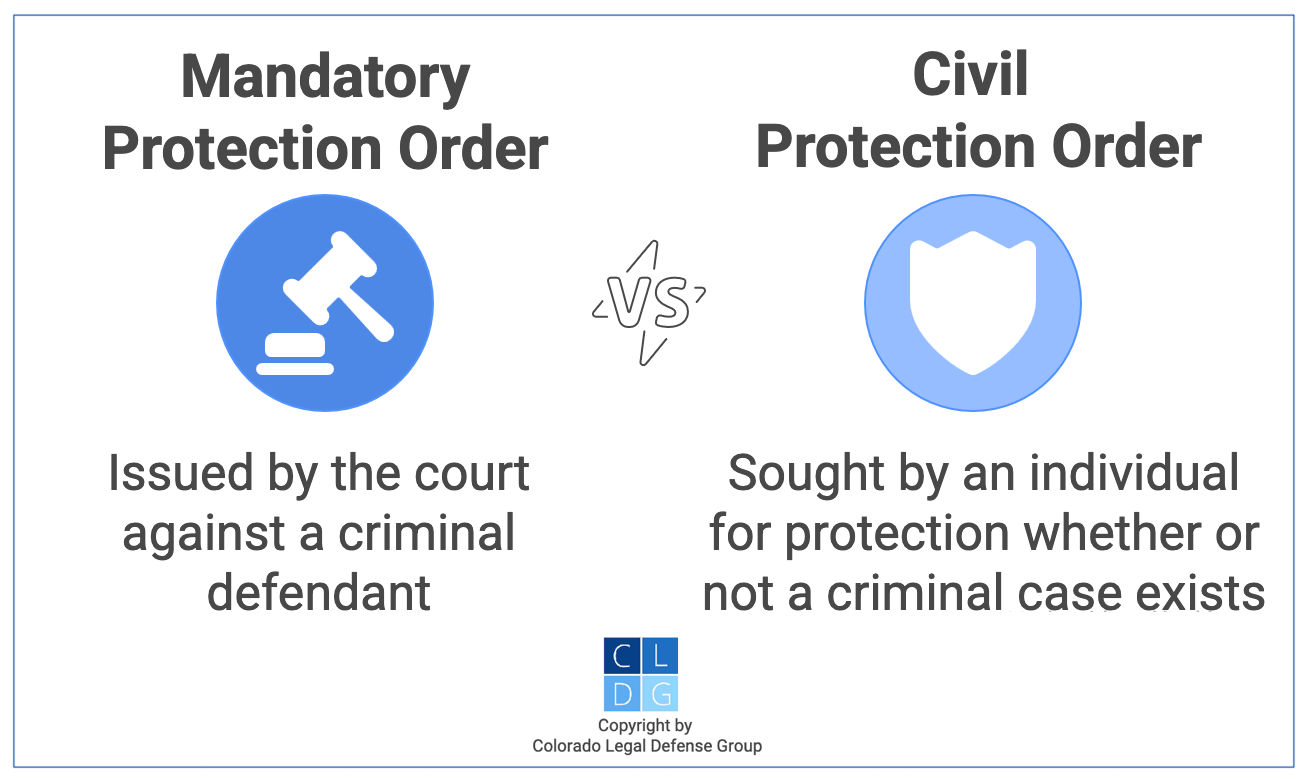
Mandatory protection orders are issued against individuals accused of committing a criminal offense, and the judge issues MPOs regardless of the victim’s desire. Meanwhile, civil protection orders CPOs get issued against people (“respondents”) accused of putting an intimate partner in danger, and the victims are the ones who ask the judge to issue them.
The subjects of mandatory protection orders are already facing criminal charges. That is why these orders are often referred to as “criminal protection orders.” Meanwhile, restraining orders can be issued to keep someone from committing a crime.
The goals of a protection order and a restraining order are different, too. Mandatory protection orders keep people with evidence of a crime safe. Restraining orders are intended to protect individuals in volatile living situations.
The following table compares and contrasts MPOs with the three types of CPOs:
| Mandatory Protection Order (MPO) | Temporary Protection Order (TPO) | Permanent Protection Order (PPO) | Extreme Risk Protection Order (ERPO) | |
| Purpose | Protect alleged victims in criminal cases | Provide immediate, short-term protection | Provide long-term protection | Temporarily remove firearms from individuals posing a significant risk |
| Duration | Throughout criminal proceedings | Up to 14 days | Indefinite, unless modified or terminated | 14 days, then up to 364 days, and can be renewed |
| How Obtained | Automatically issued in criminal cases | Petitioner files with court | After hearing, usually following a TPO | Law enforcement or family/household member petitions with an affidavit |
| Hearing Required | No | Ex parte (one-sided) hearing | Yes, both parties can present evidence | Ex parte (one-sided) for temporary order, full hearing for extended order |
| Who Can Request | N/A (court-issued) | Victim of domestic abuse, stalking, sexual assault, etc. | Same as TPO | Law enforcement, family (blood relatives and people related by marriage), and anyone who lived with the respondent in the past six months. |
| Main Restrictions | No contact, stay away from victim | No contact, stay away, temporary custody orders | Similar to TPO, can include counseling orders | Surrender of firearms and concealed carry permit |
| Modification | Can be modified by court | Can be extended or made permanent | Can be modified or terminated by court | Can be terminated early or extended |
| Penalties for Violation | Criminal charges, contempt of court | Criminal charges, contempt of court | Criminal charges, contempt of court | Criminal charges, contempt of court |
Note that the victim can ask courts for a civil protection order (CPO) even if a criminal MPO is already in place for the same case. Therefore, MPOs and CPOs can exist at the same time for the same matter.6

Judges issue an MPO whether or not the alleged victim asks for it.
Frequently Asked Questions
What happens if I accidentally contact someone protected by my mandatory protection order?
Even accidental contact or contact initiated by the protected person can result in criminal charges. Intent doesn’t matter – any violation of the MPO is a class 1 misdemeanor carrying up to 364 days in jail and/or $1,000 in fines. The order remains in effect until a judge officially modifies it.
How long does a mandatory protection order last in Colorado?
A mandatory protection order lasts throughout your entire criminal case. It begins at your first court appearance and remains in effect until you complete your sentence following a trial or plea deal, or until the district attorney drops all charges against you.
Can I ask the judge to change the terms of my mandatory protection order?
Yes, you or your lawyer can file a motion with the court to request changes to the MPO terms. However, the original order remains fully in effect until a judge officially approves any modifications. Even if you and the alleged victim agree to ignore the terms, you can still be arrested for violating the order.
What is the difference between a mandatory protection order and a restraining order?
A mandatory protection order (MPO) is automatically issued by a judge in criminal cases to protect alleged victims and witnesses. A civil protection order (restraining order) is requested by victims in civil court to protect them from future harm, even when no criminal charges exist. You can have both types of orders in place at the same time.
Additional Resources
Victims of domestic violence can find help and information here:
- Create a Safety Plan by the National Domestic Violence Hotline – Resource for domestic violence victims on how to create a “safety plan” to remain safe and escape abuse because having an MPO or civil protection order in place is not enough.
- DomesticShelters.org – Directory of domestic violence shelters.
- National Coalition Against Domestic Violence – Resources and information for victims.
- Resources for Family Members, Friends, and Supporters – Joyful Heart Foundation – A guide on how to help family members or loved ones suffering from domestic abuse.
- Signs of Abuse – National Coalition Against Domestic Violence (NCADV) – Information page on how to identify domestic violence.
Legal Citations:
- Colorado Revised Statute § 18-1-1001.
- Same. Note that federal law prohibits people subject to a domestic violence restraining order from possessing firearms or ammunition. 18 U.S.C. § 922(g)(8).
- People v. Sterns (Colo.App. 2013) 318 P.3d 535.
- See note 1. People v. Manzanares (Colo.App. 2025) No. 22CA1024.
- C.R.S. § 18-8-212. C.R.S. § 18-6-803.5(2)(c). See also People v. Delfeld (Colo.App. 2021) 503 P.3d 902.
- People v. Brockelman (Colo.App. 1993) 862 P.2d 1040.