
Colorado Revised Statute § 16-3-201 allows you to make a citizen’s arrest if you actually witness the crime taking place. Making an unlawful citizen’s arrest could result in criminal charges for
- First-degree assault,
- Second-degree assault,
- False imprisonment,
- Kidnapping,
- Impersonating a peace officer, and/or
- Obstruction.
You could also face a civil lawsuit by the arrested person.
Examples
- Jim sees Jerry grab an old lady’s purse. Jim tackles Jerry and throws him to the ground. This is a legal arrest because Jim saw the robbery.
- Frank sees a commotion in a store. Someone says a man is robbing the store, so Frank tackles him. This too is a legal arrest because the robbery was ongoing at the time of the arrest.
Citizen’s arrests are largely a relic of the old Wild West when it was up to ordinary civilians to uphold the law in remote areas, but they still happen.
In this article, our Denver criminal defense attorneys will address the following key issues regarding citizen’s arrest laws in Colorado:
- 1. Overview
- 2. Defenses
- 3. Penalties
- 4. Good Samaritan Reimbursement Law
- 5. Related Offenses
- Frequently Asked Questions
- Additional Reading
1. Overview
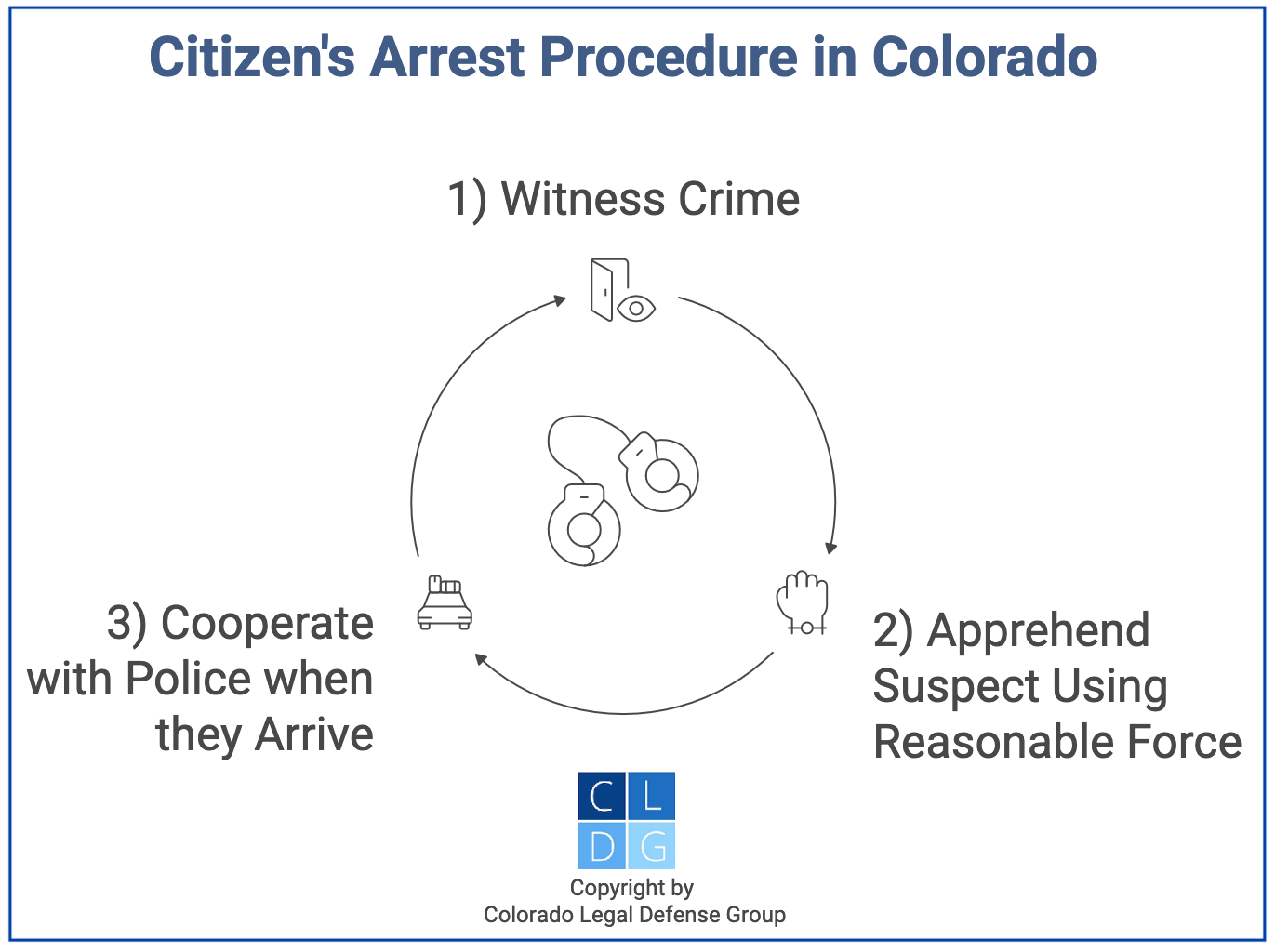
Colorado Revised Statutes 16-3-201 expressly allows you, as a private citizen, to make a citizen’s arrest if a crime happens in your presence. You can use reasonable force while making this arrest.
The law also immunizes you from criminal charges and civil liability that would typically follow from the force you used to make the arrest.
Public policy relies on “Good Samaritans” enforcing the law when peace officers cannot. If not for civil immunity, people may be too afraid to make a citizen’s arrest due to the risk of lawsuits.

Citizen’s arrests are a common law concept going back several hundreds of years.
“In the Presence of the Citizen” Meaning
C.R.S. 16-3-201 allows you to make a citizen’s arrest only if a crime was committed in your presence. A crime is considered to be in your presence if you can directly see or sense it.
Colorado courts have clarified that ‘in your presence’ does not require you to witness every single element of the crime from start to finish. However, the conduct you do observe must be legally sufficient to indicate to a reasonable person that a crime is currently in progress.
It is also in your presence if there is probable cause to suggest the crime is ongoing or just completed. Or as the Colorado Supreme Court stated, “The ‘in presence’ requirement is met if the arrestor observes acts which are in themselves sufficiently indicative of a crime in the course of commission.”1
Example: David is in the lobby of a police station. Ray gets away from the police and runs, which is a Colorado crime. David hears someone yelling “stop that man!” and tackles him in a fight. This is a lawful citizen’s arrest.2
You cannot make a citizen’s arrest if the crime happened outside of your presence:
Example: Ken and his son learn that their neighbor sells controlled substances. They break into his apartment, put handcuffs on him, and bring him to the police. This is an illegal citizen’s arrest because Ken and his son did not witness the drug sale.3
In sum, to meet the legal threshold for a valid arrest, you must have probable cause (which is the same threshold as the police). This means you must observe specific acts that are sufficiently indicative of a crime being committed at that very moment—such as witnessing a physical battery in a bar—rather than acting on a vague hunch or a report from a third party.
Off-Duty Police Officers
Off-duty police officers are private citizens and can therefore make citizen’s arrests in any jurisdiction.
Example: Ralph is an undercover peace officer with the Boulder Police Department. He arrests a store owner for buying stolen items. Ralph does not realize that the store is 12 feet over the town line. The arrest is a citizen’s arrest under C.R.S. 16-3-201 because it is outside his jurisdiction.4
How Much Force Can Be Used
To make a citizen’s arrest in Colorado, you may use non-deadly force that is appropriate to the situation. It cannot be more than what is reasonably necessary to make the arrest or prevent an escape.
The only time you can use deadly force to make a citizen’s arrest is if you reasonably believe it is necessary to defend yourself or someone else from deadly harm.
Example: David is standing in the lobby of the police station when Ray runs past. David hears someone shout “stop that man!” Rather than running after Ray, David draws a pistol and shoots him. David’s citizen’s arrest used excessive force, and David can be prosecuted.
Note that if you use excessive force while making a citizen’s arrest, the arrestee has the right to fight back in reasonable self-defense.5

Self-defense is a defense to C.R.S. 16-3-201 allegations.
2. Defenses
In our experience at Colorado Legal Defense Group, the following three defenses can be very effective at fighting allegations of an unlawful citizen’s arrest.
1) You Acted Out of Necessity
To prove a defense of necessity, you have to show that the wrongful citizen’s arrest was only to prevent a worse thing from happening. This requires evidence that demonstrates:
- There was a risk of imminent harm that you did not cause,
- You acted to prevent that harm, and
- You had no other legal options.6
2) You Acted in Self-Defense or the Defense of Someone Else
A wrongful citizen’s arrest is justified if done in lawful self-defense or defense of others. Proving this requires evidence that:
- You reasonably thought the person was about to use unlawful force, and
- You used only as much force as reasonably necessary to protect against that force.
When determining whether self-defense is justified, jurors are instructed to look at the totality of the circumstances and consider what a reasonable person would do in the same situation.7
3) You Were Helping a Police Officer
A police officer can command you to help make an arrest under C.R.S. 16-3-202. When this happens, you are immune to a criminal charge or civil lawsuit for following the police’s direction.8
Note that the city of Denver has an ordinance requiring people to aid police officers.9
3. Penalties
There are no penalties specifically for violating C.R.S. 16-3-201 and making a wrongful citizen’s arrest. However, other criminal charges can be filed against you for an incorrect citizen’s arrest.
The penalties for these criminal charges can be significant. They can include thousands of dollars in fines and years in jail.
Example: George punches Mike during a citizen’s arrest for a robbery. However, the crime was not committed in George’s presence. Therefore, George gets charged with first-degree assault and false imprisonment.
If a wrongly arrested person files a civil lawsuit against you, you may have to pay thousands of dollars in compensation, as well.

Unlawful citizen’s arrests may result in criminal charges for assault, false imprisonment, or kidnapping.
4. Good Samaritan Reimbursement Law
Even though a lawful citizen’s arrests immunizes you from civil liability in Colorado, you can still be sued.
However, if you are sued but then win your case, C.R.S. 16-3-203 requires that you be reimbursed for your court costs and reasonable attorney fees. This helps deter potential bad-faith claimants from filing a lawsuit against you.10
Furthermore, under C.R.S. 16-3-202, Colorado law provides “good faith” immunity for those who assist the legal system. This means that even if you do not physically restrain someone, you are generally protected from civil liability for reporting a crime or providing information to the police to help prevent a criminal act, provided you act in good faith.
5. Related Offenses
Violating C.R.S. 16-3-201 often comes with other criminal charges related to the wrongful arrest.
First-Degree Assault
First-degree assault (C.R.S. 18-3-202) makes it illegal to intentionally and seriously hurt someone.
Making a citizen’s arrest is something you do intentionally. Therefore, any serious injuries you inflict during the arrest can amount to assault in the first degree.
Also see our article on menacing (C.R.S. 18-3-206), a.k.a. battery.
Second-Degree Assault
Second-degree assault (C.R.S. 18-3-203) makes it illegal to hurt someone intentionally. Unlike assault in the first degree, though, it does not involve serious injuries.
Therefore if you hurt the person you were trying to arrest, you can face second-degree assault charges if the injuries you caused were not serious.
False Imprisonment
False imprisonment (C.R.S. 18-3-303) makes it illegal to detain someone without their consent. If you trap, hold down, or detain the person you were arresting, it can lead to a charge of false imprisonment.
Example: Ken and his son wrongly arrest their neighbor for a robbery. After breaking into the neighbor’s apartment and handcuffing him, they decide to wait for the police to arrive. Ken and his son committed a false arrest.
Kidnapping
Colorado’s laws against kidnapping (C.R.S. 18-3-301 and C.R.S. 18-3-302) are similar to false imprisonment laws. However, kidnapping makes it illegal to detain and then move someone without their consent.
Example: Ken and his son conduct a wrongful citizen’s arrest on their neighbor. They break into his apartment and handcuff him. Then they force him into their car and bring him to the police.
An arrest may also be justified under the “choice of evils” defense under C.R.S. 18-1-702. This doctrine argues that while detaining someone against their will is technically a crime, your actions may be excused if the arrest was necessary to prevent a “greater evil,” such as allowing a violent offender to escape into a crowded area.
Impersonating a Peace Officer
If you make a citizen’s arrest, you can be charged with impersonating a peace officer (C.R.S. 18-8-112) if you falsely pretend to be the police. When making a citizen’s arrest, never identify yourself as a police officer or lead the suspect to believe you have official police authority. Doing so can result in felony charges for impersonation, regardless of whether the underlying arrest was lawful.
Refusing to Aid a Peace Officer
Under C.R.S. 18-8-104, if a known peace officer commands your assistance in making an arrest or preventing a crime, you are required to help. Refusing to aid a peace officer is a type of obstruction punishable as a class 1 petty offense in Colorado, though the law provides you with immunity from civil liability for any reasonable actions you take while following the officer’s command.

Non-deadly force is allowed when making a citizen’s arrest.
Frequently Asked Questions
Can I arrest someone if I did not see the crime happen myself?
No, you can only make a citizen’s arrest if you personally witness the crime happening or if there is clear evidence the crime is still ongoing. Making an arrest without witnessing the crime could result in serious criminal charges against you, including assault or kidnapping.
How much force am I allowed to use during a citizen’s arrest?
You can use reasonable, non-deadly force that is necessary to make the arrest or prevent escape. You can only use deadly force if you reasonably believe it is needed to protect yourself or others from death or serious harm. Using excessive force can lead to criminal charges.
What happens if I make an illegal citizen’s arrest?
You could face serious criminal charges including assault, false imprisonment, kidnapping, or impersonating a police officer. You could also be sued in civil court and have to pay thousands of dollars in damages to the person you wrongly arrested.
Do off-duty police officers follow the same citizen’s arrest rules?
Yes, when off-duty police officers are outside their jurisdiction, they must follow the same citizen’s arrest laws as regular citizens. They have no special arrest powers beyond what any private citizen has under Colorado law.
Additional Reading
For more in-depth information, refer to these scholarly articles:
- Citizen’s Arrest Doctrine: Enabling the Modern-Day Vigilante – LSU Law Journal for Social Justice & Policy.
- The Puzzling Persistence of Citizen’s Arrest Laws and the Need to Revisit Them – Howard Law Journal.
- Citizen’s Arrest and Race – Ohio State Journal of Criminal Law.
- Vilifying the Vigilante: A Narrowed Scope of Citizen’s Arrest – Cornell Journal of Law & Public Policy.
- Reporting Crimes and Arresting Criminals: Citizens’ Rights and Responsibilities Under Their Criminal Law – Criminal Law and Philosophy.
Legal References:
- C.R.S. 16-3-201 (“A person who is not a peace officer may arrest another person when any crime has been or is being committed by the arrested person in the presence of the person making the arrest.“). C.R.S. 16-3-203 (“Any person who is not a peace officer as defined in section 24-31-301 (5), C.R.S., who is made the defendant in any civil action as a result of having sought to prevent a crime being committed against any other person, and who has judgment entered in his favor shall be entitled to all his court costs and to reasonable attorney fees incurred in such action.”). People v. Olguin (1974) 528 P.2d 234.
- Same; Schiffner v. People (Colo. 1970) 476 P.2d 756.
- People v. Joyce (Colo. App. 2002) 68 P.3d 521.
- People v. Wolf (1981) 635 P.2d 213.
- C.R.S. 18-1-707(7) (“A private person acting on his own account is justified in using reasonable and appropriate physical force upon another person when and to the extent that he reasonably believes it necessary to effect an arrest, or to prevent the escape from custody of an arrested person who has committed an offense in his presence; but he is justified in using deadly physical force for the purpose only when he reasonably believes it necessary to defend himself or a third person from what he reasonably believes to be the use or imminent use of deadly physical force.”). C.R.S. 18-1-704.
- See C.R.S. 18-1-702 (“[A] person is justified in using physical force upon another person in order to defend himself or a third person from what he reasonably believes to be the use or imminent use of unlawful physical force by that other person, and he may use a degree of force which he reasonably believes to be necessary for that purpose.”). People v. Speer (2011) 255 P.3d 1115.
- People v. Ferrell (Colo. 1980) 613 P.2d 324.
- C.R.S. 16-3-202 (“(1) A peace officer making an arrest may command the assistance of any person who is in the vicinity. (2) A person commanded to assist a peace officer has the same authority to arrest as the officer who commands his assistance. (3) A person commanded to assist a peace officer in making an arrest shall not be civilly or criminally liable for any reasonable conduct in aid of the officer or for any acts expressly directed by the officer. (4) Private citizens, acting in good faith, shall be immune from any civil liability for reporting to any police officer or law enforcement authority the commission or suspected commission of any crime or for giving other information to aid in the prevention of any crime.”).
- Denver Code of Ordinances Revised Municipal 38-38. Duty of citizens to aid police officers (“It shall be the duty of all persons, when called upon by any police officer, member of the police department, or person duly empowered with police authority, promptly to aid and assist such officer, member or person in the discharge of their duties.”). Note that C.R.S. 18-8-107 (Refusing to aid a peace officer) is repealed as of March 1, 2022. SB21-271.
- C.R.S. 16-3-203.