
Wrongful termination in violation of the California Fair Employment and Housing Act (the “FEHA”) occurs when an employer fires or otherwise retaliates against an employee who:
- Opposes workplace harassment, employment discrimination, or an employer’s failure to grant required pregnancy/family leave;
- Files a complaint about harassment or discrimination;
- Testifies or assists in any proceeding under the FEHA;1 or
- Requests workplace accommodations for their religious beliefs or observance or for a disability.2
Under California employment law, FEHA wrongful termination or retaliation can be the basis for a lawsuit against your employer. It is a form of public policy wrongful termination.
Examples
Below are several examples of employees who might be able to sue their employers for wrongful termination/workplace retaliation in violation of the FEHA:
- Christina reports sexual harassment at the hands of a supervisor, whom she reports. The supervisor then fabricates a negative performance review and uses that as a basis to have Christina fired.
- Sergio is a witness in a workplace harassment lawsuit against his employer for national origin harassment. Several weeks later, he is “laid off.”
- Lu asks her supervisor if he can avoid assigning her to shifts on Saturdays because that is when she observes the Sabbath. Days later, she is told that her employment is “not working out” and is fired.
What if I am a victim of FEHA retaliation?
If your employer terminates or otherwise retaliates against you for engaging in activities protected by the FEHA, there are three steps you can take:
- If you are still employed, report the employer’s action of retaliation to a supervisor or your employer’s human resources department.
- File a complaint with the California Civil Rights Department (CRD).
- After receiving a “right to sue” notice from CRD, file a FEHA wrongful termination / retaliation lawsuit against your employer.
In this article, our California labor and employment lawyers will address the following key topics:
- 1. FEHA Retaliation
- 2. How Employers Fight Back
- 3. Filing a Complaint
- 4. Statute of Limitations
- 5. Damages
- Frequently Asked Questions
- Additional Reading
1. FEHA Retaliation
California’s Fair Employment and Housing Act–the state’s main law prohibiting workplace harassment and employment discrimination–specifically prohibits employers from retaliating against employees for exercising their rights under the FEHA.3
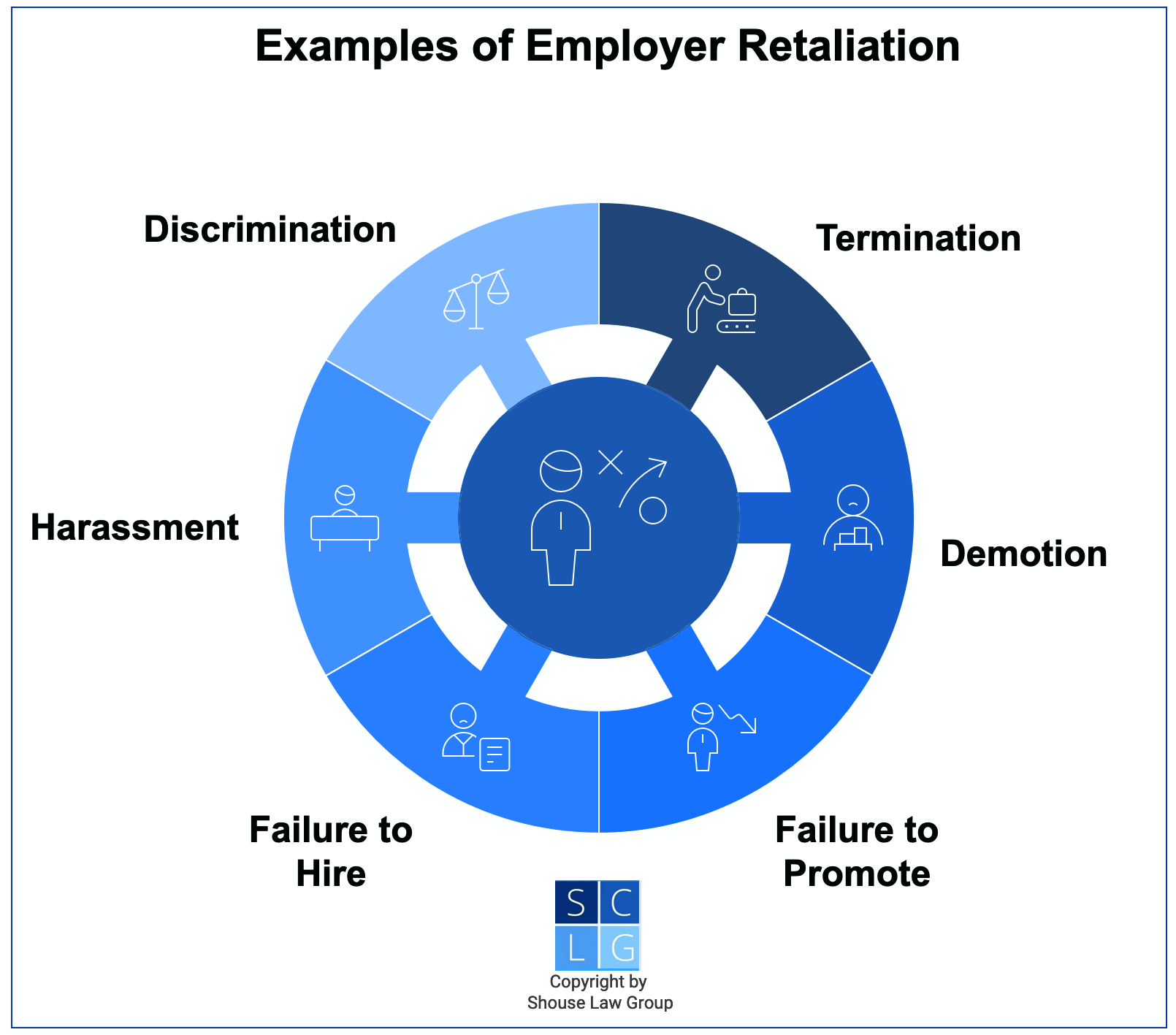
Such retaliation may consist of wrongful termination (such as firing the employee), but it can also consist of less extreme measures, such as:
- demoting the employee,
- writing up the employee unfairly,
- reducing his/her pay,
- giving him/her less desirable work assignments, or
- even mistreatment that rises to the level of wrongful constructive termination.
The legal definition of FEHA retaliation under California employment law has four main “elements”:
- An employee engaged in a protected activity under the FEHA;
- His/her employer discharged, demoted, constructively terminated or otherwise took an adverse employment action against the employee;
- The employee’s FEHA-protected activity was a substantial motivating reason for the adverse employment action; and
- The adverse employment action was a substantial factor in causing harm to the employee.4
Below we take a closer look at these four components of the FEHA’s wrongful termination definition.

Employers may not fire employees who file a complaint about harassment or discrimination.
Element 1: Protected Activity
In order to have a claim against your employer for FEHA wrongful termination or retaliation, you must have engaged in an activity that is protected by the FEHA.5
The major FEHA-protected activities are:
Opposing Harassment/Discrimination or Failure to Grant Pregnancy Leave
Your employer may not terminate or retaliate against you for opposing any practice by an employer that is forbidden under the FEHA.6
This includes:
- Workplace harassment (either sexual harassment or non-sexual harassment on the basis of protected characteristics such as race, religion, disability, national origin, sexual orientation, age, gender identity/expression, genetic information, marital status, medical condition, breastfeeding, reproductive health decision-making, and off-duty cannabis use);7
- Employment discrimination by a covered employer (typically those with 5 or more employees) on the basis of protected characteristics;8 and
- Failure by a covered employer to meet its obligations to provide pregnancy leave and family leave under the California Family Rights Act and the California Pregnancy Disability Leave Law.9
Opposing this kind of FEHA-prohibited practice may mean any of the following:
- Seeking the advice of a state agency about a possible harassment or discrimination situation;
- Assisting or advising another person who is seeking the advice of a state agency;
- Opposing employment practices that you reasonably believe to exist and believe to be a violation of the FEHA;
- Participating in an activity that the employer perceives as opposition to discrimination/harassment; or
- Contacting or communicating with a local human rights agency about activity you believe to be harassment or discrimination.10
Example: The owner of a company tells his HR director Corinne to lie to a pregnant employee and tell her that she is not eligible for pregnancy leave. Corinne refuses to do this. As a result, the company owner fires her.
Corinne has experienced FEHA wrongful termination for opposing a practice forbidden by the FEHA.
What if you oppose conduct at your employer that you believe is illegal harassment or discrimination–but it later turns out you are wrong?
Suppose your employer retaliated against you on this basis. In that case, it is still unlawful FEHA retaliation–as long as you reasonably and in good faith believed that what you were opposing met the definition of harassment or discrimination.11
Example: Paul reasonably believes his supervisor is committing sexual orientation harassment against him, and Paul complains to HR. The harassing behavior stops, but the supervisor starts assigning him to shifts which allow him to earn little in tips.
Even if the supervisor’s behavior did not quite meet the stringent definition of sexual orientation harassment under the FEHA, Paul still may have a case against his employer for his supervisor’s unlawful FEHA retaliation.
Filing a Workplace Harassment/Employment Discrimination Complaint
It is also against the law for your employer to terminate or retaliate against you for filing a complaint about:
- harassment,
- discrimination or
- other unlawful employment practices
with the Civil Rights Department (CRD).12
Filing such a complaint is typically one of the first steps a California employee can take when s/he is the victim of harassment/discrimination in the workplace.
(Retaliation for this FEHA-protected activity is essentially a form of whistleblower retaliation under California law.)
Assisting in a FEHA Proceeding
Another form of FEHA-protected activity for which your employer may not retaliate against you is assisting in any proceeding under the FEHA.13
This can mean either:
- an investigation of your employer for potential FEHA violations by the CRD or another state agency, or
- a lawsuit arising out of alleged FEHA violations.
Example: Miguel’s co-worker Rachel sues the company they work for, alleging that she was sexually harassed. After Miguel agrees to testify as a witness, Miguel is fired from his job.
Miguel may have been wrongfully terminated for participating in a proceeding under the FEHA.

Wrongfully fired employees may be able to sue for lost wages and pain and suffering.
Reasonable Accommodations Requests
California’s FEHA retaliation law also specifies that is illegal for your employer to terminate or retaliate against you in any way for:
- Requesting reasonable accommodations for your religious beliefs or observance; or
- Requesting reasonable accommodations for a physical or mental disability.14
FEHA wrongful termination or retaliation in response to a reasonable accommodations request is illegal regardless of whether your employer chose to provide the accommodation.15
Example: Max asks his supervisor if he can be excused from interviewing job candidates because of his autism-related problems with social interactions. The company agrees but then fires him.
The company may have terminated Max because of his request for accommodations for his disability–which could mean that Max can sue under the FEHA for wrongful termination.
Element 2: Adverse Action
In order for you to have a case against your employer for FEHA retaliation, your employer needs to have taken an “adverse action” against you.
An adverse action does NOT have to be as serious or final as the loss of your job or a demotion.
Instead, an adverse action is any pattern of behavior that materially and adversely affects the terms, conditions and privileges of your employment–for example, by impairing your:
- ability to do your job effectively, or
- prospects for advancement or promotion.16
This pattern of behavior might consist of a series of acts that, individually, would not be enough to constitute retaliation — but that, when taken as a whole, add up to unlawful FEHA retaliation.17
However, minor or trivial behavior that is likely only to anger or upset you–but is not likely to affect your job prospects or performance–does not count as an “adverse action” for purposes of FEHA retaliation law.18
Who can commit an adverse action?
In most FEHA retaliation cases, the adverse employment action is committed by a supervisor with authority over you.
In some cases, you can sue your employer for FEHA retaliation even if coworkers rather than supervisors took the actions against you.
For coworker behavior to give rise to a case of retaliation or constructive termination in violation of the FEHA, it also needs to be the case that a supervisor knew about the coworkers’ retaliatory behavior and either
- participated in or encouraged it, or
- failed to take reasonable action to stop it.19
Elements 3 & 4: Causal Connection & Harm
One of the most challenging aspects of a FEHA wrongful termination or retaliation lawsuit is the requirement that you show a causal link between:
- your FEHA protected activities, and
- the adverse employment action that your employer took against you, which in turn harmed you.
In order to show that you were the victim of FEHA retaliation or wrongful termination, you need to be able to show that your protected activities were a “substantial motivating reason” for the actions that were taken against you.20
“Substantial motivating reason” means a non-remote, non-trivial reason that actually contributed to the decision to take an adverse action against you. It does not mean that your FEHA-protected activities need to be the only reason for the adverse action.21
Circumstantial evidence, such as proximity in time between your FEHA-protected activities and the adverse employment actions, can be used to show the necessary causal connection.22
Example: After Bill – a teacher – assists a fellow teacher with filing a race-based discrimination complaint with CRD, the principal decides not to renew Bill’s contract.
It is possible that Bill’s involvement in the CRD investigation was not the only reason for his termination. But the timing of his firing suggests that it could have been a substantial motivating reason–and thus he could be the victim of wrongful termination for FEHA-protected activities.
A recent California law, the Equal Pay and Anti-Retaliation Protection Act (SB 497), has made it significantly easier for employees to prove a causal link. Under this law, if your employer fires, demotes, or takes other adverse action against you within 90 days of you engaging in a protected activity, the court presumes that the action was retaliatory.
This shifts the “burden of proof” onto the employer. Instead of you having to prove the firing was illegal, your employer must prove they had a legitimate, non-retaliatory reason for the discipline. This “rebuttable presumption” gives you a powerful advantage in settlement negotiations and trial if the retaliation happened quickly after your complaint.23

Employers may try to defend themselves by arguing that the fired employee committed severe misconduct.
2. How Employers Fight Back
Sometimes California employers try to defend against FEHA wrongful termination lawsuits with a defense known as “after-acquired evidence.”
The after-acquired evidence defense basically says that, after wrongfully terminating you for FEHA-protected activities, the employer discovered evidence of wrongdoing on your part that would have justified firing you anyway.
If this is truly the case, then you may not be able to collect damages from your employer for your termination in violation of the FEHA.
But in order for this defense to apply, the employer needs to show three things:
- You committed misconduct in connection with your job;
- The misconduct was severe enough that your employer would have terminated your employment because of that misconduct alone if s/he had known about it; and
- It would have been in keeping with settled company policy to discharge you for that conduct.24
In other words, after-acquired evidence will only limit your ability to collect damages in a FEHA wrongful termination suit if your misconduct was quite serious–such as:
- lying on your job application, or
- violating the law or important company policy on the job.
Subpar job performance is not enough.
3. Filing a Complaint
The process in California for taking legal action in response to FEHA wrongful termination or retaliation is the same as that for other FEHA violations such as:
- harassment or
- discrimination.
First, if the retaliation consists of adverse action at work (rather than termination), then you should strongly consider first discussing the issue with:
- a member of the human resources staff at your employer, or
- a supervisor other than the one who is retaliating against you.
This measure may lead to the reversal of the actions that have been taken against you.
CRD Complaint
But if you are unable to resolve the problem within your company, or if you have been terminated from your job in violation of the FEHA, then your next step is to file a complaint with the Civil Rights Department (CRD).
This step is required before an employee can file a lawsuit over FEHA wrongful termination or retaliation.25
CRD’s website offers an online form for submitting a retaliation complaint–or a pre-complaint inquiry for people who are not sure that they are ready to submit a full complaint.
Civil Lawsuit
When you file your FEHA termination/retaliation complaint with the CRD, as described above, you have two options:
- Request that CRD issue a “right to sue” notice immediately, or
- Decline to make such a request. In this case, CRD will still issue a “right to sue” notice–but only after they have conducted and completed an investigation of your retaliation complaint.
Whichever option you choose, you may file a lawsuit in California Superior Trial Court over FEHA retaliation only once you have received a “right to sue” notice from CRD.26
4. Statute of Limitations
In California, the deadline (statute of limitations) for filing a FEHA complaint is three years from the date of:
- your termination, or
- the retaliation against you.27
The statute of limitations for filing a FEHA wrongful termination or retaliation lawsuit is one year after the “right to sue” notice is issued to you by the CRD.28
5. Damages
There are several different types of financial damages that are available to California plaintiffs in wrongful termination suits–including FEHA wrongful termination suits.
Potential damages for a successful FEHA retaliation suit include:
- Lost wages and benefits–the lost pay and benefits that you could reasonably have expected to earn had you not been wrongfully terminated for FEHA-protected activities, minus amounts you actually earned from substantially similar employment after you were fired;29
- Damages for emotional distress/pain and suffering arising from the retaliation against you–including compensation for physical pain, mental suffering, loss of enjoyment of life, and anxiety;30
- Attorney’s fees–California law allows judges to award attorney’s fees to successful plaintiffs in FEHA retaliation suits;31 and
- Punitive damages–which are designed to punish the employer for its behavior and are only awarded in FEHA wrongful termination or retaliation cases where the employer’s behavior involved fraud, oppression or malice.
Frequently Asked Questions
What is the “90-day rule” for retaliation in California?
Under a new law (SB 497), if your employer fires or punishes you within 90 days of you engaging in a protected activity (like reporting harassment), the court automatically presumes the action was retaliatory. This shifts the burden of proof to the employer, who must then prove they had a legitimate, non-retaliatory reason for their actions.
How long do I have to file a FEHA retaliation lawsuit?
You generally have three years from the date of the retaliation or termination to file a complaint with the California Civil Rights Department (CRD). Once the CRD issues a “right-to-sue” notice, you have one year from that date to file your lawsuit in civil court.
Can I sue for retaliation if I am still employed?
Yes. You do not have to be fired to sue. “Adverse actions” can include demotions, unfair performance reviews, pay cuts, or even a hostile work environment. If these actions materially affect your job performance or advancement opportunities, you may have a valid claim.
What damages can I recover in a FEHA retaliation case?
If you win your case, you may be entitled to recover lost wages (back pay) and benefits, damages for emotional distress (pain and suffering), and attorney’s fees. In cases where the employer acted with malice, oppression, or fraud, you may also be awarded punitive damages.
Additional Reading
For more in-depth information, refer to the following scholarly articles:
- Employment Discrimination and Wrongful Discharge: Does the California Fair Employment and Housing Act Displace Common Law Remedies – University of San Francisco Law Review.
- Working 9 to Non-Stop: The Fair Housing Act’s Sexual Harassment Protections for Domestic, Agricultural, and Other Live-in Workers – Columbia Journal of Gender & Law.
- Romano v. Rockwell International: A Study in Undermining Federal Authority, Statutory Clarity, and the Function of the Department of Fair Employment and Housing in the Fight against Employment Discrimination – UC Davis Law Review.
- California Employment Discrimination Law and its Enforcement: The Fair Employment and Housing Act at 50 – UCLA Law Center for Law and Public Policy.
Legal References:
- Government Code 12940 GC.
- Government Code 12940 GC.
- Government Code 12940 GC.
- Judicial Council of California Civil Jury Instructions (“CACI”) 2505 — [FEHA] Retaliation—Essential Factual Elements (Gov. Code, § 12940(h)).
- Same.
- Government Code 12940 GC.
- Government Code 12940(j) GC.
- Government Code 12940(a) GC.
- Government Code 12945 GC — Pregnancy Disability Act; Government Code 12945.2 GC — Family Rights Act.
- California Code of Regulations (CCR) tit. 2, § 11021.
- Miller v. Department of Corr. (California Supreme Court, 2005) 36 Cal.4th 446, 473-74. (“[U]nder certain circumstances, a [FEHA] retaliation claim may be brought by an employee who has complained of or opposed conduct, even when a court or jury subsequently determines the conduct actually was not prohibited by the FEHA. Indeed, this precept is well settled. An employee is protected against retaliation if the employee reasonably and in good faith believed that what he or she was opposing constituted unlawful employer conduct such as sexual harassment or sexual discrimination.”)
- Government Code 12940 GC.
- Same.
- Government Code 12940 GC.
- Same.
- CACI 2509 — “Adverse Employment Action” Explained. See also Bailey v. San Francisco District Attorney’s Office (2024) 16 Cal.5th 611.
- CACI 2509 (“For example, the case may involve a pattern of employer harassment consisting of acts that might not individually be sufficient to constitute discrimination or retaliation, but taken as a whole establish prohibited conduct.”)
- CACI 2509.
- Kelley v. The Conco Cos. (California Court of Appeal, 2011) 196 Cal.App.4th 191, 214. (“We therefore hold that an employer may be held liable for coworker retaliatory conduct [under the FEHA] if the employer knew or should have known of coworker retaliatory conduct and either participated and encouraged the conduct, or failed to take reasonable actions to end the retaliatory conduct.”)
- CACI 2505 — [FEHA] Retaliation—Essential Factual Elements (Gov. Code, § 12940(h)). See Yanowitz v. L’Oreal USA, Inc. (2005) 36 Cal. 4th 1028, 1042.
- CACI 2507 — “Substantial Motivating Reason” [for FEHA retaliation] Explained. (“A “substantial motivating reason” is a reason that actually contributed to the [specify adverse employment action]. It must be more than a remote or trivial reason. It does not have to be the only reason motivating the [adverse employment action].”)
- Colarossi v. Coty US Inc. (2002) 97 Cal.App.4th 1142, 1153. (“Both direct and circumstantial evidence can be used to show an employer’s intent to retaliate [in violation of the FEHA]. ‘Direct evidence of retaliation may consist of remarks made by decisionmakers displaying a retaliatory motive.’ Circumstantial evidence typically relates to such factors as the plaintiff’s job performance, the timing of events, and how the plaintiff was treated in comparison to other workers.”)
- SB 497 (2024).
- CACI 2506 — Limitation on Remedies [in FEHA wrongful termination suits]—After-Acquired Evidence.
- Government Code 12965 GC.
- Same. See also Government Code 12963 GC.
- Government Code 12960 GC; California Assembly Bill 9 (2019).
- Government Code 12965 GC.
- CACI 2433 — Wrongful Discharge in Violation of Public Policy [including FEHA wrongful termination]—Damages.
- Same.
- Government Code 12965(b) GC.
- Civil Code 3294 CC.