
In California, constructive termination is when your employer intentionally creates or knowingly permits such intolerable working conditions that you reasonably feel no choice but to resign. You can then bring a wrongful termination claim against the employer as long as they had no right to fire you.1
Unpleasant workplace conditions alone are insufficient to prove constructive discharge. Examples of what can lead to a constructive discharge include:
- repeatedly yelling at, bullying, verbally harassing, or otherwise mistreating you,
- making ongoing disparaging comments or intimidating remarks to you,
- reducing your job responsibilities or demoting you without cause,
- subjecting you to unreasonable performance evaluations,
- putting you at risk of workplace injury, or
- harassing you or discriminating against you due to a protected characteristic, such as your race, sex, age, or disability.
Constructive termination is also called constructive discharge or constructive dismissal.
In this article, our Los Angeles employment law attorneys will address the following key issues regarding wrongful constructive termination laws in California:
- 1. Suing After Resigning
- 2. “Constructive Termination” Meaning
- 3. When You Do Not Quit
- 4. At-Will Employees
- 5. Deadline to Sue
- 6. Unemployment Benefits
- 7. Protect Your Claim Before Resigning
- 8. California vs. Federal Protections
- Frequently Asked Questions
- Additional Resources
1. Suing After Resigning
You can sue your employer for wrongful termination if you resigned as long as you can show you were “constructively discharged.”2
In order to bring a successful “constructive discharge” claim against your employer in California, you need to be able to show two things:
- Your employer intentionally or knowingly created or permitted working conditions for you that were so intolerable that a reasonable employer would realize that a reasonable person in your position would have no choice but to resign;3 and
- Your employer did not have the legal right to fire you outright.4
Note that in some situations – especially at larger companies – your employer may be genuinely unaware of your intolerable working conditions. Therefore, you should notify your employer of what is going on before you attempt to sue.
If you sue, and the employer can show they did not know what you were going through, your constructive termination lawsuit will not succeed.
Money Damages
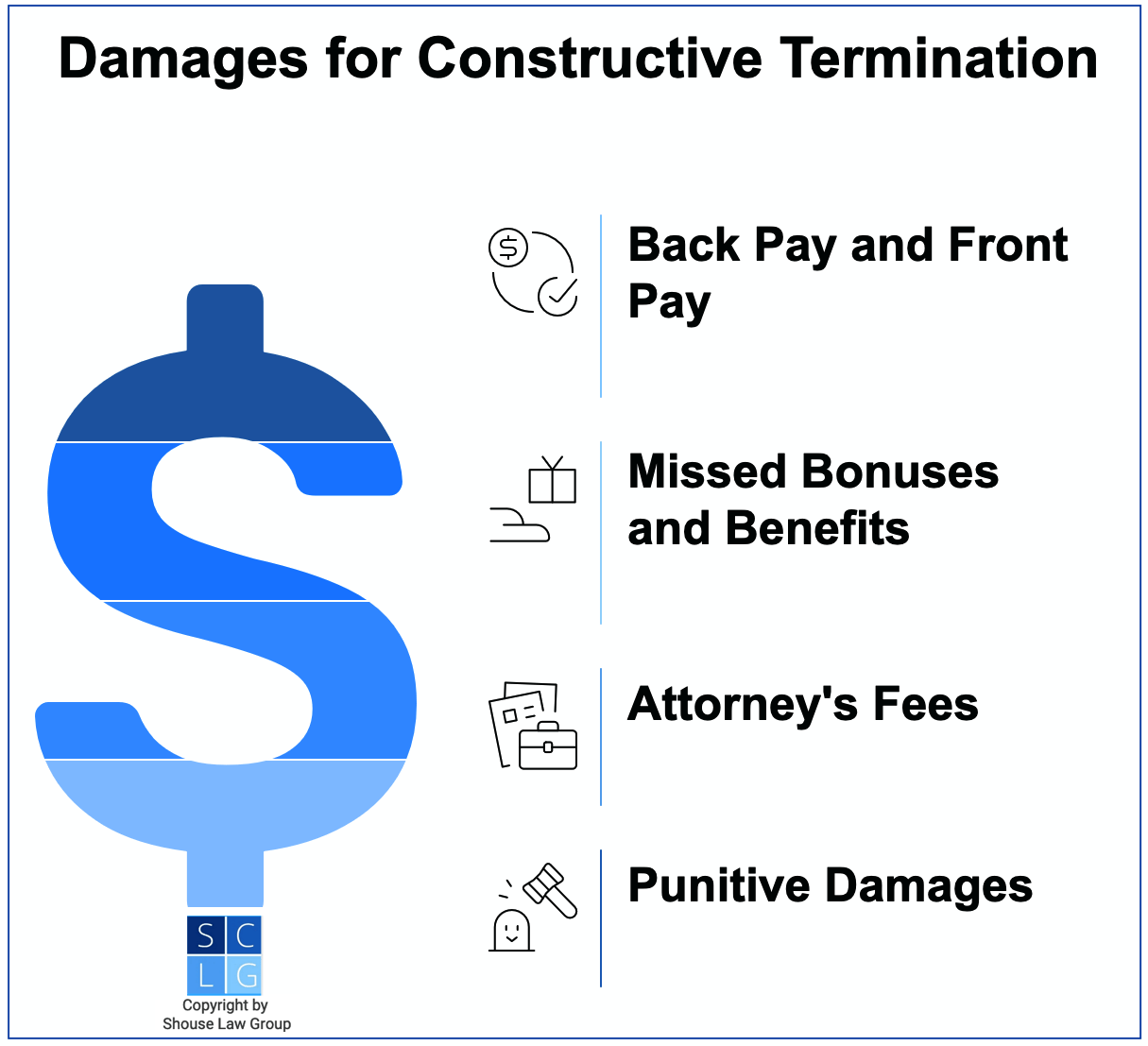
Depending on your constructive termination lawsuit, you may be able to recover such remedies as:
- back pay and front pay, plus interest,
- missed bonuses and benefits,
- attorney’s fees and damages, and/or
- punitive damages.

Employment lawyers can help wrongful constructive termination victims to file a lawsuit.
2. “Constructive Termination” Meaning
A constructive discharge claim can arise from an employer’s pattern of continuous harassment, discrimination, or clear hostility.5
Unpleasant working conditions or an isolated episode of maltreatment are not enough to constitute constructive discharge. Indeed, the conditions must be so bad that a reasonable employee would feel compelled to resign.6
Also, you have to prove that the employer either
- intentionally created the intolerable conditions or
- actually knew about them and permitted them to continue.
If the employer was unaware of the conditions, they are not liable. Where the employer is a company, this means that officers, directors, managing agents or supervisory employees need to have intended or known about the conditions.7
Constructive Termination Based on Protected Characteristics
FEHA (California’s Fair Employment and Housing Act) prohibits employers from terminating or otherwise discriminating against you based on “protected characteristics,” including your:
- gender,
- sexual orientation,
- nationality,
- ethnicity,
- color,
- age,
- disability (physical or mental),
- pregnancy,
- religion,
- creed,
- participation in an official investigation against your employer,
- any other criteria specified under federal or California law.8
If you believe you are being discriminated against based on a protected characteristic, try to compile and document all the evidence. Examples include work emails, memos, voicemails, and examples of you being treated differently from similar employees without your protected trait.
A firing, a demotion, or a cut in pay, benefits, or hours are all perfectly lawful unless the employer is doing it to discriminate against you. The more evidence you have of discrimination, the easier it will be to prove you were constructively terminated.
What Does Not Count as Constructive Termination
While many negative workplace experiences feel unfair, California courts have set a high bar for what qualifies as “intolerable.” Isolated incidents or standard management decisions rarely meet this legal standard on their own.
For example, the following actions generally do not constitute constructive discharge unless they are part of a larger pattern of harassment or discrimination:
- A single negative performance review: Receiving a poor evaluation, even if you disagree with it, is usually considered a standard employment dispute.
- Demotion or pay cuts: A reduction in rank, pay, or benefits is not automatically “intolerable” under the law unless it is accompanied by humiliation or other abusive conduct.
- Minor annoyances or social snubbing: Being treated rudely by a coworker or feeling excluded from social interactions does not typically rise to the level of constructive termination.
- A single instance of mistreatment: One heated argument or an isolated shout from a supervisor is rarely enough to prove the workplace was objectively unbearable.
3. When You Do Not Quit
You cannot bring a plausible lawsuit alleging constructive discharge if you did not actually resign from your job at some point.
That said, many plaintiffs in wrongful-constructive-termination cases stayed on the job for a significant period after the intolerable conditions began. California courts also recognize that it is often preferable for employees facing unfair behavior from their employers to
- try first to change their situation from within
- rather than promptly resigning and suing.9
Thus, you will not automatically disqualify yourself from a successful wrongful constructive discharge suit if you remain in your job for some period of time after the intolerable conditions begin.
That said, the longer you remain in your job before quitting, the harder it may be to show that the employer’s actions were intolerable enough to amount to constructive termination.

An employment attorney can often resolve wrongful constructive termination lawsuits through negotiation rather than a trial.
4. At-Will Employees
If you are an at-will employee – as most non-union workers are – your employer not only has the right to fire you: They also have the right to constructively fire you by creating working conditions so intolerable that it would lead a reasonable person to resign.
However, you still may be able to sue your employer for constructive termination if it was wrongful.10 Under California law, constructive termination is wrongful when it either:
- violated an implied contract, or
- violated public policy, or
- was in retaliation for your whistleblowing, or
- was in retaliation for you exercising your rights under the Fair Employment and Housing Act (for example, by complaining about workplace harassment or employment discrimination).
In our experience, most cases of constructive termination fall under one of the above “wrongful” categories. Therefore, even at-will employees usually have legal grounds to file a wrongful constructive termination lawsuit.
5. Deadline to Sue
The statute of limitations for wrongful constructive discharge cases varies depending on what kind of wrongful termination case it is:
| Wrongful Constructive Termination Case |
California Statute of Limitations (generally) |
| Wrongful constructive termination in violation of an implied oral contract | Two (2) years to bring a lawsuit11 |
| Wrongful constructive termination in violation of public policy | Two (2) years to bring a lawsuit12 |
| Whistleblower wrongful constructive termination | Three (3) years to bring a lawsuit13 |
| Wrongful constructive termination in violation of Fair Employment and Housing Act | Three (3) years to file a complaint with the Civil Rights Department14 |
In a wrongful constructive termination case, the statute of limitations clock begins to run
- on the date when you resign in response to intolerable working conditions
- rather than on the date when the intolerable working conditions begin.15
6. Unemployment Benefits
A common fear is that resigning disqualifies you from receiving unemployment insurance. However, California law provides an exception for “good cause.”
If you can prove that you resigned because your employer unlawfully discriminated against you, harassed you, or created unsafe working conditions, the Employment Development Department (EDD) may view your resignation as involuntary. This allows you to collect unemployment benefits while you search for a new job, provided you have documentation showing you attempted to resolve the issue with your employer before quitting.
Your best bet is to consult with a California labor law attorney to discuss your options in your particular case.
7. Protecting Your Claim Before Resigning
If you are currently facing intolerable conditions, your actions now can make or break your future legal case. Competitor firms emphasize that “paper trails” are vital because juries require proof that the employer knew about the abuse and refused to fix it.
- Report it in writing: Verbal complaints can be denied later. Send emails to HR or your supervisor detailing the specific harassment or unsafe conditions. Keep copies of these emails on a personal device.
- Keep a daily log: Maintain a personal journal listing dates, times, witnesses, and specific details of every incident of mistreatment.
- Do not resign in the heat of the moment: If possible, consult with an attorney before handing in your resignation. This ensures you frame your departure correctly (such as stating clearly in your resignation letter that you are quitting specifically due to the intolerable conditions).
8. California vs. Federal Protections
Suing under California state law (FEHA) is often more advantageous for employees than suing under federal law. Unlike federal statutes which often apply only to companies with 15 or more employees, California’s anti-discrimination laws cover employers with as few as five employees (and only one employee for harassment claims).
Additionally, California protects a broader range of characteristics than federal law, including:
- Gender identity and expression,
- Genetic information,
- Marital status, and
- Ancestry.
Frequently Asked Questions
Can I get unemployment benefits if I quit my job in California?
Yes, potentially. While voluntary resignation usually disqualifies you from unemployment, you may still be eligible if you prove you quit for “good cause,” such as unlawful harassment, discrimination, or unsafe working conditions that your employer failed to fix.
Do I have to report the problem to HR before I resign?
Generally, yes. To win a constructive termination lawsuit, you typically must show that you gave your employer notice of the intolerable conditions and a reasonable opportunity to fix them, but they failed to do so.
Does a demotion or pay cut count as constructive termination?
On its own, usually not. Courts have ruled that standard employment actions like negative performance reviews, demotions, or pay cuts—even if unfair—do not create “intolerable” conditions unless they are part of a larger pattern of harassment or abuse.
What is the statute of limitations for constructive discharge in California?
It depends on the legal basis of your claim. You generally have three years to file a complaint for violations of the Fair Employment and Housing Act (FEHA) or whistleblower retaliation, but only two years for claims based on a violation of public policy or implied oral contract.
What evidence do I need to prove constructive discharge?
You need evidence that the conditions were objectively intolerable and that your employer knew about them. Strong evidence includes written complaints (emails) sent to HR, a personal log of incidents with dates and times, witness statements, and medical records documenting the impact of the stress.
Additional Resources
For more information, refer to the following:
- California Unemployment Benefits – How to apply for unemployment benefits with Employment Development Department.
- Equal Employment Opportunity Commission – Federal agency that enforces federal laws that make it illegal to discriminate against a job applicant or an employee because of the person’s protected characteristics.
- Title VII – Civil Rights Act – Protects employees and job applicants from employment discrimination based on race, color, religion, sex and national origin.
- Constructive Termination must Be Recognized in Wrongful Termination Cases as a Matter of Law: Plaintiff’s Duty to Mitigate Damages – Scholarly article in Charlotte Law Review.
- New Developments Concerning Wrongful Constructive Termination – Article in Managerial Law.
Legal References:
- Turner v. Anheuser-Busch, Inc. (California Supreme Court, 1994) 7 Cal.4th 1238, 1252. (“Thus, a constructive discharge may, in particular circumstances, amount to breach of an employer’s express or implied agreement not to terminate except in accordance with specified procedures or without good cause. . . . Apart from the terms of an express or implied employment contract, an employer has no right to terminate employment for a reason that contravenes fundamental public policy as expressed in a constitutional or statutory provision. (Gantt v. Sentry Insurance (1992) 1 Cal.4th 1083, 1094–1095, [hereafter Gantt ].) An actual or constructive discharge in violation of fundamental public policy gives rise to a tort action in favor of the terminated employee. (Foley, supra, 47 Cal.3d at pp. 665–671, Tameny v. Atlantic Richfield Co. (1980) 27 Cal.3d 167, 178, [hereafter Tameny].)”; also see Green v. Brennan (2016) 542 U.S. 129. See also Carranza v. City of Los Angeles (2025) Cal.App.5th (‘indirect’ sexual harassment—where an employee has secondhand knowledge of inappropriate conduct directed at others—can contribute to a hostile work environment).
- Same, at 1244. (“Constructive discharge occurs when the employer’s conduct effectively forces an employee to resign. Although the employee may say, ‘I quit,’ the employment relationship is actually severed involuntarily by the employer’s acts, against the employee’s will. As a result, a constructive discharge is legally regarded as a firing rather than a resignation.”)
- Same, at 1251. (“In order to establish a constructive discharge, an employee must plead and prove, by the usual preponderance of the evidence standard, that the employer either intentionally created or knowingly permitted working conditions that were so intolerable or aggravated at the time of the employee’s resignation that a reasonable employer would realize that a reasonable person in the employee’s position would be compelled to resign.”)
- Same, at 1251. (“Standing alone, constructive discharge is neither a tort nor a breach of contract, but a doctrine that transforms what is ostensibly a resignation into a firing. Even after establishing constructive discharge, an employee must independently prove a breach of contract or tort in connection with employment termination in order to obtain damages for wrongful discharge.”). See also Carolina Beverage Corp. v. FIJI Water Co., LLC (Cal.App. 2024) .
- See endnote 3. See also, for example, Atalla v. Rite Aid Corp. (Cal.App. 2023) .
- See endnote 3, above; see our article on hostile work environments.
- Turner v. Anheuser-Busch, Inc., supra at 1251. (“For purposes of this standard, the requisite knowledge or intent [for constructive termination/constructive discharge] must exist on the part of either the employer or those persons who effectively represent the employer, i.e., its officers, directors, managing agents, or supervisory employees.”). Senate Bill 1044 (2022); California Labor Code 1139.
- California Government Code 12940.
- Valdez v. City of Los Angeles (1991) 231 Cal.App.3d 1043, 1058. (“The length of time the plaintiff remained on the job is relevant in determining the severity of the impact of the working conditions but does not as a matter of law prevent the plaintiff from proceeding with a claim for wrongful discharge. Some employees may stay on the job and endure very difficult circumstances that might have caused others similarly situated to quit sooner. Financial circumstances may not allow the employee the luxury of resigning before finding other employment. But the fact that for a time circumstances prevented the employee from resigning certainly does not decrease the burden the employer has placed on him.”)
- See endnote 4, above. Labor Code 2922 — Termination at will upon notice; employment for a specified term [general rule of at-will employment].
- Code of Civil Procedure 339 — Two years; oral contract; certificate, abstract or guaranty of title; title insurance policy; sheriff; coroner; rescission of oral contract. (“Within two years: 1. An action upon a contract, obligation or liability not founded upon an instrument of writing [such as an implied oral contract in a wrongful constructive termination case], except as provided in Section 2725 of the Commercial Code or subdivision 2 of Section 337 of this code; . . . .”)
- Code of Civil Procedure 335.1 — Two years; actions for assault, battery, or injury to, or for death of, individual caused by wrongful act or neglect [applies to wrongful termination or wrongful constructive termination]. (“Within two years: An action for assault, battery, or injury to, or for the death of, an individual caused by the wrongful act or neglect of another.”)
- Minor v. Fedex Office & Print Services, Inc. (N.D. Cal. 2016) 182 F.Supp.3d 966, 988. (“California’s statute of limitations for “[a]n action upon a liability created by statute, other than a penalty or forfeiture” is three years. See Cal. Civ. Proc. Code § 338(a). Therefore, actions commenced under § 1102.5 [whistleblower termination or constructive termination law] must be brought within three years.”)
- Government Code 12960 — Procedure for prevention and elimination of unlawful employment practices; application of article; complaints; limitations [wrongful termination based on wrongful constructive discharge for harassment/discrimination complaints]. (“(d) No complaint may be filed after the expiration of one year from the date upon which the alleged unlawful practice or refusal to cooperate occurred . . .”); California Assembly Bill 9 (2019).
- Mullins v. Rockwell Internat. Corp. (1997) 15 Cal.4th 731, 743. (“Because (1) constructive discharge is an employer-directed termination of employment, (2) termination normally is the breach alleged, and (3) the employee may elect to overlook earlier adverse actions of the employer in the hope of conciliation, we conclude that the statute of limitations does not begin to run until actual termination. An employee is not barred from bringing his or her claim on the basis of the statute of limitations as long as the claim is brought in a timely manner after the actual termination of employment.”)