

In California, it is generally unlawful for an employer to discriminate against you based on your race. This protection comes from:
- federal law under Title VII of the Civil Rights Act of 1964, which applies to employers with 15 or more employees; and
- California state law under the Fair Employment and Housing Act (FEHA), which applies to employers with five or more employees.
If you are discriminated against or harassed based on race or ethnicity, you can file a complaint with California’s Civil Rights Department (CRD) (and/or the EEOC). It that does not resolve the matter, you can obtain a right-to-sue notice and take your employer to court.
In this article, our Los Angeles labor and employment law attorneys discuss what you need to know about racial discrimination against California workers and how you can fight it:
- 1. “Racial Discrimination” Meaning
- 2. Signs of Discrimination
- 3. Filing a Complaint
- 4. Damages
- 5. Retaliation
- 6. Harassment Based on Race
- Frequently Asked Questions
- Additional Resources
1. “Racial Discrimination” Meaning
Racial discrimination refers to treating you differently because of:
- your ancestry/ethnic background,
- the way you look, or
- your heritage.
California’s FEHA prohibits employers from discriminating against you because of your race, color, or ethnicity in any aspect of employment. This includes:
- refusing to hire you,
- refusing to select you for a training program,
- assigning you different duties,
- harassing you,
- decline to promote you to a higher position when warranted,
- paying you less, reducing your salary, denying you benefits, or denying you equal pay in violation of The California Equal Pay Act,
- forcing you to quit,
- demoting, firing, barring, discharging, or denying to reinstate you, or
- discriminating against you in compensation or in terms, conditions, or privileges of employment.
The laws against racial discrimination are not limited to employers. They also apply to unions and labor organizations, which are prohibited from excluding, expelling, or restricting membership to you based on color or race. Racial discrimination prohibitions also apply to apprenticeship training programs and employment agencies.
Race, Color, and Ethnicity
Race, color, and ethnicity can have different meanings to different people, and there is often significant overlap. Racial discrimination can also involve national origin discrimination if an employer is treating you negatively because you are from a certain country or appear to be from a certain ethnic background.
Race generally refers to your physical characteristics, such as:
- skin color,
- hair color,
- hair texture,
- hairstyles,
- eye color, and
- facial features.
This also involves referring to you by a color, such as white, black, brown, red, or yellow.
Ethnicity often overlaps with national origin and ancestry. National origin refers to your place of birth or ethnic heritage. This includes:
- ancestors,
- physical, cultural, or linguistic characteristics associated with a national origin group,
- marriage to or association with a national origin group,
- tribal affiliation,
- membership with an organization that promotes the interests of a national origin group,
- participation in schools associated with a national origin group,
- attendance in churches, mosques, temples, or religious institutions associated with a national origin group, or
- name associated with a national origin group.
Ethnicity can also refer to geographical regions, countries of origin, or languages. In the United States, racial or ethnic discrimination can also refer to discrimination against Native Americans and tribal associations.
Perceived Race
Racism in employment is illegal even if the person is wrong about your race. The employment laws against discrimination based on race or color also apply to perceived race or color. It is not a defense to racial discrimination if your employer was wrong about your race or color.
Example: An employer conducting an interview may decide not to hire an applicant because the employer does not trust Japanese people. The applicant was actually a U.S. citizen, born in the United States to parents from South Korea.
If the applicant files a complaint against the employer for racial discrimination, the fact that the employer was wrong about the applicant’s race is not a defense. The employer may still be in violation of anti-discrimination laws for any discrimination based on race.
National Origin of Spouse, Family, or Associates
Employment discrimination can also protect individuals with a spouse or family member of a different race. An employer cannot discriminate against you because of your spouse’s race or perceived race.
Example: An employer is thinking of promoting a Hispanic employee. However, the employer then sees the employee’s wedding picture and believes the employee is married to a white woman. The employer does not like people of different races getting married and does not give the employee a promotion. The employer is violating California and federal employment discrimination laws based on race.
Minorities and Non-Minorities
Racial discrimination is not limited to minorities. Discrimination in employment is unlawful against any race, including Caucasians or white people.
Example: An employer of a grocery store interviews a white applicant for a job in the deli department. The employer then hires a less experienced Hispanic applicant instead because the employer believes Hispanic employees work harder.
Even if the Caucasian applicant is not considered a minority, the employer is still in violation of anti-discrimination laws because the employer discriminated against the applicant based on race.1

Racial discrimination is not always obvious.
2. Signs of Discrimination
Some discrimination is open and obvious. Sometimes the discrimination is more covert.
Asking improper or illegal questions during an interview or application process may be a sign of potential racial discrimination. This includes questions about your:
- nationality,
- lineage,
- ancestry,
- parents’ ancestry,
- applicant’s spouse’s ancestry,
- background,
- cultural heritage, and/or
- language ability, if not relevant to the job.
Indicators of possible racial discrimination against employees on the job may include:
- sudden changes in job performance reviews,
- exclusion from meetings and events,
- change in work duties or workload increases,
- promoting employees only from a certain race,
- reduced hours or reduced pay,
- different rule enforcement involving workers of different backgrounds,
- failing to put a stop to racism or ethnic jokes in the workplace,
- making fun of your accent or stereotypes about people from a certain country,
- retaliating against employees who associate with other races,
- job segregation, or hiring different races for different positions, or
- failing to consider applicants with ethnic-sounding names.
Note that it does not matter if your employer is the same race as you. If they are discriminating against you based on your race, you can still seek legal remedies.
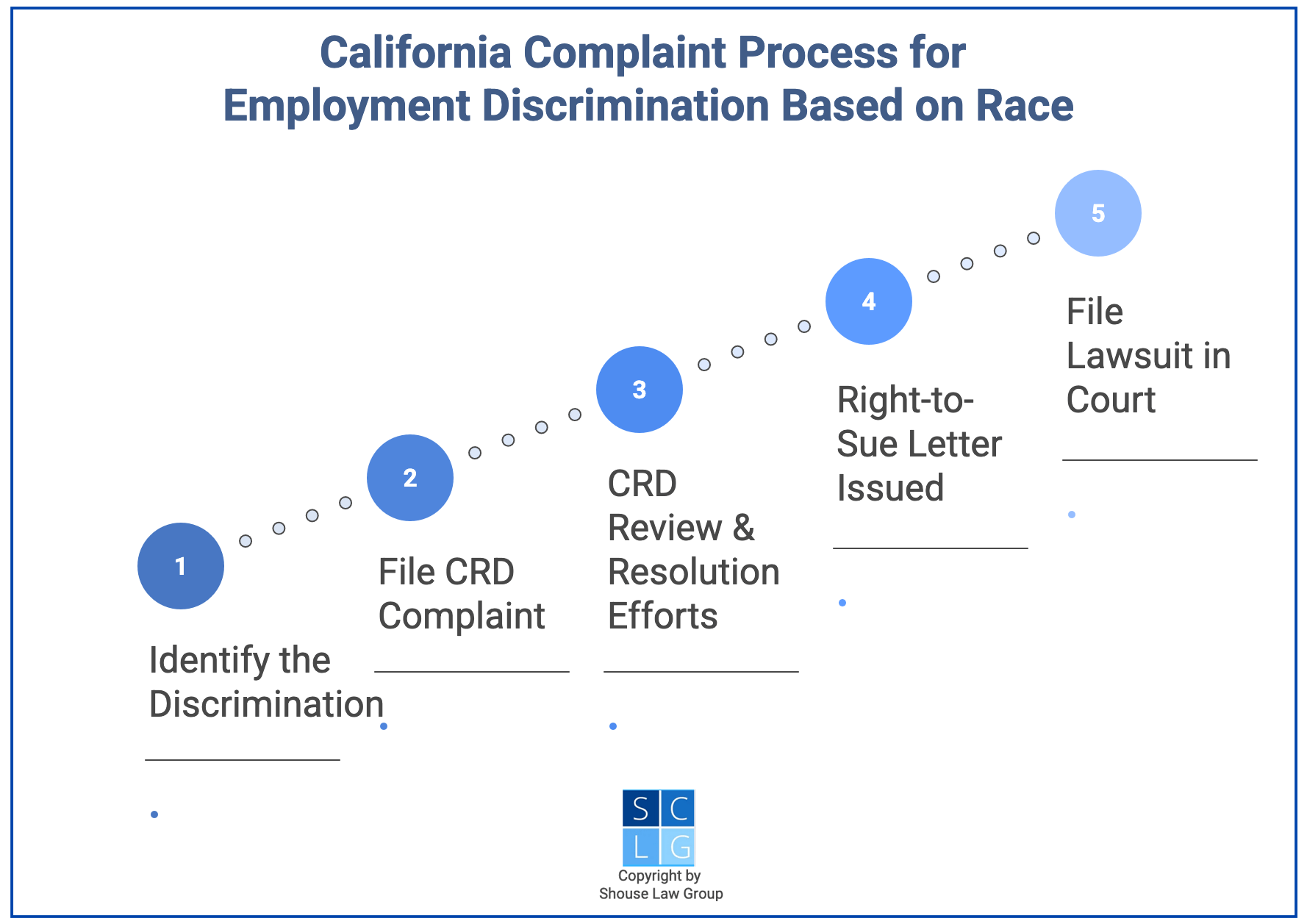
3. Filing a Complaint
If you want to file a lawsuit against your employer for racial discrimination in California, you are usually required to exhaust all administrative remedies first. This means filing a complaint with either the:
- Equal Employment Opportunity Commission (EEOC), a federal agency which enforces federal laws against workplace; and/or
- Civil Rights Department (CRD), a California state agency that handles complaints of racial discrimination.
In some cases, California law offers broader protections for anti-discrimination cases than federal law. California law may apply to employers with fewer employees and may provide an extended timeframe for filing a complaint. For this reason, many people in California prefer to file a race or national origin discrimination complaint with the CRD rather than the EEOC.
Note that your attorney may be able to request an immediate “right-to-sue notice” from the CRD without waiting for the administrative process to play out first.
The CRD Filing Process
In California, you can file a race or national origin discrimination complaint directly with the CRD online, by phone, or using the form from the CRD website.
In general, you must initiate the CRD process and file a complaint within three years of the last incident of discrimination, harassment, or retaliation. However, there are exceptions to this time limit, such as where you did not learn about the unlawful practice until after the expiration of three years.
Your filing will initiate an intake interview with the CRD and help determine whether a complaint can be accepted for investigation. A CRD representative may contact you and discuss the details of the alleged racial discrimination or harassment based on color.
If the CRD representative determines the state will not handle the complaint, the matter will be dismissed, and you may request (or will receive) a right-to-sue notice, allowing you to file in court. If the representative accepts your case, a complaint will be prepared for your signature and delivered to your employer.
(The complaint can also be dual-filed with the EEOC at this point.)
Dispute Resolution
After your employer responds to your employment discrimination complaint, the CRD will review the answer. In many cases, the CRD will offer dispute resolution services, which provide a way for you and your employer to negotiate a resolution to the complaint.
If the complaint cannot be resolved through negotiations, the CRD will initiate an investigation to determine whether there was a violation of California law.
If the investigation finds there was a violation, the case will go to the CRD Legal Division. If there is no violation, the case will be closed. If the case is closed, you still have the immediate right to take your case to court.
The CRD Legal Division generally requires you to go through mediation. Mediation is a form of alternative dispute resolution in which a neutral mediator helps the parties reach a mutually agreeable solution. In a successful mediation, you and your employer will settle without leaving the outcome to the courts.
If you cannot settle the dispute through mediation, the CRD could file a lawsuit on your behalf against your employer. If the CRD does not pursue the claim, it will close the investigation, and you may request (or will receive) a right-to-sue notice, permitting you to sue the employer in court.
Bringing a Lawsuit
Once your attorney obtains a right-to-sue notice, you can file your case in California Superior Court in the county where the discrimination occurred or another relevant county.
The complaint will be served upon your employer and anyone else named in the lawsuit as defendants. The defendants will file a formal answer to the complaint, and the case may proceed to litigation.
The employer and you can negotiate a settlement and settle the case out of court at any point before the end of a trial. This process can take weeks to several years, depending on the case.2

Discrimination is against the law even when the victim and the person who is discriminating are the same race or color.
4. Damages
The damages available if you prevail in a California employment discrimination lawsuit based on race will depend on your case and the extent of the harm.
You may be able to recover money damages related to:
- back wages (with interest),
- front pay,
- higher income from a promotion,
- higher income from a raise,
- benefits,
- pension benefits,
- bonus payments,
- pain and suffering, and/or
- emotional distress.
A successful lawsuit can also result in “equitable remedies” where the court can require the employer to:
- rehire you if you have been fired based on your race or
- hire you if you were not hired based on race.
However, in reality, after you have been discriminated against, you may not necessarily want to return to that hostile workplace.
You can also seek to recover the costs associated with bringing the lawsuit, including attorney’s fees and court costs.
Finally, in rare cases, you may also be eligible to receive punitive damages. These serve to punish your employer and deter other employers from engaging in similar wrongful behavior in the future.3
5. Retaliation
In California, FEHA protects employees who are retaliated against for:
- opposing workplace harassment,
- opposing racial discrimination against other employees,
- reporting racial discrimination or workplace harassment, and/or
- assisting with CRD investigations or government inquiries.
If your employer fires or otherwise retaliates against you for reporting FEHA violations or filing an employment discrimination complaint, you may be able to:
- file a complaint with the CRD (discussed in section 3) or
- file a lawsuit against the employer for retaliation or wrongful termination.4
6. Harassment Based on Race
FEHA also prohibits harassment based on race, and this applies to all California workplaces, regardless of size. A hostile work environment by co-workers, supervisors, and other employees may occur when:
- you experience unwelcome comments or conduct at work (workplace bullying) based on your race, and
- the harassment is pervasive or severe enough to alter the conditions of employment.
A single incident where a co-worker makes a tasteless joke or insensitive remark may not rise to the level of workplace harassment unless the incident is especially severe. Instead, the offending behavior generally requires repeated or pervasive behavior based on race or color.
Note that if your harasser is a co-worker or someone other than a supervisor – and your employer knows or should know about the harassment – they must take immediate and appropriate corrective action to prevent or stop the harassment.
If you are a victim of racial harassment in the workplace, you can go through the CRD (discussed in section 3 above) or file a negligence lawsuit after obtaining a right-to-sue letter.5

Many employment discrimination claims are resolved by California’s Civil Rights Department.
Frequently Asked Questions
Do anti-discrimination laws apply to small businesses?
Yes, but the requirements differ. Federal law (Title VII) applies to employers with 15 or more employees. However, California law (FEHA) is broader: it applies to employers with 5 or more employees for discrimination cases. For harassment claims specifically, California law applies to all employers, regardless of size.
What if my employer is wrong about my race?
Discrimination is still illegal. Discrimination laws apply to “perceived race.” If an employer mistreats you because they believe you belong to a certain racial or ethnic group—even if they are factually incorrect—they are still violating the law.
Can I be fired for reporting racism at work?
No. California law strictly prohibits retaliation. If your employer fires, demotes, or punishes you for reporting discrimination, opposing harassment, or participating in an investigation, you may have grounds for a separate retaliation lawsuit.
What kind of compensation can I get if I win?
If you prevail in a lawsuit, you may be able to recover money damages for back wages (past lost income), front pay (future lost income), and emotional distress. In cases of severe misconduct, you may also be awarded punitive damages to punish the employer.
Additional Resources
For more information, refer to the following:
- What is Employment Discrimination – Summary by the Equal Employment Opportunity Commission (EEOC).
- Know Your Rights: Workplace Discrimination is Illegal – Info sheet from the U.S. Department of Labor (DOL).
- Discrimination, harassment, and retaliation – Brief guide by USA.gov.
- Types of Discrimination – Overview by the Centers for Disease Control and Prevention (CDC).
- 91% of workers have faced workplace discrimination—here’s what employees can do, expert says: ‘No. 1 is to speak up and document things’ – Article by CNBC.com.
Legal References:
- Fair Employment and Housing Act 12940 — Unlawful Practices. (“It is an unlawful employment practice, unless based upon a bona fide occupational qualification, or, except where based upon applicable security regulations established by the United States or the State of California: (a) For an employer, because of the race, religious creed, color, national origin, ancestry, physical disability, mental disability, medical condition, genetic information, marital status, sex, gender, gender identity, gender expression, age, sexual orientation, or military and veteran status of any person, to refuse to hire or employ the person or to refuse to select the person for a training program leading to employment, or to bar or to discharge the person from employment or from a training program leading to employment, or to discriminate against the person in compensation or in terms, conditions, or privileges of employment.”). See for example: Diego v. City of Los Angeles (; Baker v. Children’s Hosp. Medical Ctr. ( Title VII, 42 U.S.C. § 2000e-2, Section 703. California Code of Regulations 11027.1 — Definitions. (“(a) “National origin” includes but is not limited to, the individual’s or ancestors’ actual or perceived: (1) physical, cultural or linguistic characteristics associated with a national origin group; (2) marriage to or association with persons of a national origin group; (3) tribal affiliation; (4) membership in or association with an organization identified with or seeking to promote the interests of a national origin group; (5) attendance or participation in schools, churches, temples, mosques, or other religious institutions generally used by persons of a national origin group; and (6) name that is associated with a national origin group.”). California Senate Bill 188 (2019). Same. California Code of Regulations 11027.1.
- Fair Employment and Housing Act 12960. California Assembly Bill 9 (2019). Fair Employment and Housing Act 12921. Fair Employment and Housing Act 12965.
- Fair Employment and Housing Act 12965.
- Government Code 12940 GC. California Code of Regulations (CCR) tit. 2, § 11021.
- Hughes v. Pair (2009) 46 Cal.4th 1035, 1042. (“To prevail on a hostile work environment claim under California’s FEHA, an employee must show that the harassing conduct was “severe enough or sufficiently pervasive to alter the conditions of employment and create a work environment that qualifies as hostile or abusive to employees.”). See also Bailey v. San Francisco District Attorney’s Office (2024) 16 Cal. 5th 611.