

California employers have a legal duty to make reasonable accommodations for your disabilities to help you perform your essential job duties. Examples of reasonable accommodations (RAs) include:
- making a worksite wheelchair accessible,
- allowing you to leave work to attend doctor appointments,
- buying equipment to better accommodate you, and/or
- restructuring your job duties or requirements.
The only time your employer can deny you a reasonable accommodation is if it would cause them to incur an “undue hardship” due to significant:
- expense, or
- difficulty.
 Your employer’s failure to reasonably accommodate you is employment discrimination on the basis of disability. You can demand accommodations and monetary damages by:
- filing an ADA complaint under the Americans with Disabilities Act;
- filing a labor board complaint with the California Civil Rights Department; and/or
- bringing a civil lawsuit.
Our California labor and employment law attorneys will address the following key issues:
- 1. Workplace Duties
- 2. Reasonable Accommodations
- 3. “Disability” Meaning
- 4. Employer Denials
- 5. Can I sue?
- 6. Request Forms
- Frequently Asked Questions
- Additional Resources
1. Workplace Duties
California employment law imposes an affirmative duty of “reasonable accommodation” on an employer when it learns that you have a specific known disability. In this situation, the employer has a legal duty to:
- reasonably accommodate, or provide for, you, and
- do so in a manner that allows you to perform your essential functions of the position.1
This duty applies unless an accommodation imposes an “undue hardship” on the employer.2
Note that this “reasonable accommodation” duty does not apply to California employers with less than five employees.3
“Interactive Process” to Accommodate your Disability
Once an employer learns of your disability, California law requires:
- the employer to enter into an “interactive process” with you, and
- do so in a reasonable effort to help find an appropriate accommodation.4
An “interactive process” refers to communication between the employer and you that:
- helps the employer find the right accommodation, and
- ensures that it assists you in performing the essential functions of a job.5
Your Employer’s Obligations
If you request a reasonable accommodation in California, the employer must respond promptly and act in good faith. Even if you do not directly request an accommodation, an employer should provide one as long as:
- your disability is observable, or
- someone else informs the employer of your disability.
Signs that an employer is acting in bad faith are if they claim your request is “contrary to company policy” or “unprecedented” or if they tell you to use your leave rather than accommodating you.
Note that employers can only request a doctor’s note if the reason for your accommodation request is not obvious. Plus, you do not have to hand over your whole medical history, just what is relevant to your limitations.
Also, your employer must keep confidential your medical records and any other documents obtained through your “interactive process” (unless you say otherwise). These records must be kept separately from your personnel file.6
Remember, if you have a disability, you are responsible for requesting accommodations. Disabled employees who do not request accommodation—and who perform poorly—can be terminated.

2. Reasonable Accommodations
In California, an employer makes a “reasonable accommodation” when it makes appropriate adjustments so that you can perform the “essential functions” of your job despite your disability.7
Whether a Job Function is “Essential”
In determining whether a job function qualifies as “essential,” California courts consider:
- How specialized the job function is;
- How many other employees can perform the function; and
- Whether the purpose of your job is to perform that function.
Common evidence in these cases includes:
- your work history in similar positions;
- the work history of past employees with same or similar jobs;
- whether prior performance reviews discuss the job function and how essential it is;
- how much time you spend on a particular job function;
- your job description;
- the training materials applicable to your job; and
- the consequences of the job function not being performed.8
Examples of Reasonable Accommodations
The following are examples of an employer’s reasonable accommodations in California:
- buying equipment to accommodate your disability and increase accessibility,
- job restructuring or alterations in work schedules,
- letting you take time off of work to make health care appointments,
- making changes in the work environment to allow for a wheelchair-accessible work site (including bathrooms, break rooms, and parking),
- reassignment of you to a vacant position,
- bringing an assistive dog to the office,
- modifying the job application process, exams, training materials, and company policies for people with disabilities,
- making schedules more flexible (“flex-time”),
- remote work,
- extended leave (even after FMLA/CFRA expires), and/or
- relaxing work restrictions, such as removing non-essential duties.
Example: Joe is an outside salesperson for a company based in Los Angeles. He works part-time in the office and spends three days a week traveling to meet with clients in San Francisco.
Joe gets in a car accident that leaves him wheelchair-bound. He speaks with his employer’s Human Resources Department and asks if it can make any reasonable and effective accommodations to help him perform his job tasks given his disability.
As part of the reasonable accommodation process, the company changes Joe’s duties so that he no longer has to fly to San Francisco and allows him to work full-time in the Los Angeles location. These changes represent a type of accommodation that is reasonable.

California employment law imposes a duty of “reasonable accommodation” on an employer.
3. “Disability” Meaning
In California, a “disability” is a condition that limits a significant life activity by making it more difficult for you to perform that activity.9 “Major life activities” include things like:
- walking,
- eating,
- working,
- performing physical tasks and activities, and
- engaging in social interactions.10
Qualifying Disabilities
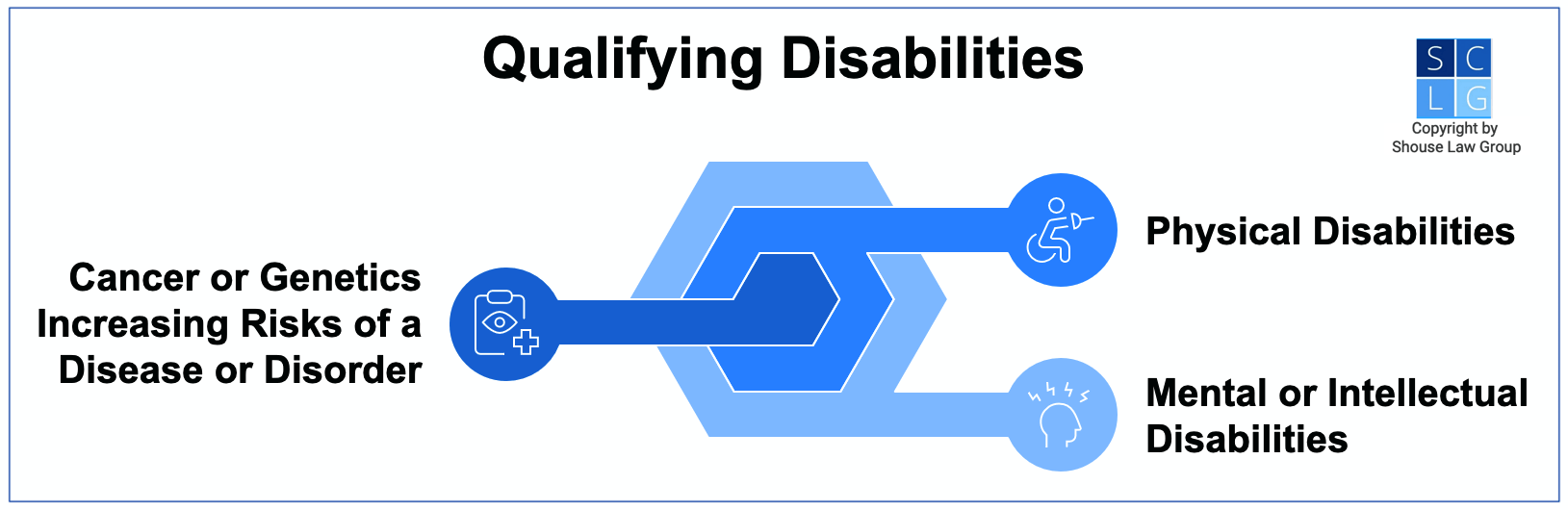
A qualified individual under these laws can suffer from either:
- a mental or intellectual disability (such as bipolar disorder, learning disabilities, clinical depression/stress/anxiety, or other mental impairment or illness), or
- a physical disability (such as pregnancy complications, migraines, missing a limb, organ impairment, or being paralyzed), or
- a medical condition, defined as either (1) cancer, or (2) genetic characteristics associated with an increased risk of developing a disease or disorder
Not covered are:
- sex behavior disorders,
- usage of unlawful psychoactive substances, or
- such disorders as compulsive gambling, starting fires (pyromania), or stealing (kleptomania).
Whether you have a qualifying disability is important because if you do not have one, employers in California do not have to accommodate it.
Cannabis Users
Note that as of 2024, most employers in California (including many state agencies) cannot discriminate against you or fire you for using marijuana off the job and away from the workplace. Employers also cannot discriminate based on a drug test that finds “non-psychoactive cannabis metabolites” (which only show you used recently, not that you are currently high).
However, you still have no right to use, possess, or be impaired by cannabis at work. Employers do not have to “accommodate” you smoking or using edibles during work hours. Also, employees in building and construction can still be tested/fired for off-duty use. Plus, people whose jobs require a federal background check can be denied or fired due to cannabis use.11
4. Employer Denials
In California, employers have a duty to provide you reasonable accommodations for your disability unless doing so would impose an “undue hardship.”
An “undue hardship” means that the company would experience significant difficulty or expense in making appropriate accommodations.12 If there is an undue hardship, then the business can deny your request for reasonable accommodations.
What Comprises an “Undue Hardship”
The facts of a case often determine whether an undue hardship exists. Some important factors to consider in this determination are:
- the true cost of the accommodations,
- the size of the business (such as the number of employees) and its financial resources,
- how the business is structured,
- the type of work the company performs (“type of operations”), and
- the interactions among the company’s facilities.13
5. Can I sue?
If there is no undue hardship, and your California employer denies your request for reasonable accommodations, then you may be able to file a complaint with either:
- the Equal Employment Opportunity Commission (EEOC.gov), a federal agency that enforces the Americans with Disabilities Act (ADA); and/or
- the California Civil Rights Department (CRD), a state agency that enforces the California Fair Employment and Housing Act (FEHA).
An employment attorney can help you determine which route to take. An attorney can also help you decide whether you should request that the agency give you a “right to sue” notice so you can bypass the agency investigations and bring a traditional lawsuit right away.
Note that you also may be able to file a claim if your employer retaliates against you due to your disability. Examples of retaliation include:
- discrimination,
- wrongful termination,
- harassment,14
- bullying, and
- reducing your pay below the minimum wage.15
In any event, do not delay in contacting a lawyer. The deadline to file an EEOC complaint can range from 180 to 300 days, depending on the case. Usually, there is a three-year statute of limitations to file a claim with the CRD.16
By filing a claim, you may be able to recover monetary penalties and injunctive relief, such as a court order to implement reasonable accommodations.
6. Request Forms
You are advised to use this form created by the California Civil Rights Department (CRD) to request reasonable accommodations from your employer. (¿Habla español? Utilice este formulario.)
If you do not use a form to request reasonable accommodations, you are advised to convey the following information to your employer in your request:
- That you have a disability;
- An explanation of how this disability affects your ability to carry out job duties;
- An explanation of which accommodations are necessary for you to perform the job’s essential duties; and
- A reminder that this information is confidential.
You can make this request orally, though you are advised to put it in writing (such as an email or text message) and to retain a copy for yourself as a record. You can keep it short, such as:
A medical condition is preventing me from doing [insert job]. Can we discuss a reasonable accommodation?

A “disability” is a condition that limits a person’s major life activity.
Frequently Asked Questions
How do I request reasonable accommodation from my employer?
You can request reasonable accommodation either verbally or in writing, though writing is recommended. Your request should include that you have a disability, how it affects your job duties, what accommodations you need, and that the information is confidential. You can keep it simple by saying “A medical condition is preventing me from doing [insert job]. Can we discuss a reasonable accommodation?” California provides a standard form you can use to make your request.
What happens if my employer says my accommodation request is too expensive?
Your employer can only deny your accommodation request if it causes an “undue hardship,” meaning significant difficulty or expense. Courts look at factors like the actual cost, company size, financial resources, and business structure. Just because something costs money doesn’t automatically make it an undue hardship. If you believe your employer wrongly denied your request, you can file a complaint with the EEOC or California Civil Rights Department.
What kinds of disabilities qualify for reasonable accommodation?
California covers mental disabilities (like depression, anxiety, bipolar disorder), physical disabilities (like mobility issues, organ problems, pregnancy complications), and medical conditions (cancer or genetic characteristics). The disability must limit a major life activity like walking, working, or social interactions. However, substance abuse, gambling addiction, pyromania, and kleptomania are not covered.
Can my employer ask for medical records when I request accommodation?
Your employer can only request a doctor’s note if your need for accommodation isn’t obvious. You don’t have to provide your entire medical history—only information relevant to your work limitations. Any medical documents your employer receives must be kept confidential and stored separately from your regular personnel file.
Additional Resources
For more information, refer to the following:
- Job Accommodation Network (JAN) – Guidance by the U.S. Department of Labor’s Office of Disability Employment Policy.
- Reasonable Accommodations in the Workplace – Fact sheet by the ADA National Network.
- Enforcement Guidance on Reasonable Accommodation and Undue Hardship under the ADA – Guide by the Equal Employment Opportunity Commission (EEOC).
- The American Association of People with Disabilities (AAPD) – Disability rights organization providing resources and information.
- National Council on Disability – Federal agency that advises government leaders on disability issues.
If you are injured at work, see our article on workers’ compensation laws in California.
Legal References:
- California Government Code 12940m1. Nealy v. City of Santa Monica (2015) 234 Cal.App.4th 359. Prilliman v. United Air Lines, Inc. (1997) 53 Cal.App.4th 935. See also 29 CFR pt. 1630 and ADA Title I. See also Lui v. San Francisco (2012) 211 Cal.App.4th 962. See also, for example, Miller v. Department of Corrections & Rehabilitation (Cal.App. 2024) ; Wentworth v. Regents of University of California (Cal.App. 2024) 105 Cal. App. 5th 580.
- See same.
- California Government Code 12926d.
- 2 Cal Code Regs 11068a. See also California Government Code 12940n. In some cases, the communication between a boss and worker can go through a third party. See Claudio v. Regents of the University of California (2005) 134 Cal.App.4th 224.
- Wilson v. County of Orange (2009) 169 Cal.App.4th 1185. Depending on the situation, possible accommodations may include sign-language interpreters, braille materials, space for a service animal, TTY (for hearing impaired workers whether or not the worker has a hearing aid), and/or large print materials or other alternate formats. What is reasonable is often determined on a case-by-case basis. Hanson v. Lucky Stores, Inc. (1999) 74 Cal.App.4th 215. Gelfo v. Lockheed Martin Corp. (2006) 140 Cal.App.4th 34.
- 2 CCR 11069a. See also California Government Code 12940. Scotch v. Art Institute of California-Orange County, Inc. (2009) 173 Cal.App.4th 986. Jensen v. Wells Fargo Bank (2000) 85 Cal.App.4th 245.
- California Government Code 12940m1. Note that the accommodation does not necessarily have to be the most expensive option. Hankins v. The Gap, Inc. (6th Cir. 1996) 84 F.3d 797.
- 2 CCR 11065e. Lui v. San Francisco (2012) 211 Cal.App.4th 962. 42 U.S.C. § 12111. 2 CCR 11069. See also Lopez v. La Casa de Las Madres (Cal.App. 2023) . Price v. Victor Valley Union High School Dist. (Cal.App. 2022) 85 Cal. App. 5th 231.
- California Government Code 12926(j) and (m). See also 2 CCR 11065(d)(1)(2).
- CA Government Code 12926j1B.
- California Government Code 12940m1. Soria v. Univision Radio Los Angeles, Inc. (2016) 5 Cal.App.5th 570; Colmenares v. Braemar Country Club, Inc. (2003) 29 Cal.4th 1019. Ross v. RagingWire Telecommunications, Inc. (2008) 42 Cal.4th 920. AB-2188.
- CA Government Code 12926u. See also Brown v. Los Angeles Unified School Dist. (Second Appellate District, Division Eight, 2021) 60 Cal. App. 5th 1092.
- See same. See also 2 CCR 11065r.
- See Roby v. McKesson Corp.(2009) 47 Cal.4th 686.
- See Diego v. Pilgrim United Church of Christ (2014) 231 Cal.App.4th 913.
- See also Section 503 of the Rehabilitation Act of 1973. Govt. Code 12960.