
The California crime of negligent homicide is killing a human being through an act of criminal negligence. You are criminally negligent when you ignore a known or obvious risk or disregard the life and safety of others.
Under California law, negligent homicide cases are charged as involuntary manslaughter under Penal Code 192(b) PC.
Examples of negligent homicide may include:
- Leaving a pitbull with a history of attacks off leash, and the animal kills a person.
- Leaving a child in an unattended car in hot weather.
- Firing a weapon in the air at a crowded celebration, and the bullet strikes and kills a participant.
Negligent homicide is a California felony. Penalties include a fine of up to $10,000 and either:
- felony probation with a jail sentence of up to 1 year or
- a jail sentence of up to 2, 3 or 4 years.
In addition, you will be stripped of your gun rights. Plus, any professional licenses you have may be in jeopardy.
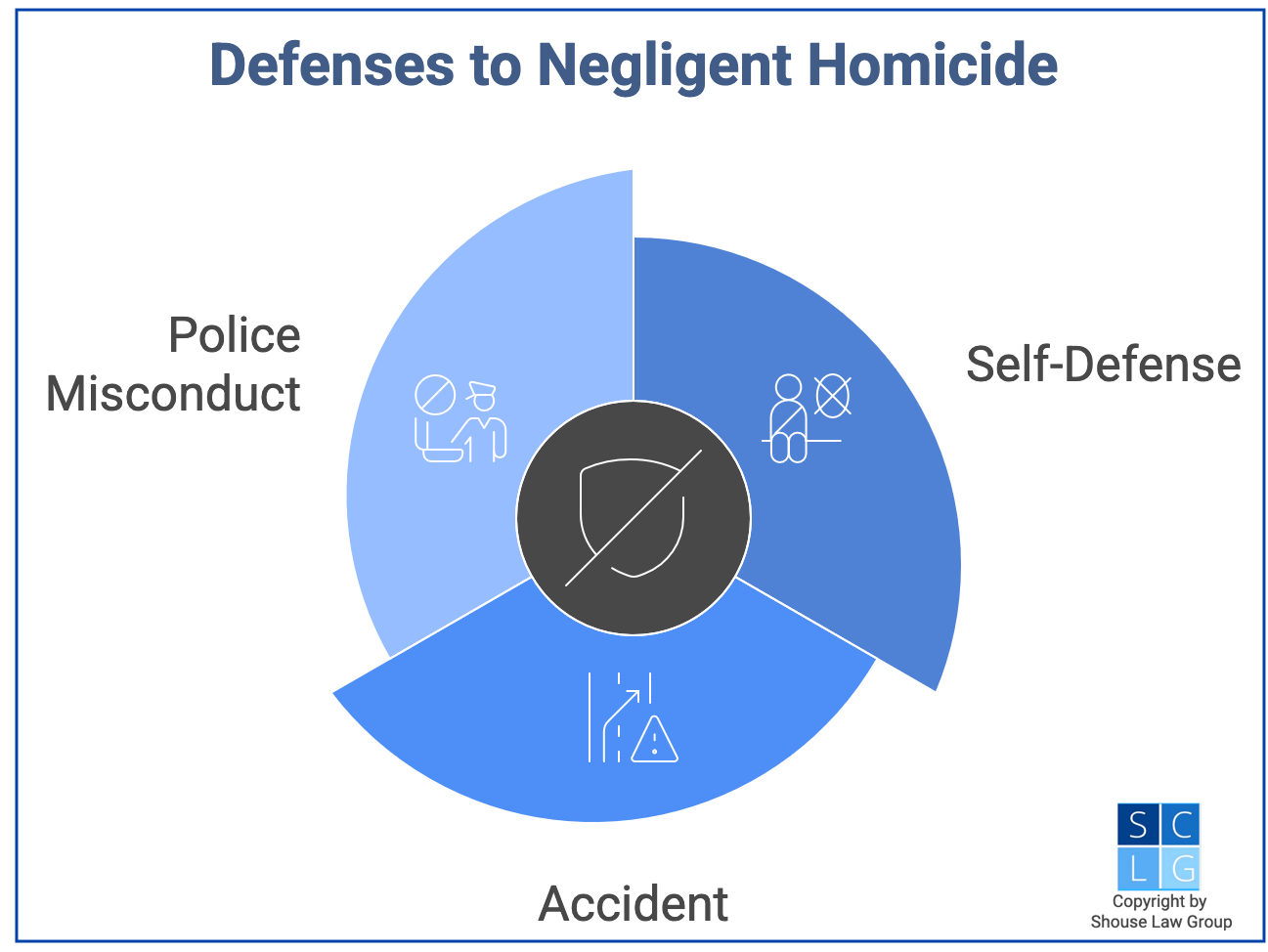
In this article, our Los Angeles criminal defense attorneys will address the following key issues regarding California negligent homicide laws:
1. Elements
For California prosecutors to convict you of negligent homicide (involuntary manslaughter) in California, they must prove beyond a reasonable doubt the following three elements of the jury instructions:
- You committed a crime or a lawful act in an unlawful manner; and
- You committed the crime or act with criminal negligence; and
- Your acts caused the death of another person.1
“Criminal negligence” is more than just ordinary negligence, which is mere carelessness, inattention, or mistake in judgment. Criminal negligence is when:
- You act in a reckless way that creates a high risk of death or great bodily injury, and
- A reasonable person would have known that acting in that way would create such a risk.2
An example of negligent homicide we have seen includes pointing a gun at someone as a joke, believing it to be unloaded without checking the chamber, which results in an accidental discharge and death.3
Note that criminal negligence can be a failure to act (“act by omission”). Examples may be neglecting to provide food or medical care for dependent elderly relatives or children you are responsible for.

Criminal negligence is one required element of Penal Code 192(b) PC.
2. Defenses
Here at Shouse Law Group, we have represented literally thousands of people charged with violent crimes such as negligent homicide. In our experience, the following three defenses have proven very effective with California prosecutors, judges, and juries at getting these charges reduced or dismissed.
1) You Acted in Self-Defense
Self-defense can get your negligent homicide charge dropped if all of the following are true:
- You reasonably believed that you, or another person, was in imminent danger of suffering bodily harm, and
- You reasonably believed that the immediate use of force was necessary to defend against that danger, and
- You used no more force than was reasonably necessary to defend against that danger.4
Depending on your case, we can use expert witnesses who can distinguish between offensive and defensive injuries.
2) The Killing Was an Accident
You should not be convicted of negligent homicide in California if the killing was an innocent accident. This means that you:
- Had no criminal intent to do harm, and
- Were not acting with criminal negligence at the time of the accidental killing, and
- Were otherwise engaged in lawful activity at the time of the accident.5
Typical evidence in these cases includes surveillance video, eyewitness accounts, and expert testimony by forensic specialists.
3) The Police Committed Misconduct
Police have strict rules they have to adhere to when conducting searches and seizures. If we can convince the judge that they found evidence through unlawful means, the judge can suppress (exclude) the evidence from your case. This may leave the D.A. with no choice but to dismiss your negligent homicide charge for lack of proof.

A conviction for 192(b) can result in jail or probation.
3. Related Crimes
Murder – 187 PC
In California, murder is the unlawful killing of a human being or fetus with malice aforethought. The penalty is 25 years-to-life in jail.6
The main difference between murder and manslaughter (including negligent homicide) is that manslaughter is killing without malice aforethought.
A timely topic courts are grappling with is how to charge drug dealers who sell controlled substances they do not realize are laced with fentanyl, which often causes the drug user to die. Whether the drug dealers acted with malice largely depends on the facts of the case.
Voluntary Manslaughter – 192(a) PC
In California, voluntary manslaughter is killing someone
- During a sudden quarrel,
- In the heat of passion, or
- Based on an honest but unreasonable belief in the need to act in self-defense or defense of others.
Voluntary manslaughter carriers heftier penalties than negligent homicide (involuntary manslaughter) because the killing is intentional.
Gross Vehicular Manslaughter while Intoxicated – 191.5 PC
Gross vehicular manslaughter while intoxicated is committing vehicular manslaughter while driving under the influence (DUI) of alcohol or drugs. For you to be convicted in California, the D.A. has to prove you acted not just with criminal negligence but instead gross negligence, which is a higher bar.

Negligent homicide is formally called involuntary manslaughter in California.
Frequently Asked Questions
Is “negligent homicide” the same as involuntary manslaughter?
Yes. California does not have a statute titled “Negligent Homicide.” Instead, prosecutors charge you with Involuntary Manslaughter under Penal Code 192(b) PC. This law covers unintentional killings resulting from criminal negligence.
Can I be sued for wrongful death if I am found not guilty?
Yes. A criminal acquittal does not protect you from civil liability. A victim’s family can still sue you for wrongful death in civil court, where the burden of proof is lower (“preponderance of the evidence”) than in criminal court (“beyond a reasonable doubt”).
Will a conviction affect my professional license?
Possibly. A conviction for California Penal Code 192(b) PC can lead to the suspension or revocation of state licenses for doctors, nurses, lawyers, real estate agents, and teachers. Licensing boards often view gross negligence as a disqualifying failure of character or competence.
How is “criminal negligence” different from ordinary negligence?
Ordinary negligence is simple carelessness, like a mistake in judgment or inattention. Criminal negligence is much more severe; it happens when you act with a disregard for human life, creating a risk of death that a reasonable person would have known to avoid.
Additional Reading
For more in-depth information, refer to these scholarly articles:
- What’s Wrong with Involuntary Manslaughter – Texas Law Review.
- Rethinking the Mental Element in Involuntary Manslaughter – The Journal of Criminal Law.
- Criminal Law – Involuntary Manslaughter – Unlawful Act as Basis for Conviction – Montana Law Review.
- The Innocent Villain: Involuntary Manslaughter by Text – Michigan Journal of Legal Reform.
- Involuntary Manslaughter and Assisting Drug-Abuse Injection – Journal of Criminal Law.
Legal References:
- California Penal Code 192 PC. CALCRIM No. 580 – Involuntary Manslaughter (Pen. Code 192(b)). Judicial Council of California Criminal Jury Instructions (2026 edition). See also CALCRIM No. 581. See also People v. Soto (1999) 74 Cal.App.4th 1099. California Penal Code 193 PC. See also People v. Sevilla (2025) . People v. Glenn (1991) 229 Cal.App.3d 1461.
- See same. See also People v. Butler (2010) 187 Cal.App.4th 998.
- See People v. Velez (1983) 144 Cal.App.3d 558.
- CALCRIM No. 3470 – Right to Self-Defense or Defense of Others.
- California Penal Code 195 PC.
- People v. Brothers (Cal.App. 2015) 236 Cal.App.4th 24.