
Quick summary
A subpoena duces tecum (SDT) is a court order that requires a person or business to produce documents or other evidence for a hearing or trial. In a California criminal case, the prosecution and the defense can both use one.
- What it must say: An SDT has to describe the records or items it wants. A business can usually comply by sending sealed copies to the court clerk within 5 days.
- Your options: You can object or ask the judge to quash the subpoena, for example because the material is privileged or the request is too broad.
- If you ignore it: Disobeying a subpoena can be punished as contempt of court, a misdemeanor carrying up to 6 months in jail and a $1,000 fine.
- Example: A defendant charged with assault subpoenas the bar’s security video. The bar sends a sealed copy to the court, and the judge decides whether the defense gets to see it.

In this article, our California criminal defense attorneys discuss the following topics about subpoenas duces tecum:
- 1. Purpose
- 2. Service requirement
- 3. What you have to do
- 4. Consequences for not complying
- 5. Objections and exclusions
- 6. Subpoenas ad testificandum
1. Purpose
In California, a subpoena duces tecum (SDT) is used when one side in a criminal case needs documents or other evidence that someone else has. Under California Penal Code 1326, a criminal subpoena can be issued by the court clerk, the district attorney, the public defender or the defendant’s attorney.1 The defense can use an SDT to get evidence from third parties, not just the prosecution can.
Sometimes the side seeking records first asks the person the records are about to consent to their release. The law allows records to be obtained that way, without a subpoena.2
In our experience, we can often get relevant evidence from the prosecution through ordinary discovery without needing an SDT. We use SDTs mainly for records held by third parties, such as businesses, phone carriers or schools.
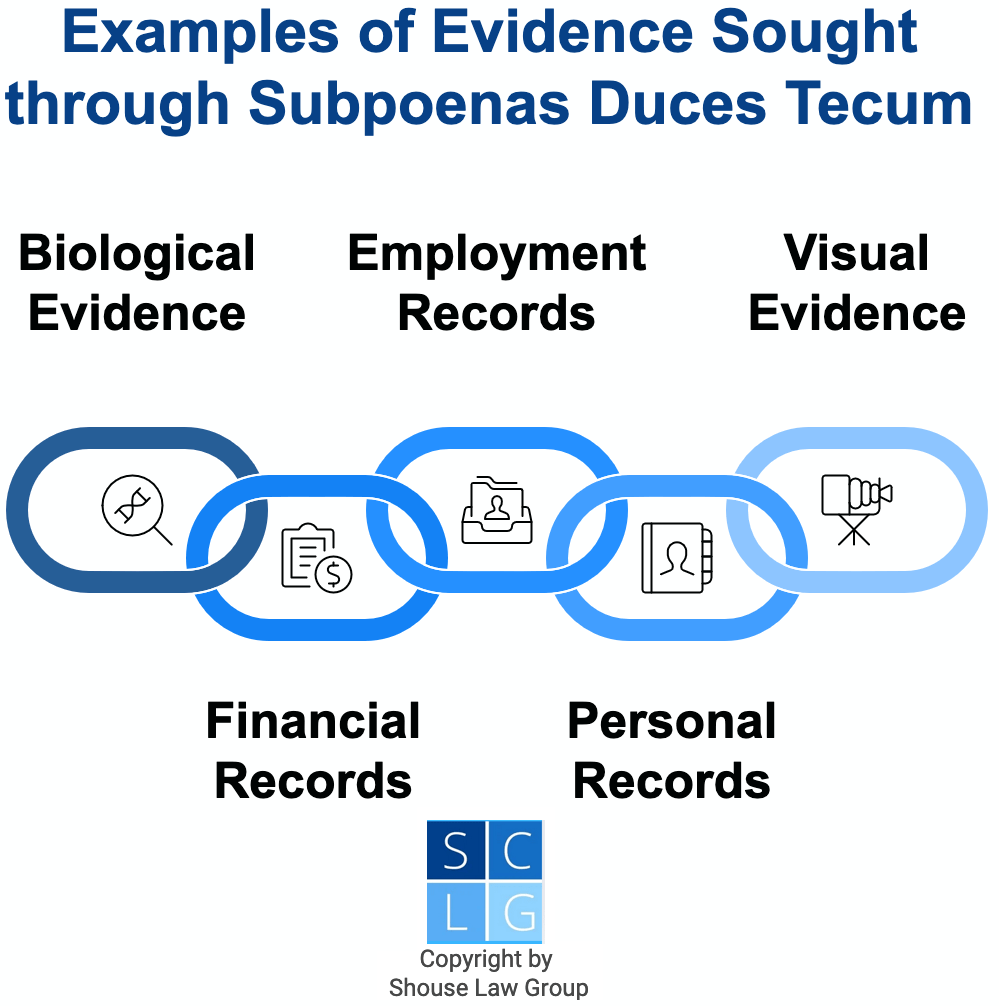
Examples
Some examples of documents and evidence sought through SDTs include:
- blood test and lab records,
- DNA test results (common in rape (PC 261) cases),
- income tax returns,
- bank statements and other financial records,
- employment and personnel records,
- business records,
- emails, text messages and voicemails,
- phone records, and
- photographs and video.
A common reason we use an SDT is when a prosecution witness is lying. Old emails, voicemails or texts can show the witness’s earlier, inconsistent statements, which we can use to challenge the witness’s testimony.
2. Service requirement

Under California Penal Code 1328, a criminal subpoena is normally served by delivering a copy to the witness personally. Any adult can serve it except the defendant in the case.3
A subpoena can also be sent by mail, messenger, email or fax. But that kind of service counts only once the witness acknowledges receiving it and confirms their identity. If a witness who was subpoenaed this way doesn’t show up, the court can’t issue an arrest warrant for them.4
Service must leave you a reasonable amount of time to gather the materials.
3. What you have to do
If a business is subpoenaed for its records in a case it isn’t part of, its “custodian of records” can usually comply without going to court. In a criminal case, the custodian sends a true copy of the records, with a sworn statement (affidavit), to the court clerk within 5 days after receiving the subpoena. The copies go in a sealed envelope, which is opened only at the hearing or trial at the judge’s direction.5
When the defense subpoenas records from someone who isn’t a party, the judge may review them privately, in what is called an “in camera” hearing, to decide whether the defense is entitled to them.6 The judge looks at whether there is “good cause” for the subpoena. The most important question is whether the defense has a plausible reason for wanting the material, but the judge also considers things like how broad the request is and how much it would burden the person who has the records.7 A similar process is used for Pitchess motions seeking police personnel records.
4. Consequences for not complying

If you ignore a properly served subpoena duces tecum, the judge can punish it as contempt and may issue a warrant for your arrest to bring you to court. California Penal Code 1331 says:
Disobedience to a subpoena, or a refusal to be sworn or to testify as a witness, may be punished by the Court or magistrate as a contempt.8
A witness who disobeys a subpoena issued by the defendant, without good cause, can also owe the defendant $100.
Willfully disobeying a court order or process is a misdemeanor in California, punishable by:9
- up to 6 months in county jail, and/or
- a fine of up to $1,000.
5. Objections and exclusions
You should not have to hand over materials in these situations:
- Privilege. If the material is protected by a legal privilege, such as the attorney-client privilege, you don’t have to reveal it.
- Inaccessibility. You can’t be made to produce documents you don’t have or that no longer exist.
- The Fifth Amendment. If producing the materials would incriminate you personally, you may be able to refuse.10
The person served can also file written objections or a motion asking the judge to quash (cancel) or limit the subpoena. When the defense subpoenas a third party, the prosecution generally has a right to be heard as well.11
6. Subpoenas ad testificandum
A subpoena duces tecum asks for documents or evidence. A subpoena ad testificandum (usually just called a “subpoena”) orders you to appear in person and testify at a:
- trial,
- hearing, or
- deposition.
A judge in a California criminal case may order the county to pay a witness fee of $12 for each day of attendance, plus reasonable expenses.12
If you have been served with a subpoena in a California criminal case, or need records for your defense, contact us for a free consultation.
Legal references:
- California Penal Code 1326(a): a subpoena “may be signed and issued by” a magistrate or their clerk, the district attorney, the public defender, the court clerk, or “the attorney of record for the defendant.”
- Penal Code 1326(f): “This section shall not be construed to prohibit obtaining books, papers, documents, or records with the consent of the person to whom the books, papers, documents, or records relate.”
- Penal Code 1328(a): “A subpoena may be served by any person, except that the defendant may not serve a subpoena in the criminal action to which he or she is a party…. The service is made by delivering a copy of the subpoena to the witness personally.”
- Penal Code 1328d(a): service by mail, messenger, email or fax is effective “when the witness acknowledges receipt”; “a warrant of arrest or a body attachment may not be issued based upon a failure to appear after being subpoenaed pursuant to this section.”
- Penal Code 1326(b); Evidence Code 1560(b)-(d) (copies due “[i]n any criminal action, five days after the receipt of the subpoena,” sealed, and opened only at the hearing on the judge’s direction).
- Penal Code 1326(e): “When a defendant has issued a subpoena to a person or entity that is not a party for the production of books, papers, documents, or records, or copies thereof, the court may order an in camera hearing to determine whether or not the defense is entitled to receive the documents.”
- Facebook, Inc. v. Superior Court (Touchstone) (2020) 10 Cal.5th 329, 345: “The plausible justification consideration is but one (albeit the most significant) of multiple factors that, together, reflect a global inquiry into whether there is good cause for a criminal subpoena.”
- California Penal Code 1331, which adds: “A witness disobeying a subpoena issued on the part of the defendant, unless he show good cause for his nonattendance, is liable to the defendant in the sum of one hundred dollars….”
- Penal Code 166(a)(4)-(6) (willful disobedience of or resistance to court process is a misdemeanor); Penal Code 19 (misdemeanor punishable by up to 6 months in county jail, a fine up to $1,000, or both).
- U.S. Const., 5th Amend. (see link in text).
- Department of Corrections v. Superior Court (1988) 199 Cal.App.3d 1087, 1092 (trial court erred in handling a defense subpoena for prison records ex parte, without the district attorney’s participation); Kling v. Superior Court (2010) 50 Cal.4th 1068: “[T]he rules concerning subpoenas duces tecum in criminal cases are not asymmetrical or nonreciprocal, at least not in any way that disadvantages a criminal defendant.” (Overruled in part on another point by Facebook (Touchstone), see note 7 above.)
- Penal Code 1329(a) (witness fees “at the rate of twelve dollars ($12) for each day’s actual attendance and for a reasonable sum… for the necessary expenses of such witness,” in the court’s discretion).